
SHRM-SCP Eligibility, Exam Content and How to Apply
Updated on 29 September 2026. What’s new: exam fee corrected to $399 for members and $499 for non-members, and content-area weightings now follow SHRM's published score split
SHRM-SCP stands for SHRM Senior Certified Professional, the credential the Society for Human Resource Management awards to HR practitioners working at a strategic level. To sit the exam you need three years of strategic-level HR work, at least 1,000 hours in each of those calendar years, and no degree or HR job title. The exam is 134 questions in 220 minutes, and the winter 2026-27 window closes to new applications on 24 December 2026.

What does SHRM-SCP stand for, and what does the credential certify?
The letters are SHRM, for the Society for Human Resource Management, and SCP, for Senior Certified Professional. Searchers often type "shrm-scp designation" because that is exactly what it is: a designation you may add after your name once you have passed SHRM's exam and while you keep it current. It sits above the SHRM-CP, the Certified Professional credential, and the difference between the two is a difference of job level rather than of subject.
SHRM describes the SHRM-SCP standard as the competency and knowledge that can reasonably be expected of senior-level HR professionals. The SHRM-CP standard is set at early-to-mid-career practitioners. Both exams draw on the same SHRM Body of Applied Skills and Knowledge, usually shortened to the BASK, which lists nine behavioral competencies and 14 HR functional areas. The BASK marks which proficiency indicators apply to every HR professional and which apply only to advanced ones, and the SHRM-SCP exam is written to reach those advanced indicators.
That is worth taking literally. A senior candidate is not being asked to memorise more facts than a mid-career one. The scenarios are pitched at a different altitude: a decision that affects a business unit or a whole organisation, made with incomplete information, where two of the four answers are defensible and only one is the best. The rest of this article works from that idea, and from what SHRM itself publishes rather than from second-hand summaries. It is written for someone who has heard of the credential, is not yet sure they qualify, and would like to know what the exam will actually ask and by when they must act.
The facts at a glance
| Detail | SHRM-SCP |
|---|---|
| Certification | SHRM Senior Certified Professional (SHRM-SCP) |
| Vendor | SHRM |
| Exam code | SHRM-SCP |
| Category | Human Resources |
| Number of questions | 134 |
| Duration | 220 minutes |
| Exam fee | Member - $399 Non-member - $499 (standard rate) |
| Result | Pass / Fail (200 Scaled Score) |
| Delivery | Prometric testing centres |
The fees are the standard rates. SHRM also publishes lower early-bird rates for each window; the early-bird period for the winter window ended on 31 August 2026, so any application made now is charged the standard rate. Everything on the exam and its rules can be checked against the SHRM-SCP page on shrm.org, which is where a candidate should look first for anything that changes.
Do you qualify for the SHRM-SCP exam?
Most people ask this in terms of a degree and a job title, and SHRM's answer for the senior exam is that neither matters. What counts is the level of the work you actually do. In its 2026 Certification Handbook, SHRM says the SHRM-SCP is for people with a work history of at least three years performing strategic-level HR or HR-related duties. Neither an HR job title nor a degree is a condition of applying. There is a second route: SHRM-CP holders who have held that credential for at least three years and are working in, or moving into, a strategic-level role.
What counts as strategic-level work?
SHRM defines it by activity. Strategic-level work includes developing HR policies or procedures, overseeing the execution of integrated HR operations, directing an entire HR enterprise and leading the alignment of HR strategy with organisational goals. Its handbook draws the contrast plainly: if your current or most recent work is operational, such as implementing policies, acting as the HR point person for staff or running day-to-day HR functions, the exam that fits you is the SHRM-CP. If the work is strategic, meaning developing policies and strategies, analysing performance metrics, or overseeing the alignment of HR with the organisation's goals, and you have done it for at least three years, you are eligible for the SHRM-SCP.
The 1,000-hour test
The part of the rule that surprises people is the arithmetic. You must be able to show that you devoted at least 1,000 hours in each calendar year, January to December, to strategic-level HR work. SHRM adds four clarifications that settle most doubtful cases:
- More than 1,000 hours in one calendar year does not equal more than one year of experience, so two intense years do not make three.
- Part-time work qualifies as long as the 1,000-hour standard is met in that year.
- Salaried and hourly experience both count.
- HR consultants can count the HR duties they perform for their clients, provided the contracted hours meet the standard.
A quick self-audit makes this concrete. Take the last three calendar years and, for each, estimate the share of a normal working week you spend on strategic tasks. Roughly 1,000 hours is a little under 20 hours a week across a 52-week year, which is about half of a full-time job. A benefits manager who spends half the week designing programmes and advising leadership on them is likely inside the standard. A generalist who mainly processes hires and answers policy questions probably is not yet, however senior the title reads on a business card.
Three checks before you apply
- Write down the duties, not the title. Reviewers read your descriptions, and a director whose duties are all administrative can look weaker on paper than a well-described senior specialist.
- Do not stretch the form. SHRM reviews a sample of applications in each testing window to verify eligibility, and its handbook lists failure to meet the minimum requirements among the reasons an application can be denied. Choose the SHRM-CP if the honest answer is that your work is operational.
- Membership and employment are not conditions. You do not need to be a SHRM member to apply, and you do not need to be employed when you submit. Membership only changes the fee.
SHRM publishes the complete criteria on its SHRM certification eligibility page, and its "Which credential is right for you?" tool sits beside it. Read both before you pay, because the application fee is not refundable once you have applied.
What does the SHRM-SCP exam contain, and how is it weighted?
The exam has 134 multiple-choice questions, and 80 of them are stand-alone knowledge questions while 54 are situational judgment items. Within the 134 sit 24 field-test items that carry no marks, because SHRM uses them to try out questions for later papers. Nothing marks them out on screen, so treat every question as if it counts. The test is delivered by computer at Prometric.
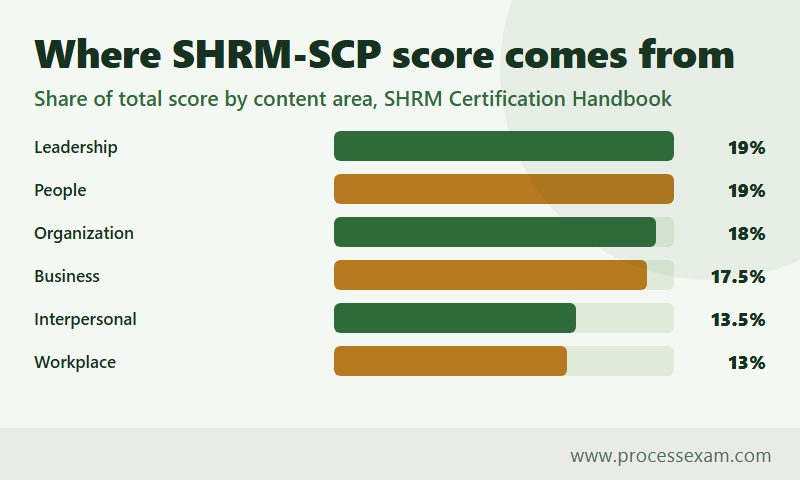
SHRM splits the scoring content in two halves. About half is spread across three behavioral competency clusters (Leadership, Business and Interpersonal) and the other half across three HR knowledge domains (People, Organization and Workplace). The handbook gives each area a share of the total score, and it is the same distribution on the SHRM-CP and on the SHRM-SCP. The first table shows those shares, and the second shows how they divide by question type.
| Content area | Group | Share of total score |
|---|---|---|
| Leadership | Behavioral cluster | 19% |
| Business | Behavioral cluster | 17.5% |
| Interpersonal | Behavioral cluster | 13.5% |
| People | Knowledge domain | 19% |
| Organization | Knowledge domain | 18% |
| Workplace | Knowledge domain | 13% |
| Item type | Share of the exam | What it tests |
|---|---|---|
| Situational judgment | 40% | Picking the most effective response to a workplace scenario |
| Foundational knowledge | 10% | Key concepts behind the behavioral competency clusters |
| HR-specific knowledge | 50% | Key concepts in the People, Organization and Workplace domains |
Both tables come from SHRM's 2026 Certification Handbook, checked in September 2026. Notice two things. First, the weights are close together: the biggest single area is 19 percent, and the smallest is 13. No area can be ignored, and none is so dominant that a candidate can pass on one alone. Second, the behavioral half is not pure "soft skills". The situational judgment items that sit inside it make up 40 percent of the exam, which is why a candidate who can recite employment-law rules but has never reasoned through a messy scenario often finds the paper harder than expected. The detailed topic list behind each area is laid out in our SHRM-SCP syllabus breakdown, and SHRM's own BASK page gives the competency definitions and proficiency indicators in full.
What each content area asks of a senior practitioner
- Leadership (19%). Leading others and the HR function, and acting ethically. At senior level this shows up as scenarios about setting direction, handling a breach of ethics by someone powerful, and deciding how to steer a team through change.
- People (19%). The talent lifecycle: how people are sourced, developed, rewarded and kept. Expect questions that ask you to weigh a workforce-level choice, not to process a single hire.
- Organization (18%). How HR supports the structure, culture and effectiveness of the business, including workforce planning and the way change is managed.
- Business (17.5%). Reading the business: understanding financial and market context, critically evaluating data and advising leaders. This is the area that separates a strategic partner from an administrator.
- Interpersonal (13.5%). Communication, relationship management and working across cultures and functions.
- Workplace (13%). Risk, compliance, safety and the working environment, framed as decisions the organisation must make rather than forms to file.
How do you answer a senior-level situational judgment question?
Forty percent of the exam is this one item type, so it repays the most careful rehearsal. SHRM describes these items as realistic workplace scenarios, each followed by several possible actions. In real life more than one action may work, but SHRM awards credit only where you pick the single most effective one. Everything below follows from that sentence.
A worked example, written by us
The scenario below is our own illustration of the style, not an SHRM question. Suppose two regional divisions merge, and each has its own bonus scheme. Employees in the smaller division learn from a rumour that their bonuses will be cut, and three of your best engineers hand in notice on the same day. You are the senior HR lead. What do you do first?
- Option A. Meet the three engineers individually and offer each of them a retention bonus.
- Option B. Issue a company-wide email that the bonus schemes are unchanged.
- Option C. Work with the finance director to decide the principle behind the merged scheme, then brief managers before announcing it to everyone.
- Option D. Ask the smaller division's manager to reassure the team while the schemes are reviewed.
Option A treats a symptom for three people and quietly creates a fairness problem for everyone else. Option B is a promise you cannot yet keep, because the schemes have not been decided, and if it turns out to be false the damage to trust is worse than the rumour. Option D delegates a strategic problem to the person least able to solve it. Option C addresses the cause: it puts a principle in place, involves the function that owns the numbers and sequences the communication so managers are not blindsided. The best answer is the one that fixes the cause at the level of the whole organisation, and that is the habit the senior exam rewards.
Three habits that carry over from strategic work
Candidates often describe three shifts in how they read these items, and each one maps to a scoring area.
- Ask what level the problem lives at. If a question is really about policy, culture or structure, an answer that fixes one person's case is almost never the best. This is the Leadership and Organization habit.
- Follow the effect beyond HR. Before you choose, ask who else the choice touches: finance, operations, legal, customers. The Business habit is checking that your answer is affordable, measurable and can be defended to a non-HR executive.
- Check the ethics before the efficiency. When two options both work, the one that is fair, transparent and consistent with professional ethics is normally the better one. This is the ethical practice thread that runs through the Leadership cluster.
A useful drill is to cover the options, read the scenario, and write one sentence naming the real problem before you look at any answer. Then read the four options and eliminate those that solve a smaller problem than the one you named. Candidates who choose the answer that sounds most decisive tend to lose marks to the answer that is most complete. Working through SHRM's published SHRM-SCP sample questions is a good first calibration, though SHRM itself notes that performance on the samples does not predict performance on the exam.
When can you sit it, and by what date must you apply?
SHRM does not offer the exam on demand. It runs two testing windows in a year, and each window has its own application periods, so the decision is really about which deadline you can meet. This is the part of the calendar most relevant today. Here is the next window as SHRM's exam options and fees page lists it, checked in September 2026.
| Winter window | Dates published by SHRM |
|---|---|
| Testing | 1 December 2026 to 15 February 2027 |
| Early-bird applications | 3 June 2026 to 31 August 2026 (closed) |
| Standard applications | 1 September 2026 to 24 December 2026, deadline 11:59 p.m. ET |
Read the table as a set of choices. The early-bird rate has gone, so the price is fixed at the standard $399 for members and $499 for non-members. Testing opens on 1 December, which means the last day to apply, 24 December, falls after testing has begun. That sounds generous, but it is a trap for a person who wants a quiet January: the later you apply, the fewer weeks of the window remain and the less time you have left to book. Prometric does the scheduling, and the sooner your approval letter arrives, the more choice of date and centre you will have.
If you miss 24 December, the next chance is SHRM's first window of 2027. At the time of checking, SHRM's fees page listed only the 2026 windows, so we have no dates to quote for it; check the same page before planning around it. The application fee is non-refundable, so apply only when your eligibility is clear and you can commit the study weeks.
What happens on the day itself?
The appointment is longer than the exam. SHRM's handbook breaks the seat time into a two-minute confidentiality reminder, a ten-minute tutorial, two exam sections of up to 110 minutes each and an eight-minute survey. Those two sections add up to the 220 minutes in the facts table, and they are timed separately. Minutes you save in section one do not roll into section two, and after you move on the earlier section is closed to you. There are no scheduled breaks; you may leave the room, but the exam clock keeps running while you are away. Phones and study materials are prohibited from the moment you arrive.
How should you spread your study time across the six areas?
Start from the weights, because they are the only objective guide SHRM gives to what earns marks. If you commit 100 hours in total, the percentages convert directly into hours. That number is an illustration for planning, not an SHRM recommendation, and you should scale it to your own background.
| Area | Weight | Hours out of 100 | How to spend them |
|---|---|---|---|
| Leadership | 19% | 19 | Ethics cases, change and direction-setting scenarios |
| People | 19% | 19 | Talent, rewards and development decisions at workforce scale |
| Organization | 18% | 18 | Structure, culture and workforce planning |
| Business | 17.5% | 17.5 | Financial and market context, data-led recommendations |
| Interpersonal | 13.5% | 13.5 | Communication and stakeholder scenarios |
| Workplace | 13% | 13 | Risk, compliance and safety decisions |
Adjust the hours, not the coverage. Someone who has spent five years in compensation may need fewer hours on the People domain and more on Business or Workplace, but nobody should drop an area to zero. SHRM's Candidate Score and Feedback Report shows performance across all six areas, so a candidate who needs a second attempt has a map of where the marks were lost. Studying to that same map from the first week saves the second attempt.
A twelve-week shape
From today, 29 September, there are 12 weeks until the 24 December deadline. That is enough for an unhurried plan, and one way to use it is below.
- Weeks 1 to 2: read the BASK. SHRM recommends candidates start with its Body of Applied Skills and Knowledge and pay attention to the proficiency indicators that distinguish the two exams. Mark each item you could not explain to a colleague.
- Weeks 3 to 8: study by area. One area per week, ordered by weight, with a short set of scenario questions at the end of each. Write the reason for every wrong answer in one line.
- Week 9: submit your application. If you have not already done so, apply now, so the approval and scheduling steps do not eat into your last weeks.
- Weeks 10 to 11: timed practice. Do at least one full paper in two 110-minute sections. A timed SHRM-SCP practice exam is the closest rehearsal of the pacing, because the test is two separately timed sections with no way back.
- Week 12: review and rest. Revisit only your error log, check the route to the centre and sleep.
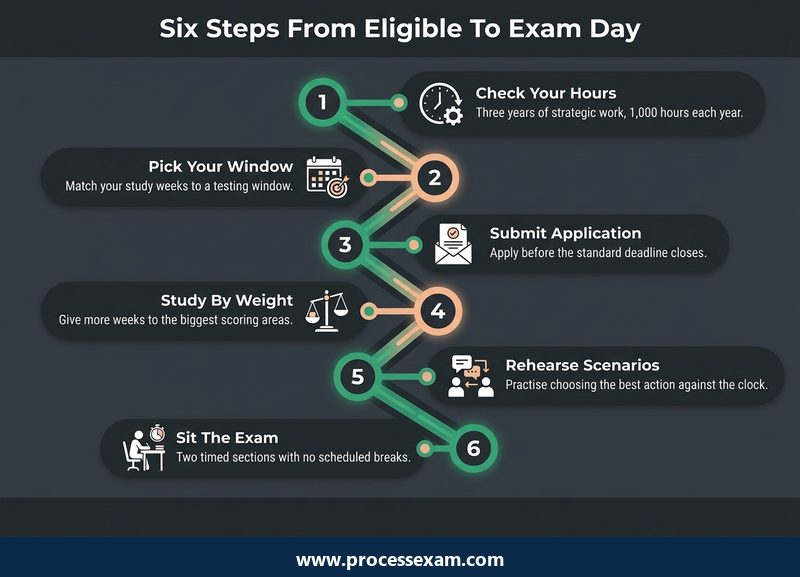
The route in the picture above holds in any window: confirm the hours, choose a window, apply, study to the weights, rehearse and sit. Applying early does not force an early exam. You can apply in October and still book an appointment in January or February, keeping the plan intact.
Which mistakes cost SHRM-SCP candidates the most?
- Treating it as a harder version of the SHRM-CP. The subject areas and their weights are the same on both. What differs is the level of the scenario and the proficiency expected, so more facts do not help as much as better judgment.
- Reading knowledge and judgment as separate skills. Roughly half the exam is scenario-based judgment. Candidates who finish a study guide and never practise choosing between two good answers arrive unprepared for the most common item type.
- Spending the clock unevenly. Each section has 110 minutes and you cannot come back to the first one. Time saved in section two cannot rescue unfinished questions in section one. Aim for a steady pace and do not leave questions you will have no time to revisit.
- Panicking at an odd question. Because 24 items are unscored field-test questions, a strange-looking one may be a trial item. You cannot know which ones they are, so answer everything, but do not let one puzzling item cost you the next five.
- Applying under the wrong exam. An application that overstates strategic work risks denial and forfeited fees, and an honest SHRM-CP application costs the same fee as a hopeful SHRM-SCP one.
- Leaving the application until the last week. With the deadline at 11:59 p.m. ET on 24 December, a holiday-season problem with documents or payment leaves no room to fix it.
- Using memorised answers. Materials that circulate as exam recalls teach the wrong lesson for a judgment exam and breach SHRM's confidentiality rules. Learn the reasoning instead.
How is the exam scored, and how do you keep the credential?
The exam is scored against a fixed standard, not against other candidates. SHRM sets the passing score using the Modified Angoff method and says that if every candidate meets the standard, every candidate passes. Results are reported as scaled scores from 120 to 200, and everyone who passes receives the maximum score of 200, which is why the facts table shows Pass / Fail rather than a percentage. You will see a preliminary pass or did-not-pass result at the testing centre when you finish. The official result follows about two to three weeks later, when SHRM emails you to collect it from your certification portal, and it comes with a Candidate Score and Feedback Report that graphs your performance across the six areas.
Passing starts a three-year cycle. To keep the SHRM-SCP you must earn 60 professional development credits over three years or retake the certification exam. Credits come from three routes, which SHRM calls Advance Your Education, Advance Your Organization and Advance Your Profession, and each has its own maximum, so it pays to plan the 60 early. The feedback report is useful here too, because it shows which of the six areas to strengthen with the credits you earn.
Finally, keep the credential in perspective. The SHRM-SCP will not turn operational work into strategic work, and eligibility depends on you already doing it. What it gives you is an external test that your judgment holds at senior level, taken at a time of your choosing within the two windows. If the winter window suits your calendar, the working sequence is to confirm your hours this week, put the application date in your diary well before 24 December and let the weights, not the length of the syllabus, decide how you spend the weeks between.
Frequently Asked Questions
What does SHRM-SCP stand for?
SHRM-SCP stands for SHRM Senior Certified Professional. SHRM is the Society for Human Resource Management. The designation shows that a practitioner has passed SHRM's exam at the senior level, which SHRM describes as the competency and knowledge reasonably expected of senior HR professionals working at a strategic level.
Who is eligible for the SHRM-SCP exam?
SHRM requires a work history of at least three years performing strategic-level HR duties, with at least 1,000 hours of such work in each calendar year. No degree or HR job title is required. SHRM-CP holders who have held that credential for three years and work in strategic roles also qualify.
How many questions and how long is the SHRM-SCP exam?
The exam has 134 multiple-choice questions and 220 minutes of testing time, taken in two separately timed sections of up to 110 minutes. There are 80 knowledge questions and 54 situational judgment items. Twenty-four of the 134 are unscored field-test items, mixed in so candidates cannot identify them.
How much does the SHRM-SCP exam cost?
The standard exam fee is $399 for SHRM members and $499 for non-members. SHRM also charges lower early-bird rates in the early application period, but for the winter 2026-27 window that period closed on 31 August 2026. Standard applications for that window are accepted until 11:59 p.m. ET on 24 December 2026.
What is the passing score for the SHRM-SCP?
SHRM reports results as scaled scores from 120 to 200, and every candidate who passes receives 200, so the result is shown as pass or fail. The passing standard is set with the Modified Angoff method and does not compare candidates with each other. Official results arrive about two to three weeks after testing.
- Human Resources |
- SHRM Senior Certified Professional Test Questions |
- SHRM-SCP Question Bank |
- SHRM Senior Certified Professional Book |
- Senior Certified Professional Certification Cost |
- Senior Certified Professional Certification Requirements |
- SHRM Senior Certified Professional Sample Questions |
- SHRM-SCP Exam Questions Download |
- SHRM-SCP Test Questions |
- Senior Certified Professional PDF |
- SHRM-SCP BASK


