
LSSYB Certification: LSSA Yellow Belt Exam Cost, Pass Mark and Study Plan
Updated on 1 October 2026. What’s new: exam fee corrected to USD $282 for the Lean Six Sigma Academy Yellow Belt exam
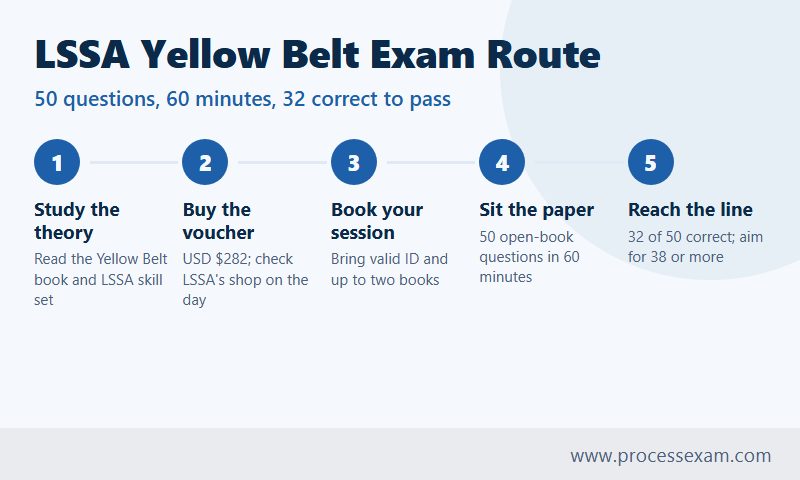
LSSYB is the everyday shorthand for the Lean Six Sigma Academy Yellow Belt, the entry-level credential from LSSA, a certification body that has run Lean Six Sigma belts since 2009. The exam is 50 multiple-choice questions in 60 minutes, open book, with a passing score of 32 / 50. This guide covers what the paper asks, what LSSA's own sample reveals, the cost, a ten-day plan and what a Yellow Belt does afterwards.
People reach this topic by typing many spellings: LSSYB, LSS YB, LSS-YB, LSSA-YB or the longer Lean Six Sigma Yellow Belt. They all point to the same LSSA exam, with exam code LSSA-YB. One warning for anyone who typed "CLSSYB": that is usually a slip for ASQ's CSSYB, a different Yellow Belt from a different body with a different exam. If your employer asked for the LSSA version, you are in the right place.
The belt is aimed at people who do the work rather than people who lead the improvement. LSSA's own page describes a Yellow Belt as someone with day-to-day experience of processes, which makes them a natural team member on Kaizen, Green Belt and Black Belt projects, and as someone responsible for improving operational performance in a department or on a production line.
What does LSSYB mean, and who stands behind the LSSA Yellow Belt?
The Lean Six Sigma Academy (LSSA) presents itself as a worldwide standard for Lean Six Sigma training and certification, working since 2009 through accredited training organisations and exam institutes rather than selling every course itself. Its belts run from Yellow upwards, with Orange, Green and Black Belt above it and a Master Black Belt level at the top. The full name of our exam record is Lean Six Sigma Academy Certified Lean Six Sigma Yellow Belt (LSSA-YB).
Two points about how the scheme is organised matter to a candidate. First, you can sit the Yellow Belt exam on its own. LSSA says the Yellow Belt level includes only a theoretical exam, with no practical component, so you do not need a completed project to be certified. Second, LSSA offers a separate Lean Yellow Belt with a different paper (40 questions, a pass at more than 63%, which LSSA writes as 25 points). Check which of the two your employer or course asked for before you buy a voucher, because the Lean Six Sigma version is the one covered here.
The credential is built on the same framework as the rest of the LSSA range. Its materials describe a Continuous Improvement Maturity Model that brings together TQM, Kaizen, TPM, Lean and Six Sigma. That explains why the sample paper wanders across tools that many candidates think of as separate subjects, as you will see below.
How is the 50-question, 60-minute paper set out, and what does 32 out of 50 ask of you?
The paper has 50 multiple-choice questions and one hour to answer them, which is 72 seconds a question. It is a theory exam only. You may bring a maximum of two books, a basic calculator is allowed and you must show valid identification. The practice or exercise book from LSSA's range is explicitly not allowed in the room, so do not plan to lean on it.
| Detail | LSSA-YB |
|---|---|
| Exam code | LSSA-YB |
| Full name | LSSA Lean Six Sigma - Yellow Belt |
| Vendor | LSSA / Lean Six Sigma Academy |
| Questions | 50 |
| Duration | 60 minutes |
| Passing score | 32 / 50 |
| Fee | $282 (USD) |
| Format | Multiple choice, open book, theory only |
How should you read the pass line?
Our exam record gives the passing score as 32 / 50, which is 64%. LSSA's skill-set page words the rule as answering more than 32 of 50 correctly, while its web shop says you need at least 32. The two sentences differ by exactly one question. Rather than gamble on which wording the examiner applies, treat 33 as your bare minimum and aim for 38 or more in practice, so one unlucky batch of questions does not decide the outcome.
What does 72 seconds a question mean for an open-book paper?
Open book does not mean slow. A question that asks you to recall a definition takes ten seconds if you know it and two minutes if you have to find it. The books help with exact formulas and the names of tools, not with understanding. Two books are enough to hold a handful of tabs, but not enough to teach you the syllabus during the exam. Spend roughly the first half of the hour on a first pass, answering what you know, marking what you do not, and use the remaining time for the marked questions and your tabs.
What do LSSA's own sample questions reveal about the syllabus?
LSSA publishes a ten-question sample paper in English, with a 15-minute limit, an open-book rule and a pass mark of 7 correct out of 10. It is the closest thing to a window into the real exam, and it is short enough to read in one sitting. Open it on the LSSA sample questions PDF and look at the spread before you read on. The ten questions touch five families of topic, and they are not what a candidate expecting only the DMAIC acronym would predict.
| Topic family | What the sample asks about | What you should be able to do |
|---|---|---|
| Lean tools | Quick changeover, waste, value stream thinking | Name the tool for a situation and its purpose |
| Statistics and experiments | Process capability index, factor experiments | Use the Cp formula and explain why designed experiments beat one-factor tests |
| Control and standards | What a control plan contains, what a standard procedure is for | Separate a plan, a procedure and a record |
| Maintenance and quality systems | The pillars of total productive maintenance | Spot which item does not belong in a list |
| Principles | The philosophy Lean and Six Sigma share, operational excellence | Choose the answer that puts customer value first |
The sections below teach each family in the way the sample tests it. The exam's wording belongs to LSSA, so these are explanations in our own words, not copies of its questions.
Lean tools: changeovers and the seven kinds of waste
The first sample question asks for the method that converts a line from one product to another quickly and efficiently. The answer is Single Minute Exchange of Dies, usually shortened to SMED. Its idea is simple: split every changeover task into internal work, which can only be done while the machine is stopped, and external work, which can be prepared while it still runs. Then move as much as possible from the first group to the second.
The same area covers waste. Lean classically lists transport, inventory, motion, waiting, over-production, over-processing and defects, and LSSA's materials also talk about customer-facing waste such as delay, duplication and unclear communication. A question might describe an end product that does not meet what the customer expected and ask which waste most likely caused it. The sample's answer points at unclear communication: if nobody wrote down what the customer wanted, speed and neatness will not rescue the result.
Statistics: capability and designed experiments
Yellow Belt does not mean maths-free. The sample includes a process capability question, and the Cp formula is one to memorise. Cp equals the upper specification limit minus the lower specification limit, divided by six times the standard deviation. The six in the denominator is the width of the process spread, three standard deviations either side of the mean.
A short worked example makes it stick. A filling line must deliver between 498 and 502 millilitres, so USL minus LSL is 4. The measured standard deviation is 0.5 millilitres, so the spread is 6 times 0.5, which is 3. Cp is 4 divided by 3, or about 1.33. The specification window is a third wider than the process spread, so the line can hold the tolerance if it stays centred. Change the standard deviation to 0.8 and the spread becomes 4.8, so Cp falls to 0.83. The process now cannot meet the specification even when perfectly centred.
The same question family asks why changing one factor at a time is a weaker way to learn than a designed experiment. The reason is interactions. Imagine two settings, temperature and speed, each at a low and high level. Testing one at a time tells you what each does alone. A designed experiment runs all four combinations, so it also shows if high temperature only helps when the speed is low. The one-factor method cannot see that, and an exam answer saying interactions are not revealed is the one to choose.
Control: plans, procedures and records
The last phase of DMAIC is Control, and the sample tests it by asking what belongs in a control plan. A useful plan lists the product and process characteristics being watched, the actions to minimise potential failures, and an out-of-control action plan that says what the operator does when a measurement drifts. A failure mode and effects analysis feeds the plan but is not one of its elements. The plan is not a record of what happened, and it is not the written method for doing the job.
Keep the three documents apart. A standard operating procedure describes how to carry out one task within the quality management system. A control plan says what to watch and what to do when it goes wrong. A record is evidence that something was done. Exam options often offer all three together, and the wrong ones are written to sound plausible.
Maintenance, excellence and the shared philosophy
Two sample questions step outside DMAIC. One asks which item is not among the eight pillars of total productive maintenance, a list that includes focused improvement, training and education, and quality maintenance, among others. The exam rewards remembering the list, so write the eight pillars on a card and tab it in your book. Another asks what operational excellence focuses on, where the answer is the customer's needs rather than sales or management skills.
The philosophy questions are the easiest marks on the paper if you read them calmly. Lean and Six Sigma share one belief: create value for the customer so the organisation reaches its goals. A principle of Lean is to identify the value stream and remove waste. Any option that cuts quality for profit, wins at others' expense or piles up stock is a distractor.
What will the LSSYB certification cost, and where do you buy the voucher?
Our exam data lists the fee as $282 (USD). LSSA's own web shop sells the Lean Six Sigma Yellow Belt exam voucher in euros, listed at €260 at the time of checking, so your invoice depends on the currency and on whether a training provider bundles the voucher into a course. Treat both as a snapshot and look at the LSSA exam voucher page on the day you buy.
The shop page, when we looked in October 2026, showed the product as not in stock, so expect to ask LSSA or an accredited training organisation how a voucher is issued rather than assuming checkout is instant. The exam is delivered in English by exam institutes, in online and paper formats with a proctor, according to LSSA.
What else belongs in your budget?
- The theory book. LSSA recommends its Lean Six Sigma Yellow Belt book before the exam, and the same author's Yellow and Orange Belt practice book. The practice book cannot be taken into the exam.
- Practice papers. Mock tests cost far less than a failed attempt, and they teach pace as well as content.
- Training. LSSA connects candidates with accredited training providers, and it also runs a Yellow Belt eLearning course. A course is optional: the exam has no stated prerequisites.
The sensible way to compare costs is to count the whole route: voucher, book and practice material, and your own study hours. A $282 voucher used once with a passing result is cheaper than a lower-priced attempt that you have to repeat.
How would you prepare for the LSSYB exam in ten days?
Ten days works for someone who has seen process improvement at work. If the vocabulary is entirely new, stretch the same sequence over three weeks. The plan below is built around the open-book rule: you learn the ideas, then you index your two books so lookups are fast.
| Days | Focus | Output |
|---|---|---|
| 1-2 | Read the LSSA skill set and your theory book once, quickly | A one-page list of tools and what each is for |
| 3-4 | Lean: waste, 5S, SMED, value stream, visual management | Flash cards of tool, purpose and trigger situation |
| 5-6 | Six Sigma: DMAIC, process capability, variation, experiments, control plans | Three worked Cp examples and one factor-experiment sketch |
| 7 | Quality systems, TPM pillars, standards and operational excellence | Tabs for the TPM list and the document types |
| 8 | Take the LSSA ten-question sample timed, then a full 50-question paper | Score by topic family |
| 9 | Fix the weakest family and re-read every wrong answer | A shortlist of ten facts you keep missing |
| 10 | Second full timed paper, then rest | A score of 38 or higher, with ID packed |
How should you set up your two books?
Choose the two books you will bring and decide their roles. One is the theory book for definitions and tool descriptions. The other is whatever reference you used for formulas and lists. Tab five places: the DMAIC overview, the waste list, the capability formulas, the TPM pillars and the control plan contents. Add a one-line summary above each tab. Do not tab everything, because a book where every page has a tab is as slow as a book with none.
How can you use the practice papers best?
Run the first paper without books. It shows what you actually know. Run the second with books and a clock. It shows whether your tabs help. A candidate who scores 40 without books and 40 with them has indexed nothing useful. A candidate who rises from 30 to 40 has found the right rhythm. The LSSA-YB practice exam on ProcessExam mirrors the 50-question, 60-minute format, and the LSSA-YB syllabus page lists the topics in order if you prefer to check coverage first.
Why do open-book candidates still run out of marks or minutes?
Most failed attempts on open-book papers share a few habits, and every one of them is avoidable.
- Looking up everything. Candidates who check every answer in the book finish with ten questions unread. Use the book only when you can name what you are looking for.
- Confusing the tools. SMED, 5S, Kaizen and TPM all sound like improvement slogans. Know the one-line job of each. A changeover problem is SMED, a messy workplace is 5S, and a maintenance question is TPM.
- Skipping the formulas. Cp is on LSSA's own sample. Write the formula down on day one and practise it with different numbers until the six in the denominator is automatic.
- Mixing up documents. Procedure, control plan and record are three different things. Questions are written to make them blur.
- Ignoring the wording of "NOT" questions. A question asking which item is not part of a list reverses everything. Underline the word before you read the options.
- Starting late. The voucher and session booking take time. Book the date first, then study toward it.
Another common error is treating the exam as a vocabulary test only. The sample shows that some questions need calculation and some need a judgement about what a team should do. Practise both kinds.
What does a Yellow Belt actually do at work, and where does the next belt fit?
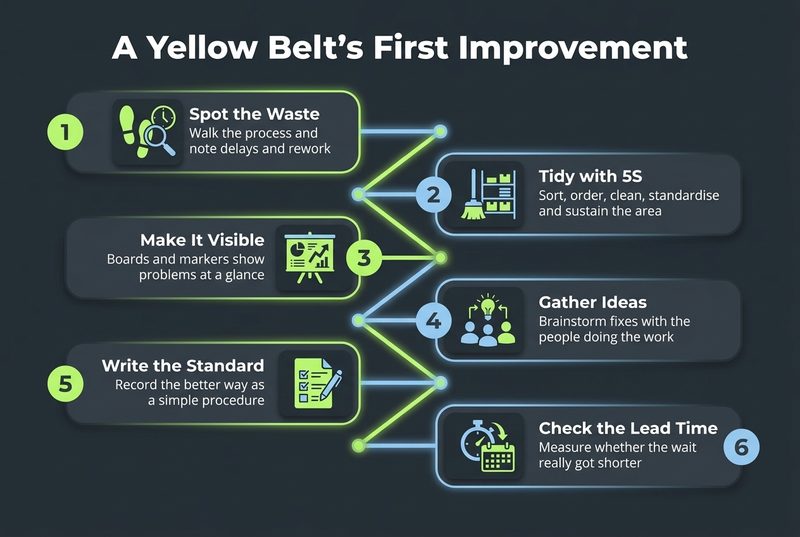
LSSA's description of the role is practical rather than managerial. Yellow Belts help improve operational performance in a department or production line: shortening lead times, solving problems and improving quality. Typical activities are 5S, visual management, helping write standards and taking part in brainstorming sessions. In other words, the credential says you can contribute to a project and run small improvements in your own area, not that you lead the project.
The picture below follows one small improvement from start to finish, using only the activities LSSA lists for the role.
How would a first improvement play out?
Take a back-office team that processes supplier invoices. An invoice takes five working days from arrival to payment approval, which is about 2,400 minutes at eight hours a day, yet the people touching it spend a combined 48 minutes of actual work. That is 2% of the lead time, and 98% is waiting. The Yellow Belt does not need advanced statistics to see that. They walk the process, note where invoices sit, tidy and label the shared tray with 5S, add a board that shows how old each invoice is, ask colleagues for fixes, write the new routine down as a one-page standard, and measure the lead time again a month later. If it falls to three days, the same 48 minutes now make up about 3.3% of the elapsed time. That is a small gain, but it is repeatable and it comes from the people nearest the problem. The figures in this example are illustrative, not LSSA data.
Where does the next belt fit?
LSSA's ladder continues with the Orange, Green and Black Belt levels, and each belt is certified by its own exam, so you do not have to pass the Yellow Belt first. In practice, many people begin with the Yellow Belt because it is the cheapest, shortest paper and shows an employer that you speak the vocabulary. If you later join a project led by a Green Belt, you will already know the tools they are using. The LSSA Yellow Belt skill-set page also offers the free skill set document, which is the best checklist for deciding whether you are ready to move up.
A realistic expectation helps. A Yellow Belt rarely brings a new job title by itself, and it carries no pay figure that we can cite. What it can do is make you the person who is asked to join the improvement team, and that visibility is where the career effect usually starts.
Frequently Asked Questions
What does LSSYB certification mean?
LSSYB is shorthand for the Lean Six Sigma Academy Yellow Belt, the entry-level LSSA credential with exam code LSSA-YB. It shows you know Lean and Six Sigma basics and can join improvement projects. It is not the same as ASQ's CSSYB, which is a different exam.
How many questions are on the LSSA Yellow Belt exam?
The LSSA-YB exam has 50 multiple-choice questions in 60 minutes. It is a theory-only, open-book paper: you may bring a maximum of two books, a basic calculator and valid identification. That works out to roughly 72 seconds per question.
What is the passing score for LSSA-YB?
The passing score is 32 / 50, which is 64%. LSSA's skill-set page words the rule as more than 32 correct, while its shop says at least 32. Because the wordings differ by one question, aim for 38 or more in practice.
How much does the LSSA Yellow Belt exam cost?
Our exam record lists the fee as $282 (USD). LSSA's own web shop prices the Lean Six Sigma Yellow Belt voucher in euros, so the amount you pay depends on currency and on whether a training provider bundles it. Check the LSSA shop on the day you buy.
Are there prerequisites for the LSSA Yellow Belt?
No prerequisites are listed for the Yellow Belt. LSSA describes it as suitable for anyone who wants to learn the basic principles and key tools of Lean Six Sigma, and says the Yellow Belt level has only a theory exam with no practical part.
- Lean Six Sigma Yellow Belt PDF |
- Lean Six Sigma Yellow Belt Certification Requirements |
- Lean Six Sigma Yellow Belt Certification Cost |
- Management |
- LSSA-YB Question Bank |
- LSSA-YB Exam Questions Download |
- LSSA-YB Test Questions |
- LSSA Lean Six Sigma Yellow Belt Test Questions |
- Lean Six Sigma Yellow Belt Simulator |
- Lean Six Sigma Yellow Belt Mock Exam |
- LSSA Lean Six Sigma Yellow Belt Book |
- LSSA Lean Six Sigma Yellow Belt Sample Questions


