
LEED AP O+M Exam Study Plan: 30 Days on LEED v5
Updated on 1 October 2026. What’s new: the exam now runs on LEED v5 with eight content areas, and Energy and Atmosphere carries the most questions, 21 of the 85 scored.
Yes, 30 days is enough for LEED AP O+M if you already hold the LEED Green Associate credential and can give it about an hour to an hour and a half on weekdays and a longer block at weekends. The exam has 100 multiple-choice questions in 120 minutes, and you need 170 out of 200. It now runs on LEED v5. This plan spends the days where the marks are: Energy and Atmosphere first, then Indoor Environmental Quality.
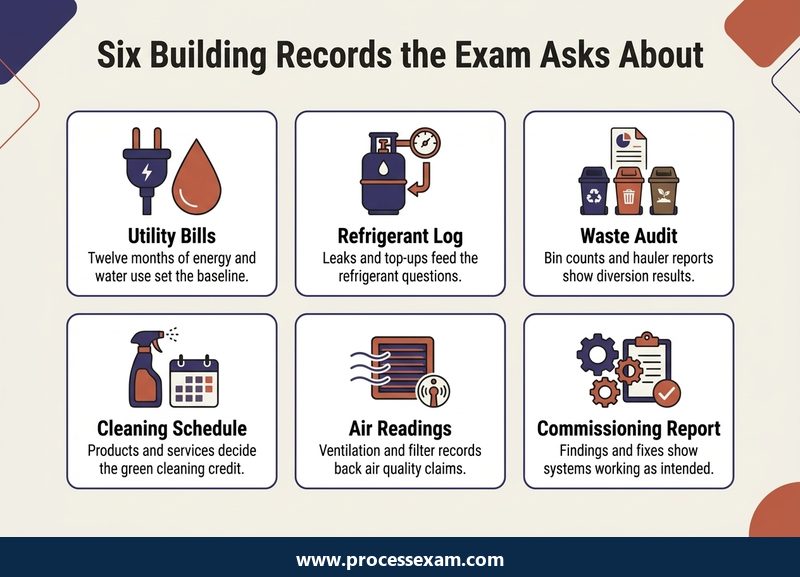
Most 30-day plans on the internet are a list of weeks with a vague topic each. That is not enough for this exam, because LEED AP O+M is the specialty exam for people who run buildings that already exist. Its questions assume you have seen a utility bill, a refrigerant log, a waste hauler's report and a cleaning contract. So the plan below uses a different idea. You pick one building you know, real or imagined, and you study every area of the exam against the records that building would produce.
Below you will find the version question first, because it decides which books you open. Then the exam facts, the split of the scored questions, a day-by-day calendar, and the practice and exam-day routine for the last week.
Can you really get ready for LEED AP O+M in 30 days, and who should try?
Thirty days works for three kinds of candidate. The first is a facility manager, building engineer or sustainability coordinator who already works in an occupied building and has met LEED language in meetings. The second is a consultant who has done LEED design or construction work and now wants the operations credential. The third is a recent Green Associate whose core concepts are still fresh. All three can usually cover the material in a month because the exam is about applying known ideas to building performance, not about learning a new field.
It does not work well for someone who has never read a LEED credit. USGBC's page for the credential lists a current LEED Green Associate credential as the entry point, or the combined exam that bundles the Green Associate with the specialty, and it strongly recommends prior LEED project experience. If you are missing that background, stretch the same calendar to eight weeks and double every block. The order stays the same.
How many hours does the 30-day version need?
Plan for roughly 45 to 60 hours in total. That is about 75 minutes a weekday and three hours on each weekend day, with one weekend day kept free. Those hours are a planning figure of ours, not a USGBC number, and your own pace matters more. If a block is going well, move on; if you cannot explain a topic out loud without notes, repeat it before you advance.
What do you need on your desk before day 1?
- The exam reference list from USGBC, which includes the LEED v5 Reference Guide for Building Operations and Maintenance, February 2026 edition.
- The topic outline, which you can compare with our AP O+M syllabus page.
- Twelve months of electricity, gas and water bills for one building. A real building is best; a sample set from a colleague also works.
- A blank spreadsheet for your error log, with columns for the question, the exam area, why you missed it and the credit it belongs to.
Which version of the O+M exam are you studying for in October 2026?
You are studying for the LEED v5 exam, and it is still in its beta period. USGBC's LEED v5 exam information page, which showed a last-updated date of 28 September 2026 when we checked it this month, says the LEED v4 version of the O+M exam is no longer available; its last test date was 28 June 2026. For anything about versions, this guide follows USGBC's own page.
The dates on that page matter for your calendar. Candidates who opt in to the beta can register until 21 October 2026 and must test between 30 June and 27 October 2026. During the beta you do not get a score at the end of the sitting. USGBC says score reports come once the passing score has been finalised, with February 2027 given as the expected release. The beta also carries a 50% discount on the registration fee, continuing education hours when you pass, and a 50% discount on a second attempt.
What does the beta mean for a plan that starts today?
If you start on 1 October and follow thirty calendar days, your last study day falls on 30 October, three days after the beta testing window closes. So you have a real choice. You can compress the calendar to about three weeks and sit before 27 October, which means doing the Energy and Atmosphere block in four days, not seven. Or you can keep the full thirty days and register for whatever route USGBC lists after the beta. Read the exam information page before you book, because USGBC says its dates can change.
Either way, your study material is the same: the v5 reference guide and the v5 content areas. A LEED v4 guide, however good, is now teaching you credits the exam no longer asks about. That includes older Operations and Maintenance credit names that the current outline replaces with items such as decarbonization and efficiency plans, a climate resilience assessment, a human impact assessment and a carbon projection from energy use.
What are the exam facts you plan around?
The table below uses the figures we hold for this exam. It lists both price lines, because the price depends on whether you need the Green Associate exam too and whether you belong to USGBC.
| Item | LEED AP O+M |
|---|---|
| Exam name | USGBC LEED Accredited Professional Operations and Maintenance |
| Exam code | AP O+M |
| Questions | 100 multiple choice |
| Duration | 120 minutes |
| Passing score | 170 out of 200 |
| Fee, combined exam | $550 ($400 for USGBC members) |
| Fee, specialty only | $350 ($250 for USGBC members) |
| Version | LEED v5 (beta period, tested to October 2026) |
Two practical points come out of the table. First, the combined route is meant for people who do not yet hold the Green Associate; if you do hold it, the specialty-only line is the one that applies. Second, the passing score of 170 out of 200 is a scaled score, not 85 per cent of the questions. Do not convert it into a target percentage. Use timed practice and your error log to judge readiness instead.
USGBC's LEED AP with specialty page is where you check fees, eligibility and the credential maintenance rules before you pay anything.
How are the scored questions split, and what does that do to your days?
The eight content areas in our outline carry question counts that add up to 85. Since the exam has 100 questions, that is consistent with 15 unscored trial questions mixed in at random, so you cannot tell which ones count and should answer all of them. The table shows the counts, each area's share of the 85, and the days this plan gives it.
| Content area | Questions | Share of 85 | Days in this plan |
|---|---|---|---|
| Energy and Atmosphere | 21 | 25% | 7 |
| Indoor Environmental Quality | 17 | 20% | 4 |
| LEED Process | 10 | 12% | 3 |
| Integrative Process Planning and Assessments | 10 | 12% | 3 |
| Location and Transportation | 8 | 9% | 2 |
| Water Efficiency | 7 | 8% | 1 |
| Materials and Resources | 7 | 8% | 1 |
| Sustainable Sites | 5 | 6% | 1 |
Notice that Energy and Atmosphere and Indoor Environmental Quality together carry 38 of the 85 questions, about 45 per cent of what is scored. The two process areas add another 20. That means a candidate who is solid on those four areas has a base of 58 scored questions before touching water, waste, sites or transport. The days column adds up to 22; the rest of the thirty go to set-up, practice tests and your error log.
Why do the small areas still deserve a day each?
Sustainable Sites at five questions and Water Efficiency at seven look cheap, but they are also the areas where a few facts decide the answer: a metering rule, a light pollution limit, a threshold for heat island reduction. One focused day makes those marks nearly free. Skipping them to spend a fifth day on energy usually returns less.
How do you study each area using one building you know?
This is the method that replaces a generic reading list. For every area, you look at the records a building would hold and ask which credit, requirement or policy that record proves. The questions then feel familiar, because they describe situations you have already walked through.
Energy and Atmosphere: the bills tell the story
Start with your twelve months of energy bills. Work out the energy use intensity, which is energy per unit of floor area per year, and note how it moves between summer and winter. Then read the outline's items one by one against that data: the carbon projection from energy use and the building performance standard it ties to, energy monitoring and reporting, minimum and optimised energy performance with a historical baseline, peak load reduction, commissioning (including monitoring-based and retro-commissioning), decarbonization and efficiency plans, refrigerant management and the greenhouse gas emissions reduction performance, including onsite combustion and renewable energy.
For each item write one sentence on what a building team must show and what a building team must do. Scenario questions in this area usually give you a few numbers and ask which action follows. Knowing the difference between a requirement, a performance threshold and a strategy is worth more than memorising credit names.
Indoor Environmental Quality: walk the floors
This is the area where a walk through the building helps most. Look at the air handlers and ask what the outline wants known about ventilation and filtration: minimum outdoor air, how it is verified, economizer operation and filter grades. Then look at what the building does about indoor air quality performance, whether through continuous monitoring or targeted one-time testing, including VOC testing. The outline also lists resilient spaces and management modes for respiratory disease or outdoor air events, green cleaning, integrated pest management, no smoking, facility stewardship audits and occupant-related items.
A good habit here is to link each topic to a person. Green cleaning belongs to the cleaning contractor, pest management to the pest vendor, ventilation to the engineer. Questions often ask who must do what, and the person-to-topic link makes the answer easy to see.
LEED Process and Integrative Process Planning: the paperwork areas
These two areas, at 10 questions each, are less about physics and more about how a LEED O+M project actually runs. For the process area, learn the minimum program requirements, prerequisites, exclusions to the O+M protocol, the certification flow from registration through the reporting period to recertification, project priorities such as regional priority and exemplary performance, pilot credits and the role of addenda and interpretations. For the planning area, learn the integrative process, the Current Facilities Requirements and the O+M plan, operations assessment and policy, operational planning for resilience, the climate resilience assessment, the human impact assessment and worker safety and training.
Both lists reward flashcards, but pair each card with a sentence on when you would use the item in a real project. Reciting definitions is not what these questions test.
Water, Materials, Sites and Transport: short, factual areas
Water Efficiency is about metering and reporting, water use intensity against a baseline and advanced submetering of subsystems. Materials and Resources is about waste reduction performance and strategies: diversion data, composting, hazardous waste, organics recycling and a zero-waste audit. Sustainable Sites covers heat island reduction, light pollution reduction and bird collision reduction. Location and Transportation covers sustainable transportation performance, transportation demand management (unbundled parking, shared mobility, bicycle infrastructure) and electric vehicle provision.
For these areas, make one page per credit with three lines: the intent, the data you must collect, and the number or rule that decides success. Then use your building's records: a hauler's monthly report for waste, a roof photo for heat island, a transport survey for mode share.
What does each of the 30 days look like?
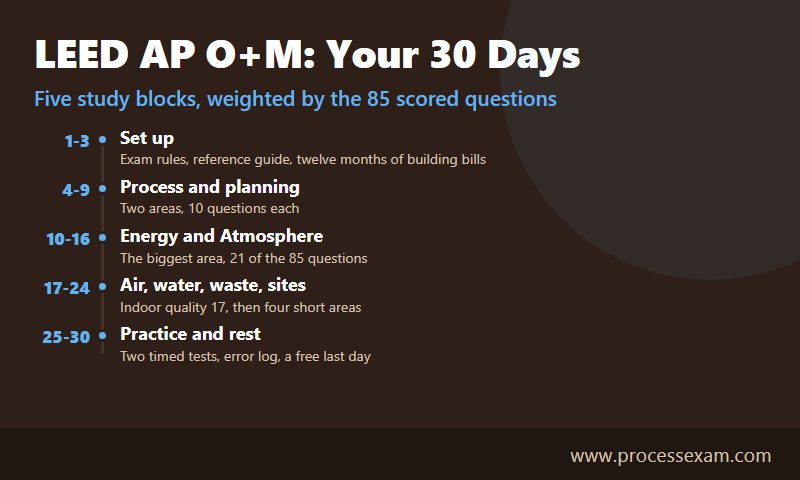
The calendar below puts the time where the marks are. Each row ends with a proof of completion, so you can tell when a block is done rather than when it has merely been read.
| Days | Study block | You are done when you can |
|---|---|---|
| 1-3 | Set-up: exam rules, reference guide layout, building records | Name the eight content areas, say how each is weighted, and show the twelve months of bills in a sheet |
| 4-6 | LEED Process | Walk through certification from registration to recertification without notes |
| 7-9 | Integrative Process Planning and Assessments | Explain the O+M plan, the resilience items and the two assessments to a colleague |
| 10-16 | Energy and Atmosphere | Work out your building's energy use intensity and say which credit each result feeds |
| 17-20 | Indoor Environmental Quality | Match every topic to the person who owns it in a building |
| 21-22 | Water Efficiency and Materials and Resources | Read a water bill and a waste report and say which credit each supports |
| 23-24 | Location and Transportation, Sustainable Sites | State the intent and deciding rule for each credit |
| 25-26 | First timed practice test and review | Explain why each wrong answer was wrong and file it in the error log |
| 27-28 | Fix the weak areas, then second timed test | Score better than the first sitting and shorten the error list |
| 29 | Error log and one-page notes | Read your notes in half an hour |
| 30 | Rest and logistics | Confirm time, place, identification and system check |
Week 1: foundations and the two process areas
Days 1 to 9 are about vocabulary and flow. By the end you should hold a clear picture of how an O+M project moves, because the later areas hang from it. Do not try to memorise numbers yet; focus on sequence and responsibility.
Week 2: Energy and Atmosphere
Days 10 to 16 are the heart of the plan. Take the first two days for monitoring, baselines and performance. Take the next two for peak load, commissioning and refrigerants. Use days 14 and 15 for carbon, decarbonization and emissions work, and use day 16 to answer questions from any source on energy only. If you cannot get through it in seven days, borrow one from the short areas rather than rushing.
Week 3: air quality and the short areas
Days 17 to 24 go to Indoor Environmental Quality and the four smaller areas. The pace quickens because each of the small areas has less depth. Keep the one-page-per-credit habit, and read each page aloud once at the end of each day.
Week 4: practice, review and rest
Days 25 to 30 are for practice. Sit the first full test in a single 120-minute block with no pauses. Review it the same day. Two days later, repeat with a different set of questions. Our AP O+M practice exam follows the same 100-question, 120-minute format, which makes it handy for the pacing rehearsal.
How should you use practice tests and an error log in the last week?
A practice test is a measuring tool, not a study method. Its value comes from what you do after it. After each sitting, sort every missed or guessed question into one of three piles: you did not know the fact, you knew it but misread the scenario, or you ran out of time. Each pile needs a different cure. Missing facts go back to the one-page credit sheets. Misread scenarios need slower reading of the last line of the question first. Time pressure needs a rule, such as moving on after 90 seconds and flagging the question.
The pacing arithmetic is simple. 100 questions in 120 minutes is 72 seconds each, with no spare time for rereading everything. A first pass at about 60 seconds per question leaves about a sixth of the paper for flagged items. Practise that rhythm in both tests, not just the second.
Which mistakes cost O+M candidates marks?
- Studying design and construction credits. O+M works on existing buildings and performance data. A new-build answer is often the trap.
- Ignoring the reporting period. Many requirements depend on a defined period of data, not a snapshot.
- Skipping metering rules. Water and energy metering questions turn on exactly what is metered and how often it is reported.
- Learning the credit names but not the thresholds. Some questions are purely about a rule or a number; flashcards for those save time.
- Using v4 notes. Several current items did not exist in the previous version.
What should the day before and exam day look like?
The day before, read the one-page notes and the error log, and stop at a sensible hour. Check how you are sitting the exam, at a test centre or by remote proctoring, because USGBC's handbook lists the rules for each, and confirm the identification you must bring. On the day, read the last line of each scenario first, eliminate options that belong to a different credit, and keep to your timing rule. Remember that during the beta no score appears at the end; you receive a notice of completion and wait for results.
Is the credential worth 30 days of work, and how do you keep it?
LEED AP O+M signals that you can improve performance in a building that already exists. That is a different claim from knowing how to design a green building, and it suits roles in facilities, property management, energy services and sustainability. We do not quote salary figures here, because no single survey fits this credential.
Keeping it costs less than getting it. USGBC requires 30 continuing education hours within two years of passing, and says hours can come from education, project experience, authorship and volunteering activities. Its credential maintenance guide lists which hours count. If you opted in to the beta, the continuing education hours that USGBC gives you for passing it count toward that total from the start.
Before you pay for the exam, check the exam information page on USGBC's site one more time. If the dates or the version have moved, the calendar above still works; only the start date changes. And if you want a quick check of where you stand today, the topic outline pairs well with a first timed practice test, taken on day 1 as a baseline rather than on day 25 as a verdict.
Frequently Asked Questions
What does LEED AP O+M stand for?
LEED AP O+M stands for Leadership in Energy and Environmental Design Accredited Professional, Operations and Maintenance. It is a USGBC specialty credential for people who improve the performance of existing buildings. You hold the Green Associate credential first, or take the combined exam that includes both.
How many questions are on the LEED AP O+M exam?
The exam has 100 multiple-choice questions and a 120-minute time limit. The content-area counts in our outline add up to 85, which fits 15 unscored trial questions mixed in at random. You cannot tell which ones count, so answer every question and keep to roughly 72 seconds each.
What score do you need to pass LEED AP O+M?
You need 170 out of 200. That is a scaled score, not a percentage of correct answers, so a target such as 85 per cent is only a rough guide. During the LEED v5 beta, USGBC releases score reports after the passing score has been finalised, with February 2027 expected.
How much does the LEED AP O+M exam cost?
The combined exam, which includes the Green Associate, costs $550, or $400 for USGBC members. The specialty-only exam costs $350, or $250 for members. USGBC states that the LEED v5 beta carries a 50% discount on the registration fee, so check its current page before paying.
Is the LEED AP O+M exam on LEED v5 now?
Yes. USGBC's exam information page, last updated 28 September 2026, says the LEED v4 version is no longer available and the last v4 test date was 28 June 2026. The v5 beta runs for opted-in candidates until 27 October 2026, and study material should be the v5 reference guide.
- LEED Accredited Professional |
- USGBC LEED Accredited Professional Operations and Maintenance Test Questions |
- AP O+M Question Bank |
- LEED AP O+M Simulator |
- LEED AP O+M Mock Exam |
- USGBC LEED Accredited Professional Operations and Maintenance Book |
- LEED Accredited Professional Operations and Maintenance Certification Cost |
- LEED Accredited Professional Operations and Maintenance Certification Requirements |
- USGBC LEED AP O+M Question Bank |
- USGBC LEED AP O+M Book |
- USGBC LEED AP O+M Study Guide |
- LEED AP O+M Certification |
- LEED AP O+M Certification Cost |
- LEED AP O+M Certification Requirements |
- USGBC LEED Accredited Professional Operations and Maintenance Sample Questions |
- AP O+M Exam Questions Download |
- AP O+M Test Questions |
- LEED Accredited Professional Operations and Maintenance PDF |
- USGBC LEED AP O+M Exam Questions |
- USGBC LEED AP O+M Sample Questions |
- LEED AP O+M |
- LEED AP O+M PDF |
- USGBC AP O+M Handbook


