
Why Should You Take a Free CAPM Practice Test?
Updated on 22 September 2026. What’s new: CAPM exam fees corrected to $225 for PMI members and $300 for non-members.
Picture a candidate who scores almost perfectly on a short free CAPM quiz, books the exam that week, and leaves the 150-question, 180-minute paper with a fail and Below Target in two domains. Both results were honest. The quiz measured recall on a small, friendly sample; the real paper measured judgement across four domains, held for three hours. That gap is why a free CAPM practice test is worth taking, provided you know what kind of test it is and what its score can tell you.

This article is about using practice tests well, not about whether the credential is right for you. It covers when to sit your first one, how to read a practice result against the four bands PMI uses on its score report, how to drill each domain, the myths that make free question banks less useful than they look, and how many full papers to sit before you pay for an exam appointment.
Why did a strong free quiz score not survive the real paper?
The candidate in the opening did nothing wrong on the quiz. The quiz simply answered a different question from the one PMI asks. Five differences explain almost every case like this, and each one points to a way of practising that closes the gap.
The sample was too small to mean much
A short quiz covers a handful of topics. If those topics happen to be the ones you studied last, the score flatters you; if they are the ones you skipped, it frightens you. Neither result predicts a paper that samples every task in the exam content outline. The smaller the quiz, the wider the range of scores you could get on another day with the same knowledge, so a single short quiz is a mood reading, not a measurement.
There was no clock
Answering a question correctly in three minutes and answering it correctly in seventy seconds are different skills. The real CAPM gives you 180 minutes for 150 questions, which works out at a little over a minute each. Untimed quizzes let you reread, reconsider and look things up in your head at leisure. Under a clock, the same candidate starts guessing on long scenarios and second-guessing short ones.
Three hours is an endurance event
Concentration fades. Questions around the second hour are read less carefully than questions in the first twenty minutes, and misreading a qualifier such as first, best or except is how prepared candidates lose marks they should have kept. A quiz that takes ten minutes never exposes this. Only a full-length sitting does.
The quiz used easier question styles
PMI's CAPM Exam Content Outline says the paper mixes multiple-choice items with drag-and-drop questions, animations or comic strips, and hot spot items where you click an area of an image. Many free banks offer only four-option multiple choice, and most of their questions are one-line definitions. The real paper leans on short scenarios where two options are defensible and one is better.
Some of the questions were already familiar
Free question sets circulate widely. If you have met a question before, even on another site, you are recognising it rather than solving it. Recognition feels exactly like knowledge from the inside, which is why a score inflated by repetition is so convincing and so misleading.
Put those five together and the lesson is not that free practice is useless. It is that each type of practice measures one thing. A short quiz is fine for checking whether a topic has stuck. It cannot stand in for a timed paper of the real length, and treating it as one is how the candidate in the opening ended up booking too early.
When should you take your first CAPM practice test?
Earlier than feels comfortable: before you open a textbook, or within the first few days of study. Most candidates wait until they feel ready, which means the first test arrives when there is no longer time to act on what it shows.
What a cold first test is for
A first attempt taken with little preparation is a map, not a grade. It shows which domains you already handle from work or study, which vocabulary is completely new, and which question styles slow you down. A candidate from an operations background may find the predictive material familiar and the business analysis material foreign; a recent graduate may find the opposite. Without a baseline, both would study the same chapters in the same order and waste the first weeks on material they did not need.
Short or full-length?
For the baseline, a set of about fifty mixed questions across all four domains is enough, untimed or loosely timed. Save the full 150-question sittings for later, when the result can tell you something about readiness rather than confirming that you have not studied yet. A full paper taken on day one mostly measures fatigue and discouragement.
What to record from it
Note three things only: which domain produced the most misses, which question type took you longest, and how many answers were guesses you happened to get right. That last number matters more than people expect. A correct guess is not knowledge, and counting it as such is one reason early scores look better than they are.
PMI publishes a short set of free CAPM sample questions in PDF form. Because they come from the exam's owner, they are a sound way to see the style and tone of real items before you use any other bank, even though the set is far too short to serve as a baseline on its own.
How do you read a practice score against PMI's four result bands?
There is no published passing percentage for the CAPM. PMI's score report gives an overall pass or fail and places your performance in each domain into one of four bands. Understanding those bands changes how you should read any practice percentage.
| The real CAPM paper | Detail |
|---|---|
| Certification | PMI Certified Associate in Project Management (CAPM) |
| Vendor | PMI |
| Exam code | CAPM |
| Questions | 150 |
| Time allowed | 180 minutes |
| Fee | Member Price: USD $225 / Full Price: USD $300 |
| Results given as | Above Target / Target / Below Target / Needs Improvement |
What each band says about you
Above Target means your performance in that domain was comfortably beyond the level PMI requires. Target means you met it. Below Target means you were slightly short, and Needs Improvement means you were well short. The bands are reported per domain as well as overall, so a single report can show strength in one area and a clear gap in another.
Why a practice percentage is not a band
PMI scores the exam psychometrically and includes unscored questions: the exam content outline states that 15 of the 150 are pretest items that do not count toward your result, placed at random so you cannot tell which ones they are. PMI does not say what raw percentage corresponds to Target, and no practice provider can know it. Anyone who tells you that a particular practice score equals a pass is guessing.
A practical way to translate your results
Instead of chasing a magic number, read your practice results the way PMI reads your exam: domain by domain, and for consistency rather than peaks.
- Treat a domain as secure when you score well in it on several different sets of questions you have never seen, sat under time pressure.
- Treat a domain as borderline when your score in it swings widely between sets, or holds up only on familiar questions.
- Treat a domain as a gap when it is consistently your lowest, even if your overall score looks healthy.
An overall score can hide a weak domain completely. A candidate who is strong in fundamentals and agile can post a respectable total while sitting at Needs Improvement in business analysis, and the real report will show exactly that. The goal is no weak domain, not a high average.
One high score is not a trend
Scores bounce. A single excellent result after a run of middling ones is more likely to be an easy set than a breakthrough. Look for the pattern across your last three full-length papers. If all three sit in the same healthy range with no domain lagging, the evidence is strong. If one is high and two are not, keep practising.
How should you drill the four CAPM domains with practice questions?
A full paper tells you where you stand. Domain drills are where you actually improve. Once your baseline has shown which areas are weakest, spend most practice time on focused sets of twenty to thirty questions from one domain at a time, then mix them back together.
Project Management Fundamentals and Core Concepts
This is the largest domain, and its questions test whether you can apply ideas rather than name them. Drill it with questions about choosing a life cycle, understanding roles, and knowing which planning artefact solves which problem. When you miss one, ask whether you misunderstood the concept or misread what the question wanted. Fundamentals misses are often the second kind.
Business Analysis Frameworks
This domain surprises candidates who learned project management from general texts. Drill the sequence from identifying stakeholders to eliciting, documenting and validating requirements, and practise telling similar activities apart. Many questions turn on the difference between gathering a requirement and confirming it was met. If your bank has few business analysis questions, that is a warning sign about the bank, not a sign that the domain is small.
Agile Frameworks and Methodologies
Agile questions reward judgement: when an adaptive approach suits the situation, how a team plans an iteration, how progress is shown without a fixed scope. Drill scenario questions rather than terminology lists. A useful habit is to answer each question first as a predictive project manager would, then as an agile team would, and notice where the two answers differ. The exam often sits in exactly that gap.
Predictive, Plan-Based Methodologies
The smallest domain is also the one with the most calculable content. The exam content outline lists tasks such as applying critical path methods and calculating schedule variance, so drill a small number of worked problems until the arithmetic is automatic. Speed here buys time for the longer scenarios elsewhere.
Mix the domains back together
Drilling one domain at a time makes you fast inside that domain, but the real paper places questions at random. After a week of focused sets, return to mixed practice so you learn to switch context from a requirements question to a scheduling question without losing pace. The free CAPM sample questions on our site are arranged for exactly this kind of mixed warm-up before a full sitting.
Which myths about free CAPM question banks cost candidates marks?
Free banks are a reasonable place to start and a poor place to finish. These are the beliefs that turn a helpful resource into a misleading one.
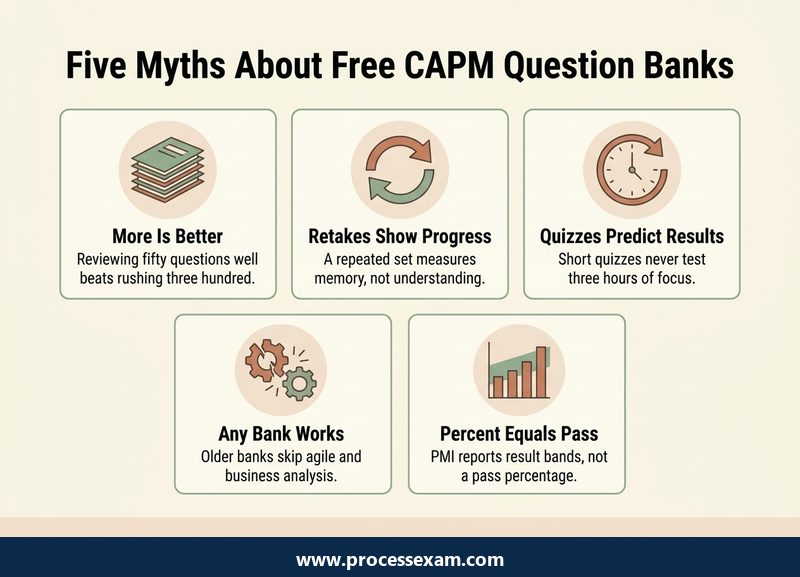
Myth: the more questions you answer, the better
Volume without review teaches very little. A candidate who answers fifty questions and studies every miss improves faster than one who races through three hundred and checks only the score. The review is where learning happens; the answering is just how you find out what to review.
Myth: a retaken set measures progress
If you sit the same free set twice, the second score measures memory. It will rise whether or not your understanding has changed. Progress can only be measured on questions you have not seen before, which is why a small free bank runs out of useful questions faster than it seems.
Myth: a short quiz predicts the full exam
A quiz of ten or twenty questions has no clock pressure worth the name and no fatigue. It cannot tell you whether you will hold your accuracy through three hours, and the opening of this article shows what happens when a candidate assumes it can.
Myth: any CAPM bank still works
PMI rewrote the CAPM exam content outline, and the current version gives substantial weight to business analysis and agile. Many older free banks were written for the earlier exam and are built around knowledge areas and process groups. Their questions may still be correct, but they test a different paper. Check that a bank's questions are spread across the four current domains before trusting its score.
Myth: explanations are optional
A bank that gives only the correct letter tells you that you were wrong, not why. Without an explanation, a candidate often repeats the same reasoning error on the next question of its kind. Prefer banks where each answer explains why the chosen option beats the others.
Myth: a percentage equals a pass
As covered above, PMI reports bands, not a pass percentage. A bank that promises you will pass once you hit a certain score is inventing that threshold. Use its percentages to compare yourself with yourself over time, and nothing more.
What should you do with the review after each practice test?
The hour after a practice test is worth more than the test itself. How you spend it decides whether the next score moves.
Sort every miss by its cause
Instead of a list of wrong answers, keep four columns. Did not know: the concept was missing, so it goes back into study. Misread: you knew the material but answered a different question from the one asked, usually because of a qualifier. Fell for a distractor: you chose an option that is true in general but does not fit the scenario. Ran out of time: you rushed or guessed near the end of a section. Each column has a different cure, and mixing them together hides which cure you need.
Review your correct answers too
Go back over the questions you got right but were unsure about. A lucky right answer is a hidden miss. If you cannot explain why the correct option is correct, treat it as a miss for study purposes, even though the score counted it.
Turn misses into short study tasks
A column full of did not know entries in one domain becomes a study session on that domain before your next test. A column full of misread entries becomes a reading habit: underline the final sentence of each scenario before you look at the options. A full ran out of time column means your next sitting should use pacing checkpoints, described below.
Watch the columns change
Early on, most misses sit in did not know. As preparation goes well, that column shrinks and the others become most of what is left. When the remaining misses are mostly misreads and distractors spread thinly across all four domains, you are close to ready; the remaining gains come from care and pace rather than new content.
How do you turn a practice test into a rehearsal of exam day?
A full-length practice paper only predicts the real one if it feels like the real one. Casual conditions produce casual scores.
Copy the real conditions
Sit the whole paper in one session at the time of day your exam is booked. Put the phone in another room, close every other window, and do not pause the timer for a drink or a message. If you plan to test online with remote proctoring, practise at the same desk with the same clear surface you will need on the day. If you will sit at a test centre, practise somewhere that is not your usual study chair.
Rehearse the mid-exam break properly
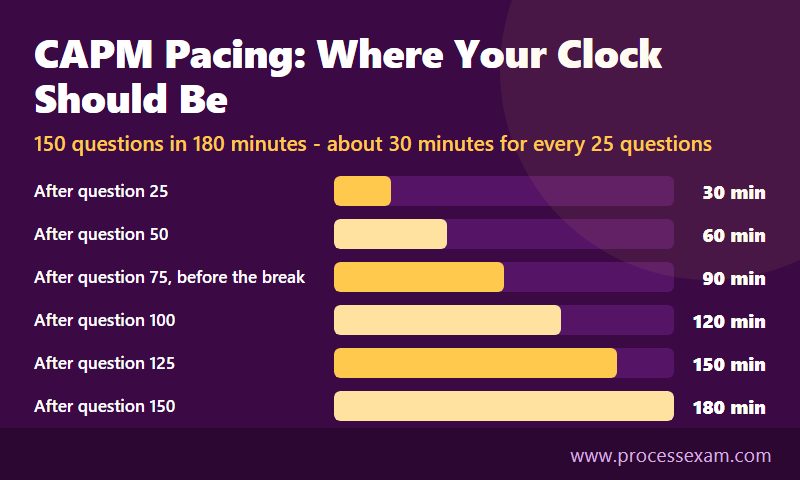
The exam content outline describes a 10-minute break after questions 1 to 75, and it adds a detail many candidates miss: once you have reviewed your answers and start the break, you cannot return to the first section. That makes the break a hard deadline for reviewing your flagged questions from the first half. In practice papers, finish the first 75 questions, review your flags, and only then stop the clock for a short pause. Candidates who save all their reviewing for the end of the exam discover on the day that half of it is locked.
Use pacing checkpoints
A steady pace across 180 minutes and 150 questions puts you at about 30 minutes for each block of twenty-five questions. Write the checkpoints down before you start and glance at them as you pass each one. Being slightly ahead at the halfway point is ideal, because it leaves time to review flagged questions before the break locks the first section.
Flag and move on
When a question takes more than about two minutes, choose your best answer, flag it and move on. Leaving a question blank to return to later risks forgetting it; choosing an answer first means a flagged question never costs you a mark through the clock alone.
Practise the question formats you will see
If your practice material is multiple choice only, spend a little time with drag-and-drop and hot spot items too, so the format does not slow you on the day. The skill being tested is the same, but an unfamiliar interface costs seconds on every item, and seconds add up across a paper of this length.
How many full CAPM practice tests should you sit before booking?
There is no number PMI endorses, and a fixed count is less useful than a condition. Still, most candidates who prepare well sit somewhere between three and five full-length papers, and the pattern of those papers matters more than the count.
A workable sequence
- Baseline: a shorter mixed set in the first week, to map strengths and gaps.
- First full paper: once you have studied every domain at least once, under real timing, to find your weakest domain and your natural pace.
- Second full paper: after a round of domain drills on the weakest areas, on questions you have not seen, to check that the drills worked.
- Third full paper: as a full rehearsal of exam day, including the break and the pacing checkpoints.
- Optional fourth or fifth: only if the third showed a domain still lagging or a timing problem you have since worked on.
The booking test
Book when three things are true together. Your last two or three full papers, all on unseen questions, sit in the same healthy range. No domain is consistently your weak spot. And you finish the paper with time left to review flagged questions, including the first-half flags before the break. If any of the three is missing, book later rather than hoping the real exam will be kinder than your practice.
Why booking too early is expensive
Booking commits you to a fee of USD $225 at the member price or USD $300 at the full price, and PMI limits how many attempts you get within your eligibility period. A result of Below Target in a domain you already knew was weak is the most avoidable way to spend that money. One more week of drilling is almost always cheaper than a re-examination.
Where a paid practice exam fits
Free material is enough to build a baseline and to drill; it rarely has enough unseen, current questions to run three full papers without repeats. That is the point at which a full-length bank earns its place. Our timed CAPM practice exam runs the complete 150 questions against a 180-minute clock and reports the result by domain, so each full sitting in the sequence above can be done on fresh questions.
Signs you are over-practising
Practice tests can become a way to avoid studying. If your scores have flattened for two weeks and the same domain keeps appearing as your weakest, another full paper will not fix it. Stop testing for a few days, return to the material for that domain, then test again. Equally, if your scores have been steady and strong across several unseen papers, more practice is unlikely to add much. Book the exam.
Frequently Asked Questions
Is there a free CAPM practice test from PMI?
PMI publishes a short PDF of free CAPM sample questions that shows the style of real exam items. It is too brief to act as a full practice test, so candidates usually combine it with longer question banks and at least one timed, full-length paper before they book the exam.
How many questions are on the CAPM exam and how long is it?
The CAPM exam has 150 questions and a time limit of 180 minutes, which is a little over one minute per question. PMI's exam content outline also describes a 10-minute break after question 75, after which you cannot go back to the first section.
What practice test score means I am ready for the CAPM?
PMI does not publish a passing percentage, so no practice score maps directly to a pass. A better sign is consistency: several timed papers on unseen questions landing in the same strong range, with no domain that is repeatedly your weakest and enough time left to review flagged questions.
Are free CAPM mock exams accurate?
Some are useful, but many were written for the older exam, use only multiple choice and repeat questions found elsewhere. Check that a mock exam covers all four current domains, gives explanations for every answer and matches the real length and timing before you trust its score.
How many CAPM practice tests should I take before the exam?
Most well-prepared candidates sit three to five full-length practice papers after an early baseline set. The count matters less than the pattern: book once your last two or three papers on unseen questions are steady, no domain lags, and you finish with time to review.
- PMI Project Management Associate Exam Questions |
- PMI Project Management Associate Question Bank |
- PMI Project Management Associate Questions |
- PMI Project Management Associate Study Guide |
- PMI CAPM Quiz |
- CAPM Certification |
- CAPM Questions |
- CAPM Practice Test |
- CAPM Study Guide Material |
- CAPM Sample Exam |
- Project Management Associate Certification |
- PMI Project Management Associate Book |
- Project Management Associate Certification Cost |
- Project Management Associate Certification Requirements |
- PMI Project Management Associate Sample Questions |
- CAPM Exam Questions Download |
- CAPM Test Questions |
- Project Management Associate PDF |
- PMI Certified Associate in Project Management


