
What Is CSSBB? What the ASQ Black Belt Changes at Work
CSSBB stands for Certified Six Sigma Black Belt, the ASQ credential for people who lead improvement projects. Passing it does not hand you a title. It changes what you are trusted with: cross-functional projects that carry a benefit target, Green Belts to coach, and a voice in how improvement work is chosen. It also adds upkeep, because ASQ asks for 18 recertification units every three years. This guide covers what shifts after the exam, and what does not.
Most pages about the CSSBB stop at the exam: how many questions, what it costs, which topics to revise. This one starts where the exam ends. The question it answers is the one a candidate asks quietly the night before booking: if I pass, what will actually be different on Monday morning, and in three years?
The honest answer has three parts. Some things change quickly, because an employer or client can now verify what you can do. Some change only when you push them, because a credential opens a door rather than walking you through it. And some things become obligations you did not have before, chiefly the recertification cycle. The sections below take each in turn, using ASQ's own pages for every figure that comes from the vendor.
What does CSSBB stand for, and what is ASQ actually certifying?
The letters stand for Certified Six Sigma Black Belt. ASQ, the American Society for Quality, awards the credential to people who can lead a Six Sigma project from a vague business problem to a controlled, measured result, and who can also help an organisation decide which problems deserve that treatment. The word that matters is lead. A Green Belt applies the toolkit inside a project someone else scopes. A Black Belt is expected to scope it, staff it, defend it to a sponsor and hand it over so the gain lasts.
That is why ASQ will not let you sit the exam on knowledge alone. The candidate has to show three years of full-time, paid work in the body of knowledge and at least one finished project backed by a signed affidavit. In other words, the credential certifies something you have already done once, and asserts that you can do it again on a bigger stage. That framing helps when you talk to employers later: you are not a person who studied a method, you are a person who has run a project and then passed an external check on the method behind it.
The exam facts we hold, in one place:
| Exam detail | CSSBB |
|---|---|
| Certification | ASQ Certified Six Sigma Black Belt (CSSBB) |
| Exam code | CSSBB |
| Vendor | ASQ |
| Category | Six Sigma |
| Number of questions | 165 |
| Duration (minutes) | Total appointment time - 270 Exam time - 258 |
| Exam fee (USD) | ASQ MEMBERS - $485 NON-MEMBERS - $585 RETAKES - $385 |
| Passing score | 550/750 |
Two details on ASQ's Black Belt page are worth adding to that table. Of the 165 questions, 150 are scored and 15 are unscored trial items, and you cannot tell which is which. And the exam is open book, so the skill being tested is finding and applying the right method quickly, not reciting it. If you want to feel that format before you commit, the free CSSBB sample questions are a low-cost way to try it.
What changes on the day you pass, before anything moves at work?
Less than people expect, and that is worth knowing. A computer-based result appears as soon as you submit the exam. ASQ then confirms it by email within three to five business days and sends a second message explaining how to claim a digital certificate and badge. The badge is the practical change: it is a link you can put on a profile or an email signature, and anyone who clicks it sees the credential as ASQ issued it rather than as you typed it.
The other immediate change is the right to use the letters. From that day you may write CSSBB after your name, and ASQ maintains a certification verification registry that an employer or a client can use to check the claim. That matters more than it sounds. Belt titles are cheap to print, and many organisations run in-house belt programmes whose standards vary from one company to the next. A credential that a recruiter can verify in a minute, and that comes from a body assessed to the ISO 17024 personnel-certification standard, is easier to trust than a certificate of attendance.
What does not change
Your job title, your reporting line and your salary do not move on the day you pass. The credential is evidence you carry, not an instruction to your employer. The candidates who benefit fastest are the ones who tell their sponsor the result the same week and ask a direct question: which project would you give a certified Black Belt that you would not give me today? That question converts a badge into a conversation about scope, which is the only place the real change happens.
How does a Black Belt's scope of work differ from a Green Belt's or an analyst's?
The clearest way to see the difference is to walk down the areas ASQ tests and ask what each one means as a job responsibility. The body of knowledge is not only a study list. It is a description of the decisions a Black Belt is expected to be able to make.
| Area of the body of knowledge | What an analyst or Green Belt usually does | What a Black Belt is expected to do |
|---|---|---|
| Organization-wide planning and deployment | Takes the project that is assigned | Helps decide which problems become projects, and argues for the ones with a real business case |
| Organizational process management and measures | Reports the metrics for one process | Chooses measures that leaders will act on, and links them to strategy |
| Team management | Takes part in the team | Forms it, keeps it working through conflict, and reports to the sponsor |
| Define, Measure, Analyze, Improve, Control | Runs the tools on a defined problem | Owns the whole path, decides when a tollgate is passed, and can defend the statistics to a sceptic |
| Design for Six Sigma (DFSS) | Rarely involved | Applies a design method such as DMADV when the process does not yet exist |
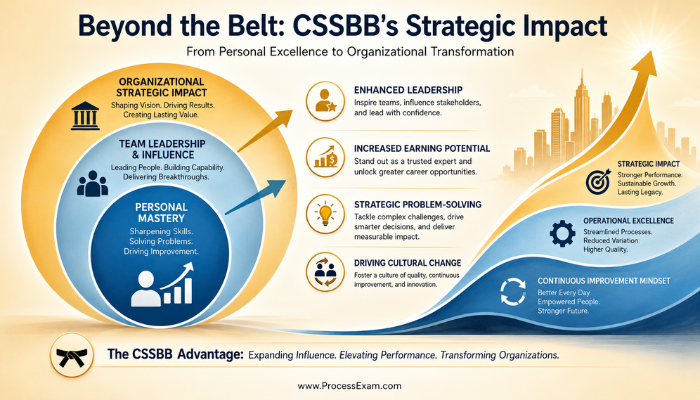
Read down the right-hand column and the pattern is clear. The Black Belt moves earlier in the chain (which problem?), later in the chain (does the gain hold?), and wider across the organisation (who else must agree?). The statistical tools are the same ones a Green Belt learns, used with more autonomy and under closer questioning. The larger change is that you are now expected to persuade people who do not report to you.
A common surprise in the first year
New Black Belts often find that the technical work is the easy part. A capability study or a hypothesis test has a clear answer. Getting a busy department head to release two people for a project, or to accept that the current process is the cause of the defects, has none. The team management and deployment areas of the exam look soft on paper. In practice they decide whether a Black Belt's projects finish, and it is where most first-year frustration sits.
What kind of projects will you lead, and how do you get judged on them?
A Black Belt project is a chartered piece of work with a problem statement, a scope, a team, a timeline and a target that someone has agreed to in advance. The target is normally financial or operational: fewer errors, shorter lead time, lower cost of poor quality, faster response. Judging happens at tollgates, the review points at the end of each phase where a sponsor or steering group decides whether to continue, redirect or stop.
The kinds of problem that suit the method share one feature: the answer is not obvious and the cause is not known. If everyone already knows why invoices go out wrong, you need a fix, not a project. If three departments blame each other and nobody has data, you need a Black Belt.
An illustrative project, start to finish
To see how it works, take an invented example. A distribution company sends about 1,200 invoices a month, and roughly 6 in every 100 need a correction, which is 72 a month. Each correction takes a clerk and a customer-service call.
- Define. The charter states the problem in numbers, names the sponsor, and sets a target: cut corrections from 6 in 100 to 2 in 100.
- Measure. The team checks that people classify an error the same way, then records the cause of every correction for a month.
- Analyze. A Pareto chart shows that most corrections come from three causes, and a hypothesis test confirms that one customer group is far worse than the others.
- Improve. The team pilots a change to how order data is entered for that group and compares the pilot with the old process.
- Control. A control chart on weekly errors, a revised procedure and a named owner keep the gain from fading.
At the target rate the company would send 24 corrected invoices a month instead of 72, so 48 fewer corrections. Whether that is worth doing depends on what each correction costs, and that is a question a Black Belt is expected to answer with the finance team rather than leave to guesswork. The figures here are made up to show the arithmetic, not a benchmark for any real company.
When the process does not exist yet
Not every project improves something old. If a company is launching a service and wants it to run at a low defect rate from day one, there is nothing to measure and nothing to fix. That is the territory of Design for Six Sigma, which the CSSBB body of knowledge covers as its final area, and where a method such as DMADV replaces DMAIC. Being credible in both modes is part of what separates a Black Belt from a Green Belt who has only ever tuned existing processes.
Coaching is part of the job
Black Belts are usually asked to coach Green Belts as well as run their own projects. In practice that means reviewing another person's charter, spotting the weak measurement plan before it wastes six weeks, and knowing when to say that a project is too small or too vague to carry the label. Some organisations count the number of Green Belts a Black Belt has coached to completion as a performance measure alongside their own savings.
How do employers actually use the CSSBB?
Employers use the credential in four ways, and it helps to know which one you are dealing with.
- As a screen. Job adverts for continuous improvement, operational excellence and process improvement roles often name Black Belt certification, either as required or as preferred. For an applicant tracking system and a busy recruiter, the letters are a quick filter.
- As a promotion gate. Some companies run their own belt ladder and treat an external credential as the way to enter it at the Black Belt level, or as proof for a role that formally requires a Black Belt.
- As proof for clients. Consultants and contractors are often asked to show a credential that the client can verify. A registry entry is easier to defend than a slide of past projects, though the project record still does most of the persuading.
- As a common language. When a manager in one plant and an analyst in another both know the same method, a project can move between sites without a week of translation. That effect is hard to measure and easy to underrate.
What employers do not do
Very few employers pay a fixed premium for the letters alone, and you should be careful with any page that quotes a single salary uplift for the CSSBB. Pay depends on industry, country, seniority and the scope you actually hold. ASQ runs its own salary survey and links it from its certification pages, and that is a better starting point than a round number from a blog. What the credential does reliably is shorten the argument: it is easier to ask for a bigger project, or a role with more scope, when an external body has confirmed the method behind your work.
It is also worth being clear about the limits. The CSSBB cannot replace a project record. A hiring manager comparing two Black Belts will ask about the projects, the benefit each delivered, and how long the gain lasted. The letters get you to the interview, and the projects decide it. For a short, neutral overview of where the method came from and how belt levels are usually described, the general Six Sigma article on Wikipedia is a reasonable refresher.
Which career routes open up once you hold it?
The Black Belt sits in the middle of the improvement career ladder, which means it opens routes in more than one direction. The realistic ones are these.
- Continuous improvement or operational excellence lead. The direct path: you run a portfolio of projects and a small group of Green Belts, and report benefits to an executive sponsor.
- Transformation or process-improvement consultant. Inside a consultancy or as an independent, the credential supports a client conversation about method and results.
- Quality manager. Many Black Belts move into broader quality leadership, where deployment planning, measures and team management from the body of knowledge carry over directly.
- Master Black Belt. For those who want to coach at organisation level, ASQ offers the Master Black Belt credential, which starts with a portfolio review of your Black Belt work rather than a plain exam application.
- Functional leadership. Operations, supply chain, healthcare and finance leaders increasingly use a Black Belt background to run their own departments with data instead of opinion.
None of these is automatic, and none requires you to leave your current employer. The Black Belt is a licence to take on more, and the route you follow depends on which of those things your organisation needs.
A first-year plan that makes the credential count
The months after passing decide how much the credential is worth. A sensible sequence looks like this.
- Week one. Claim the digital badge, add the credential to your profile, and tell your sponsor and manager the result.
- First month. Ask for a scoped conversation about your next project. Bring a short list of two or three candidate problems with the data you already have on each.
- First quarter. Start one chartered project with a target agreed in writing, and offer to coach one Green Belt through theirs.
- First year. Finish the project, record the result with the finance team's sign-off, and keep the paperwork. It becomes the evidence for your next role, your next conversation with a client, and possibly your Master Black Belt portfolio.
- All the time. Log every learning event, conference day and mentoring hour as you go. The next section explains why.
How do the 18 recertification units add up over three years?
This is the part candidates rarely price in. The Black Belt is not a lifetime credential. ASQ asks you to recertify every three years, either by earning recertification units and submitting them, or by retaking the exam. The units are the everyday route, and the numbers are more forgiving than they first look because your ordinary work counts.
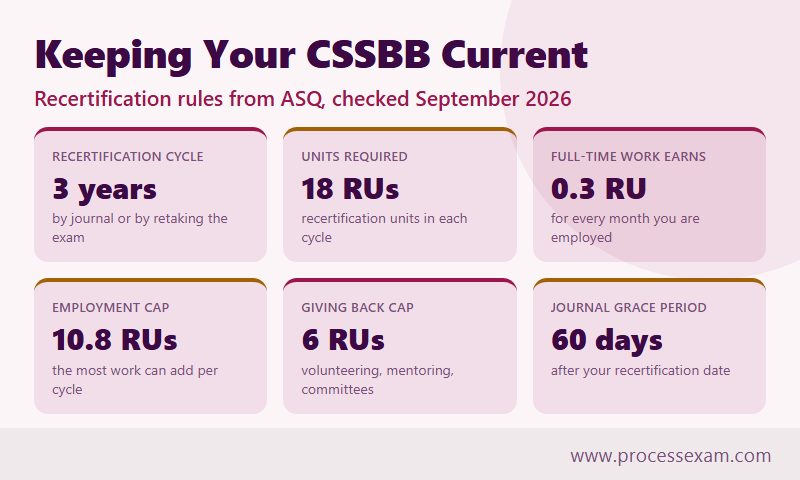
ASQ's recertification page sets the requirement at 18 recertification units, or RUs, in each three-year period. It groups the ways of earning them into three categories:
- Professional development, with no cap. Learning hours earn 0.1 RU each, conference days and workshop days earn 1.0 RU each, and publishing or presenting earns more.
- Employment, capped at 10.8 RUs. Full-time work earns 0.3 RU per month, which is 3.6 RUs a year.
- Giving back, capped at 6 RUs. Volunteering, professional membership, mentoring and committee service all count within their own limits.
Working through the arithmetic
Suppose you work full time for the whole three years. Employment alone gives you 36 months at 0.3 RU, which is 10.8 RUs, the maximum in that category. You need 7.2 more. Forty hours of training or webinars adds 4.0. Three conference days add 3.0. Fifteen hours of mentoring a Green Belt adds 1.5. That makes 19.3 RUs against a requirement of 18, and you have not published anything or joined a committee.
The lesson is that most working Black Belts qualify without extra effort, provided they keep records. The trap is the last month of the cycle, when people try to reconstruct evidence they never saved. Log each item when it happens.
Cost, deadlines and the exam route
ASQ's fee for filing a recertification journal is $120 if you are a member and $160 if you are not. ASQ sets two recertification due dates a year, 30 June and 31 December, and your cycle attaches to one of them according to the month in which you passed. You can submit up to six months before your date, and ASQ allows a 60-day grace period after it. Miss the grace period and the journal route closes, leaving recertification by exam at $485 for members and $585 for non-members. Check the ASQ page for current fees, because ASQ says prices can change without notice.
If you hold more than one ASQ credential that needs recertifying, ASQ lets you synchronise them so that a single journal, backed by the 18 units, renews them together. For a Black Belt who later adds a second credential, that is the cheapest and simplest way to stay current.
Is the CSSBB worth doing now, and how should you prepare so it pays off?
It is worth doing if your work already resembles the right-hand column of the scope table above, or if the next role you want does. It is a poor investment if nobody around you will ever ask you to lead a project, because the credential proves capability rather than creating the opportunity. A quick test: can you name a project you have led, a sponsor who would sign for it, and a result you could describe in one sentence with a number? If yes, the affidavit is nearly done and the exam is the smaller hurdle.
Preparing so the exam does not waste your time
Because the exam is open book, preparation is mostly about speed and navigation. The 258 minutes of exam time work out at roughly a minute and a half per question, which is generous for a definition and tight for a calculation with a table lookup. Practise with the references you will take in, tab them so you can find a formula in seconds, and learn which topics you can answer from memory and which need the book.
Spread your revision across all the areas rather than the ones you like. Candidates who have run many projects tend to be strong on the improvement phases and weaker on deployment, team management and design methods, precisely because their jobs have not required them. A full-length timed run on the CSSBB practice exam shows quickly where the gaps are, and it lets you rehearse the pacing before you sit in a Prometric test centre.
Plan the calendar
ASQ delivers the exam through Prometric in testing windows that recur every two months, and each has an application deadline roughly three weeks before it opens. Because the eligibility review and the affidavit take time, start the application well before the deadline of the window you want. Check the current dates and the application steps on ASQ's site before you commit to a date.
Finally, decide what you will do with the result before you take the exam. Passing is a moment, and the value of the CSSBB comes from what you use it for in the following three years: the projects you lead, the people you coach and the evidence you keep.
Frequently Asked Questions
What does CSSBB stand for?
CSSBB stands for Certified Six Sigma Black Belt, the ASQ credential for professionals who lead Six Sigma improvement projects. It certifies that the holder can scope, staff and deliver a DMAIC project, apply Design for Six Sigma, and coach team members through the method.
How many questions are on the CSSBB exam?
The CSSBB exam has 165 questions, of which 150 are scored and 15 are unscored. The total appointment time is 270 minutes and the exam time is 258 minutes. The exam is open book, and you need a score of 550 out of 750 to pass.
How much does the ASQ CSSBB exam cost?
The CSSBB exam costs USD $485 for ASQ members and USD $585 for non-members. A retake costs USD $385. ASQ can change its fees without notice, so confirm the current price on ASQ's Black Belt certification page before you submit your application.
Does the CSSBB expire?
Yes. ASQ requires Black Belts to recertify every three years, either by earning 18 recertification units and submitting a journal, or by retaking the exam. ASQ allows a 60-day grace period for the journal route. After that, recertification is by exam.
Will the CSSBB raise my salary?
There is no fixed uplift. Pay depends on industry, country, seniority and the scope of work you hold. The credential helps most by supporting a case for larger projects and leadership roles. ASQ publishes its own salary survey, which is a better guide than a single quoted figure.
- Six Sigma |
- ASQ Six Sigma Black Belt Sample Questions |
- ASQ Six Sigma Black Belt Test Questions |
- CSSBB Question Bank |
- CSSBB Exam Questions Download |
- CSSBB Test Questions |
- Six Sigma Black Belt PDF |
- ASQ Six Sigma Black Belt Book |
- ASQ CSSBB BOK PDF |
- Six Sigma Black Belt Certification Cost |
- Six Sigma Black Belt Certification Requirements |
- CSSBB Body of Knowledge (BOK) |
- CSSBB Handbook


