
SSM Certification: How a SAFe Scrum Master Works Beyond the Team
Updated on 22 September 2026. What’s new: rewritten for the AI-Empowered SSM exam, with its current domains, pass mark, included attempts and retake terms.
Maya's team met every sprint goal for ten weeks straight. Their velocity was steady, their retrospectives were honest, and their board was green. Then the Inspect and Adapt event showed the train's main PI objective had slipped, because the one story another team was waiting on sat in her team's backlog, unplanned. The SSM certification exists for that gap. It tests whether a Scrum Master can serve a team and the whole Agile Release Train at once.
Scaled Agile's current version is the AI-Empowered SAFe Scrum Master. Its exam asks 45 questions in 90 minutes and needs 80% to pass, and two of its six domains are built around train events that a Scrum Master on a standalone team never attends: PI Planning, the IP iteration and Inspect and Adapt. This guide follows Maya's problem through each of those areas, then covers the exam itself, how attempts and retakes work, a study plan and where the credential fits in a career.
How can a team hit every iteration goal while the train misses its PI objective?
Maya did nothing wrong by the standards of a single Scrum team. She protected the team's focus, kept the daily sync short, turned impediments around within a day and made sure every iteration ended with working software the Product Owner accepted. On a team that owns its product from end to end, that is the job done well.
An Agile Release Train changes the arithmetic. Five, eight or a dozen teams plan together, deliver on one cadence and share a set of objectives that business owners care about far more than any single team's velocity. A feature often needs work from three teams before a customer sees anything. When one of them treats its own iteration goal as the finish line, the feature stalls, and nobody on that team feels the pain until the system demo shows a hole.
Where the slip actually happened
Trace Maya's ten weeks backwards and the failure has a clear shape. During PI Planning, the platform team placed a dependency on the ART planning board: they needed an interface change from Maya's team by the third iteration. Maya's team agreed, but the item never became a story with an owner. Their own backlog was full of work the Product Owner had ranked higher. Every iteration the team chose the stories that served its own goal, and every iteration the dependency waited.
Nobody hid anything. The item simply belonged to no one's iteration goal. A team-level Scrum Master measures success by what the team finishes. A Scrum Master on a train has to ask a second question at every planning session: what did this team promise to the rest of the train, and is it in the plan?
Iteration goals and PI objectives measure different things
Iteration goals describe what one team intends to finish in one iteration. PI objectives, in Scaled Agile's words, summarise the business and technical goals that teams and trains intend to achieve in the upcoming PI, and they come in two kinds, committed and uncommitted. Business owners score them, and those scores feed the ART's predictability measure. A team can reach every one of its iteration goals and still score poorly on its PI objectives, because the objectives reward delivered business value and the goals reward completed work.
The SSM exam leans on exactly this distinction. Expect scenarios where a team is performing well by its own numbers and the right answer is to look outward: raise the dependency at the coach sync, revisit the team's committed objectives with the Product Owner, or make the risk visible to the Release Train Engineer before it turns into a missed objective.
What does a SAFe Scrum Master do that a team-level Scrum Master does not?
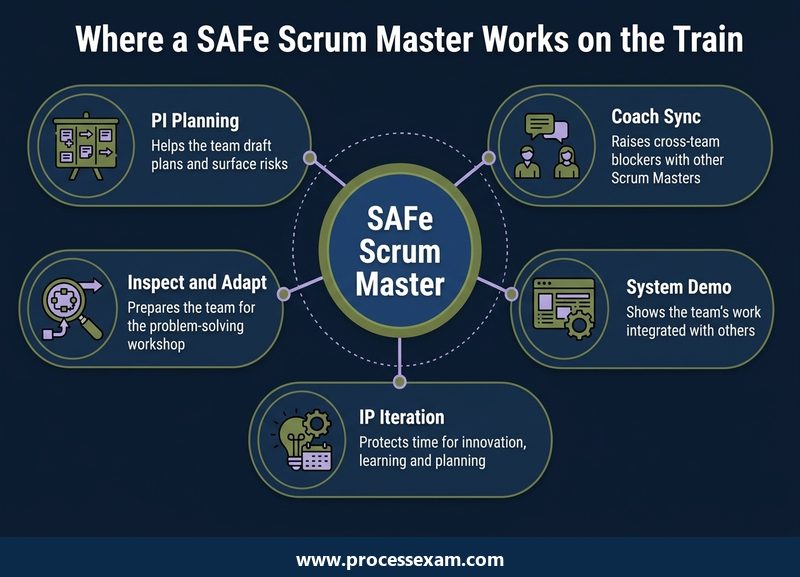
Scaled Agile describes the Scrum Master/Team Coach as someone who facilitates team events and processes, helps the team take part in ART events, and works with the other Scrum Masters and the RTE to improve how the train performs. The first half of that sentence would fit any Scrum Master. The second half is what the SAFe version adds, and it shows up in five places across a Planning Interval.
Before and during PI Planning
PI Planning is a two-day event for the whole train, led by the RTE. A team-level Scrum Master has nothing like it; sprint planning covers a couple of weeks and one backlog. In SAFe, the Scrum Master helps the team arrive ready, with its capacity for each iteration worked out and the features it is likely to pull understood in advance. During the breakouts the Scrum Master keeps the team drafting a realistic plan, pushes it to talk to other teams about dependencies as soon as they appear, and makes sure risks are written down rather than mentioned in passing.
Risks raised on the first day are sorted on the second using the ROAM categories: resolved, owned, accepted or mitigated. A Scrum Master who lets a risk leave the room without one of those labels has left a gap like the one that caught Maya. The exam domain for this area names the tasks directly: describe the steps of PI Planning, draft PI plans, assess draft plans for risks and understand why committing to PI objectives matters.
Between iterations, at the coach sync
Once the PI starts, Scrum Masters on the same train meet regularly with the RTE to check progress towards the objectives and to clear impediments that one team cannot remove alone. This is where Maya's missing story should have surfaced by the second iteration. The meeting only works if Scrum Masters bring cross-team problems to it, not a recital of their own team's burndown.
At the system demo
A single Scrum team demonstrates its own increment. On a train, the system demo shows the integrated work of all teams, and a feature that three teams built only counts if the pieces run together. The Scrum Master's contribution is making sure the team integrates continuously during the iteration, so the demo reflects working software instead of three disconnected pieces.
In the IP iteration
The Innovation and Planning iteration closes each PI. It gives teams room for innovation, learning, infrastructure work and preparation for the next PI Planning, and it acts as an estimating buffer. Under pressure, teams are tempted to fill it with leftover feature work. Coaching the team to use the IP iteration for its purpose, and not as spare capacity, is one of the tasks the SSM exam lists by name.
At Inspect and Adapt
Inspect and Adapt is an ART event in three parts: the PI system demo, a quantitative and qualitative measurement review, and a retrospective followed by a problem-solving workshop. The workshop is where Maya's train would look at its missed objective and find the root cause. The Scrum Master prepares the team to take part honestly and helps facilitate the workshop's six steps, from agreeing on the problem statement through root-cause analysis to improvement backlog items that go into the next PI Planning.
Put side by side, the two roles look like this:
| Situation | Scrum Master on a standalone team | SAFe Scrum Master on an ART |
|---|---|---|
| Planning horizon | One sprint at a time | A whole PI, planned with every team on the train |
| Success measure | Sprint goal met | Team PI objectives delivered and the train's objectives supported |
| Dependencies | Rare; the team owns its product | Common; tracked on the ART planning board and raised at the coach sync |
| Demo | The team's own increment | Integrated work of all teams at the system demo |
| Improvement | Team retrospective | Team retrospective plus the train's problem-solving workshop |
| Main working partner | Product Owner and team | Product Owner, team, other Scrum Masters and the RTE |
What does the AI-Empowered SSM exam look like in 2026?
These figures come from Scaled Agile's exam details page for the AI-Empowered SAFe Scrum Master, dated 11 August 2026, and from its certification page. We checked both in September 2026.
| Exam detail | SAFe Scrum Master |
|---|---|
| Certification | Certified SAFe Scrum Master (SSM) |
| Exam code | SSM |
| Vendor | SAFe (Scaled Agile, Inc.) |
| Current release | AI-Empowered SAFe Scrum Master |
| Number of questions | 45 |
| Duration | 90 minutes |
| Passing score | 80% |
| Question type | Multiple choice, one answer per question |
| Delivery | Online through your Learning Plan; closed book, taken alone |
| Attempts included | The first two, when taken within 60 days of course completion or exam purchase |
| Retake fee | $50 unproctored, $450 proctored |
| Maintenance | 24 CEUs in each two-year certification cycle |
Ninety minutes for 45 questions leaves exactly two minutes a question, which is comfortable for a reader who knows the material and tight for one who rereads every scenario three times. The pass mark is the harder part. At 80% you need 36 correct answers, so nine misses is the most you can afford. Every question counts the same, a blank counts as wrong, and the exam submits itself when the timer runs out, so guessing is always better than leaving a gap.
Why some guides still show a lower pass mark and four domains
Scaled Agile keeps an older SSM study guide online for learners who attended the earlier course. That guide shows the same 45 questions and 90 minutes but a lower pass mark and four domains. If you took the course before the AI-Empowered release, check which exam your Learning Plan actually opens and prepare for that one. For anyone attending the course now, the exam details page linked above is the one that applies, and every figure in this article follows it.
What the questions feel like
Very few items ask for a definition. Most describe a team in a situation and offer four actions that all sound sensible. One will solve the team's problem locally, one will escalate too early, one will skip a SAFe practice, and one will deal with the team and the train together. That last one is usually right. Reading the question for its train-level consequence, as Maya learned the hard way, is the single most useful habit you can build before exam day.
Which six domains does the SSM exam cover, and where does the train show up?
Scaled Agile publishes a weighting range for each domain. Converted to questions on a 45-item paper, the ranges translate into the approximate counts below. The two domains named after ART events, Participating in PI Planning and Finishing the PI, together make up 28-32% of the exam, which is roughly 13 or 14 questions about work a standalone Scrum team never sees.
Introducing Scrum in SAFe (10-12%)
About five questions on basic agile development concepts, Scrum's concepts and values, and how an agile team is set up in SAFe. Candidates with Scrum experience rarely lose marks here, but watch the vocabulary: SAFe says iteration rather than sprint, team sync rather than daily scrum, and it treats the team as part of a train from the first lesson.
Characterizing the role of the Scrum Master (21-23%)
Around ten questions on defining the role, facilitating team events, collaboration and conflict resolution techniques, and the characteristics of high-performing teams. Scenario items often describe a disagreement inside the team or a pushy stakeholder. The best answer usually helps the team resolve the problem itself rather than having the Scrum Master decide.
Participating in PI Planning (14-16%)
About seven questions on the steps of PI Planning, drafting PI plans, assessing draft plans for risks and why commitment to PI objectives matters. This is where Maya's missing dependency would appear as a question: a team has a full backlog and a request from another team, and you choose what the Scrum Master should do before the plan is finalised.
Facilitating the Iteration Execution (21-23%)
Around ten questions on iteration planning, the team sync, tracking progress, backlog refinement and the iteration review, plus the CALMR approach to DevOps and Release on Demand. CALMR stands for culture, automation, lean flow, measurement and recovery. The trap in this domain is treating iteration execution as purely internal; SAFe expects the team to integrate with others continuously, not at the end of the PI.
Finishing the PI (14-16%)
About seven questions on coaching the IP iteration, the six steps of the problem-solving workshop and getting the team ready for Inspect and Adapt. Learn the workshop's steps in order and know what each one produces, because questions often give you the output of one step and ask what comes next.
Augmenting the Scrum Master Role with AI (12-14%)
Roughly six questions on AI basics and terminology, prompting, the risks of AI and its responsible use, and using AI to support the Scrum Master's work. The certification page gives examples such as facilitation, retrospectives, coaching conversations, metrics analysis and stakeholder communication, always with a person reviewing what the tool produces. Answers that hand a decision entirely to an AI tool, or that paste sensitive team data into one without thought, tend to be wrong.
Our free SAFe Scrum Master sample questions are a quick way to see how these domains turn into scenario items before you commit to a full study plan.
How do the course, the two included attempts and the retakes work?
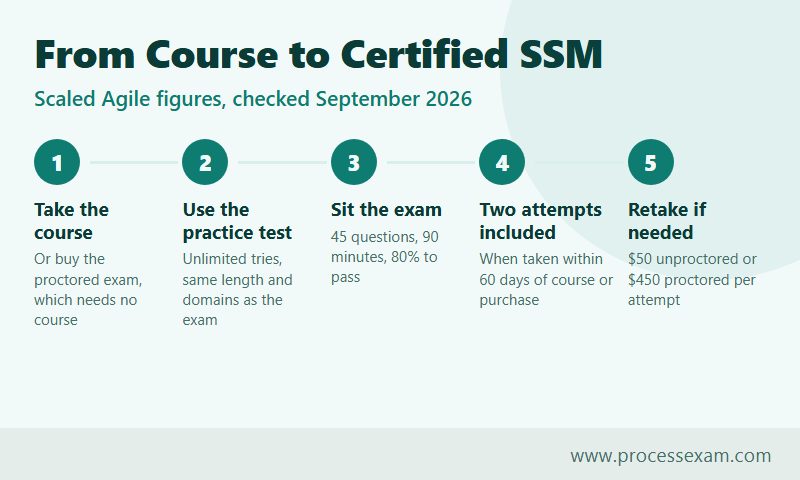
Most candidates reach the exam through the AI-Empowered SAFe Scrum Master course, taught by a certified SAFe Practice Consultant through one of Scaled Agile's training partners, online or in a classroom. The course fee covers the exam, and the exam and a practice test appear in your Learning Plan once the class ends. Scaled Agile's certification page also offers a proctored exam you can buy without taking the course, which suits experienced SAFe practitioners who want the credential without a classroom.
Attempts, retakes and waiting periods
Your first two attempts are included when you take them within 60 days of finishing the course or buying the exam. After that, each attempt is paid: $50 for the unproctored exam, $450 for the proctored one. Retakes also follow a waiting schedule:
- The third attempt is available straight after a second failure.
- The fourth attempt opens 10 days after the third.
- The fifth opens 30 days after the fourth.
- Every attempt after that needs another 30-day wait.
Two free attempts can make a first sitting feel low-stakes. Treat it as the real thing anyway. A failed first try tells you which domains are weak, but a failed second one moves you onto paid attempts and, from the fourth onward, onto a calendar that can stretch preparation well past the point where the course is fresh.
Keeping the certification
According to Scaled Agile's SAFe Scrum Master certification page, you maintain the credential by earning at least 24 continuing education units in each two-year cycle, which works out at 12 a year. Certified professionals also receive a digital badge and can claim PMI PDUs and Scrum CEUs for the training, which is useful if you hold a PMI credential or another Scrum certification that needs its own renewal hours.
The optional prep course
For learners who are unsure after the practice test, Scaled Agile offers an optional three-hour, on-demand exam prep course that revisits the main topics. It is not required. Most candidates who work through the course material and the practice test carefully will not need it, but it is a reasonable choice if your practice scores sit just below the pass mark.
What study plan gets a working Scrum Master ready for the train-level questions?
If you already work as a Scrum Master, the team-level domains will feel familiar and the risk sits elsewhere: in the ART events you may never have attended and in the AI domain, which is new to everyone. A three-week plan inside the 60-day window works for most people with a full-time job.
Week one: map the PI from the course, not from habit
Within a few days of the class, rebuild one full Planning Interval on a single sheet: PI Planning, the iterations with their team syncs and coach syncs, the system demos, the IP iteration and Inspect and Adapt. Next to each event, write one line on what the Scrum Master does there that a standalone Scrum Master would not. If you cannot write that line, reread the lesson. This sheet becomes your answer key for scenario questions.
Week two: take the practice test and read the feedback
You can repeat Scaled Agile's practice test as often as you like, and it is built to match the live exam in length, difficulty, time limit and domain coverage. Take it once cold, then spend more time on the question-level feedback than on the score. For every miss, note whether you chose a team-only answer to a train-level problem. Candidates who come from standalone Scrum teams usually find that pattern behind most of their errors.
Week three: timed runs and the AI domain
Run full 90-minute sessions and aim to finish with ten minutes to spare. When you want scenarios the practice test has not already shown you, the SSM mock exam on ProcessExam serves a fresh 45-question set on each attempt. Give the AI domain a dedicated evening: know the basic terms, the principles of a good prompt, the main risks and the idea that a person always checks AI output before acting on it.
Five habits that lose marks on the day
- Answering as a standalone Scrum Master. If an option protects the team's goal at the train's expense, it is probably the trap.
- Letting the Scrum Master decide. SAFe's Scrum Master facilitates and coaches. Options where the Scrum Master assigns work or overrules the Product Owner are rarely correct.
- Escalating everything to the RTE. The RTE helps with problems teams cannot solve together. Going there first skips the coach sync and the teams themselves.
- Filling the IP iteration with features. Answers that use it as spare delivery capacity miss what it is for.
- Using Scrum Guide terms without translating. Iteration, team sync and PI objectives have specific meanings in SAFe. Read the options in SAFe's language.
Who gets real value from the SSM, and who should pick a different credential?
The SSM pays off most for Scrum Masters and team coaches who already work on a train, or are about to join one. For them the course and exam give a shared vocabulary with the RTE, the Product Owners and the other Scrum Masters, and a clear picture of how the team's work connects to the train's objectives. Hiring managers at SAFe organisations often list it for Scrum Master roles because it signals that the candidate understands PI Planning and ART events, not only team-level Scrum.
Scaled Agile also pitches the certification at people outside the Scrum Master role: project managers moving into agile facilitation, engineers who want to understand the mechanics of the train, and people in support or HR roles who work closely with agile teams. For them the credential is a way into the train's language rather than a job title.
When another route makes more sense
If your organisation does not use SAFe and has no plans to, a general Scrum certification will serve you better, because the SSM spends much of its time on events you will not attend. If you already hold the SSM and run a team comfortably, the next step is usually the SAFe Advanced Scrum Master, which goes further into facilitation across teams and coaching at scale. And if the part of Maya's story that interests you most is the train itself, the Release Train Engineer path is where that work lives.
What the certificate cannot do for you
No exam turns anyone into the Scrum Master Maya became after that Inspect and Adapt. The credential shows you know how the train is meant to work. The value comes when you start asking, at every iteration planning, what your team owes the rest of the train and whether it is on the board. Prepare for the SSM with that question in mind and the exam's scenarios will read like meetings you have already sat through.
Frequently Asked Questions
What is the SSM certification in Agile?
SSM is the Certified SAFe Scrum Master credential from Scaled Agile. It covers the Scrum Master or team coach role inside the Scaled Agile Framework, including team events, PI Planning, the IP iteration, Inspect and Adapt and responsible AI use, so it goes beyond running Scrum for a single team on its own.
How many questions does the SSM exam have, and what score do you need?
The AI-Empowered SAFe Scrum Master exam from Scaled Agile has 45 multiple-choice questions to answer in 90 minutes, and you need 80% to pass, which is 36 correct answers. Some older guides quote a lower pass mark; that applied to the earlier course, so check the exam in your Learning Plan.
Can I take the SAFe Scrum Master exam without attending the course?
Yes. Scaled Agile's certification page offers a proctored SAFe Scrum Master exam that you can buy without taking the course. Most candidates still attend the course, because it includes the exam, the practice test and the course material, and the first two attempts are covered when taken within 60 days.
How much does it cost to retake the SSM exam?
The first two attempts are included in the course or exam fee when taken within 60 days. After that each attempt costs $50 for the unproctored exam or $450 for the proctored exam. The third attempt is available at once, the fourth after 10 days, and later attempts after 30 days each.
How do I keep my SAFe Scrum Master certification active?
Scaled Agile asks certified SAFe Scrum Masters to earn at least 24 continuing education units in each two-year certification cycle, about 12 a year. Keeping the credential current also keeps your digital badge valid, and the training can count as PMI PDUs and Scrum CEUs for other certifications you hold.


