
SPHRi Certification: Eligibility, Cost and How to Pass
Updated on 21 September 2026. What’s new: passing score corrected to HRCI's scaled 500 on a 100-700 scale, replacing the percentage the old article gave.
SPHRi is the senior HR credential for people whose work sits outside the United States, or spans several countries at once. It certifies strategy, policy and people-management judgement without testing US employment law, which is exactly what separates it from SPHR. The exam has 140 questions, runs for 165 Minutes plus 30 minutes administration time, and costs an Exam Fee of $495 plus an Application Fee of $100.

That one difference matters more than most candidates expect. An HR director in Dubai, Nairobi, Singapore or Warsaw who studies for SPHR spends weeks on FLSA, FMLA, Title VII and the NLRA, and then answers questions about a legal system that will never appear in their working life. SPHRi removes that layer and replaces it with what senior HR leaders actually do anywhere in the world: set HR strategy, build workforce plans, design total rewards, manage talent and govern people data.
This guide covers who should choose SPHRi over its US sibling, whether you qualify to apply, what the exam looks like on the day, what HRCI's current exam content outline asks of you, and how to build a preparation plan that fits around a full-time senior role.
Who sits SPHRi rather than SPHR, and why does the distinction matter?
HRCI runs two parallel families of credentials. The domestic family - PHR and SPHR - is written around US employment law and US practice. The international family - PHRi and SPHRi - covers the same profession without tying it to any one country's statute book. Both are administered by the same body, both are earned by examination, and neither is a junior version of the other.
The practical test is simple. Ask yourself whether your decisions are governed mainly by US federal and state employment law. If they are, the SPHR credential is the right target. If your work is governed by local labour law in one or more other countries, or by a mixture of jurisdictions across a region, SPHRi is the one that reflects what you do.
The four candidates SPHRi fits best
- Senior HR leaders based outside the United States. An HR manager or director in the Gulf, Africa, Asia-Pacific or Europe whose employer has no US operations gains nothing from studying US statute.
- Regional HR leads covering several countries. SPHRi's framing - apply and evaluate local labour laws against the strategy - is written for people who must work across different legal environments rather than inside one.
- HR professionals in multinationals outside US headquarters. Country and cluster HR heads who implement global frameworks locally need strategic vocabulary that travels, not one nation's compliance detail.
- Experienced practitioners moving from operational to strategic work. SPHRi tests the leadership end of the profession, so it suits someone stepping up from delivery into function ownership.
Where SPHRi sits against PHRi and GPHR
PHRi certifies operational and technical HR work - the person who runs the processes. SPHRi certifies strategic and policy-making work - the person who decides what the processes should be. GPHR is different again: it is built around cross-border HR operations such as global mobility, expatriate management and multi-country programme design. If your job is leading an HR function in an international setting, SPHRi is usually the closer fit; if your job is running global mobility across many jurisdictions, look at GPHR.
One thing worth saying plainly, because candidates ask it constantly: SPHRi is not a discount version of SPHR. It is set at the same senior level, it uses the same scoring standard, and it costs the same. The content differs, not the difficulty.
Do you meet HRCI's eligibility requirements for SPHRi?
SPHRi has an experience gate, and it is checked before you are allowed to book. HRCI's official SPHRi certification page sets out three routes, and you need to satisfy only one of them:
- At least four years of experience in a professional-level HR role, plus a master's degree or global equivalent;
- At least five years of experience in a professional-level HR role, plus a bachelor's degree or global equivalent;
- At least seven years of experience in a professional-level HR role, with no degree requirement.
The phrase doing the work in all three routes is "professional-level HR role". Administrative and coordinator time generally does not count. HRCI is looking for work where you exercised judgement - designing or owning a process, advising the business, deciding policy - rather than executing someone else's instructions. If your career includes a long administrative period followed by a shorter professional period, count only the second part.
"Global equivalent" is there because degree structures differ by country. A three-year bachelor's degree awarded outside the United States is normally treated on its merits rather than being rejected for having the wrong shape, but if your qualification is unusual it is worth resolving that question with HRCI before you pay anything.
What the application actually involves
You apply online, HRCI reviews the application, and you receive one of three answers: approved, more information needed, or selected for a random audit. An audit is not an accusation - applications are picked at random - but it does mean producing evidence for the experience you claimed, so keep dates, job titles and reporting lines accurate rather than generous.
Once you are approved, the clock starts. HRCI gives you an exam eligibility period of 180 days in which to schedule and sit the exam. Miss it and you reapply and pay again. That window is the single strongest argument for doing your honest self-assessment before you submit the application rather than after.
What does the SPHRi exam look like on the day?
The figures below come from our exam summary for this credential and should be the numbers you plan against.
| Exam detail | SPHRi |
|---|---|
| Exam name | HRCI Senior Professional in Human Resources - International |
| Exam code | SPHRi |
| Vendor | HRCI |
| Number of questions | 140 |
| Exam duration | 165 Minutes plus 30 minutes administration time |
| Exam fee | Exam Fee: $495 |
| Application fee | Application Fee: $100 |
| Passing score | 500 (on a scale of 100-700) |
Two details inside those numbers change how you should prepare.
Not every question counts. HRCI states that its exams mix scored questions with pre-test questions, that pre-test items are scattered through the exam and are not distinguishable from the rest, and that they are not counted in the final result. For SPHRi that means 115 of the 140 questions are scored and 25 are being trialled for future exams. You cannot tell which is which, so the only sane strategy is to answer all 140 with the same care.
Your result is a scaled score, not a percentage. HRCI sets the cut score using the modified Angoff method and then converts raw performance onto a common scale so that a slightly harder version of the exam is not a harder pass. The passing score is 500 on a scale of 100-700, and it stays at 500 whichever version you sit. This is why comparing your practice-test percentage directly against "the pass mark" is misleading - what a practice test gives you is a map of weak areas, not a prediction of a scaled score.
Beyond that, the format is what senior HR professionals expect: mostly multiple-choice items, delivered year-round through Pearson VUE, either in a test centre or as a virtual online proctored exam from your own room. Online delivery has its own equipment and environment rules, so check them before you choose it rather than on the morning.
What does HRCI's SPHRi exam content outline actually cover?
The exam is built from the SPHRi Exam Content Outline, which HRCI develops through a practice analysis of the profession and re-issues periodically. The version in force today took effect in 2024, and as of September 2026 it is still the current one published on HRCI's site. It divides the credential into five functional areas with fixed weightings.
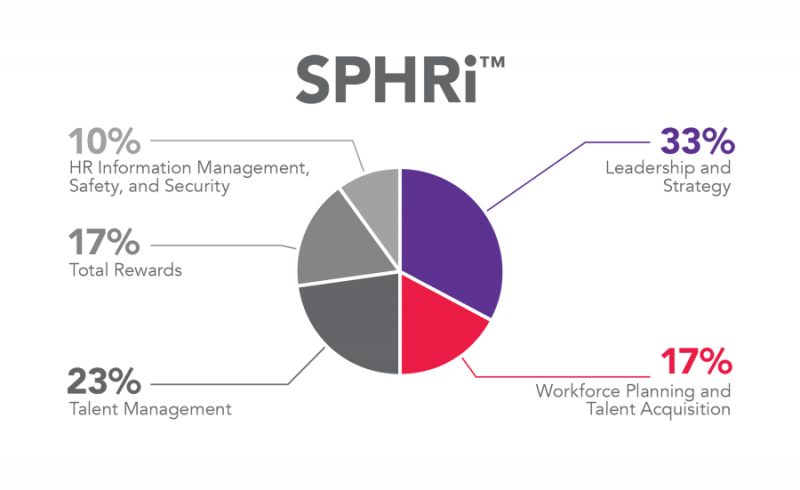
Those weightings decide how your study hours should be distributed. Leadership and Strategy alone is a third of the exam; the smallest area is a tenth. If you want the responsibility statements in full, HRCI publishes the complete SPHRi exam content outline as a free download, and our topic-by-topic breakdown of the same five areas sets the same material out as a study checklist.
Leadership and Strategy - 33 percent
This is the heart of the credential and the area candidates most often underestimate. It covers contributing to organisational strategy and planning, developing and leading HR strategies aligned to that plan, and analysing internal and external factors to choose a risk management strategy - including human capital risk, business continuity, geopolitical scanning and mental health. It also covers interpreting business metrics such as KPIs, financial statements and budgets; using credible information such as salary data and published surveys to make recommendations; and shaping culture through workplace practices tied to vision, values, sustainability, corporate social responsibility, ethics and anti-corruption.
Two further threads run through this area and reappear elsewhere: designing and evaluating diversity, equity and inclusion strategies, and identifying HR metrics - predictive analytics, turnover, cost per hire, return on investment, pay equity analysis - that inform strategic action. Change strategy, stakeholder influence, alignment of HR strategy across sites and business units, and applying local labour law to complex HR strategy complete it.
Workforce Planning and Talent Acquisition - 17 percent
A compact area with three responsibilities and a lot of depth behind each. You forecast organisational needs across business cycles to build or revise workforce plans, including through restructuring, divestitures, expansion and reduction. You develop, monitor and assess recruitment strategies using labour market analysis, salary expectations, selection processes, sourcing, employee value proposition and employer branding. And you design and evaluate onboarding and cultural integration, which HRCI deliberately extends to mergers, acquisitions, joint ventures and global expansion rather than treating it as a first-week induction exercise.
Talent Management - 23 percent
The second largest area, and the broadest in scope. It spans evaluating how DEI is integrated into workplace culture; designing and evaluating workforce development programmes and knowledge management; succession planning for key roles to protect business continuity; engagement, satisfaction and retention strategies including mentoring, sponsorship and flexible working; aligning team and individual goals to organisational measures of success; performance management design and evaluation; leadership development; and career and growth opportunities.
It also includes three areas that candidates frequently skip and then meet in the exam: policies for employees returning to the organisation after parental leave, an international assignment, a sabbatical or a layoff; labour strategy including collective bargaining, grievance programmes and union relationships; and offboarding strategy such as exit interviews, layoff approach and alumni programmes.
Total Rewards - 17 percent
Four responsibilities, all strategic rather than administrative. You design a total rewards philosophy and communication strategy that balances organisational and individual needs across hourly, salaried, expatriate, foreign national, executive, board and contractor populations. You create and evaluate compensation strategy - classification, direct and indirect pay, incentives, bonuses, equity, executive compensation. You do the same for benefits across health, welfare, retirement, work-life balance and wellness. And you design recognition programmes, monetary and non-monetary.
The consistent trap here is answering as a compensation analyst rather than as a rewards strategist. The exam rarely asks you to calculate; it asks which strategy fits a stated organisational objective and population.
HR Information Management, Safety, and Security - 10 percent
The smallest area, and the one most changed by the last few years. It has three responsibilities: aligning HR data privacy and security processes to the organisation's data protection strategy, covering cyber security, phishing, documentation and employee files; evaluating employee safety and security strategies including emergency response, access control, contingency planning and crisis management; and leading and evaluating HR digitalisation - workflows, emerging technologies, gamification, employee self-service, social networking, HRIS and risk management systems.
Ten percent of 115 scored questions is still roughly a dozen marks. Candidates who skip this area entirely because it is "only ten percent" give away more than they can usually afford.
How do you build an SPHRi study plan around a full-time job?
Most successful candidates give SPHRi ten to twelve weeks at five to seven hours a week. The plan below assumes you already work at a senior HR level and can study on weekday evenings plus one weekend session. Scale it up if strategy and metrics are newer to you than operations.
| Weeks | Focus | What to finish |
|---|---|---|
| 1 | Baseline and planning | Read the exam content outline end to end, score yourself honestly on each of the five areas, decide your route to eligibility |
| 2-4 | Leadership and Strategy | All twelve responsibilities, plus business metrics, HR analytics, risk and change strategy |
| 5-6 | Talent Management | Development, succession, engagement, performance, labour strategy, return-to-work and offboarding |
| 7 | Workforce Planning and Talent Acquisition | Forecasting, recruitment strategy, employer branding, onboarding through M&A and expansion |
| 8 | Total Rewards | Rewards philosophy, compensation and benefit strategy, recognition programmes |
| 9 | HR Information Management, Safety, and Security | Data privacy, safety and security strategy, HR digitalisation and HRIS |
| 10-12 | Integration and rehearsal | Timed full-length practice, error log by functional area, targeted revision of the two weakest areas |
Study the way the exam asks questions
SPHRi items are situational. A typical stem describes an organisation, a constraint and a goal, then asks what a senior HR leader should do first, or which option best supports the stated objective. Several answers will be defensible in isolation; one fits the scenario best. Reading a textbook chapter teaches you the vocabulary, but it does not train that judgement. What does train it is taking each responsibility statement in the outline and asking yourself: what would I do about this in my own organisation, and why would I do that rather than the obvious alternative?
Use your own organisation as the case study
You have something most study guides cannot give you - a live employer with real constraints. Work through the outline against it. How is your total rewards philosophy communicated, and what does it fail to explain? What would your succession plan look like if two key roles vanished next quarter? How is HR data protected and who audits it? Candidates who do this consistently report that the scenarios stop feeling abstract.
Rehearse under the clock, early
The application fee is separate from the exam fee and your 180-day window starts the moment HRCI approves you, so the cheapest time to discover a weak functional area is before you apply, not after. Sitting a timed SPHRi practice exam around the end of week two gives you that diagnostic while there is still room in the plan to act on it - and repeating it in week ten tells you whether the hours you moved actually paid off. Read the breakdown by area rather than the headline score; the areas where you lose marks twice are the ones that will cost you on the day.
Which mistakes cost SPHRi candidates their first attempt?
The failure patterns are consistent, and every one of them is avoidable.
- Studying SPHR material by mistake. The two exams share a name and nothing else in their content. Anything built around US federal employment law is the wrong book for this exam.
- Ignoring the weightings. Spending equal time on all five areas gives a third of the exam a fifth of your attention.
- Answering as a practitioner, not a leader. Options that describe what an HR administrator would do are the most common distractors at this level.
- Skipping the smallest area. HR Information Management, Safety, and Security is ten percent, which is still a dozen or so scored questions you can win cheaply.
- Treating a practice percentage as a scaled score. They are not the same measure. Use practice results to find weaknesses, not to predict a 500.
- Letting the 180 days drift. Book the appointment when you are approved, then plan backwards from it. An unbooked exam slips.
- Overrunning on long scenarios. With 140 questions in 165 minutes you have about seventy seconds each. Read the final sentence of the stem first, answer, flag anything that resists, and come back.
What happens after the exam, and how do you keep the credential?
Your result is reported as pass or fail with a scaled score. If you do not pass, the report also shows how you performed across the exam topic areas, which is genuinely useful: it tells you where the marks went rather than leaving you to guess.
HRCI applies a 90-day cooling-off period from the date of an unsuccessful attempt before you may schedule a retake, and the route back depends on whether you bought Second Chance Insurance with the original application. With it, HRCI sets up the retake automatically with no extra fee and no new application; without it, you reapply, requalify and pay the related fees again. The HRCI Certification Handbook sets out both routes, along with the identification rules, test-centre rules and online proctoring requirements worth reading a week before your appointment rather than the night before.
If you pass, the credential is valid for three years. To keep it you earn 45 HR and 15 Business recertification credits - 60 in total - across that three-year cycle, or you retake the exam. The business credits are deliberate: HRCI wants senior certificants to keep learning outside HR as well as inside it. Start logging activities from the month you pass; the people who scramble in year three are the ones who logged nothing in year one.
Is SPHRi worth it for an international HR career?
For senior HR professionals working outside the United States, SPHRi is one of the few credentials that answers the question employers actually have: can this person run an HR function strategically, in our legal environment, rather than in America's? HRCI itself is long-established and its certifications are held in more than 125 countries, which is what gives the letters portability when you move between employers or regions.
Three benefits show up consistently. It gives independent evidence of strategic capability, which matters most when you are applying into an organisation that does not already know your work. It forces breadth: preparing for it makes you engage with rewards strategy, workforce analytics and data governance even if your day job has let you avoid one of them. And it signals international framing specifically, which is a real advantage for regional roles where a US-centric credential can look like a poor fit.
The roles it supports include HR manager and HR director, regional or country HR lead, head of talent, HR business partner moving into function ownership, and HR consultant working across borders. Set against a total outlay of $495 plus $100 and roughly sixty to eighty hours of study, that is a modest investment for a senior credential - provided you choose it because your work is genuinely international, and not simply because the application looked easier than SPHR's. It is not.
Frequently Asked Questions
What is the difference between SPHRi and SPHR?
Both are senior HRCI credentials set at the same level. SPHR is written around United States employment law and practice, while SPHRi covers senior HR strategy without tying it to any one country's statute. Choose SPHRi if your work is governed by local labour law outside the United States.
What are the eligibility requirements for the SPHRi exam?
HRCI accepts three routes: four years in a professional-level HR role with a master's degree or global equivalent, five years with a bachelor's degree or global equivalent, or seven years of professional-level HR experience with no degree. You need to satisfy only one of them.
How much does the SPHRi certification cost?
There are two charges. The Exam Fee is $495 and the Application Fee is $100, so a first attempt costs $595 in total. Optional extras such as Second Chance Insurance are priced separately, and fees are confirmed on HRCI's own certification pages before you apply.
How many questions are on the SPHRi exam and how long is it?
The SPHRi exam has 140 questions with a duration of 165 Minutes plus 30 minutes administration time. HRCI scatters unscored pre-test questions among the scored ones and does not identify them, so answer every question with the same care.
What is the passing score for SPHRi?
The passing score is 500 on a scale of 100-700. HRCI reports a scaled score rather than a percentage, using the modified Angoff method and equating so that a slightly harder version of the exam is not a harder pass. The cut score stays at 500 for every version.
- Strategic Certification |
- HRCI HR Senior Professional in Human Resources - International Test Questions |
- SPHRi Question Bank |
- HRCI HR Senior Professional in Human Resources - International Book |
- HR Senior Professional in Human Resources - International Certification Cost |
- HR Senior Professional in Human Resources - International Certification Requirements |
- HRCI HR Senior Professional in Human Resources - International Sample Questions |
- SPHRi Exam Questions Download |
- SPHRi Test Questions |
- HR Senior Professional in Human Resources - International PDF


