
Software Testing Certification Career Path: Which ISTQB Step Pays Off?
A tester two years into the job rarely asks whether certification is good in general. The real question is which certificate to take next and whether anyone will notice. With ISTQB the answer depends on your job: the Foundation certificate (CTFL, USD $229, 40 questions in 60 minutes) opens the ladder, and each step after it only pays off when it matches the work you want to do.
This guide treats the scheme as a ladder and asks one question at every rung: which job does this step belong to, and what does it change for the person who holds it? It deliberately skips the habits that make you a better tester and what employers gain from hiring certified staff; both are covered elsewhere on the blog. Every exam figure comes from ISTQB or from the exam sheet, and salary figures are left out because none could be checked against a source page that loads today. The ISTQB pages were read in October 2026.
What does the ISTQB ladder look like from Foundation to Expert?
ISTQB groups its Certified Tester scheme into four bands on its certifications page: Core Foundation, Core Advanced, Specialist and Expert Level. Most testers will only ever stand on the first two. The other two exist for people who have chosen a niche or a leadership route and have the years of work to back it.
| Band | Certificates it holds | Who it is built for | What ISTQB asks before you sit it |
|---|---|---|---|
| Core Foundation | CTFL v4.0 | Testers, test analysts, developers, business analysts, project and quality managers | Nothing; it is the base of the scheme |
| Core Advanced | Test Analyst (CTAL-TA v4.0), Technical Test Analyst (CTAL-TTA), Test Management (CTAL-TM v3.0), Test Automation Engineering (CTAL-TAE v2.0), Agile Tester (CTAL-AT v2.0) | Testers who have settled into a role and want depth in it | The Foundation certificate plus sufficient practical experience, judged by the member board or exam provider |
| Specialist | Technologies and approaches (AI testing, test automation strategy, mobile, model-based), quality characteristics (performance, security, usability), and particular domains (finance, automotive, games, gambling) | Testers whose project is the specialism | Foundation first; some modules add years of experience |
| Expert Level | Test management and test process improvement certificates | Long-serving test managers and process owners | Further along the Advanced route; ISTQB says Test Management holders can go on to Expert Level |
Two details on those pages change how you plan. First, the Foundation certificate is described as the prerequisite for the other certificates that require it, so it cannot be skipped. Second, some Advanced and Specialist certificates mention experience rather than only a certificate. The exact experience test is left to the national ISTQB member board or to the provider handling your booking, so put the question to them before paying for a course.
The scheme also moves. When this article was checked, ISTQB showed the older Test Analyst certificate and the first AI Testing version as retiring, with Test Analyst v4.0 and AI Testing v2.0 marked as new. A certificate you plan to take a year from now may therefore sit under a newer version, which is one more reason to read the vendor page on the day you book.
Which job title matches which step on the ladder?
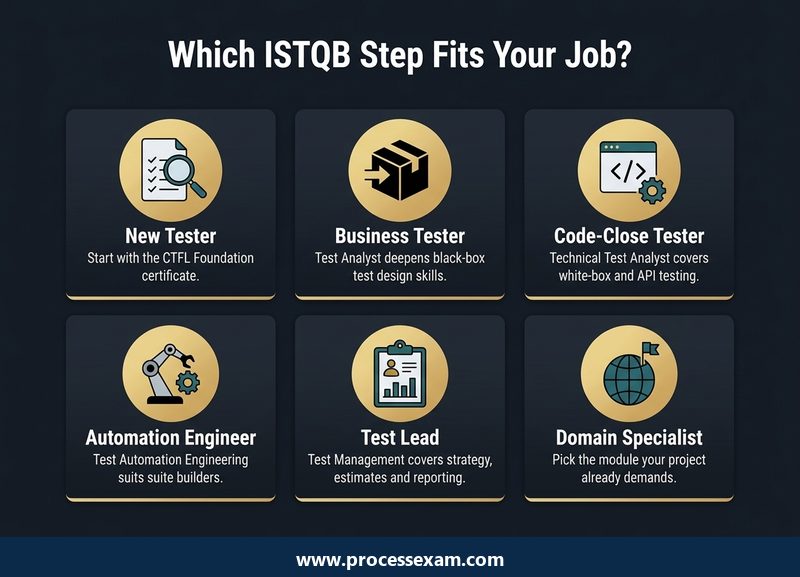
ISTQB describes an audience for each certificate. Reading those descriptions against everyday job titles gives the mapping below. The pairing is a reading of the audience text, not a rule ISTQB publishes, so treat it as a starting point and test it against the job advertisements you actually want.
| Where you are or where you are heading | The step that fits | Why it fits |
|---|---|---|
| First year in testing, or moving in from support, development or business analysis | CTFL | Gives you the shared vocabulary and the basic techniques; ISTQB lists developers and business analysts among its audience |
| Functional or business-facing tester who designs most of the test cases | Test Analyst | ISTQB describes the role as focused on customer business needs, mainly functional testing, using black-box and experience-based techniques |
| Tester who reads code, works on APIs or sits close to developers | Technical Test Analyst | Covers white-box techniques, API testing, static and dynamic analysis and risk-based testing tasks |
| Engineer who builds and maintains automated suites | Test Automation Engineering | ISTQB expects software engineering skills here and says the syllabus does not teach them |
| Test lead, scrum master or project manager who owns the plan | Test Management | Covers strategy, estimation, metrics, defect management and building a test team |
| Tester asked to cover an AI feature, a payments flow or a load target | The matching Specialist module | These modules are narrow on purpose, so they pay when the project already demands the topic |
Do the Advanced paths close doors on each other?
No. Test Analyst and Technical Test Analyst are often described as two sides of the same job, the business side and the technical side, and nothing stops one person from holding both. In practice most people take the one that matches their current role first and add the second when their work drifts that way. Test Management is a change of job more than a change of depth: you stop designing tests and start planning, estimating and reporting on them.
What if your title is not "tester" at all?
Developers who write their own tests, business analysts who run acceptance sessions and project managers who answer for quality all appear in ISTQB's own audience lists. For them the Foundation certificate works as a shared language rather than a job switch, and it is a legitimate end point. Nobody has to climb the ladder to make the first rung worthwhile.
What does the first rung, CTFL, actually involve?
The first step is a single multiple-choice paper. Its syllabus covers six areas: the fundamentals of testing, testing across the software development lifecycle, static testing, test analysis and design, managing the test activities, and test tools. That is a wide, shallow survey, which is exactly why it suits career starters and people who learned testing on the job without ever naming the techniques they use.
| Item | CTFL |
|---|---|
| Certification | ISTQB Certified Tester - Foundation Level (CTFL) |
| Version | CTFL v4.0 |
| Exam price | USD $229 |
| Duration | 60 minutes |
| Questions | 40 |
| Passing score | 26 / 40 |
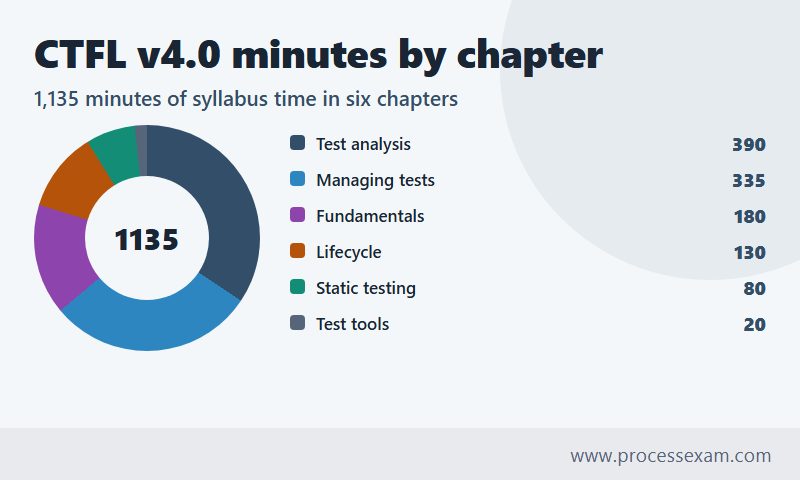
The syllabus spends its 1,135 minutes of study time unevenly, as the chart shows: test analysis and design plus managing the test activities take nearly two thirds of it, while test tools get 20 minutes.
ISTQB's Foundation page also lists 25 per cent extra time for candidates not sitting in their native language. To check whether this rung is within reach before you book, work through the CTFL practice exam and read your results chapter by chapter. The CTFL syllabus overview shows how the six areas are laid out if you want to see the scope first.
What the Foundation certificate does not do is separate you from other certified testers. Many people hold it, so it works as an entry ticket and a vocabulary check, not as a differentiator. The differentiator comes from what you stack on top of it and from the evidence in your own work.
When is an Advanced certificate worth its extra cost?
An Advanced exam is a bigger commitment than the Foundation one. The papers are longer, the questions are scenario based, and ISTQB expects real project experience behind them. The exam sheet lists the following figures.
| Certificate | Version | Price (USD) | Duration | Questions | Passing score |
|---|---|---|---|---|---|
| CTAL-TA Test Analyst | v4.0 | $249 | 120 minutes | 45 | 51 / 78 |
| CTAL-TTA Technical Test Analyst | v4.0 | $249 | 120 minutes | 45 | 51 / 78 |
| CTAL-TM Test Management | v3.0 | $249 | 120 minutes | 50 | 58 / 88 |
| CTAL-TAE Test Automation Engineering | v2.0 | $249 | 90 minutes | 40 | 43 / 66 |
On exam fees alone, the Foundation certificate plus one Advanced certificate comes to USD $478 at these prices. Training courses, study time and the exam provider's own charges come on top, and an employer that sponsors the course changes the arithmetic completely. Because the cost is meaningful, ask three questions before you commit.
- Does my next role ask for it? Open five advertisements for the job you want in two years. If two or more name the Advanced certificate or the skills behind it, the exam has a concrete payoff.
- Can I already do the work? The Advanced syllabi assume you have designed tests, estimated effort or read code in a real project. Without that, the questions feel abstract and the certificate says less about you.
- Is someone else paying, or is the date fixed? A team plan, a promotion review or a client requirement is a reason to go now. Idle curiosity can wait for a quieter month.
What does each Advanced paper ask you to do on the job?
The syllabus contents on ISTQB's pages show what each certificate expects you to be able to do. The Technical Test Analyst syllabus covers risk-based testing tasks, white-box techniques from statement and decision testing to MC/DC and multiple condition testing, API testing, and static and dynamic analysis. The Test Management syllabus covers the test process, risk-based testing, the project test strategy, test improvement, tools, metrics, estimation, defect management and the test team. One reads like a developer's neighbour; the other reads like a manager's desk. If the topic list describes a normal week for you, the exam will feel like a review. If it describes a week you would like to have, the exam doubles as a guided course.
Which Advanced step moves a career furthest?
For a tester who wants to stay hands-on, Test Analyst or Technical Test Analyst deepens the craft. For someone who wants to lead, Test Management is the one that lines up with a change of title. ISTQB says the Test Management certificate is valid for life and does not need renewal, and that holders may go on to the Expert Level. That makes it a durable line on the record of someone moving toward test lead roles, though the title itself will still come from your employer and your results, not from the paper.
Which Specialist module should follow the core steps?
Specialist modules are the part of the scheme that changes fastest, because they track what projects ask for. ISTQB's page groups them by technology (AI testing, test automation strategy, mobile, model-based testing), by quality characteristic (performance, security, usability, acceptance), and by domain (finance, automotive, games, gambling). A handful of figures from the exam sheet show how they compare with the core steps.
| Module | Price (USD) | Duration | Questions | Passing score |
|---|---|---|---|---|
| CT-AI AI Testing (Version 2.0) | $199 | 60 minutes | 40 | 29/40 |
| CT-PT Performance Testing (Version 2018) | $199 | 90 minutes | 40 | 26 / 40 |
| CT-TAS Test Automation Strategy (Version 1.0) | $199 | 60 minutes | 40 | 32/49 |
| CT-SEC Security Tester | $249 | 120 minutes | 45 | 52 / 80 |
Prerequisites differ, and that is the detail people miss. ISTQB's AI Testing page names the Foundation certificate as the prerequisite. The Security Tester page asks for the Foundation certificate and not less than three years of relevant academic, practical or consulting experience. A Specialist badge without the matching project is therefore the weakest combination on the ladder; it pays when a live project or a hiring plan already needs the topic.
A rule for choosing a module
Choose by the work in front of you in the next six months, not by what looks newest. If you are about to test a feature built on machine learning, the AI module teaches the vocabulary your colleagues will use. If your release is slipping on load tests, performance testing will pay back faster than a second Advanced certificate. If nothing in your backlog touches the topic, the module is a hobby, and a good one, but not a career move.
When does a certificate move a career, and when does it just sit on the CV?
Certificates move careers in specific situations, and most of them are about getting past a gate rather than being better at the work.
- The first job or the first switch. A recruiter screening many applications for a junior role has little to go on. A Foundation certificate shows that you know the vocabulary and the basic techniques before you have any project history. This is the case where it helps most.
- Coming from another discipline. A developer, analyst or support engineer who moves into testing can use the Foundation certificate to prove that the move was planned.
- Consultancy and outsourcing work. Delivery firms often need to show a client that the team holds recognised credentials. Where that is a contract requirement, the certificate is simply part of getting staffed.
- A step toward leading a team. Test Management gives a tester a structured way to talk about estimates, risk and reporting before their title changes.
It stays a line on the CV when a hiring manager has a portfolio, strong references or a practical test in front of them. A senior tester with ten years of shipped work gains little from a Foundation paper, and a certificate cannot cover for weak bug reports or shallow test design in the interview.
A note on salary. Earlier versions of this article quoted averages from a job site. Those numbers depend on country, seniority and which roles a site groups together, so they are left out here rather than repeated without a page you can open. If pay matters to your decision, compare salary surveys for your own country and level and check whether certified and uncertified testers are even listed separately.
What would a sensible two-year route look like?
A route works better than a shopping list. The version below fits a tester who starts with little structure and wants to be leading or specialising within two years; adjust the timings to your job.
Months 0 to 3: take the first rung
Read the Foundation syllabus, sit the exam, and put the certificate on your profile. The point is to get the vocabulary and the basic test design techniques in order, so that you can discuss your work precisely. At this stage the useful question to ask is not what else to collect, but which technique from the syllabus you are not yet using in your own project.
Months 3 to 12: gather evidence
Use the time to apply what you learned. Pick one project and keep a short record of defects found, tests designed from the techniques, and any improvement you proposed. By the end of the year you will have material for the Advanced decision: which of Test Analyst, Technical Test Analyst, Automation Engineering or Test Management your work has been pulling you toward.
Months 12 to 18: choose one Advanced step
Take the Advanced certificate that matches the pull. Check the experience criterion with the member board or exam provider first. If an employer will fund the course, schedule the exam close to a review cycle so the result lands when it can be discussed.
Months 18 to 24: add one Specialist module or stop
Add a Specialist module only if a current or planned project demands it. If none does, stop collecting and spend the time on a visible piece of work: a framework you built, a test strategy you wrote, an incident you traced to its cause. Those carry further in an interview than a fourth certificate.
Two things about this route are worth stating plainly. It is optional at every step, because a tester who changes jobs at month eight may find the Foundation certificate was all the new employer wanted. And it is cumulative: the Advanced exams assume you stayed engaged with real testing between steps, which is why the gaps are there.
Frequently Asked Questions
Is a software testing certification worth it for your career?
It is worth most at the start of a testing career or when moving into testing from another discipline, because it proves vocabulary and technique before you have a track record. For experienced testers the benefit shrinks unless a role, client or promotion asks for it. Check advertisements for the job you want.
Which ISTQB certificate should you take first?
Take the Foundation certificate, CTFL v4.0. ISTQB treats it as the prerequisite for the Advanced and Specialist certificates that require a Foundation level, so it cannot be skipped. The exam sheet lists it at USD $229, with 40 questions in 60 minutes and a pass mark of 26 out of 40.
Can you take an Advanced ISTQB certificate without the Foundation certificate?
No. ISTQB states that candidates for the Advanced certificates must hold the Foundation certificate and have sufficient practical experience. The member board or exam provider you book through decides the exact experience test, so confirm it with them before paying for training or an exam.
How much do ISTQB certificates cost?
The exam sheet lists CTFL at USD $229, the Advanced certificates Test Analyst, Technical Test Analyst, Test Management and Test Automation Engineering at USD $249 each, and the Specialist modules shown here at USD $199 to $249. Training fees and exam provider charges are separate and vary by country.
Does a testing certificate replace experience?
No. A certificate shows that you know the terminology and techniques, while experience shows you can apply them under project pressure. ISTQB itself asks for practical experience before several Advanced and Specialist exams. Employers usually weigh both, so keep evidence of your own work beside the certificate.
- ISTQB Tester Foundation Exam Questions |
- ISTQB Tester Foundation Question Bank |
- ISTQB Tester Foundation Questions |
- ISTQB Tester Foundation Study Guide |
- ISTQB CTFL Quiz |
- CTFL Certification |
- CTFL Questions |
- CTFL Practice Test |
- CTFL Study Guide Material |
- CTFL Sample Exam |
- Tester Foundation Certification |
- ISTQB Tester Foundation Book |
- ISTQB Tester Foundation Sample Questions |
- CTFL Exam Questions Download |
- CTFL Test Questions |
- Tester Foundation PDF |
- ISTQB Foundation Level Certification |
- ISTQB Foundation Level Exam Questions |
- ISTQB Foundation Level Sample Questions |
- ISTQB Foundation Level |
- ISTQB Foundation Level PDF |
- ISTQB Foundation Level Book |
- ISTQB Foundation Level Question Bank |
- ISTQB Foundation Level Study Guide |
- ISTQB Foundation Level Questions


