
Skip the Jargon: OMG OCEB 2 Fundamental Explained Simply

The OMG OCEB 2 Fundamental certification, officially known as OMG Certified Expert in BPM 2 - Fundamental (Exam Code: OMG-OCEB2-FUND100), is designed to validate an individual's foundational understanding of Business Process Management (BPM) concepts, principles, and modeling techniques. This credential from the OMG (Object Management Group) serves as a crucial entry point for professionals aspiring to demonstrate their competence in analyzing, designing, and improving business processes. This article clarifies the essence of the OMG OCEB 2 Fundamental certification, outlining its purpose, benefits, exam structure, syllabus, and effective preparation strategies for aspiring candidates looking to enhance their BPM expertise. It aims to demystify the certification process, offering a clear roadmap for success.
Understanding the OMG OCEB 2 Fundamental Credential
The OMG OCEB 2 Fundamental certification establishes a benchmark for professional competency in Business Process Management. It signifies that an individual possesses a fundamental grasp of BPM terminology, lifecycle phases, and the modeling notations used to represent business processes effectively. This certification is particularly relevant for business analysts, process owners, project managers, and IT professionals who interact with or are involved in process improvement initiatives. Earning this credential confirms a candidate's ability to speak the common language of BPM, fostering better collaboration and understanding within organizations.
Purpose and Scope of the Certification
The core purpose of the OMG OCEB 2 Fundamental certification is to ensure that professionals have a standardized knowledge base in BPM. It covers essential areas such as understanding business process concepts, modeling techniques, and the frameworks that govern process quality and metrics. The scope is broad enough to provide a solid foundation for anyone involved in process-centric roles, preparing them for more advanced BPM challenges and certifications. It’s about building a common ground of knowledge, enabling better process communication and execution across diverse teams and industries.
Ascertaining the OMG OCEB 2 Fundamental Exam Details
The OMG Certified Expert in BPM 2 - Fundamental (OMG-OCEB2-FUND100) exam is structured to thoroughly assess a candidate's grasp of foundational BPM knowledge. Understanding these details is the first step towards a successful preparation journey, providing clarity on what to expect on exam day.
The exam format and scoring are as follows:
-
Exam Name: OMG Certified Expert in BPM 2 - Fundamental
-
Exam Code: OMG-OCEB2-FUND100
-
Exam Price: USD $350
-
Duration: Residents of English-speaking Countries: 90 Minutes; All others: 120 Minutes
-
Number of Questions: 90 Passing Score 62 / 90
These specifics highlight the need for both speed and accuracy, emphasizing a comprehensive understanding of the subject matter rather than rote memorization. Candidates should plan their study time to cover all areas sufficiently, aiming not just to pass but to master the concepts validated by the exam.
Exploring the OMG OCEB 2 Fundamental Syllabus Domains
The OMG OCEB 2 Fundamental syllabus is meticulously designed to cover all foundational aspects of Business Process Management. Each domain contributes a specific percentage to the overall exam, indicating its weight and importance. A detailed review of these topics is essential for focused study and ensuring comprehensive preparation. Candidates can refer to the official exam guide for the most current and authoritative syllabus information directly from the source.
|
Syllabus Domain |
Weight |
|---|---|
|
Business Process Modeling Concepts |
24% |
|
Business Motivation Modeling |
16% |
|
Business Process Modeling Skills |
16% |
|
Process Quality, Governance and Metrics Frameworks |
15% |
|
Business Process Concepts and Fundamentals |
11% |
|
Business Process Management Concepts and Fundamentals |
10% |
|
Business Goals, Objectives |
8% |
Business Process Modeling Concepts (24%)
This domain forms the largest portion of the exam, emphasizing the core principles and notations used in process modeling. It covers the understanding of what a business process is, its components, and how to represent it graphically. Candidates are expected to be familiar with standard modeling languages and their elements.
Foundational Modeling Principles
Understanding the basic building blocks of process diagrams, including events, activities, gateways, and flows. This involves recognizing different types of each element and their purpose in a process model. It’s crucial to grasp how these elements combine to depict a complete process flow.
Process Types and Patterns
Differentiating between various types of processes (e.g., sequential, parallel, iterative) and common process patterns. This knowledge helps in accurately modeling complex real-world scenarios and ensuring the logical consistency of process designs.
Business Motivation Modeling (16%)
This section focuses on understanding the "why" behind business processes. It delves into how business goals, objectives, and strategies drive process design and improvement initiatives. Candidates learn to connect high-level business drivers to operational processes.
Goals, Objectives, and Strategies Alignment
How business goals and objectives are articulated and linked to the underlying processes that support their achievement. This involves understanding the hierarchy from strategic intent down to concrete actions.
Stakeholder Perspectives
Identifying different stakeholders involved in processes and their varied motivations and concerns. Recognizing these perspectives is vital for designing processes that meet diverse requirements and gain organizational buy-in.
Business Process Modeling Skills (16%)
Beyond theoretical concepts, this domain assesses the practical ability to apply modeling notations and techniques. It tests a candidate's skill in creating clear, unambiguous, and effective business process models.
Practical Application of BPMN Elements
Demonstrating proficiency in using Business Process Model and Notation (BPMN) elements to accurately depict process flows. This includes selecting the correct symbols for specific situations and structuring models logically.
Model Interpretation and Analysis
The ability to read, interpret, and analyze existing business process models to identify inefficiencies, redundancies, or areas for improvement. This skill is critical for any role involved in process optimization.
Process Quality, Governance and Metrics Frameworks (15%)
This domain addresses how processes are managed, measured, and continuously improved. It covers the principles of process governance, quality assurance, and the use of metrics to evaluate performance.
Quality Management Principles
Understanding frameworks and methodologies for ensuring the quality and efficiency of business processes. This often includes concepts like continuous improvement and defect prevention.
Process Performance Measurement
Identifying key performance indicators (KPIs) and metrics used to monitor and assess the effectiveness and efficiency of processes. This enables data-driven decision-making for process enhancements.
Business Process Concepts and Fundamentals (11%)
This section lays the groundwork by covering the fundamental theories and ideas underpinning business processes. It establishes a common understanding of what constitutes a business process and its significance.
Core Process Definitions
Defining what a business process is, its characteristics, and how it differs from a task or project. This foundational knowledge is crucial for a consistent understanding across BPM initiatives.
Process Architecture Components
Understanding the various layers and components that make up an organization's process architecture, from high-level value chains to detailed operational processes.
Business Process Management Concepts and Fundamentals (10%)
This domain broadens the perspective to Business Process Management as a discipline, covering its lifecycle, benefits, and strategic importance within an organization.
BPM Lifecycle Phases
Overview of the BPM lifecycle, including process discovery, analysis, design, implementation, monitoring, and optimization. Understanding these phases helps in managing end-to-end process initiatives.
Strategic Role of BPM
Recognizing how BPM contributes to organizational strategy, competitive advantage, and operational excellence. This highlights the value of process thinking beyond mere efficiency.
Business Goals, Objectives (8%)
While related to motivation modeling, this section specifically focuses on the definition and hierarchy of business goals and objectives. It ensures a clear understanding of what an organization aims to achieve.
Defining Business Goals
The process of articulating clear, measurable, achievable, relevant, and time-bound (SMART) business goals. This is foundational for aligning processes to strategic outcomes.
Goal Decomposition and Alignment
How high-level strategic goals are broken down into operational objectives that can be directly supported and measured through specific business processes. This ensures all process efforts contribute to broader organizational aims.
Why Earn the OMG OCEB 2 Fundamental Certification?
Obtaining the OMG OCEB 2 Fundamental certification offers a compelling advantage for professionals navigating the complexities of modern business operations. It’s more than just a piece of paper; it’s a recognition of a crucial skill set that is increasingly in demand across industries. This credential empowers individuals to articulate, analyze, and optimize business processes, leading to tangible improvements in organizational efficiency and effectiveness.
Enhanced Professional Credibility
A certification from the Object Management Group, an internationally recognized standards body, significantly boosts a professional's credibility. It signals to employers and peers that the certified individual possesses a validated understanding of BPM principles and best practices. This can open doors to new opportunities and career advancement in process-centric roles.
Standardized Knowledge and Common Language
The certification ensures that professionals understand and apply a standardized approach to BPM, particularly through the use of established modeling notations like BPMN. This common language facilitates clearer communication and collaboration within project teams and across departments, reducing misunderstandings and improving project outcomes. For those aiming for robust understanding, exploring OMG's UML directory can provide additional context on related modeling standards.
Career Progression and Opportunities
For many organizations, individuals with certified BPM skills are invaluable for driving digital transformation and operational excellence initiatives. The OMG OCEB 2 Fundamental certification can be a stepping stone to more advanced roles such as Business Process Analyst, Process Architect, or BPM Consultant, commanding higher salaries and greater responsibilities. It demonstrates a commitment to continuous professional development and expertise in a critical business function.
Preparing for OMG OCEB 2 Fundamental Exam Success
Effective preparation is paramount for passing the OMG OCEB 2 Fundamental (OMG-OCEB2-FUND100) exam. A structured approach, combining various learning resources and consistent practice, will significantly increase your chances of success. Candidates should not rely solely on theoretical knowledge but also focus on applying concepts, especially in modeling.
Crafting a Comprehensive Study Plan
Start by thoroughly reviewing the official syllabus and allocating study time proportional to the weight of each domain. Create a realistic schedule that allows for deep dives into complex topics and regular review sessions. Consistency is key, so aim for regular, focused study periods rather than cramming.
Leveraging Official Resources and Training
The OMG provides an excellent foundation through their official documentation. Supplement this with recommended textbooks, whitepapers, and industry articles on BPM. Consider enrolling in an official OMG Certified Expert in BPM 2 - Fundamental training course, as these are often structured to align directly with exam objectives and can offer valuable insights and practical exercises.
Practicing with Realistic Exam Questions
Engaging with OMG OCEB 2 Fundamental exam questions through practice exams is crucial. This helps you become familiar with the question format, identify areas where you need further study, and manage your time effectively during the actual exam. Look for OMG Certified Expert in BPM 2 - Fundamental practice exam resources that mirror the difficulty and style of the real test. Regular self-assessment is key to building confidence and pinpointing weaknesses. For further preparation, consider exploring comprehensive study materials that provide a simulated testing environment.
Who Benefits from OMG OCEB 2 Fundamental Expertise?
The OMG OCEB 2 Fundamental certification targets a broad spectrum of professionals whose roles intersect with business processes. Its foundational nature makes it highly valuable for individuals at various career stages, equipping them with a common language and understanding of BPM. This credential clarifies core concepts for those seeking to enhance their analytical and operational capabilities.
Business Analysts and Process Owners
For business analysts, the certification sharpens their ability to identify, document, and analyze business requirements from a process perspective. Process owners gain a structured framework for managing and improving the processes they oversee, ensuring they are efficient and aligned with business objectives.
Project Managers and IT Professionals
Project managers can leverage BPM knowledge to better plan and execute projects involving process changes or system implementations. IT professionals, particularly those involved in developing or integrating systems that support business processes, benefit from understanding the underlying process logic, leading to better system design and user adoption.
Students and Aspiring BPM Professionals
Individuals new to the field of BPM or students looking to specialize will find the OMG OCEB 2 Fundamental learning path an excellent starting point. It provides a solid academic and practical foundation, making them more attractive to employers seeking candidates with certified BPM knowledge.
Validing Skills with OMG OCEB 2 Fundamental
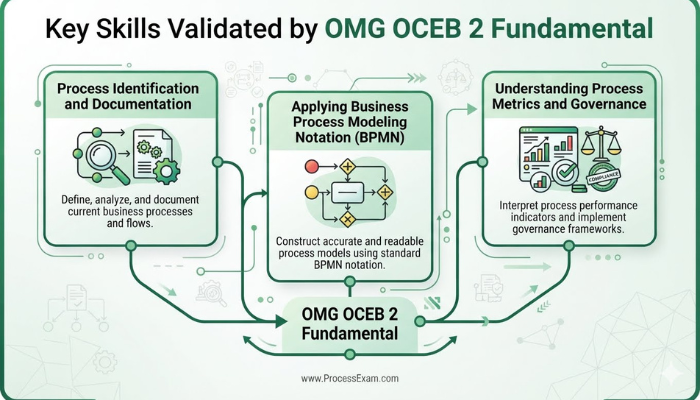
The OMG OCEB 2 Fundamental certification is a clear signal of specific, validated skills that are essential in today’s process-driven business environment. It ensures that certified individuals possess the capabilities to understand, describe, and contribute effectively to BPM initiatives. This credential goes beyond theoretical knowledge, emphasizing the practical application of BPM concepts.
Process Identification and Documentation
Certified professionals are skilled in identifying existing business processes and documenting them clearly and accurately. This includes understanding process boundaries, inputs, outputs, and the various activities involved, forming the basis for any improvement effort.
Applying Business Process Modeling Notation (BPMN)
A key validated skill is the ability to effectively use BPMN for process modeling. This involves not only understanding the syntax of BPMN but also applying it to create precise, unambiguous, and easily understandable models that can be used for communication, analysis, and execution.
Understanding Process Metrics and Governance
Candidates demonstrate knowledge of how to measure process performance using relevant metrics and the importance of establishing governance frameworks. This skill enables them to contribute to continuous process improvement efforts and ensure that processes consistently meet quality standards and business objectives.
Progression Beyond the Fundamental Level
The OMG OCEB 2 Fundamental certification is often the initial step in a broader professional development journey within Business Process Management. It provides the essential building blocks upon which more advanced knowledge and skills can be developed. For those committed to specializing in BPM, there is a clear pathway to higher levels of expertise.
Advanced OMG OCEB 2 Certifications
Beyond the fundamental level, the OMG offers advanced certifications in BPM that delve into more complex aspects of process analysis, design, and implementation. These higher-level credentials require a deeper understanding of advanced modeling techniques, process architecture, and the strategic application of BPM. Earning the Fundamental certification provides a solid foundation, making the transition to these advanced topics smoother and more successful.
Continuous Learning in BPM
The field of BPM is constantly evolving, with new methodologies, tools, and best practices emerging regularly. Achieving the Fundamental certification should be viewed as an ongoing commitment to continuous learning. Professionals are encouraged to stay updated with industry trends, participate in BPM communities, and explore specialized areas such as process automation, robotics, and artificial intelligence in BPM. This commitment ensures that their skills remain relevant and valuable in a dynamic business landscape.
Common Hurdles and Overcoming Them
Pursuing the OMG OCEB 2 Fundamental certification, like any professional exam, can present certain challenges. Recognizing these common hurdles and developing strategies to overcome them is crucial for a smooth and successful preparation experience. Many candidates face difficulties in conceptual understanding or time management during study.
Demystifying Jargon and Concepts
BPM, like many specialized fields, has its own terminology and complex concepts that can be daunting for beginners. Overcoming this involves not just memorization but truly understanding the 'why' behind each principle. Utilize diverse resources such as case studies, real-world examples, and visual aids to solidify your understanding. Engage in discussions with peers or instructors to clarify doubts.
Balancing Theory with Practical Application
The exam tests both theoretical knowledge and the ability to apply modeling concepts. A common mistake is focusing too heavily on one aspect. Ensure your study includes hands-on practice with BPMN modeling tools, even if it's just for personal exercises. Regularly converting theoretical knowledge into practical models can bridge this gap, enhancing both your understanding and your readiness for application-based questions.
Maximizing Your OMG OCEB 2 Fundamental Credential
Earning the OMG OCEB 2 Fundamental certification is a significant achievement, but the true value lies in how you leverage it throughout your career. This credential is an asset that can be strategically utilized to open new doors and enhance your professional profile. It represents an investment in your expertise and future.
Highlighting on Professional Platforms
Update your LinkedIn profile, professional résumés, and portfolios to prominently feature your OMG Certified Expert in BPM 2 - Fundamental credential. Clearly articulate the skills validated by the certification, such as business process modeling, analysis, and improvement. This helps in attracting recruiters and demonstrating your capabilities to potential employers or clients.
Applying Knowledge in Real-World Scenarios
Actively seek opportunities within your current role or through new ventures to apply your BPM knowledge. Volunteer for process improvement projects, contribute to process documentation efforts, or take the lead in designing more efficient workflows. Practical application not only reinforces your learning but also showcases the tangible benefits of your certification to your organization. This practical engagement is crucial for solidifying the OMG Certified Expert in BPM 2 - Fundamental benefits.
Networking with BPM Professionals
Connect with other certified BPM professionals and participate in industry forums and associations. Networking can provide insights into best practices, emerging trends, and career opportunities. Sharing experiences and learning from others who are also committed to process excellence can be invaluable for continuous growth and development in the BPM field.
The OMG OCEB 2 Fundamental certification is a powerful stepping stone for any professional dedicated to mastering Business Process Management. It offers a structured approach to learning the essential concepts, tools, and techniques required to excel in process-driven roles. By investing in this certification, you equip yourself with a universally recognized credential that not only validates your expertise but also significantly enhances your career trajectory in an increasingly complex and competitive business landscape. Prepare diligently, embrace the learning journey, and unlock your full potential in BPM. To further your certification journey and access a wide array of preparation resources, visit ProcessExam for detailed guides and practice materials.
FAQs
1. What is the OMG OCEB 2 Fundamental certification?
The OMG OCEB 2 Fundamental certification is an entry-level credential from the Object Management Group (OMG) that validates an individual's foundational knowledge of Business Process Management (BPM) concepts, principles, and modeling techniques, particularly using BPMN.
2. Who should consider taking the OMG OCEB 2 Fundamental exam?
This certification is ideal for business analysts, process owners, project managers, IT professionals, consultants, and students who need to understand and apply fundamental BPM principles in their roles or studies.
3. How much does the OMG OCEB 2 Fundamental certification cost?
The exam price for the OMG OCEB 2 Fundamental (OMG-OCEB2-FUND100) is USD $350. Additional costs may include training courses or study materials.
4. What is the passing score for the OMG OCEB 2 Fundamental exam?
Candidates must achieve a score of 62 out of 90 questions to pass the OMG OCEB 2 Fundamental exam, demonstrating a solid grasp of the core BPM concepts covered in the syllabus.
5. Are there any prerequisites for the OMG OCEB 2 Fundamental certification?
While the OMG does not specify formal prerequisites, candidates are expected to have a basic understanding of business operations and a strong interest in process improvement. The certification itself serves as a foundational credential.
- OMG Exam |
- OMG OCEB 2 Fundamental Exam Questions |
- OMG OCEB 2 Fundamental Question Bank |
- OMG OCEB 2 Fundamental Questions |
- OMG OCEB 2 Fundamental Test Questions |
- OMG OCEB 2 Fundamental Study Guide |
- OMG-OCEB2-FUND100 |
- OMG-OCEB2-FUND100 Question Bank |
- OMG-OCEB2-FUND100 Certification |
- OMG-OCEB2-FUND100 Questions |
- OMG-OCEB2-FUND100 Practice Test |
- OMG-OCEB2-FUND100 Study Guide Material |
- OMG-OCEB2-FUND100 Sample Exam |
- OCEB 2 Fundamental |
- OCEB 2 Fundamental Certification |
- OMG Certified Expert in BPM 2 - Fundamental |
- OMG OCEB 2 Fundamental Book |
- OMG-OCEB2-FUND100 Exam |
- OMG-OCEB2-FUND100 Study Guide PDF |
- OMG OCEB 2 Fundamental Sample Questions |
- OMG-OCEB2-FUND100 Exam Questions Download |
- OMG-OCEB2-FUND100 Test Questions |
- OCEB 2 Fundamental PDF |
- OMG-OCEB2-FUND100 Quiz |
- BPM 2 Certifications |
- OMG BPM 2 Fundamental Exam Questions |
- OMG BPM 2 Fundamental Questions |
- OMG BPM 2 Fundamental Sample Questions |
- BPM 2 Fundamental |
- BPM 2 Fundamental PDF |
- BPM 2 Fundamental Simulator |
- BPM 2 Fundamental Mock Exam


