
Six Sigma vs PMP: Improve the Process or Deliver the Project?
Updated on 22 September 2026. What’s new: current PMP and ASQ Six Sigma exam figures side by side, replacing the old article's retired PMP exam format.
The rollout is six weeks late and the new housings keep cracking, and two managers are arguing over whose problem it is. The plant manager blames a plan that ignored how the moulding press behaves; the programme manager blames a press that cannot hold tolerance. Both are partly right, and that is the whole difference: a Six Sigma belt proves you can find and remove the cause of a process failure, while the PMP proves you can deliver a defined project to its date, budget and scope.
Search for six sigma vs PMP and most answers treat the two as rival badges on the same ladder. They are not on the same ladder. One certifies how well you improve something that runs every day; the other certifies how well you lead something that has a start and a finish. This guide uses one troubled rollout to show where each credential earns its keep, compares the exams on eligibility, cost and format using ASQ's and PMI's own requirements, and then gets practical: which jobs call for which credential, when holding both pays off, and which one to earn first.
Who should own a rollout that is both late and defective?
Picture the situation in more detail. A manufacturer is launching a smart thermostat, and the plastic housing is being moved from a pilot cell to a second plant so that volume can ramp before a retail launch. The programme has a fixed launch window agreed with retailers, a budget signed off by finance and a plan with a few hundred tasks. At the second plant, a share of housings crack at one snap-fit during assembly. Nobody can say why the pilot cell never showed the fault.
What the programme manager sees
The programme manager, who holds a PMP, sees a critical-path problem. Every week of cracked housings pushes the retail date. The instinct is to protect the milestone: re-baseline the schedule, add a second shift of inspection so that bad parts do not ship, raise the issue in the risk register, escalate to the sponsor and negotiate a partial launch with the retailers. All of that is competent project leadership, and none of it touches the reason the housings crack.
What the plant manager sees
The plant manager came up through operations and led improvement projects as a Six Sigma Black Belt. What the plant manager sees is a process that is not capable. Inspection only sorts good parts from bad; the scrap, the rework and the cost stay. The instinct is to slow down, measure the moulding parameters, check whether the gauge can even tell a good snap-fit from a weak one, compare the two plants' resin drying and cooling times, and prove the cause before changing anything. That is competent improvement work, and on its own it has no date attached.
Where the two views meet
The argument ends when both managers admit they are running two different kinds of work inside one effort. The rollout is a project: it is temporary, it produces a unique result and it ends when the thermostat is on shelves. The cracking is a process problem: it will keep happening on every shift after the project closes unless someone removes its cause. The sensible fix is to give each kind of work an owner. The programme manager keeps the plan, the retailer conversation and the budget; the plant manager runs a short, time-boxed root-cause study with a decision date written into the programme plan. That split is exactly the line between the two certifications.
What does each credential actually prove to an employer?
A certificate is a claim about what you can be trusted to do without supervision. The claims these two make barely overlap.
A Six Sigma belt: you can make a process behave
Six Sigma treats a recurring problem as a question about variation. Its projects follow a gated sequence usually called DMAIC: frame the problem and the customer requirement, confirm the measurements can be trusted and record a baseline, find the causes the data supports, change those causes, then lock the gain in with a control plan. The toolkit is statistical: capability studies, hypothesis tests, regression, designed experiments and control charts. A belt holder is someone who reaches for data before opinion.
ASQ grades its Six Sigma certifications by depth. The Green Belt is aimed at people who work on improvement projects alongside or under a Black Belt, and ASQ's Green Belt requirements ask for three years of full-time, paid work in areas its body of knowledge covers. The Black Belt goes further: ASQ's Black Belt page asks for the same three years plus one finished Six Sigma project with a signed affidavit, or two projects with affidavits. So the Black Belt proves more than exam knowledge; it proves you have already taken an improvement project to its end.
The PMP: you can land a project
The Project Management Professional certification from PMI is about leading temporary work to a result. On its PMP certification page, PMI describes it as recognising people skilled at managing the people, processes and business priorities of professional projects, and stresses that it is not tied to one methodology, industry or country: the candidate should be able to lead in predictive, agile or hybrid ways of working. In daily terms that means scoping, planning, scheduling, budgeting, managing risk and change, leading a team you may not line-manage, and keeping sponsors and customers aligned when something goes wrong, as it did in the thermostat rollout.
Why neither one contains the other
People sometimes assume a Black Belt is a project manager with extra statistics, or that a PMP already covers quality. Both assumptions break on contact with real work. A Black Belt project is itself a small project, but the belt exams do not test contract negotiation, schedule compression or managing a portfolio of vendors. The PMP expects a project manager to plan and manage quality, but it does not test whether you can run a designed experiment or read a control chart. Each credential leaves a blind spot exactly where the other one is strong.
How do the PMP and ASQ Six Sigma exams compare on paper?
The table uses the exam figures from our exam records for the three credentials this article discusses. Fees are in US dollars and show both published rates where the vendor sets a member price.
| PMI Project Management Professional (PMP) | ASQ Certified Six Sigma Green Belt (CSSGB) | ASQ Certified Six Sigma Black Belt (CSSBB) | |
|---|---|---|---|
| Exam code | PMP | CSSGB | CSSBB |
| Exam fee | Member Price: USD $425 Full Price: USD $675 |
ASQ MEMBERS - $383 NON-MEMBERS - $483 RETAKES - $283 |
ASQ MEMBERS - $485 NON-MEMBERS - $585 RETAKES - $385 |
| Duration (minutes) | 240 | Total appointment time - 270 Exam time - 258 |
Total appointment time - 270 Exam time - 258 |
| Questions | 180 | 110 | 165 |
| Passing score | Above Target / Target / Below Target / Needs Improvement | 550/750 | 550/750 |
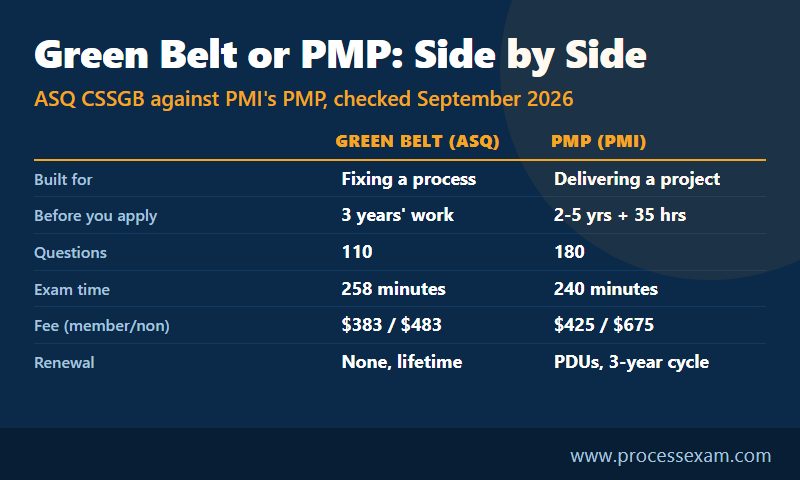
Three differences in that table matter more than the numbers themselves.
How the result is reported
ASQ gives you a scaled score, and 550 out of 750 is the line. PMI reports PMP performance in rating bands, from Above Target down to Needs Improvement, rather than a single published pass mark. If you are used to one system, the other can feel opaque; either way, what you should study is the published content, not a target percentage.
What you may bring into the exam
ASQ's Six Sigma exams are open book: candidates bring their own reference material, and many bring the handbook ASQ publishes for their belt. The PMP is a closed-book, scenario-heavy exam in which most questions describe a situation and ask what a project manager should do next. The two call for different habits. A belt candidate needs well-tabbed references and quick calculation; a PMP candidate needs judgement that holds up without notes.
When you can sit it
PMI runs the PMP year-round once your application is approved. ASQ runs its computer-based exams in testing windows, each with an application deadline that falls well before the window opens, so a missed deadline moves your exam back by a whole cycle. ASQ lists the coming windows on its certification dates page; read it before you promise a date to your manager.
Which jobs call for a Six Sigma belt, and which for a PMP?
The fastest way to decide is to look at what you will be judged on a year from now. If the answer is a number that describes a running process, such as yield, first-pass rate, cycle time or complaints per thousand orders, you are in belt territory. If the answer is whether something was delivered, when and for how much, you are in PMP territory.
Roles where the process is the product
- Quality and process engineers in manufacturing, medical devices, pharmaceuticals and food, who own capability and scrap on specific lines.
- Continuous improvement and operational excellence leads, who run a pipeline of improvement projects and coach others through them.
- Service operations analysts in claims handling, banking back offices, contact centres and hospital departments, where the "line" is a queue of cases rather than parts.
- Supplier quality engineers, who have to prove a supplier's process is capable before parts are accepted.
Roles where the deadline is the product
- Project and programme managers in construction, engineering, IT and product launches, who answer for scope, schedule and cost.
- PMO leads, who set how projects are governed, reported and staffed across a department.
- Delivery managers in consultancies and agencies, whose clients buy an outcome by a date.
- Implementation managers who roll out systems, sites or services and hand them to operations when they are done.
Roles that sit on the line between them
Some jobs are defined by the handover between a project and a process. New product introduction managers, like the thermostat programme manager, deliver a launch but inherit whatever process weaknesses the launch exposes. Plant and operations managers spend most of the year on steady-state performance but also sponsor capital projects: a new line, a warehouse move, a system cutover. Supply chain transformation leads redesign networks as projects and are then measured on how the new network performs. These are the roles where a single credential leaves a visible gap.
Read the verbs in the job advert
Job adverts give the answer away. Verbs such as reduce, stabilise, analyse root causes, improve capability and sustain point to a belt. Verbs such as deliver, plan, coordinate, manage stakeholders, control budget and govern point to the PMP. An advert that uses both sets, and many launch and operations roles do, is telling you the employer has already had the argument from the opening of this article.
When does holding both certifications pay off?
Holding both is not a trophy; it earns its cost only when your work keeps crossing the line between building something and running it. Four patterns are common.
Improvement projects with real budgets
A Black Belt project that replaces equipment, changes a supplier or touches several departments is a project in every sense PMI would recognise. It has a sponsor, a budget, stakeholders who resist, and a date by which the business expects savings. Black Belts who add project management discipline stop losing months to unclear scope and silent stakeholders. The statistics find the cause; the project skills get the fix installed.
Launches that must hand over a stable process
The thermostat rollout is the textbook case. A programme manager who also understands capability studies would have asked, months earlier, whether the second plant's process had been proved capable before volume was committed. That single question, asked at a gate review, is worth more than any recovery plan. Put a readiness check with real capability data into the launch plan and the argument in the opening never happens.
Leading a portfolio of improvement work
Continuous improvement managers often run twenty or thirty projects at once. Choosing, sequencing, staffing and reporting on that many projects is portfolio work, and it is where PMP-style governance helps an improvement function look credible to finance and the executive team.
Consulting and interim roles
Consultants are hired to deliver a result by a date, and the result is often a better process. Clients read the two credentials as two separate promises: that the consultant can diagnose the problem and that the engagement will not overrun. Holding both lets one person make both promises.
When one is enough
If you will never lead work with its own budget and end date, a PMP adds little to a quality career. If you will never be asked to explain or reduce variation in a running process, a belt adds little to a delivery career. In both cases, a short course in the other discipline often covers the gap at a fraction of the effort. It is better to be excellent at the credential that matches your job than average at both.
Should you earn Six Sigma or the PMP first?
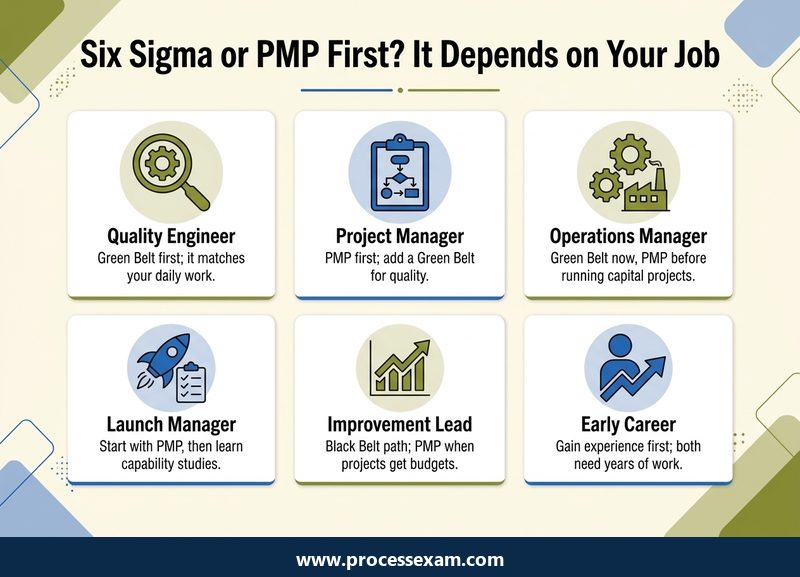
Earn first the one your current work lets you qualify for and use straight away. The eligibility rules do much of the deciding, because both bodies ask for real experience before they will let you sit the exam.
What each body asks before you can apply
PMI's current requirements scale with your education. With a bachelor's degree you need three years of experience managing projects; with an associate's degree or vocational diploma, four; with a high school diploma, five; and graduates of a PMI Global Accreditation Center programme need two. PMI counts time in the last ten years in which you were responsible for planning, decisions, delivery and outcomes, without double-counting projects that overlapped. On top of that you need 35 hours of project management training, and PMI's page notes that from 1 December 2026 live, instructor-led classes count only when they come from a PMI Authorized Training Partner, a registered provider in China or an eligible accredited higher-education programme; self-paced courses and an active CAPM are also accepted.
ASQ's Green Belt asks for three years of full-time, paid work in areas of its body of knowledge, and does not grant education waivers. The Black Belt adds the project affidavit described earlier. Notice what that means for sequencing: nobody fresh out of university qualifies for either, and the Black Belt is out of reach until you have actually led an improvement project.
Path one: you are in quality or operations today
Start with the Green Belt, because your daily work already gives you the experience ASQ asks for and the method pays off in your current role. Then volunteer to lead improvement projects end to end. If you were genuinely responsible for their planning, decisions and delivery, that is the kind of experience PMI's definition describes, so those projects can build toward a later PMP application; record dates, budgets and outcomes as you go. Whether the Black Belt or the PMP comes next depends on where you want to go: deeper into improvement, or towards running larger programmes and sites.
Path two: you are a project manager today
Take the PMP first. It matches your experience, it is the credential project roles screen for, and PMI tests year-round. Add a Green Belt when you notice that your projects keep slipping for quality reasons you cannot diagnose, or when you move into launches, manufacturing or operations where a process must work after you leave. A PMP holder seldom needs a Black Belt unless the career move is into leading improvement itself.
Path three: you are early in your career
Neither exam is open to you yet, and that is useful information rather than a setback. Use the next few years to collect the experience both bodies want: ask to join an improvement team, keep a log of projects you coordinate, and learn the basic vocabulary of both fields. By the time you qualify, your work will have shown you which credential to take first.
What about doing both at once?
It is possible, and rarely wise. The two exams reward different reading habits, one open book with calculations and one closed book with situational judgement. Studying for both in the same months tends to produce two average attempts. A gap of six to twelve months, with the first credential put to use in between, gives the second exam real examples to draw on.
How do you prepare for the second credential without starting from scratch?
Whoever you are, the second certificate is easier than the first, because half of each discipline turns up in the other. The trick is to know which half.
From a belt to the PMP
Belt holders already write charters, map stakeholders, run meetings with data and manage a small team to a deadline, so the start of a project and its reporting will feel familiar. What is new is breadth. The PMP expects fluency in agile and hybrid delivery, team leadership without formal authority, procurement, change control across a large plan and the business case that justifies a project. The exam's format is new as well: 180 questions in 240 minutes, most of them scenarios with several plausible answers. Belt holders often lose marks by choosing the most analytical answer when the question is really about the next conversation a project manager should have. Before booking, try a timed PMP mock exam and sort your wrong answers into two piles: ones where you did not know the concept, and ones where you knew it but picked the answer an analyst would pick. The second pile is the one to work on.
From the PMP to a belt
Project managers already understand scope, a charter, risk and stakeholder management, so the Define phase will feel natural. The gap is statistics, and it is real. Expect to spend most of your study time on measurement system analysis, capability, hypothesis testing, regression and control charts, and to practise calculations until they are routine, because an open-book exam still runs out of time if you have to look up every formula. If you are aiming at the Black Belt, study its Black Belt syllabus breakdown section by section: it goes beyond the project itself into how an organisation deploys and manages an improvement programme, and a PMP holder will find those sections easier than the statistics.
Keeping each credential alive
Plan for renewal before you pay for the second exam. PMI renews the PMP on a three-year cycle: you earn professional development units, spread across the areas of its Talent Triangle, log them and pay a renewal fee, as PMI sets out on its certification maintenance page. ASQ treats its belts differently. It lists the Six Sigma Green Belt as a lifetime certification with no recertification, while a Black Belt must be renewed every three years by earning 18 recertification units or retaking the exam. A PMP holder who adds a Green Belt therefore takes on no extra renewal work; one who adds a Black Belt runs two renewal cycles side by side.
What mistakes do people make when choosing between Six Sigma and PMP?
The same few errors come up again and again when people weigh these two.
- Choosing by salary headlines. Survey figures compare people in different jobs. Pick the credential that matches the work you do or want, and the salary follows the job, not the letters.
- Treating a Green Belt as a project management qualification. It proves you can improve a process with data. It does not prove you can run a multi-team project with contracts and a fixed launch date.
- Expecting the PMP to teach statistics. It prepares you to plan and manage quality, not to find the cause of a defect in a noisy data set.
- Ignoring eligibility until the application form. Both bodies want years of documented experience, and ASQ's Black Belt wants signed project affidavits. Start collecting evidence now.
- Booking a belt exam without checking the window. A missed ASQ application deadline can push your exam back by a whole testing cycle.
- Studying for both in the same season. Two exams with opposite formats compete for the same evenings.
- Forgetting renewal. The PMP needs development units every cycle, and a Black Belt needs recertification units; budget the time as well as the fee.
Go back to the two managers arguing over the cracked housings. The rollout recovered only when the programme manager protected the plan and the plant manager was given a fixed window to prove the cause. If your job looks like the programme manager's, start with the PMP. If it looks like the plant manager's, start with a Six Sigma belt. If you keep finding yourself in both chairs, that is the signal to earn the second credential, in that order.
Frequently Asked Questions
Is Six Sigma or PMP better for my career?
Neither is better in general; they certify different work. A Six Sigma belt suits quality, process and operations roles judged on how well a running process performs. The PMP suits project and programme roles judged on delivering scope on time and within budget. Choose the one that matches what your next job will measure you on.
Is Lean Six Sigma a project management certification?
No. Lean Six Sigma and Six Sigma certifications prove you can improve a process by removing waste and reducing variation, using structured projects and data. They use project tools such as charters, but they do not test the scheduling, budgeting, procurement and stakeholder leadership that a project management credential such as the PMP covers.
Should I get Six Sigma or PMP first?
Earn first the credential your current experience qualifies you for and your job uses. People in quality or operations usually start with a Green Belt, then add the PMP once they have led projects. Project managers usually start with the PMP and add a Green Belt when quality problems keep affecting delivery.
Can Six Sigma training count toward PMP renewal PDUs?
It can, when the course is relevant to your work as a project professional. PMI renews the PMP on a three-year cycle and counts education hours as professional development units, spread across the areas of its Talent Triangle. Check PMI's continuing certification rules before you log a course, and keep the evidence.
What experience do the PMP and ASQ Six Sigma exams require?
PMI asks for two to five years of experience leading projects, depending on your education, plus 35 hours of project management training. ASQ's Six Sigma Green Belt asks for three years of full-time, paid work in areas of its body of knowledge; the Black Belt adds one or two completed projects with signed affidavits.
- PMP Certification |
- PMI Project Management Exam Questions |
- PMI Project Management Question Bank |
- PMI Project Management Questions |
- PMI Project Management Study Guide |
- PMI PMP Quiz |
- PMP Questions |
- PMP Practice Test |
- PMP Study Guide Material |
- PMP Sample Exam |
- Project Management Certification |
- PMI Project Management Book |
- Project Management Certification Cost |
- Project Management Certification Requirements |
- PMI Project Management Sample Questions |
- PMP Exam Questions Download |
- PMP Test Questions |
- Project Management PDF |
- PMI Project Management Professional


