
Black Belt Benefits Over a Green Belt: Is the Step Up Worth It?
Yes, if you already hold a Green Belt and your work is shifting from running one part of a project to choosing which projects run, leading the team and proving the savings. No, if you have never finished a project, because ASQ will not let you sit the CSSBB without signed affidavits. The Black Belt adds leadership, project selection, financial validation and design methods on top of DMAIC.

Should a Green Belt take the step up to Black Belt?
Treat the decision as a change of job description, not as a harder version of the Green Belt exam. ASQ describes a Green Belt as someone who analyses and solves quality problems inside improvement projects. It describes a Black Belt as the person who leads the improvement process: defining projects for Green and Yellow Belts, mentoring them, managing projects that cross departments and leading wider improvement efforts. If your week already looks like that, the certificate describes work you do. If it does not, the certificate will not create that work for you, and it is better to know that before you pay for the exam.
The two exams are built differently, and the numbers show where the extra effort goes. ASQ's published question counts for both bodies of knowledge, set beside the exam facts, give this picture.
| Point of comparison | Green Belt (CSSGB) | Black Belt (CSSBB) |
|---|---|---|
| Experience ASQ asks for | Three years in a full-time, paid role within the Green Belt syllabus areas, and no project at all | Two completed projects with affidavits, or one project with an affidavit plus three years of work |
| Questions on the paper | 110, of which 100 are scored | 165, of which 150 are scored |
| Scored questions in the five DMAIC phases | 89 of 100 | 105 of 150 |
| Scored questions outside DMAIC | 11 | 45 |
| Exam fee | ASQ members $383, non-members $483, retakes $283 | ASQ members $485, non-members $585, retakes $385 |
| Passing score | 550/750 | 550/750 |
Read the middle rows twice. The Black Belt paper is still mostly DMAIC, so a Green Belt does not start from zero. What changes is the other 45 scored questions: they go to deploying Six Sigma, managing the team, measuring the business and designing new processes, and the Green Belt paper gives none of those an area of its own. The two outside-DMAIC totals come from adding ASQ's per-area counts rather than from a single ASQ headline figure. The experience row matters just as much. A Green Belt candidate needs time in role; a Black Belt candidate needs evidence of results.
Three signs you are ready for the step
- You already lead people you do not manage. Black Belt projects run on influence. If colleagues from other departments take your meeting requests seriously, you have the raw material.
- You have a finished project with a measured result. Not an improvement that is still under way, and not a tidy-up with no before-and-after figure. ASQ's form asks for both, as the section on affidavits below shows.
- Someone senior is prepared to sign for you. The affidavit is signed by the project champion. If that person has left the company or never knew the project, you have a gap to fix first.
What does a Black Belt add beyond the Green Belt's scope?
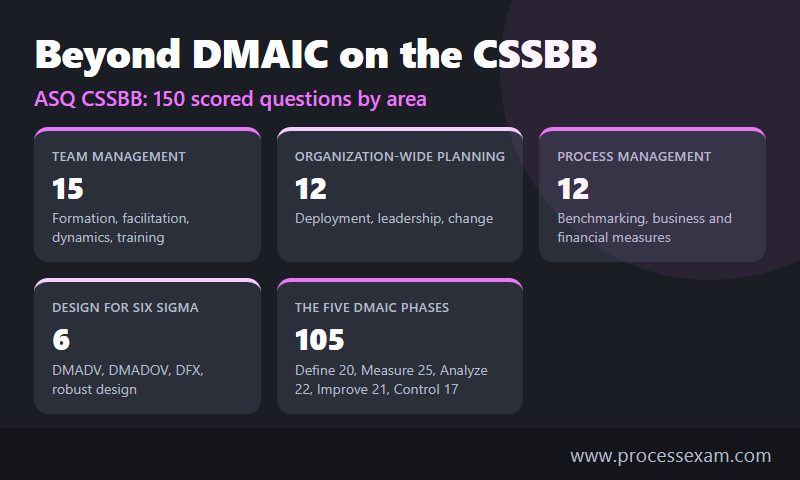
ASQ's 2022 body of knowledge for the CSSBB has nine areas. Five are the DMAIC phases that a Green Belt also studies. The other four are where the extra benefits of the Black Belt come from, and the full topic list is on our CSSBB syllabus page. Here is what each one means in practice.
Leading and coaching: team management (15 questions)
This is the biggest of the four areas. It covers choosing a team type to suit the constraints (virtual, cross-functional or self-directed), picking members by their ability to influence and their openness to change, motivating people, and choosing among four leadership approaches: direct, coach, support and delegate. It also includes a training strand: finding the skills gap, planning the delivery and evaluating whether the training worked. That strand is a reminder that a Black Belt is expected to teach the Green Belts on the project, not only supervise them.
Project selection and financial validation: deployment and business measures (12 and 12 questions)
Two areas deal with a question a Green Belt is rarely asked: should this project exist at all? The deployment area asks you to use screening criteria to pick projects, to know when Six Sigma is the wrong approach, to run a SWOT analysis and to plan for contingencies. The process management area adds benchmarking and business measures such as the balanced scorecard, key performance indicators, objectives and key results, and leading and lagging indicators. It also names the financial measures: revenue growth, market share, margin, net present value, return on investment and cost-benefit analysis, with the distinction between hard savings that appear on a profit and loss statement and soft benefits such as cost avoidance.
That last distinction decides whether a finance team accepts your numbers. A reduction in scrap that lowers a purchasing budget is a hard saving. A lower chance of a future warranty claim is a soft one. A Black Belt who can say which is which before the project starts is far easier to back than one who presents a single large figure at the end.
Team dynamics: the behaviours that stall a project
Inside the team area, ASQ tests conflict resolution at its highest cognitive level, evaluate. Its examples include the loud member, the silent member, the team that agrees too quickly and the meeting that drifts off the agenda. You will also meet meeting management and decision-making tools such as consensus, the nominal group technique and multi-voting. A Green Belt can take part in these discussions; a Black Belt is expected to choose the technique and defend the choice.
Design for Six Sigma: a small but distinct area (6 questions)
Design for Six Sigma, usually shortened to DFSS, is for building a new process or product rather than repairing an old one. The paper expects you to describe DMADV (define, measure, analyze, design, validate) and DMADOV, which adds an optimise step, along with design for cost, manufacturability, test and maintainability, and robust and tolerance design. It is only 6 of 150 scored questions, so do not choose the Black Belt for this area alone. It is, though, a way of working that a Green Belt role rarely meets, and it matters if your employer designs products or services as well as running them.
Can you sit the exam, and what must the affidavits show?
This is the point where many Green Belts stall, so settle it before anything else. ASQ asks for a full-time, paid role and then offers two routes. Route one is a single completed project with a signed affidavit plus three years of work in at least one of the CSSBB areas. Route two is two completed projects, each with its own signed affidavit. ASQ lists no Green Belt certificate as a prerequisite, and its form says that without at least one completed project you will not be allowed to take the exam.
The form itself, which you can read on ASQ's project affidavit, is more demanding than the sentence on the exam page suggests. Each affidavit covers one project and asks for the following.
| What the form asks | What to have ready |
|---|---|
| Project title and the business objective it served | A two- or three-sentence description that links the project to something the company wanted, such as shorter lead time or fewer returns |
| Start and completion dates, month and year | Real dates from the charter and the closing review, not estimates |
| Your own hands-on part, with tools named | The tools you used yourself: process maps, DPU, DPMO, rolled throughput yield, charts. A list of what the team did does not answer this question |
| Benefits achieved | Measured before-and-after results; ASQ's own example is a percentage cut in cycle time. Savings, labour and material costs may all be quoted |
| Verification by the project champion | A signature and date, plus the champion's job title, company, address, email and telephone number |
Two practical points follow from the form. First, ASQ says not to send supporting documents with the description, so the description has to carry the case on its own. Second, the signed affidavits must reach ASQ within one week of your application, or the application is cancelled and only a partial refund follows. Start collecting signatures before you apply, not after. Confirm the conditions on ASQ's CSSBB page before you commit, since ASQ revises its rules from time to time.
If you hold only one finished project, the three-year route is the one to use, and the three years must fall in areas the body of knowledge covers. Years spent in a role unrelated to quality or improvement work may not count. If a project is half finished, finish it and capture the closing numbers before you apply; an affidavit for work still under way is not what the form describes.
Which benefits only appear at Black Belt level?
Many of the benefits people quote for the Black Belt, such as knowing DMAIC well or being attractive to employers that ask for Six Sigma, are shared with the Green Belt. The ones below depend on the extra scope and the extra evidence.
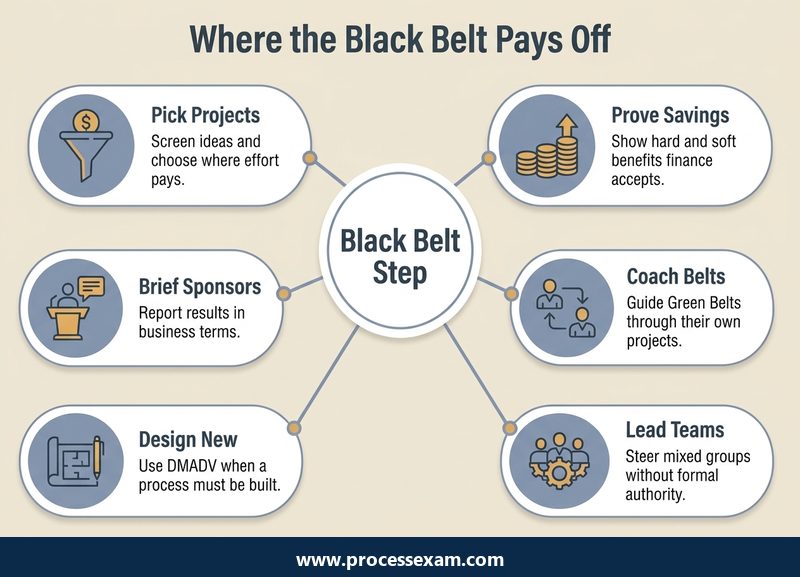
- You choose the work, not only do it. ASQ says a Black Belt defines projects for Green and Yellow Belts. Being the person who screens ideas and says which ones are worth a team's time is a different seat from taking a charter someone else wrote.
- Your results speak the language of finance. Because the exam covers hard and soft savings, return on investment and cost-benefit analysis, you can state a project's value in terms a controller will accept. That makes it easier to win resources for the next project.
- Your impact multiplies through other people. ASQ describes Black Belts mentoring Green Belts through their projects. When three Green Belts finish projects because you coached them, the organisation sees a result larger than your own.
- You can take on projects that span the enterprise. Cross-departmental work needs someone who can handle stakeholders, resistance and change planning. The deployment area of the exam includes stakeholder analysis, readiness assessments and communication plans for this reason.
- Your credential comes with proof. A certificate that needs a signed project record tells an employer more than one that needs only a paper. ASQ adds that an outside body, ANAB, has accredited the program against ISO 17024, so the way the certification is run has been independently checked.
- You open a route towards larger roles. ASQ also offers a Master Black Belt certification for people who go on to coach Black Belts and executives. That is a longer road and not a benefit you collect on exam day, but a record of led projects is where it begins.
One benefit is missing from that list on purpose: a salary figure. Pay for Black Belts varies by country, industry and the size of the projects you lead, and figures quoted in older articles are often out of date. ASQ runs an annual salary survey; check the current edition for your region instead of relying on a number copied from a blog.
The benefits also have a limit. The credential does not hand you a team. If your employer has no improvement programme and no sponsor, you may hold a Black Belt and have nowhere to use it. That is why the question of whether the step is right belongs before the exam fee, not after.
What does the step up cost, and what does exam day involve?
The exam fee is the smaller cost; the larger ones are study time and the effort of collecting affidavits. These are the exam facts for the computer-based paper.
| Exam detail | CSSBB |
|---|---|
| Certification | ASQ Certified Six Sigma Black Belt (CSSBB) |
| Exam code | CSSBB |
| Vendor | ASQ |
| Number of questions | 165 |
| Duration (minutes) | Total appointment time - 270 Exam time - 258 |
| Exam fee (USD) | ASQ MEMBERS - $485 NON-MEMBERS - $585 RETAKES - $385 |
| Passing score | 550/750 |
A few notes on the table. The 165 questions include 15 that ASQ does not score, and you are not told which they are. ASQ says membership takes $100 off the initial exam fee, and that a candidate who does not pass keeps the cheaper retake price for the next two years. Fees can change, so check them on ASQ's page before you book.
The exam is open book. Your reference materials must be bound, which ASQ defines as stitched, glued or fastened through every page, and an administrator checks every book at the door. Sticky notes may be used as tabs only if they are already attached when you arrive. The computer-based exam provides a basic scientific calculator on screen, and a hand-held calculator without programmable memory is also accepted. A candidate who has leaned on a Green Belt handbook for years should note that the Black Belt rewards finding the right page quickly, so the index you build is part of your preparation. On the computer-based paper the pass or fail result shows the moment you submit; an email follows within a few working days.
Set the cost beside what it protects. If the credential moves you into a project leader's role, the fee is small. If it is a speculative purchase with no change of role in sight, the fee, the study time and the hours spent chasing champions are better spent on one more finished project first.
When should a Green Belt wait before stepping up?
A good answer is sometimes "not yet". These are the situations where waiting is the better decision.
- You have no project that meets the form. A project with no before-and-after measurement will not fill in the benefits section. Finish one properly, record the result and come back.
- Nobody can sign. If your champion has left, find the sponsor who held the budget or ask your manager who can verify the project. Do this before you pay the application fee, because the one-week deadline is short.
- Your DMAIC is still shaky. The five phases are 105 of the 150 scored questions. If you cannot explain why you chose a test in the Analyze phase or how you set up a control plan, the extra areas will not rescue the score.
- Your employer asks for the Green Belt, not the Black Belt. Some job descriptions name the belt level they want. Read the roles you are aiming for and see what they ask before choosing.
- The role you want is design, not improvement. If most of your work is building new products or services, DFSS is a narrow slice of this exam. A design or engineering credential may sit closer to what you need.
None of these is permanent. They work as a checklist, and each item can usually be cleared with a few months of deliberate work.
How can a Green Belt close the gap before exam day?
A Green Belt does not need to relearn DMAIC. The work is to find the weak spots in the 45 questions that sit outside it and to bring the DMAIC knowledge up to Black Belt depth. A sequence that fits:
- Score yourself by area. List the nine areas from the body of knowledge and rate yourself from one to five on each, honestly. Experienced project leaders usually score high on Measure and Analyze and low on deployment and finance.
- Start with the weak non-DMAIC areas. Spend the first block of your plan on team management, deployment and business measures. They are where the extra marks are, and they are the least likely to have been part of your daily work.
- Learn the finance vocabulary by using it. Take a project you finished and restate its benefit as a hard saving, a soft benefit, a return on investment and a net present value. If you cannot, you have found a gap.
- Write DMADV and DMADOV out in your own words. Then list what design for X means for cost, test and maintainability. The area is only six questions, so one afternoon is enough, and those marks are cheap.
- Build your open-book index. Tab and index the handbook you bring by body of knowledge area, so any term is a ten-second search. Bind it as ASQ requires, and check the binding rule before the day.
- Rehearse a full sitting. The exam is long, and stamina matters as much as knowledge. Practise the whole paper in one session, then review every answer you guessed.
When your gap list is written, work through the CSSBB practice exam to find out whether your answers on teams, finance and design come from the reference books or only from habit.
If the gap list is short and the affidavits are in order, the step is worth taking. If it is long, the list tells you what to fix, and that is a better use of a few months than a hurried application. Either way, the useful question is not only what the benefits are, but which of them your own job will let you use.
Frequently Asked Questions
Is the Six Sigma Black Belt worth it after a Green Belt?
It is worth it if your work is moving towards leading projects, choosing them and proving their savings. The Black Belt adds team management, deployment, business measures and design methods, and ASQ expects completed projects with signed affidavits. If you have no finished project yet, complete one first.
What do you need to qualify for the CSSBB exam?
ASQ asks for a full-time, paid role and either two completed projects with signed affidavits, or one completed project with a signed affidavit plus three years of work experience in one or more areas of the CSSBB body of knowledge. Without at least one completed project, you cannot sit the exam.
How much does the CSSBB exam cost?
ASQ lists the CSSBB at MEMBERS - $485, NON-MEMBERS - $585 and RETAKES - $385. Membership takes $100 off the initial exam fee. A candidate who does not pass keeps the cheaper retake price for two years. Check ASQ's page for the current fee before booking.
How is the Black Belt exam different from the Green Belt exam?
The Black Belt paper has 165 questions, 150 of them scored, against 110 and 100 for the Green Belt. Both use a pass mark of 550/750. The Black Belt adds areas on team management, organisation-wide deployment, business measures and design for Six Sigma, and it requires project affidavits.
Is the CSSBB exam open book?
Yes. ASQ exams are open book, but reference materials must be bound and are inspected before you enter the room. The CSSBB computer-based paper has 165 questions with 15 unscored, a total appointment time of 270 minutes and an exam time of 258 minutes. The pass mark is 550/750.
- Six Sigma |
- ASQ Six Sigma Black Belt Sample Questions |
- ASQ Six Sigma Black Belt Test Questions |
- CSSBB Question Bank |
- CSSBB Exam Questions Download |
- CSSBB Test Questions |
- Six Sigma Black Belt PDF |
- ASQ Six Sigma Black Belt Book |
- ASQ CSSBB BOK PDF |
- Six Sigma Black Belt Certification Cost |
- Six Sigma Black Belt Certification Requirements |
- CSSBB Body of Knowledge (BOK) |
- CSSBB Handbook


