
SIE Exam and Your Securities Career: Series Exams, Validity and Jobs
Yes, partly. The SIE is the one FINRA exam you can sit before anyone has hired you: you must be 18, no firm has to sponsor you, and a pass stays valid for four years. What it does not do is register you to sell anything. It is the first of two exams on almost every securities career path, so the real question is what the second one is and when to take it.
This guide follows the route in the order a candidate meets it: what a pass gives you, which Series exam pairs with which job, what the 75 questions test, how the four-year clock and the retake waits work, where to put your study hours, what booking and exam day involve, and how to make the credential count with an employer. Every rule and figure beyond the exam facts comes from FINRA's own pages, which are linked where they are used.
What does an SIE pass give you, and what does it leave out?
The Securities Industry Essentials exam is an introductory test of how the securities industry works: the products and their risks, how the markets are structured, which regulators do what, and which practices are prohibited. FINRA describes it as the first step towards a career in the industry and open to anyone aged 18 or older, including students. You do not have to be a US citizen, and you do not have to be tied to a broker-dealer to enrol. You can take it before you have a job offer, which is exactly what makes it useful to a student or a career changer with no industry experience.
What a pass does not do matters just as much. The SIE has no registration category of its own, so passing it alone does not qualify you to engage in securities business, and you will not appear in BrokerCheck on the strength of an SIE pass. To become a registered representative you must pass the SIE and a qualification exam suited to the work you will do, and you must be associated with a member firm before you can sit that second exam. Think of the SIE as a verified starting position and the qualification exam as the licence itself.
FINRA lists the benefits of passing in plain terms: you stand out from other candidates chasing internships or jobs, you can start on your career goals before a firm commits to you, and you get your pass or fail result immediately, with performance feedback if you fail. FINRA also runs the Financial Industry Networking Directory, a service that tries to connect individuals with member firms recruiting for full-time and internship roles. An SIE pass is the sensible ticket to enter that kind of conversation.
| SIE exam detail | What to expect |
|---|---|
| Exam name | FINRA Securities Industry Essentials |
| Exam code | SIE |
| Vendor | FINRA |
| Number of questions | 75 |
| Duration | 105 minutes |
| Exam fee | USD $100 |
| Passing score | 70 |
| Sponsorship needed | No firm association required |
| Result valid for | Four years from the pass date |
FINRA publishes the format, fee and enrolment steps on its SIE exam page, and a separate page for students. Fees and rules can change, so check that page before you book.
Which Series exam should come next for the job you want?
FINRA's career guidance sorts securities jobs into families and names the exams each one needs. In every family it lists, the SIE is the common first exam, and the second exam is what changes. The table below compresses that guidance, with example job titles from the same page.
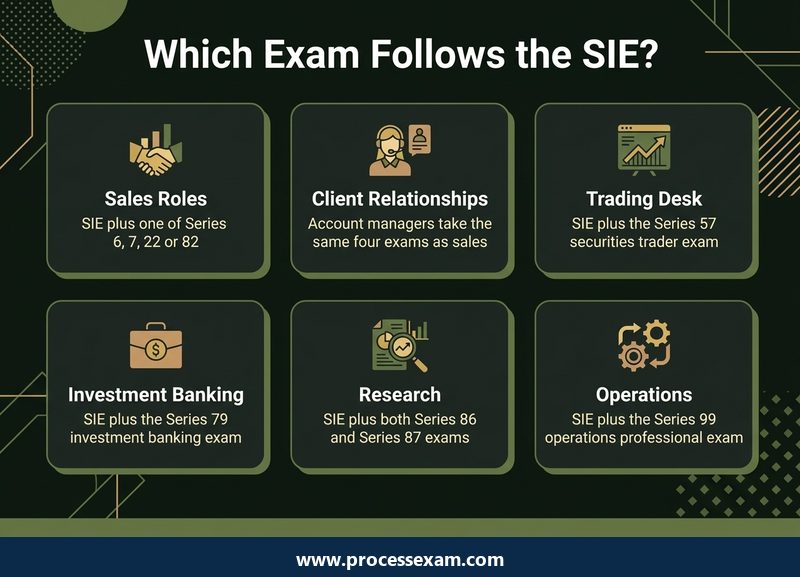
| Job family | Example job titles | Exam paired with the SIE |
|---|---|---|
| Sales | Financial consultant, investment advisor, institutional sales | Series 6, 7, 22 or 82 |
| Relationship management | Client services associate, account manager, financial planner | Series 6, 7, 22 or 82 |
| Trading | Equity trader, fixed income trader, market maker | Series 57 |
| Investment banking | M&A advisor, capital markets professional, equity research associate | Series 79 |
| Research | Research analyst, sector analyst, investment strategist | Series 86 and 87 |
| Operations | Trade settlement analyst, new accounts representative, margin analyst | Series 99 |
Compliance and supervision roles sit beside these families, and FINRA says supervisors take principal-level exams as their career develops and their firm needs. Those come later, after a representative-level registration, so they are not part of the first move.
How the two exams compare in size
The second exam is usually the bigger commitment. On FINRA's qualification exams page the SIE is 75 questions in one hour and 45 minutes for $100, while the Series 7, the broadest sales exam, is 125 questions in three hours and 45 minutes for $395. The Series 6 is closer to the SIE: 50 questions in one hour and 30 minutes for $100. Fees and lengths belong to each exam's own page, so treat these as a snapshot of what FINRA listed when this article was written.
What about the Series 63 and Series 65?
An older version of this article said that without the SIE the Series 63 and Series 65 cannot be pursued. FINRA does not support that. Its qualification exams page lists the Series 63, 65 and 66 under a separate heading as exams from the North American Securities Administrators Association, which sets state-law exams, while the SIE and the representative-level exams sit under FINRA's own headings. Whether a particular role needs a state exam depends on the state and the employer, so ask the firm or your state regulator rather than assuming the SIE unlocks them.
Do you need the second exam to be employed?
Not always. FINRA's registration rules are about who may engage in securities business. Plenty of back-office and support jobs involve no registration at all, and a firm may ask a new hire to start in such a role while it sponsors the qualification exam. In that sequence the SIE does its best work: you arrive having already cleared the first half of the requirement, and the firm only has to sponsor the second.
What do the four SIE sections test?
FINRA's content outline divides the 75 scored questions into four sections. The weights are the most useful number on the page, because they tell you where a wrong turn costs the most.
| Section | Share of questions | Questions |
|---|---|---|
| 1. Knowledge of capital markets | 16% | 12 |
| 2. Understanding products and their risks | 44% | 33 |
| 3. Trading, customer accounts and prohibited activities | 31% | 23 |
| 4. Overview of the regulatory framework | 9% | 7 |
The full topic list is in FINRA's SIE content outline, and the SIE syllabus breakdown on ProcessExam lays the same four sections out for study. The notes below show what each section asks of you.
Section 1: capital markets (16 percent, 12 questions)
This section is about the cast and the stage. You need to know what the SEC does, what a self-regulatory organisation is, and where other bodies fit: the Treasury and the IRS, state regulators, the Federal Reserve, the Securities Investor Protection Corporation and the FDIC. You also meet the market participants, from investors and broker-dealers to issuers, underwriters, transfer agents and clearing corporations.
Market structure covers the primary market, where securities are first sold, and the secondary market, plus the third and fourth markets. The economics piece asks how the Federal Reserve affects business activity, what the stages of the business cycle are, how leading and lagging indicators differ, and how things like GDP and exchange rates feed into markets. The last block covers offerings: initial public offerings, best-efforts versus firm-commitment underwriting, shelf registrations, prospectuses and the filing exemptions for private offerings. It is the lightest section by weight, but its vocabulary is used everywhere else, so a weak first section drags down the other three.
Section 2: products and their risks (44 percent, 33 questions)
Nearly half the exam sits here, so this is where your hours should go. The outline walks through every product family:
- Equities: common and preferred stock, rights, warrants and American depositary receipts, with questions on ownership, voting and order of liquidation.
- Debt: Treasury, agency, corporate and municipal bonds, plus money market instruments. Expect coupon, par value, yield, ratings, call features and the inverse relationship between bond prices and interest rates.
- Options: puts and calls, strike price, premium, expiration, in-the-money and out-of-the-money, covered versus uncovered, and the Options Disclosure Document.
- Packaged products: closed-end and open-end funds, unit investment trusts and variable annuities, with loads, share classes, net asset value, breakpoints, rights of accumulation and letters of intent.
- Municipal fund securities: 529 plans, local government investment pools and ABLE accounts.
- Other products: direct participation programs, real estate investment trusts, hedge funds and exchange-traded products.
The section also covers risk: capital, credit, currency, inflation, interest rate and reinvestment, liquidity, market, non-systematic, political and prepayment risk, together with the standard ways to reduce it, which are diversification, rebalancing and hedging. Study each product against the same four questions: who owns what, how does it pay, what can go wrong, and who is it suitable for. Questions in this section are often a product on one side and a risk on the other, so a table with products down the side and risks across the top is a good revision aid.
Section 3: trading, accounts and prohibited activities (31 percent, 23 questions)
This is the practical section, and the one that most resembles daily work at a firm. Trading covers order types such as market, limit, stop and good-til-canceled, principal versus agency capacity, long and short positions, investment returns, dividend dates, settlement and corporate actions such as splits, tender offers and mergers. Customer accounts cover cash, margin and options accounts, the ways an account can be registered, from individual and joint to trust, custodial and retirement accounts, and the paperwork a firm must keep.
Anti-money laundering has its own topic, including the stages of laundering, suspicious activity reports and currency transaction reports. Communications with the public, know-your-customer duties and best-interest obligations round out the account material. Then comes the prohibited list: market manipulation, insider trading, borrowing from customers, financial exploitation of seniors, and falsified records. It is a section of short rules and clear definitions, and it rewards candidates who can recognise a prohibited act from a one-paragraph description.
Section 4: the regulatory framework (9 percent, 7 questions)
The smallest section is about the people who will employ you. It covers registered versus non-registered persons, background checks and fingerprinting, statutory disqualification, and the two parts of continuing education, the Firm Element and the Regulatory Element. It also covers conduct: when to update Form U4 and Form U5, outside business activities, private securities transactions, gifts and business entertainment, political contributions, and reportable events such as felonies and bankruptcies. Seven questions is not many, but they are close to free marks for anyone who has read this part of the outline once.
Does a passing score of 70 mean answering 70 percent of the questions?
Not exactly. FINRA states that the passing score is 70 on a scale of 0 to 100 and that scores are placed on a common scale through a statistical process called equating. Equating adjusts for small differences in difficulty between the different sets of questions candidates receive, so that everyone is held to the same standard whichever set they got. A passing score of 70 is therefore a scaled result, not a simple count of 52 or 53 right answers out of 75, and nobody outside FINRA can tell you the exact raw cut-off.
Three other details from the outline help you plan. Each exam contains five extra, unscored pretest questions mixed in at random, so you will actually see 80 questions even though only 75 count, and you cannot tell which are which. There is no penalty for guessing, so never leave a question blank. And you cannot bring reference materials into the session, which means formulas and definitions have to be in your head.
FINRA does not publish a pass rate on the pages used for this article, so any percentage you see quoted online is someone else's estimate. A better readiness test is your own score on timed practice sets built around the four sections, with the products section showing consistently strong results.
How long does a pass last, and what happens if the first attempt fails?
FINRA's SIE frequently asked questions give the rules in two short answers. A pass stays good for four years, counted from the day you pass. If you join a broker-dealer inside that window and need to register as a general securities representative, you only need to pass the Series 7. If you register with a firm and later terminate your representative-level registration, the SIE is valid for four years from the termination date.
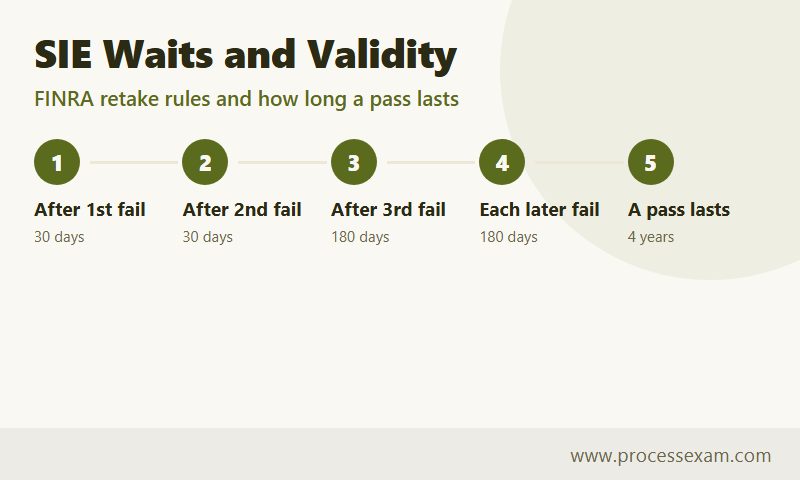
If you fail, the waiting periods are the same as for FINRA's other exams. After the first and second failed attempts you wait 30 days. After the third failed attempt you wait 180 days, and every attempt after the third also carries a 180-day wait. The schedule is the argument for treating the first sitting as a real attempt rather than a trial run: two quick failures cost you two months, but a third can cost you half a year.
Why the four-year clock shapes your timing
A student who passes the SIE in the first year of a four-year degree could find the pass expiring around graduation, before any firm has sponsored a second exam. A student who passes in the final year gets the full four years of runway to land a job, be sponsored for a Series exam and keep the SIE alive. A working professional should line up the SIE with a realistic hiring date, because the aim is to hold a valid SIE on the day a firm is ready to sponsor the next exam.
The SIE and the Series exam on the same day
Someone already associated with a broker-dealer is allowed to take the SIE and a qualification exam such as the Series 7 on the same day, if the testing centre has seats for both. The two are separate sessions. FINRA adds that it makes no difference which of the two you pass first, provided you pass both. For example, if you pass the Series 7 but fail the SIE on the same day, the Series 7 result still counts once you pass the SIE.
Where should your study hours go if products carry 44 percent of the exam?
Allocate time by weight and then adjust for what you already know. Suppose you have 40 hours. This is simple arithmetic on the FINRA weights, not a FINRA recommendation: about 6 hours for capital markets, 18 for products and risks, 12 for trading, accounts and prohibited activities, and 4 for the regulatory framework. If you come from a business degree, move an hour or two from section 1 to section 3. If you have never met an option or a bond, move time the other way.
| Section | Share of exam | Hours out of 40 |
|---|---|---|
| Capital markets | 16% | 6 |
| Products and their risks | 44% | 18 |
| Trading, accounts, prohibited activities | 31% | 12 |
| Regulatory framework | 9% | 4 |
A sequence that works
Start with the outline itself: read the whole thing once and mark each line as known, half-known or new. Then study in order of weight, products first, because the vocabulary of the other sections leans on it. Use short daily sessions rather than one long weekend, since a lot of the SIE is definitions and rules that only stick after a second and third exposure. Close each session with a handful of practice questions on that day's topic and write down the ones you miss.
In the last stretch, switch from topic questions to full-length practice that matches the real conditions: 75 questions, 105 minutes and no notes. When you want that rehearsal, a SIE practice exam run against the clock will show quickly whether your recall holds up under timing, and which of the four sections is losing you marks.
Mistakes that look like knowledge gaps
- Mixing up similar products. Closed-end and open-end funds, or REITs and DPPs, are asked about together, and a vague picture of each loses marks.
- Reading the bond-price rule backwards. When rates rise, prices fall. Check each yield and price question against that single rule.
- Treating the prohibited list as trivia. The questions describe a scenario and ask you to name the violation, so practise recognising the pattern, not reciting the name.
- Skipping section 4. Seven questions can be the difference between a pass and a fail when the score is close.
- Studying only from memory aids. Practice questions show where recall breaks; summaries only show what you already know.
What happens when you book and on the day of the exam?
You enrol through FINRA's own enrolment system. Students, people considering a securities career and formerly registered individuals without SIE credit can enrol themselves: create an account, pay by credit card or ACH or redeem a voucher, then schedule the exam at a Prometric test centre or online. FINRA recommends a Windows laptop or desktop for enrolment because users have reported problems on Mac, mobile and tablet devices. Organisations with access to FINRA's registration system can enrol staff, and other organisations can buy vouchers to hand out. FINRA also offers vouchers to schools, subject to limited supply, and says veterans who qualify for the GI Bill may be able to claim reimbursement of the SIE fee.
Get your details right when you enrol
You must give your Social Security number or, if you do not have one, your mother's maiden name. FINRA warns that this information has to match exactly what you later give a broker-dealer on Form U4. If it does not, your SIE result may not be imported into your registration record, and you could be required to retest. It is a dull detail, and it is also one of the few ways to lose a passed exam to paperwork.
On the day
The exam is computer-based and starts with a tutorial. FINRA says appointment times include an extra 30 minutes for the tutorial and the post-exam survey, so the booked slot is longer than the 105 minutes you get to answer. Reference materials are not permitted. Use the time like this: do a first pass of the questions you can answer cleanly, flag the ones that need working out, and use the remaining time on those. Because there is no penalty for guessing, answer everything before you submit.
After the result
You see pass or fail straight away. A pass puts the four-year clock in motion, so record the date. A fail comes with performance feedback, which tells you which sections to repair before the 30-day wait is over. Use it, and book the next attempt with a plan, not just a date.
How do you make an SIE pass count with employers?
A pass shows an employer that you have the foundations and have spent your own time and money on them. It is a signal of seriousness, not a guarantee of an offer. FINRA's own wording is modest on purpose: it says the SIE can help you distinguish yourself from peers, jumpstart your career goals and increase your marketability. The old advice that it gives a salary uplift or guarantees faster promotion is not something FINRA claims, and this article does not either.
Pay is not quoted here
An earlier version of this article listed salary ranges with no source. They are removed. Pay in securities roles depends on the firm, the city, the role and commissions, and no figure belongs in an article without a salary survey behind it. When you research pay, use a recognised salary survey for the specific job title and region, and treat any range on a blog, including this one, as a starting point to verify.
Four practical moves
- Put the pass date on your CV. List the exam, the year and the fact that it is valid for four years. A recruiter who knows the process will see how far along you are.
- Match the second exam to the job. Use the family table above. Applying to a trading desk and talking about the Series 57 is a stronger signal than saying you want to get licensed.
- Look for internships and the FINRA directory. The Financial Industry Networking Directory is built for individuals looking for full-time and internship roles with member firms.
- Ask the firm about sponsorship early. Qualification exams need the firm's sponsorship, so ask in the interview which exam they would enter you for and how soon.
A realistic route from degree to registration
Picture a business student who passes the SIE in the final year. She applies to an investment firm, is hired into a client service role, and the firm files her Form U4. She then sits the Series 7, which she needs alongside the SIE to register as a general securities representative. Each step is a FINRA requirement, and none of it needs the SIE to be repeated, provided the second exam comes inside the four-year window. The route is neither fast nor guaranteed, but it is clear, and the SIE is the only step you control entirely yourself.
Before you book, read FINRA's guidance on managing a securities industry career for the job families and the exams behind them, as FINRA may update the list.
Frequently Asked Questions
Do I need a sponsor to take the SIE exam?
No. FINRA says you do not need any association with a broker-dealer to take the SIE, and you do not have to be a US citizen. You must be 18 or older. A sponsoring firm is only required later, when you sit a qualification exam such as the Series 7.
How long is an SIE pass valid?
An SIE pass is valid for four years from the date you pass. If you register with a firm and later terminate your representative-level registration, FINRA counts the four years from the termination date instead. Plan the second exam inside that window so you never retake the SIE.
How much does the SIE cost and what score do you need?
The SIE fee is USD $100 and the exam is 75 questions in 105 minutes. The passing score is 70 on a scale of 0 to 100. FINRA places scores on a common scale, so 70 is a scaled score, not a plain count of correct answers.
Can I take the SIE and the Series 7 on the same day?
Yes, if you are associated with a broker-dealer and a Prometric centre has seats for both. FINRA treats them as separate sessions. The order you pass them does not matter, and you need both to register as a general securities representative.
What happens if I fail the SIE exam?
You can retake it after a waiting period. FINRA sets 30 days after the first and second failed attempts and 180 days after the third. Every attempt after the third also carries a 180-day wait. A failed result comes with performance feedback showing which sections to repair.
- FINRA Securities Industry Essentials Test Questions |
- SIE Question Bank |
- Securities Industry Essentials Exam (SIE) |
- Securities Industry Essentials Simulator |
- Securities Industry Essentials Mock Exam |
- FINRA Securities Industry Essentials Book |
- Securities Industry Essentials Certification Cost |
- Securities Industry Essentials Certification Requirements |
- FINRA Securities Industry Essentials Sample Questions |
- SIE Exam Questions Download |
- SIE Test Questions |
- Securities Industry Essentials PDF


