
SHRM-SCP Study Plan and Test Day Guide
The SHRM-SCP, short for SHRM Senior Certified Professional, is awarded by the Society for Human Resource Management, and its winter 2026-27 testing window opens on 1 December and runs to 15 February 2027. For anyone still preparing, that leaves somewhere between six and eleven usable weeks, a 134-question computer exam at a Prometric centre, and a choice that matters more than the length of the syllabus: how you spend those weeks and the final seven days.
What is the SHRM-SCP exam, and what are you preparing for?
The SHRM-SCP is the senior of SHRM's two certification exams, aimed at HR practitioners who work at a strategic level. This guide assumes your eligibility is settled; SHRM sets that out on its eligibility criteria page. What follows is about the part candidates tend to leave until too late: turning the exam's structure into a plan for the weeks you have and for the day itself. The figures below come from the exam sheet and from SHRM's own pages, checked in November 2026.
| Item | Detail |
|---|---|
| Credential | SHRM Senior Certified Professional (SHRM-SCP) |
| Questions | 134 (80 knowledge items and 54 situational judgment items; 24 of the 134 are unscored field-test items) |
| Testing time | 220 minutes |
| Exam fee, standard rate | Member - $399; non-member - $499 |
| Passing score | Pass / Fail (200 scaled score) |
| Winter window | Testing from 1 December 2026 to 15 February 2027; standard applications close 24 December 2026 at 11:59 p.m. ET |
| Delivery | In person at an authorized Prometric test center, on a computer |
One line of the handbook shapes everything that follows. SHRM's 2026 Certification Handbook divides the items by type: situational judgment is 40% of the exam, foundational knowledge 10% and HR-specific knowledge 50%. So the paper is two different kinds of work. Half of it rewards what you can recall and apply, and a large share of the rest rewards how you choose between actions that all look reasonable. A plan that treats both as "reading" will leave one of them under-trained.
How many study weeks do you really have before the window closes?
Count from Monday 30 November. The table converts a test date into the weeks you can actually study. The arithmetic is ours, and the last column draws on the handbook's scheduling rules rather than on any SHRM recommendation.
| Test in the week of | Study weeks from 30 November | What to weigh |
|---|---|---|
| 11 January 2027 | 6 | Works if your HR knowledge is current and you can study most days |
| 25 January 2027 | 8 | Room for every phase of the route below, with a short buffer |
| 8 February 2027 | 10 | Comfortable on study time, but inside the period where SHRM does not guarantee a new slot if you must move |
| 15 February 2027 | 11 | The final day of the window, so no margin if anything changes |
The reason the later dates are not simply better is in the handbook. Once your payment is processed, the authorization to test letter arrives by email within ten business days, and SHRM encourages you to book as soon as it does, searching a date range of at least seven to ten days to widen the choice. A candidate who cannot get an appointment forfeits all fees. The handbook also warns that anyone trying to reschedule less than thirty days before the window closes is not guaranteed a new appointment. Thirty days before 15 February is 16 January, so after that point a changed plan can mean no seat at all.
That argues for a date in the second half of January if you can manage it: far enough from the close to leave you a second chance, and long enough after 1 December to complete an eight-week route if you start now. If it is not realistic, SHRM allows one transfer to the next window per application for USD 150, and its exam options and fees page listed only the 2026 windows when we checked, so confirm the later dates there before you plan around them.
As a rough size for the work, eight weeks at six to eight hours a week comes to somewhere between 48 and 64 hours. That is an illustration to adjust against your own background, not a figure from SHRM.
How should you split the weeks between knowledge and judgment?
Split them by the kind of effort each half needs, not by chapter. Knowledge items reward retrieval: you read, close the book and try to say it from memory. Judgment items reward comparison: you meet a scenario, choose, and then explain why the other options are worse. The route below puts the knowledge work early, because facts need time to settle, and moves toward scenarios and the clock as the date approaches.
Week 1: map the content before you study it
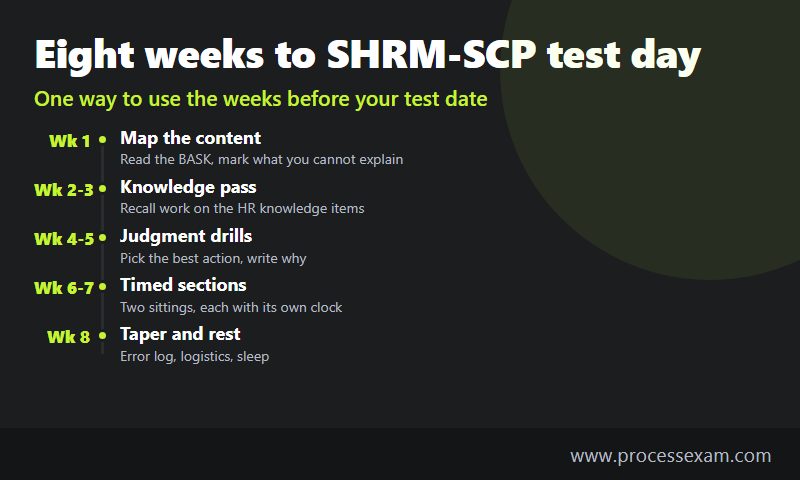
SHRM recommends starting with its Body of Applied Skills and Knowledge, the SHRM BASK, and looking closely at the proficiency indicators that separate the senior exam from the SHRM-CP. Read it with a pen. Beside each topic write one of three marks: can teach it, can follow it, or cannot explain it. The third mark becomes your list for the weeks ahead, and it is more useful than any chapter order.
Weeks 2 and 3: a recall pass over the knowledge items
Work through the HR knowledge domains, covering the topics marked "cannot explain" first. After each topic, close the material and write a short explanation from memory, then check it. Leave out anything you cannot tie to a work situation, because the exam asks you to apply knowledge as often as to state it. Keep a running error log: one line per slip, naming the idea, not the question.
Weeks 4 and 5: judgment drills
Now the scenarios. Do a handful at a time and give each one the same routine: choose the best action, then write one line on why it beats the runner-up. SHRM says that more than one strategy may work in real life, but you earn credit only for the best or most effective course of action. The runner-up line is the habit that trains for that. The next section sets out three tests for doing it quickly.
Weeks 6 and 7: timed sections
Rehearse the structure, not just the content. The real exam is two separate sections, each with its own countdown, and you cannot go back once you move on. Run a paper as two sittings with a firm stop on each. For this you need items you have not met before: the SHRM-SCP practice exam is one source of unseen questions to split across two sittings, and SHRM's own practice questions are another. SHRM notes that performance on its samples does not predict performance on the exam, so read the result as a pacing check, not a forecast.
Week 8: taper
No new topics. Revisit the error log, do light recall of the "cannot explain" list, and keep the logistics from the sections below on your calendar. The aim is to arrive rested, because a long exam punishes fatigue, and judgment items are where it shows first.
How do you work a situational judgment item under the clock?
Start with the time budget. Dividing 220 minutes by 134 items gives a little over a minute and a half per item on average. That average hides a spread: a knowledge item you know takes seconds, while a scenario with four plausible actions takes longer, so the saving on the first kind pays for the second. Because the sections are timed separately and unused time does not carry forward, set a checkpoint inside each one. When the section clock reaches its halfway point you should be roughly halfway through the questions. That is our rule of thumb, not a SHRM instruction.
Then use three tests on each option. They are quick enough to run in seconds and they remove most wrong answers before you compare the rest.
- The sequence test. Ask what must already be true before this action makes sense. Jumping to discipline, a policy change or an announcement before the facts are known fails here.
- The ownership test. Ask whether the action stays within your role. An option that hands the problem to someone else, or takes over a job that belongs to a manager or another function, fails here.
- The proportion test. Ask whether the response fits the size of the signal. A company-wide measure for a single plant's issue is too heavy; a quiet word for a serious pattern is too light.
A worked example, written by us
The scenario below is invented for this guide and is not a SHRM item. Reported safety incidents at one plant have doubled in a quarter. The plant director says it only shows that people are now more willing to report, and asks HR to leave it alone. You are the senior HR lead for the region. What is the best first action?
- Option A. Send every plant a reminder of the safety policy.
- Option B. Review the reports with the plant's safety lead to see which incident types rose and where, then agree the findings with the director before choosing a response.
- Option C. Open a formal investigation into the plant's supervisors.
- Option D. Accept the director's explanation and record the rise as a healthy reporting culture.
Option D fails the sequence test: it accepts an explanation before anyone has looked at the data. Option C fails it too, from the other side, because it assigns blame before the facts exist. Option A fails proportion, a blanket message for what may be one plant's pattern, and it does nothing about the signal itself. Option B passes all three: the facts come first, the person who owns the safety data is in the room, and the director is brought in before anything is decided. Notice that the best answer was neither the most decisive nor the most cautious. It was the one that put the steps in the right order.
When two options both pass, ask which one you would be comfortable explaining to the people affected. Fair, transparent and consistent usually beats clever. For practice material, work through SHRM's own SHRM-SCP practice questions and the SHRM-SCP sample questions on our site, and for each item write down which of the three tests removed each wrong option.
What should the final week look like?
The last week has one job: to take uncertainty out of the day. Nothing you learn in these seven days will change your result as much as a name mismatch at check-in or a missed appointment.
| When | What to do |
|---|---|
| Seven days out | Finish your last full rehearsal as two separate sittings, at the same time of day as your appointment. Review the errors, then stop adding new material. |
| Six to four days out | Short recall sessions on the topics you marked "cannot explain" in week one, and a handful of scenarios with the three tests. |
| Three to two days out | Check the logistics: your confirmation email, the confirmation number, the centre's address and your route. The confirmation number is different from the Eligibility ID on your authorization letter, and you need the confirmation number to confirm, reschedule or cancel. |
| The day before | Set out your ID, finish studying by early evening and protect your sleep. |
| Test day | Eat, arrive early, and put everything except your ID in the locker without a second thought. |
The name check deserves its own look because it is the one failure that no amount of study can fix. The handbook says the name and photo on your ID must exactly match the name on your authorization letter, or you will not be allowed to test. Its own examples are instructive: an application in the name William B. Johnson with an ID reading Bill Johnson is not admitted, while Jamie Taylor-Smith applying with an ID reading Jamie Smith is. If your name has changed since you applied, the handbook asks you to submit a name change request through the online portal at least ten business days before the exam, so do not leave it to the final week.
SHRM also sells half-length preview exams in an app, which its handbook describes as a replica of the real exam with feedback and rationales. If you use one in the last week, treat it as a rehearsal of pace and calm, not as a score to worry about.
What will the test centre expect from you before and during the exam?
Expect a security check closer to an airport than a classroom. The handbook describes the SHRM exams as delivered in highly secure Prometric centres, supervised by trained proctors, with the sessions monitored and possibly recorded in audio and video. Knowing the routine ahead of time takes away a surprising amount of stress.
At check-in
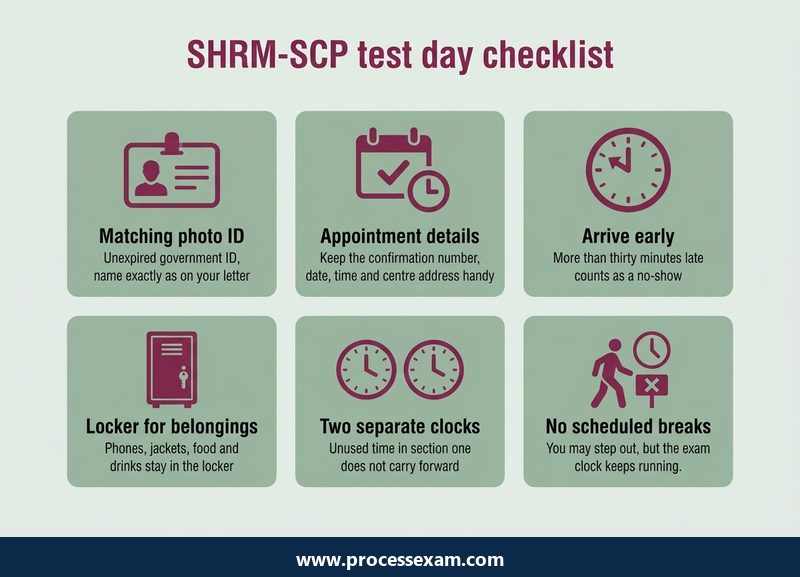
- Identification. You need an unexpired, original government-issued photo ID that carries your signature. If the primary ID lacks a photo or signature, a secondary ID with the missing element is needed, in the same name. Without suitable ID, contact SHRM at least five business days before the appointment.
- Belongings. Lockers are provided for purses, mobile phones, jackets, food, drinks and medical supplies. Smartwatches, tablets, wireless earbuds and any other wearable or electronic device are prohibited in the centre.
- Your person. Jewellery other than wedding and engagement rings is not allowed, you will be asked to empty your pockets, and you will be wanded or sent through a metal detector. Religious headwear may be worn but can be inspected.
During the exam
- No scheduled breaks. Stepping out of the room is allowed, yet the timer does not stop while you are gone, and you may not leave the testing facility. Decide before the day whether you will step out at all, and assume any break comes out of your own time.
- No phones or notes. Accessing a mobile phone or study material after arriving at the centre, including during a break, is prohibited.
- Noise. Other exams run at the same time, so you may hear typing, coughing and people coming and going. Prometric cannot offer a noise-free room, but you can ask for headphones or earplugs.
Arriving on time
The handbook counts you as a no-show, and you forfeit all fees, if you arrive more than thirty minutes after your appointment time or arrive without proper identification. A no-show is not a rescheduling problem; there is no refund and no transfer. Build your travel plan around that line, not around the appointment time itself.
What if your plans slip, and what happens after you finish?
Plans slip for ordinary reasons, and the handbook's rescheduling rules reward the candidate who decides early. A request goes through Prometric, which charges its own cancellation fee.
| When you ask | Can you reschedule? | Cost |
|---|---|---|
| Thirty or more calendar days before the appointment | Yes | USD 45 Prometric cancellation fee |
| Between five and 29 calendar days before | Yes | USD 60 Prometric cancellation fee |
| Fewer than five calendar days before | No | Treated as a no-show; all fees forfeited |
Two further rules sit around that table. All SHRM certification fees are nonrefundable, apart from individually assessed medical or personal emergencies. And the one-time transfer to the next window, for USD 150 plus any Prometric fee, must be requested no later than five business days before the appointment, after you have cancelled it. In practice a doubt about your readiness is cheapest to act on early, ideally before the thirty-day mark, and mid-January is the last point at which a move fits comfortably inside this window.
When you finish
You will see a preliminary pass or did-not-pass decision at the centre when you finish. About two to three weeks afterwards SHRM sends an email telling you to fetch the official result from your portal; the result itself is never sent by email, phone or fax. Passing candidates all receive the maximum scaled score of 200. The report carries a diagnostic graph across the three behavioural competency clusters and the three HR knowledge domains, which is the map to use if you retake.
A retake is allowed, with no limit on attempts, but not in the same window. You apply again as a new candidate in a later window and pay the full exam fee. Check SHRM's SHRM-SCP page for the current exam description before you commit to a date, because windows and fees are reset each year.
Frequently Asked Questions
What is SHRM-SCP?
SHRM-SCP is the SHRM Senior Certified Professional credential from the Society for Human Resource Management. It is awarded to HR practitioners working at a strategic level who pass SHRM's computer-based exam, which has 134 questions and is taken in person at a Prometric test centre.
What types of questions are on the SHRM-SCP exam?
The 134 questions are 80 knowledge items and 54 situational judgment items. Knowledge items test facts and understanding. Judgment items present a workplace scenario and ask for the best of several actions. Twenty-four of the 134 are unscored field-test items mixed in at random, so you cannot tell which they are.
When is the next SHRM-SCP testing window?
SHRM's winter 2026-27 window runs from 1 December 2026 to 15 February 2027. Standard applications close on 24 December 2026 at 11:59 p.m. ET. SHRM runs two windows a year, so check its exam options and fees page for later dates before planning past February.
How many weeks should you study for the SHRM-SCP?
SHRM publishes no recommended study hours. From the end of November, a test date in the second half of January gives about eight weeks, which is enough for a mapped content review, judgment practice and two timed rehearsals. Adjust the length to how current your HR knowledge already is.
Can you reschedule a SHRM-SCP exam appointment?
Yes, through Prometric. A request made thirty or more calendar days ahead carries a USD 45 fee, and one made between five and 29 days ahead carries USD 60. Within five calendar days you cannot reschedule, and the booking is treated as a no-show with all fees forfeited.
- Human Resources |
- SHRM Senior Certified Professional Test Questions |
- SHRM-SCP Question Bank |
- SHRM Senior Certified Professional Book |
- Senior Certified Professional Certification Cost |
- Senior Certified Professional Certification Requirements |
- SHRM Senior Certified Professional Sample Questions |
- SHRM-SCP Exam Questions Download |
- SHRM-SCP Test Questions |
- Senior Certified Professional PDF |
- SHRM-SCP BASK


