
SHRM-CP vs SHRM-SCP: Which Certification Fits Your Role?
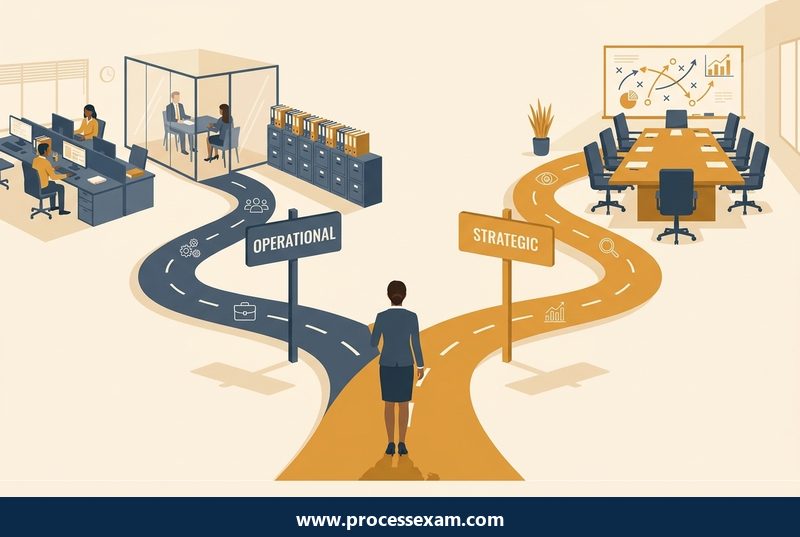
Two buttons sit on the SHRM application screen, and one question settles which you press: is the HR work you do today operational or strategic? SHRM-CP is built for professionals who carry out general HR duties; SHRM-SCP is built for those who set HR strategy and policy. Both exams run to 134 questions inside the same four-hour appointment. What changes is the level of judgement each one expects from you.

That single distinction decides more than which exam fee you pay. It decides which half of the SHRM Body of Applied Skills and Knowledge you are scored against, how the situational-judgement questions are marked, and whether the credential you end up holding actually describes the job you do. Choose wrongly and you either sit an exam pitched above your daily work, or you earn a credential that undersells the role you already hold.
This guide is not a pass-first-time playbook. It answers the questions that come before and after that: which of the two credentials belongs on your signature, why the competency half of the exam behaves so differently from the knowledge half, what the three-year recertification cycle really asks of you, and what the letters change about a career once you have them.
SHRM-CP or SHRM-SCP - which one is your exam?
SHRM runs two credentials for the same profession, not a beginner version and an advanced version of one qualification. Both are earned by examination, both draw on the same body of knowledge, and neither expires faster than the other. They differ in the altitude at which they expect you to work.
The seniority test that settles it
SHRM describes SHRM-CP as being for people who "perform general HR and HR-related duties at work; or for those pursuing a career in Human Resource Management", and says a candidate's current or recent HR work should be "operational in nature". SHRM-SCP is written for candidates whose work "is strategic in nature (i.e., drives culture, creates HR strategy, develops policy, etc.)".
Translate that into a test you can apply in thirty seconds. Ask what happens to your working week if a senior leader changes the company's direction. If your week fills with implementation - rewriting a policy, rerunning a hiring plan, reworking a benefits communication, retraining managers - your work is operational and SHRM-CP is your exam. If your week fills with defining that direction for people - deciding what the culture has to become, writing the strategy the implementation will follow, choosing what the organisation will stop doing - your work is strategic and SHRM-SCP is your exam.
Job titles are a poor guide here. An HR Manager in a 60-person business often makes genuinely strategic calls; an HR Director inside a large group may spend the year executing a group-level strategy written elsewhere. SHRM publishes its own side-by-side comparison on the page where it explains how to choose between its credentials, and it is worth reading against your actual calendar rather than your title.
Where the two credentials are identical
It helps to know what the choice does not change. Both exams contain 134 questions. Both are delivered in a four-hour appointment. Both are reported as pass or fail against a scaled score rather than a percentage. Both are recertified on the same three-year, 60-credit cycle. Both are recognised by the same employers, because both come from the same body.
So the decision is not about difficulty in the ordinary sense. A candidate who sits the wrong exam does not fail because the questions are harder; they fail because the questions assume a vantage point they do not yet occupy.
What aiming too high actually costs
Candidates who reach for SHRM-SCP before their work has become strategic tend to lose marks in a specific place: the scenarios where several options are defensible and the credited answer is the one a person accountable for the whole organisation would choose. Reading about strategy does not reliably produce that instinct; doing strategic work does. There is no penalty for earning SHRM-CP first and moving up later, and a great many credential-holders do exactly that.
Why do two exams with the same format measure different things?
The mechanism behind the difference is the SHRM BASK - the SHRM Body of Applied Skills and Knowledge, which replaced the older SHRM Body of Competency and Knowledge and was most recently updated in 2021. If you learned about SHRM certification some years ago and remember the acronym SHRM BoCK, this is the same framework under its current name, and the current name is the one SHRM's study materials use.
Inside the BASK, each behavioural competency is described by proficiency indicators, and those indicators come at two levels: one set "For All HR Professionals" and a second set "For Advanced HR Professionals". The SHRM-CP exam is built against the first set only. The SHRM-SCP exam is built against both. That is the whole engine of the distinction - not different subjects, but a different bar for what counts as competent behaviour in the same subject.
A worked illustration makes it concrete. Take the competency of Consultation. At the level SHRM-CP tests, a strong answer identifies the business problem behind a manager's request and proposes an HR solution that fits it. At the level SHRM-SCP adds, a strong answer also weighs that solution against the organisation's strategy, its risk appetite and what it will cost the business elsewhere. Both answers are good HR. Only one of them is the credited answer on the senior exam.
SHRM publishes the full framework, including every proficiency indicator at both levels, in the SHRM BASK. Read the indicators for your own exam and ignore the other set. Candidates who study both dilute their preparation and start second-guessing answers that were already correct.
What sits on the knowledge half of the SHRM-CP exam?
SHRM splits the exam down the middle. Approximately half the items are allocated across the three behavioural competency clusters, and the other half across the three HR knowledge domains. Those knowledge domains - People, Organization and Workplace - between them hold fourteen functional areas, and they are the part of the exam that behaves like a traditional subject test.
Here are the SHRM-CP figures in one place.
| Exam detail | SHRM-CP |
|---|---|
| Certification | SHRM Certified Professional (SHRM-CP) |
| Vendor | SHRM |
| Exam code | SHRM-CP |
| Category | Human Resources |
| Number of questions | 134 |
| Duration | 220 minutes |
| Exam fee | Member - $399 Non-member - $499 (standard rate) |
| Result | Pass / Fail (200 Scaled Score) |
SHRM reviews its fees, application windows and testing dates between cycles, so confirm the current figures on SHRM's own SHRM-CP exam page before you apply. Of the 134 questions, SHRM states that 80 are knowledge items and 54 are situational-judgement items, of which 24 are field-test items that do not count toward your result.
People
The People domain covers HR Strategy, Talent Acquisition, Employee Engagement and Retention, Learning and Development, and Total Rewards. This is the domain most HR professionals already live in, which makes it the one candidates most often under-prepare. The exam does not ask what a compensation structure is; it asks which structure answers a described problem, and why the obvious alternative does not.
Organization
The Organization domain covers Structure of the HR Function, Organizational Effectiveness and Development, Workforce Management, Employee and Labor Relations, and Technology Management. Technology Management is worth singling out. It is not a question about which HR system you use; it covers how technology supports the HR function and the policies that govern its use in the workplace, which is territory many candidates have never had to articulate in words.
Workplace
The Workplace domain covers Managing a Global Workforce, Risk Management, Corporate Social Responsibility, and U.S. Employment Law and Regulations. That last area is the one international candidates ask about most. It sits inside the SHRM-CP exam regardless of where you work, so a candidate based outside the United States has to learn it as examinable content rather than as daily practice.
How do situational-judgement items work, and why do they catch people out?
The other half of the exam is where prepared candidates lose marks they did not expect to lose. A situational-judgement item describes a workplace scenario - a manager who has done something unwise, a conflict between two departments, a policy that is producing an outcome nobody intended - and offers several courses of action. None of them is absurd. That is the point.
Why "a good answer" is not "the best answer"
Knowledge items have a right answer. Situational-judgement items have a best answer, and the gap between the two is where the exam does its work. Three of the options may be things a competent HR professional could reasonably do. The credited option is the one that best reflects the proficiency indicators for the competency being tested: it addresses the real problem rather than the presenting symptom, it respects the organisation's process, and it does not create a larger issue somewhere else.
Candidates who read quickly tend to pick the option that feels most decisive, or the one that would make the immediate irritation go away. The exam rewards neither. It rewards the option that a well-functioning HR function would still defend a month later.
How to rehearse judgement rather than recall
Flashcards do not help here, because there is nothing to memorise. What helps is arguing with yourself in writing. Take a scenario, choose your answer, then write one sentence explaining why each of the other options is worse. If you cannot explain why an option is worse, you have not yet understood the competency it is testing - and that is the gap the exam will find.
Do that against full-length, timed sets rather than a handful of questions, because pacing matters too: 134 items across a four-hour appointment leaves little room to deliberate at length over any single scenario. A SHRM-CP mock exam run end to end under the clock will tell you two things a study guide cannot - how your judgement holds up when you are tired, and whether your reasoning survives contact with questions you have not seen before.
What does it take to hold on to SHRM-CP for the next three years?
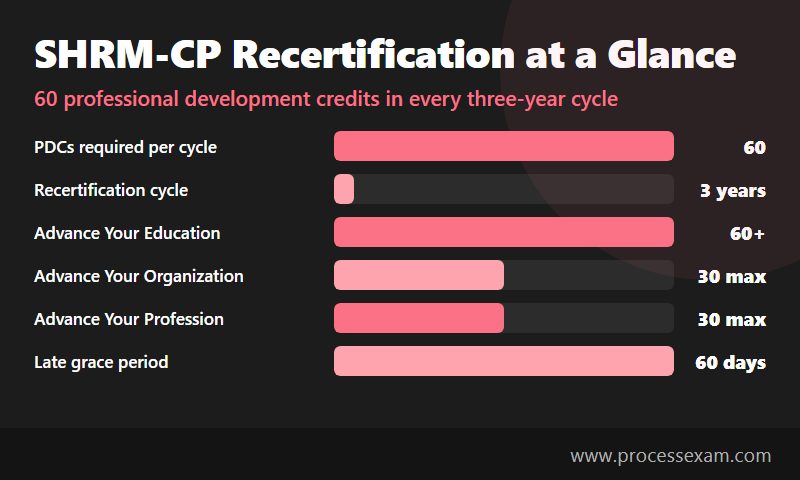
Passing is the shorter half of the commitment. SHRM-CP is not awarded for life. Every credential-holder earns 60 professional development credits, known as PDCs, within a three-year recertification cycle that runs from the date you pass to the last day of your birth month in the third year. Miss that, and the credential lapses.
The three ways to earn PDCs
SHRM groups qualifying activity into three categories, and two of them are capped.
- Advance Your Education. Conferences, seminars, webcasts, e-learning and other structured learning. There is no PDC maximum in this category, so a credential-holder can in principle earn all 60 credits here.
- Advance Your Organization. Work projects that apply HR knowledge to your employer's problems, credited by hours: a 40-hour project earns 10 PDCs, an 80-hour project 20, and a 120-hour project 30. The category is capped at 30 PDCs per cycle.
- Advance Your Profession. Speaking, writing, volunteer leadership, mentoring and similar contributions to the profession itself. Also capped at 30 PDCs per cycle.
The caps matter more than they first appear. Because two of the three categories stop at 30, at least some of your 60 credits will usually have to come from Advance Your Education - which means recertification is not something you can complete entirely through your day job. SHRM sets out the qualifying activities and the current fees on its recertification pages.
What happens when the cycle runs out
There is a 60-day grace period after the end of your cycle in which you can still submit, at a higher late fee. After that the credential is no longer current, and recovering it means sitting the exam again. The practical lesson from credential-holders who have been through a lapse is the same every time: log the PDCs as you earn them rather than reconstructing three years of activity in the final month.
Recertifying by examination
There is a second route. Instead of collecting PDCs you may retake the certification exam within the last year of your cycle, no earlier than twelve months before it ends, after contacting SHRM first. It is a genuine option for someone whose three years contained little qualifying activity, but it carries a real risk: if you sit it and do not pass, the credential is revoked and the PDC route is no longer available to you for that cycle. Most people should treat it as a fallback rather than a plan.
Can you move up to SHRM-SCP later, and when should you?
Yes, and the path is more open than candidates expect. Holding SHRM-CP is not a prerequisite for SHRM-SCP, and SHRM-SCP is not a second exam you sit on top of the first. They are separate credentials, and you apply for the senior one when your work has changed, not when a waiting period has elapsed.
The signal to watch for is the same seniority test, applied again. When your week has stopped being dominated by implementing decisions and started being dominated by shaping them - when you are the person being asked what the organisation should do about a people problem, rather than the person asked to carry out the answer - the senior exam has become the one that describes you.
Two practical points. First, once you hold SHRM-SCP you hold that credential rather than both: there is no value in maintaining two cycles for the same profession. Second, the preparation is not simply "more of the same". The knowledge domains do not change; what changes is the level the situational-judgement items are pitched at, which is why working through a SHRM-SCP practice exam is a more honest readiness check than re-reading material you already know.
Timing is personal, but a useful rule of thumb is to move when you have spent at least a full performance cycle making strategic calls, not merely attending the meetings where they are made.
What does SHRM-CP change about your career, and what does it not?
It is worth being straight about this, because the credential is often sold as a promotion in an envelope, and it is not.
What it reliably does: it clears a filter. A growing number of HR job advertisements list SHRM-CP or an equivalent as preferred or required, and applicant tracking systems screen on exactly that string. A credential you hold is a box that gets ticked before a human reads your CV. It also standardises your vocabulary - after preparing against the BASK, you describe HR problems in the same terms as the people interviewing you, which is a quieter advantage but a real one. And it signals current knowledge, because the three-year cycle means a current credential cannot have been earned and abandoned a decade ago.
What it does not do: it does not substitute for experience. The exam certifies that you can apply HR knowledge at an operational level; it does not certify that you have run a redundancy programme, rebuilt a broken hiring process or handled a grievance that went wrong. Interviewers will still ask about those, and the credential will not answer for you. Nor does it guarantee a salary increase. Some employers pay a differential for certification and some do not, and the honest answer for any individual depends on the employer, the market and the role rather than on the letters themselves.
Where it pays off most clearly is at transitions. Moving from a generalist role into a specialism, from a small employer to a large one, from an administrative HR job into a managerial one, or from another country's HR system into a US-centred organisation - these are the moments when an external, examined benchmark does work your CV cannot do alone. For someone already established and respected in a stable role, the effect is smaller and slower.
The realistic way to think about SHRM-CP is as a credential that removes obstacles rather than one that creates opportunities. It gets you seen, it gives you a shared professional language, and it commits you to keeping current for as long as you hold it. What you do with the seeing, the language and the currency is still the part that determines the career.
Frequently Asked Questions
What does SHRM-CP stand for, and what does it certify?
SHRM-CP stands for SHRM Certified Professional, a credential awarded by the Society for Human Resource Management. It certifies that you can apply HR knowledge and behavioural competencies at an operational level, meaning you carry out general HR duties rather than setting HR strategy and policy for an organisation.
What is the difference between the SHRM-CP and SHRM-SCP exams?
Both exams have 134 questions and share the same body of knowledge. SHRM-CP is scored against proficiency indicators written for all HR professionals, while SHRM-SCP is scored against those plus a second set for advanced HR professionals. The difference is the level of judgement expected, not the subjects covered.
Does the SHRM-CP certification expire?
Yes. SHRM-CP runs on a three-year recertification cycle ending on the last day of your birth month in the third year. Holding it requires 60 professional development credits inside that cycle, or retaking the exam in its final year. A 60-day grace period applies, at a late fee.
How many questions are on the SHRM-CP exam and how long is it?
The SHRM-CP exam has 134 questions and a duration of 220 minutes, delivered inside a four-hour appointment. SHRM states that 80 are knowledge items and 54 are situational-judgement items, of which 24 are field-test questions that are not counted toward your result.
Can you take SHRM-SCP without holding SHRM-CP first?
Yes. SHRM-CP is not a prerequisite for SHRM-SCP; they are separate credentials rather than two levels of one qualification. You apply for SHRM-SCP when your HR work has become strategic in nature, and there is no waiting period or earlier credential you must hold first.
- SHRM Certified Professional Exam Questions |
- SHRM Certified Professional Question Bank |
- SHRM Certified Professional Questions |
- SHRM Certified Professional Study Guide |
- SHRM-CP Quiz |
- SHRM-CP Certification |
- SHRM-CP Questions |
- SHRM-CP Practice Test |
- SHRM-CP Study Guide Material |
- SHRM-CP Sample Exam |
- Certified Professional Certification |
- SHRM Certified Professional |
- SHRM Certified Professional Book |
- Certified Professional Certification Cost |
- Certified Professional Certification Requirements |
- SHRM Certified Professional Sample Questions |
- SHRM-CP Exam Questions Download |
- SHRM-CP Test Questions |
- Certified Professional PDF |
- SHRM-CP BASK


