
Are You Ready for the ServiceNow CSA Exam? A Readiness Check
A popular myth says that scoring well on a few practice attempts means you are ready for the ServiceNow Certified System Administrator (CSA) exam. It does not, because one score hides which domains produced it and whether you had already met the questions. The CSA is 60 questions in 90 minutes for USD $300 and is reported only as Pass or Fail, so readiness is a pattern you read, not a number you chase.

This guide is for the candidate who has studied for a few weeks and now wonders whether to book. It shows how to set the blueprint weights against your own weak areas, what different score patterns on mock attempts really mean, how the scenario questions are built, and the signals that say it is time to pick a date. The question here is judgement, not method.
Is the CSA exam hard, and for whom?
People who ask whether the CSA exam is hard usually want a single answer, and there is not one. The exam is hard for a candidate who has only watched the platform and has never configured it, because the questions describe a business request and ask what an administrator should do. It is much gentler for someone who has spent a few months building forms, lists, catalog items and access rules on a real instance. The same paper feels like two different exams.
The difficulty is also uneven inside the paper. The blueprint on ServiceNow University splits the exam into six domains, and the heaviest one, database management and platform security, carries almost a third of the questions. A candidate who loves navigation and forms but avoids imports and access control can feel confident for weeks and still sit well below the line on exam day, because the areas they skip are the areas the paper rewards.
What makes it feel harder than the syllabus suggests
- Answers that are all partly true. Several options describe something ServiceNow can really do. Only one fits the stated requirement with the least effort or the right tool.
- Multi-select questions. Some questions ask for two or three answers and say how many. A candidate who picks one correct answer out of two gets no credit for it.
- Terms that look alike. UI policy and business rule, role and group, import set and transform map, update set and application: the pairs are easy to swap when you have only read about them.
So the useful question is not whether the exam is hard in general. It is whether it is hard for you, in the domains the paper weights most. The rest of this guide is a way to answer that with evidence instead of mood.
How do you set the blueprint weights against your own weak areas?
Most study guide advice says to follow the blueprint, which is correct and not very useful: it gives every domain equal attention in your calendar and unequal weight on the paper. A better habit is to multiply two things you can state honestly, the weight of a domain and the size of your gap in it. The domain names and weights come from the mainline CSA exam blueprint on ServiceNow University; the topic lists sit on our CSA syllabus page.
A quick gap map
Rate each domain from one (never done it) to five (could teach it). Subtract your rating from five to get a gap, then multiply the gap by the domain's weight. The domain with the biggest result is where your next study hours belong. Here is a worked example for an administrator who is comfortable with lists and forms but has rarely run an import or an access rule:
| Domain | Weight | Self-rating (1-5) | Gap x weight | Share of your effort |
|---|---|---|---|---|
| Database Management and Platform Security | 30% | 2 | 90 | 36% |
| Self Service & Automation | 20% | 2 | 60 | 24% |
| Data Migration and Integration | 13% | 1 | 52 | 21% |
| Instance Configuration | 10% | 3 | 20 | 8% |
| Configuring Applications for Collaboration | 20% | 4 | 20 | 8% |
| Platform Overview and Navigation | 7% | 4 | 7 | 3% |
Read the table the way a coach would. The candidate in the example rates themselves low in security and imports, and those two domains together take over half of the effort. The 20 percent collaboration domain, which sounds heavy, earns only a small share because the gap is small. That is the point: a heavy domain you already know is a place to hold, not to study.
Rate yourself with evidence, not with feeling
A self-rating drifts upward when the topic feels familiar. Anchor each number to something you did in the last fortnight. A five means you could set up the feature on a blank instance without notes; a three means you can do it with the documentation open; a one means you can only describe it. If you cannot name the last time you configured a feature, rate it a two at best. The honest version of this table is a little humbling and far more predictive than a confident one.
Redo the gap map every week. A domain that moves from a two to a four drops out of the top of the list, and the next-weakest one takes its place. When no row has a gap larger than one, the map is telling you that blueprint coverage is no longer your problem and the remaining risk sits in how you read questions.
Does a high score on practice attempts mean you are ready?
Not by itself, and this is where the myth in the opening does its damage. A score is an average across domains and across question types, and it can come from very different shapes of knowledge. Two candidates who both score high on a mock can be one step from passing and one step from failing, depending on what the score is made of and whether the questions were new to them.
What different score patterns on mock attempts actually mean
Look at three or more attempts side by side before you draw a conclusion. The shape matters more than any single figure:
| Pattern across attempts | What it usually means | What to do next |
|---|---|---|
| Flat and middling | A general gap in understanding, not a few missing facts; reading more of the same material is not moving you. | Stop re-reading. Build the weakest feature on a Personal Developer Instance, then retest only that domain. |
| Rising fast on repeated questions | You are learning the answers, not the platform. The rise says little about new questions. | Switch to questions you have never seen, or rewrite each one as a configuration you would perform. |
| High overall, one domain far below the rest | A hidden hole. On the real paper that domain may be larger or phrased differently than in your set. | Treat that domain as the whole exam for a week; the overall score is not a safe guide. |
| Swinging widely from attempt to attempt | Guessing between plausible answers. Your knowledge is real but not yet stable. | Review the questions you got right by luck as carefully as those you missed. |
| Steady, no weak domain, new questions | The pattern readiness looks like. | Plan the booking, and keep a light revision rhythm until the day. |
The fourth row catches more candidates than any other. A swing from low to high between two sittings feels like progress, but it often means that on the good day the plausible-looking options happened to fall your way. Readiness shows up as a boring graph: close results, no domain far behind the others, and a missed-question list that no longer repeats the same topic.
Why your own wrong answers are the best data
Keep a short log with one line per missed or guessed question: the domain, why the wrong option was tempting, and the rule that decides it. After two or three attempts the log shows whether your misses cluster on a topic, on a way of reading, or on carelessness with the stated number of answers. A cluster on one topic is a study problem. A cluster on reading is a technique problem, and no extra revision fixes it. This log is also the quickest way to see that a repeated question has stopped teaching you anything, which is the moment to move to fresh material.
Which scenario-question styles should you expect, and how do you take them apart?
The CSA does not test whether you can recite menu paths. It describes a small business situation and asks which feature, setting or approach resolves it. Once you recognise the common shapes, each one becomes a short routine rather than a surprise. These are the styles worth rehearsing; the vendor does not publish a style list, so treat them as patterns seen in the blueprint topics rather than an official classification.
The "which tool" scenario
A requirement is stated and the options name four different mechanisms. The skill is knowing the boundary between them. Behaviour on a form that must react as the user types points to client-side logic; a rule that must hold no matter how a record is saved points to server-side logic; a rule about who may read or change a record points to access control. Ask yourself where the rule must be enforced and who must be affected, and two of the four options usually fall away at once.
The "least effort" scenario
Several options would work, and the question asks for the simplest, the most maintainable or the one that avoids scripting. The trap is choosing the clever answer. Platform configuration generally beats custom code when both meet the requirement, so rank the options by how little they ask of the next administrator to maintain, and choose accordingly.
The "who can see what" scenario
These describe a user, a role or a group and ask what that person can do on a table, field or record. Walk the request in order: does the person have a route to the record at all, then to the table, then to the field? Draw it on scratch paper if the exam interface lets you note it down. Candidates who answer from the first rule they remember tend to miss the case where a more specific rule applies.
The "what happens next" scenario
The question gives a sequence, an import with a particular key setting or a customization captured in a particular way, and asks for the result. These reward candidates who have actually run the process. If you have loaded the same file twice with and without a matching key, or moved a change between two instances, you can predict the outcome. If you have only read the description, you are guessing between equally sensible endings.
The multi-select scenario
When a question asks for more than one answer and states how many, read that sentence before you read the options. Decide on each option separately as true or false for the scenario, then count. If you find three plausible choices and the question asks for two, return to the stem and look for the word that rules one out, usually a limit such as "without code", "for all users" or "only for one group".
A routine that works on all of them
- Read the last sentence of the question first, so you know what you are being asked to produce.
- Read the scenario and underline the constraint in your head: who, how many, with or without code.
- Cross out options that fail the constraint before choosing among the rest.
- If two options remain, choose the one that uses a built-in capability over a custom one.
- Mark it and move on if you are still unsure after a short pause, and come back with the time you saved.
What do the exam facts mean for pacing and for your readiness test?
The exam facts are short, and they shape how you should rehearse. These are the figures for the paper you are preparing for; confirm the current fee and any conditions in your ServiceNow University account before booking, because the vendor can change them.
| Exam detail | ServiceNow CSA |
|---|---|
| Exam name | ServiceNow Certified System Administrator |
| Exam code | CSA |
| Vendor | ServiceNow |
| Number of questions | 60 |
| Exam duration | 90 minutes |
| Exam fee | USD $300 |
| Passing score | Pass / Fail |
| Delivery | Pearson VUE |
Divide the clock by the questions and each one gets about a minute and a half. That is comfortable for a short scenario and tight for a long one with a multi-select at the end. A sensible rehearsal target is to be through half the questions when half of the clock has gone, with the remaining half reserved for the flagged ones. If your attempts regularly finish with spare time, you are probably reading carefully enough; if you are rushing the last fifteen questions, the pacing is the problem, whatever your knowledge level.
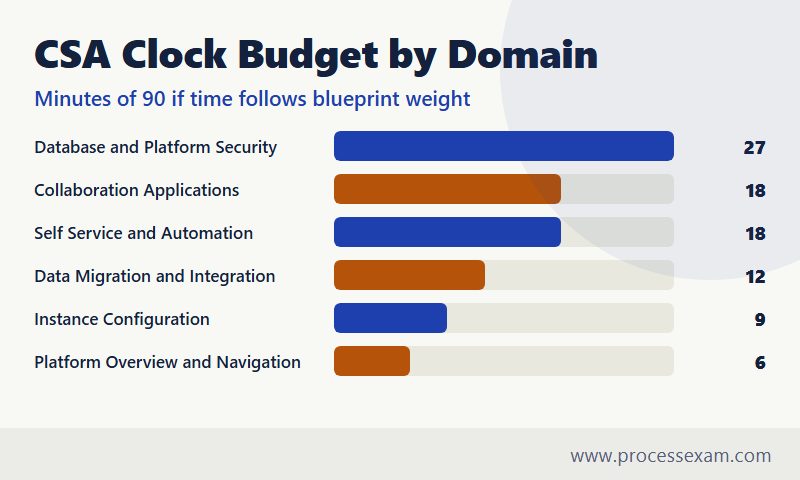
The chart above turns the blueprint weights into a clock budget. If time followed weight, the security and database domain would take about twenty-seven of the ninety minutes, and the navigation domain about six. Nobody should time each domain on the real paper, because questions arrive mixed. The value is in rehearsal: after a mock attempt, sort your missed questions by domain and ask whether the time you lost sat in a heavy domain or a light one. Losing time in a light domain is the cheapest mistake to fix.
Since the vendor reports only Pass or Fail and publishes no numeric pass mark, any percentage you read on a forum is somebody's guess. Do not build a plan around a magic score. Build it around the pattern in the earlier table, which is something you can check yourself and which does not depend on a figure nobody outside the vendor can confirm.
When is the right moment to book the exam?
Booking too early turns a readiness check into a deadline you cannot meet. Booking too late lets the material go stale and lets a comfortable plateau feel like a plan. The best moment is when four things are true together, and you can say so with evidence rather than hope.
Four signals that say book
- No weak domain. Your gap map has no row with a gap larger than one, or the only one left is a light domain.
- A steady pattern. Your last two or three full attempts landed close together on questions you had not met before.
- Short missed-question log. The same topic has stopped appearing from one attempt to the next.
- Hands-on confidence. You can build the weakest feature from a blank page on a Personal Developer Instance without notes. The ServiceNow developer site is where you request one.
Signals that say wait
Wait if your best result came from repeated questions, if one domain sits far below the rest, or if your attempts swing from one sitting to the next. Also wait if you are booking because a date feels motivating but your log is not shrinking. A fixed date helps a candidate who is already close; it adds pressure to one who is not. If you are in that second group, push the date back by a couple of weeks, work through the largest gap in the map, and test again.
Once the signals agree, choose a date soon enough that the knowledge stays warm and far enough ahead to fit one light revision week. In that last week, do not learn new topics. Re-read your missed-question log, redo the single weakest feature on your instance, and sleep. The exam is delivered through Pearson VUE, and the current options for booking, rescheduling and any retake conditions sit in your ServiceNow University account, so check them before you pick a date rather than relying on a forum thread.
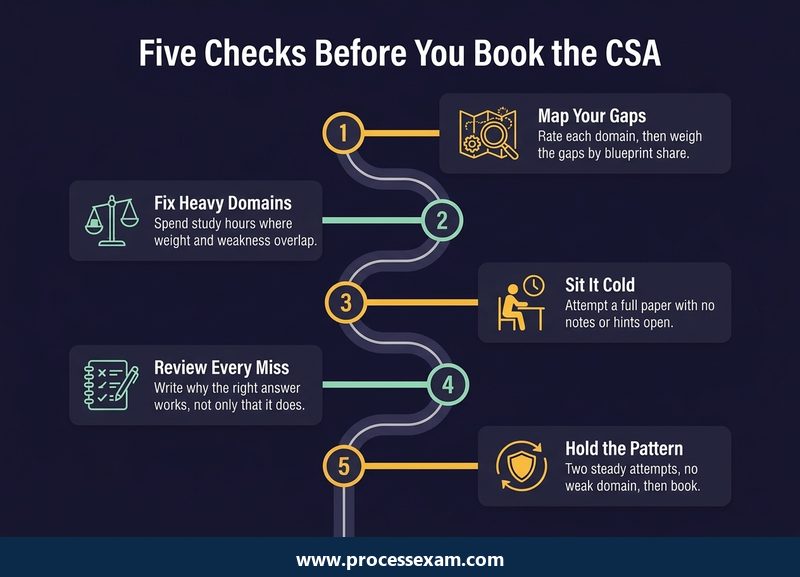
The roadmap above is the whole readiness check in five steps. If one of them still fails, that step, not the calendar, is your next task. Treat the booking as the last step, not the first.
What should a practice attempt tell you that a study guide cannot?
A study guide tells you what exists. A practice attempt tells you how you behave when four sensible answers compete for your attention, and no amount of reading reproduces that. This is why people search for a CSA practice test or a CSA mock test in the final weeks, and why the usefulness depends on how you use it, not on how many you take. Used as a mirror, a full attempt shows your domain profile, your pace and your habits with multi-select questions. Used as a drill, it teaches you the answers to that one set and little else.
That is also the honest answer to whether practice exams are helpful for CSA preparation: they are helpful for diagnosis and pacing, and much less helpful for learning a feature you have never used. Pair them with hands-on work, so that every missed domain becomes something you build. When you reach the stage of full, unseen attempts, the CSA practice exam gives you a paper to sit cold and a domain-by-domain view to compare with your gap map.
For deeper study on a feature you keep missing, the vendor's ServiceNow product documentation explains behaviour in more detail than any summary can. Read the relevant page after you have tried the feature on your instance, not before, and the explanation sticks. If you keep a CSA study guide of your own, build it from your missed-question log rather than from the blueprint headings: it will be shorter, and every line in it will be something you actually get wrong.
A readiness check you can run this week
- Draw the gap map and list your two biggest results.
- Spend three or four study sessions on those two domains, hands-on first, reading second.
- Sit one full attempt on questions you have never seen, with no notes, and log every miss and every guess.
- Compare the result with your earlier attempts using the pattern table, not the single score.
- Repeat until the pattern is steady, then book.
Ordinary preparation fills the calendar. A readiness check empties the guesswork. If you follow it for two or three rounds, the decision to book will no longer feel like a gamble; it will be the next line in a plan you can defend.
Frequently Asked Questions
Is the CSA exam hard?
It depends on your hands-on time. The CSA describes business situations and asks which ServiceNow feature or setting fits, so candidates who have configured forms, access rules and imports find it manageable, while those who only read about the platform struggle. The heaviest blueprint domain, database management and platform security, is where unprepared candidates usually fall short.
How should I prepare for the ServiceNow CSA exam?
Start from the six blueprint domains and rate your skill in each, then weight each gap by the domain's share of the exam. Build the weakest features on a free Personal Developer Instance, sit full attempts on unseen questions, and log every miss. Book once your results are steady and no domain lags.
Are CSA practice tests helpful?
Yes, mainly for diagnosis and pacing. A full attempt on unseen questions shows which domains are weak, how you handle multi-select items and whether you finish with time to spare. They help less for learning a feature you have never used, so pair them with hands-on work on a developer instance.
How many questions and how long is the CSA exam?
Expect 60 questions against a 90 minute limit, roughly a minute and a half apiece. A few items want several answers and tell you the count. Read that count before the options, since selecting only part of the right set does not earn the mark.
What is the passing score for the CSA exam?
There is no published number. The vendor gives candidates a Pass or Fail outcome only, so any percentage on a forum is a guess. Judge yourself instead by a steady pattern across several full attempts on unseen questions, with no blueprint domain far below the rest, before booking the USD $300 exam.
- ServiceNow System Administrator Test Questions |
- CSA Question Bank |
- ServiceNow System Administrator Book |
- System Administrator Certification Cost |
- System Administrator Certification Requirements |
- ServiceNow System Administrator Sample Questions |
- CSA Exam Questions Download |
- CSA Test Questions |
- System Administrator PDF |
- Platform and AI


