
CIS-SM Certification: ServiceNow Service Mapping Exam Guide
Your lead has just handed you your first Service Mapping project: one customer-facing service, a list of servers, and a request for a map that operations can trust. The CIS-SM exam checks that you can deliver it. It has 60 questions in 90 minutes, costs USD $450, is graded Pass or Fail, and needs Data Foundations (CIS-DF) in your name before you can book. This guide follows that project to show what each blueprint domain is really asking.

What does a first Service Mapping project actually ask of you?
Picture the first week. The service is an online ordering system. Nobody has drawn it for two years, and the diagram on the intranet still shows a server that was retired. Your job is to let ServiceNow find the application tiers itself, show how they connect, and write the result into the CMDB so that incident and change records point at the right components.
That small story contains most of the exam. You need to know which people and tools must be in place before a map is attempted (MID Servers, credentials, IP ranges). You need to know how the application is recognised (patterns). You need to know what to do when the map comes back with gaps (troubleshooting). And you need to know where the result lands (the CMDB, with its identification and reconciliation rules) and why the business cares (faster resolution, fewer surprises in change).
ServiceNow's own description of the credential says it confirms you can configure, implement and maintain the Service Mapping application, design and troubleshoot patterns, integrate with Discovery and Event Management, and maintain the CMDB. Read that sentence as a job description. Every clause maps to a domain weight further down this page.
Why does the exam reward people who have watched a map fail?
Questions are written as short situations: a credential error on a map, an application that shows up as generic, authentication failing during a Discovery run. Candidates who have only read about the tool tend to recall definitions. Candidates who have watched a map fail recall a sequence of causes, and sequences are what the answer options test. Whatever your background, plan to spend real time in a lab instance, because the questions assume you have seen the screens.
Who can sit CIS-SM, and what must you already hold?
ServiceNow's blueprint names a hard prerequisite and a soft one. The hard one is the Certified Implementation Specialist - Data Foundations (CMDB and CSDM) certification, which must be on your record before you register for CIS-SM. Nothing in the blueprint offers a waiver. If you do not hold it yet, your first exam is CIS-DF, not CIS-SM.
The soft prerequisite is experience. The recommendation is six months of field experience, or involvement in at least two ITOM deployments that were predominantly Service Mapping, together with intermediate or better Windows and Unix administration skills. The Windows and Unix requirement is not decoration. Patterns run commands on target servers and read what comes back, so you must be able to read a process list, a listening port, a configuration file and a registry value without help.
The exam is open to customers, partners, employees and anyone else who wants to become a ServiceNow implementer or administrator. You do not need to be on a partner payroll. What you do need is time on the platform, because the blueprint says exam questions are drawn from ServiceNow's training materials, its product documentation and its developer site, and warns that study material posted elsewhere is not official and should not be used to prepare.
Which training does ServiceNow suggest first?
The recommended courses run from the basics to the specialist tracks: Welcome to ServiceNow, ServiceNow Administration Fundamentals, ServiceNow Platform Implementation, Get Started with Now Create, ITOM Overview, then Service Mapping Fundamentals, Service Mapping Advanced and Service Mapping Extras. The additional list adds the Credentialing Program Guide, CSDM Fundamentals, CMDB Fundamentals, MID Server Fundamentals, Discovery Fundamentals and Event Management Fundamentals. Notice how many of those are not Service Mapping at all. That is a hint about where the marks sit.
What are the exam facts, and how does booking work?
| Item | CIS-SM |
|---|---|
| Certification | ServiceNow Certified Implementation Specialist - Service Mapping (CIS-SM) |
| Number of questions | 60 |
| Duration | 90 minutes |
| Exam fee | USD $450 |
| Passing score | Pass / Fail (no percentage published) |
| Prerequisite | Certified Implementation Specialist - Data Foundations (CMDB and CSDM) |
| Question types | Multiple choice (single answer) and multiple select |
| Delivery | Pearson test centre or online with OnVUE |
| Window after registering | 90 days to schedule and sit the exam |
ServiceNow's mainline blueprint for this exam, last updated November 2025 and read on 10 October 2026, is the source for the structure above. Fees can change, so confirm the amount at checkout.
How does registering differ from scheduling?
This catches people out. On ServiceNow's process, registering is paying: it secures an attempt, and learning credits or a credit card can be used. From that moment you have 90 days to schedule and complete the sitting. If the window closes you register and pay the full fee again, and the fee is not refundable. The blueprint adds that instructor-led training includes one free exam attempt and that employer benefits may bring a discounted price, so check both before paying out of pocket.
Scheduling goes through Pearson. You choose between a Pearson test centre and online proctoring through OnVUE, where a proctor watches through your webcam. Pearson VUE keeps a ServiceNow page with the delivery options. Because the 90-day clock starts at payment, register after your timed practice scores are steady, not before.
What does the result tell you?
The moment you submit, the screen shows a provisional pass or fail, and a report follows showing the percentage correct in each section. Conditional means ServiceNow can audit the result later and revoke it if its test-security policies were broken. The cut score is not published and, in ServiceNow's words, is not always 70 percent. Each question is worth one point, and multiple-select questions give no partial credit, so a question that asks for three answers is lost if you give two of the three. The section percentages do not decide the outcome and should not be averaged, but they are the best map of where to revise if you must retake.
How is the blueprint split across its six domains?
ServiceNow publishes six domains with weights that add up to 100 percent. Pattern design is the heaviest, and the two domains that sound most like Service Mapping (design and configuration) hold half the paper. The other half belongs to the surrounding platform, which is why a pure Service Mapping specialist can still fail.
| Domain | Share | What the blueprint lists |
|---|---|---|
| Service Mapping Pattern Design | 30% | Pattern Designer, match and parse operations, scripting with WMI, SSH, regex, command line and SNMP, identification and connection sections |
| Service Mapping Configuration | 20% | Configuration files and tuning, IP ranges, MID Servers, entry points, CI types, credentials, schedules, service groups, process flow, Discovery log |
| Discovery Configuration | 15% | Behaviors, clusters, schedules, process flow (PCIE phases, ECC queue), authentication errors, duplicates |
| Configuration Management Database | 15% | CMDB Health Dashboard, CI Class Manager, reclassification, relationships, identification and reconciliation rules, de-duplication tasks |
| Machine Learning | 10% | Service mapping methods, ML-powered mapping, Service Mapping Workspace, mapping service candidates |
| Service Mapping Engagement Readiness | 10% | Scoping, planning, licensing, supported applications, KPIs and use cases |
ServiceNow is careful to say that the listed sub-skills are not an exhaustive list. Treat them as the minimum. The CIS-SM syllabus page walks through the same six areas topic by topic if you want a checklist to tick off.
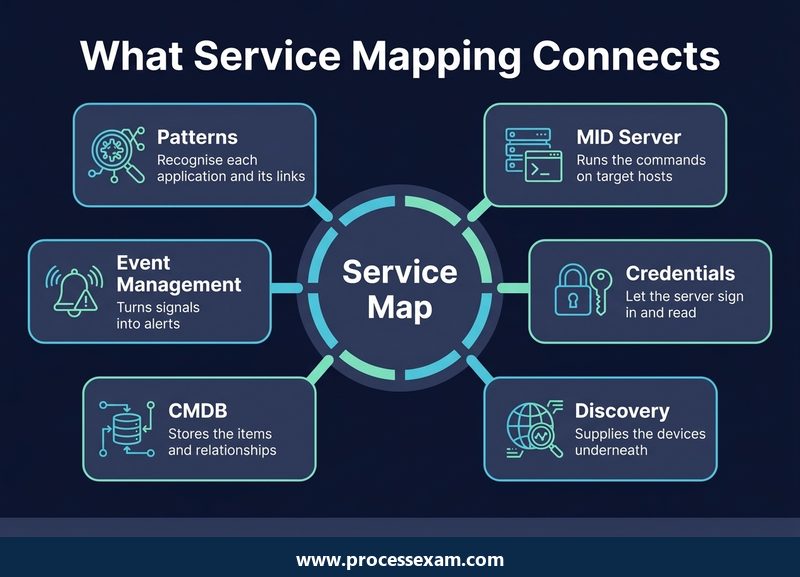
Why does the non-mapping half deserve equal respect?
Add Discovery (15), CMDB (15), Machine Learning (10) and Engagement Readiness (10) and you reach 50 percent of the paper. Many candidates arrive from a Service Mapping project and assume the other half is a courtesy. It is not. The blueprint's sample questions include one on which Discovery phase raises authentication errors, one on what an Event Management rule creates, one on how a server moving to a Windows server class is described, and one on which operational KPI improves once a service map exists. None of those needs a pattern, and all of them need preparation.
What can the machine learning and readiness domains still cost you?
Together these two domains are one fifth of the paper, and they are where experienced implementers drop easy points because they never studied them as topics.
The machine learning domain covers guidance on service mapping methods and ML-powered mapping, including the Service Mapping Workspace and the idea of mapping service candidates. The skill tested is judgement: when a pattern-led map is the right method, when a suggested candidate is worth building into a service, and what the implementation involves. Read ServiceNow's documentation for the current workspace behaviour, because this is the part of the product that changes fastest. The ServiceNow documentation site is the source the blueprint itself points to.
The readiness domain is the consulting half. Scoping asks what counts as a service, how shared services are handled, what licensing applies and which applications are supported. Planning asks which skills the team needs, what the MID Servers must satisfy, and what security teams will want to approve. Operationalising asks you to name measurable KPI improvements and use cases. The sample question here is instructive: of four ServiceNow KPIs, the one that improves most directly once a service map exists is the mean time to resolve incidents, not major change counts or the number of incidents per known problem. When you see KPI questions, ask which metric a better map shortens, not which metric merely sounds related.
How does a service map get built, from entry point to CMDB?
Service Mapping works top-down. Where Discovery scans a network and asks what is out there, Service Mapping starts from something a user touches, called an entry point, and follows the application inward to the servers, databases and middleware that support it. Walk through a typical run.
Step 1: prepare the ground
A MID Server must be able to reach the target network, and credentials must exist for the hosts it will log in to. IP ranges and the MID Server assigned to them are part of setup. Skipping this step produces the most common beginner symptom: a map that stops after one hop. In exam terms, this is the Setup and Configuration part of the configuration domain, with the Discovery fundamentals underneath it.
Step 2: define the service and its entry point
You create the technical service, choose the CI type of the entry point, and give it the address a user would use, such as a web address and port. The entry point tells ServiceNow where to start. A wrong CI type or an unreachable address is a configuration fault, not a pattern fault, and the exam likes to test whether you can tell the two apart.
Step 3: let patterns identify and connect
Each application type has a pattern. An identification section recognises the application on a host, and a connection section works out what it talks to next. When no pattern identification section matches, the application is shown as a generic application, and nothing downstream of it can be mapped by a pattern. That relationship is one of the blueprint's own sample questions, so know it cold. Patterns are built in Pattern Designer from operations such as match and parse, backed by scripting that reads files, runs commands over SSH or WMI, queries SNMP, or applies a regular expression to the output.
Step 4: read the map and its flags
After the run you open the map and read its icons. A credential problem appears as a warning marker on the affected node, which the blueprint's sample question identifies as a yellow triangle rather than a stop sign or a question mark. The process flow and the Discovery log explain what happened, and troubleshooting by following that log is a named sub-topic.
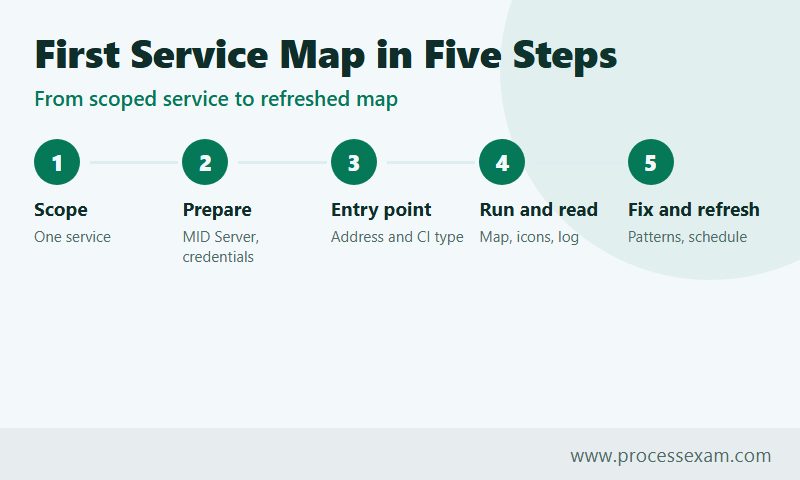
Step 5: write it into the CMDB and keep it fresh
Mapped components become configuration items with relationships between them. This is where the CMDB domain takes over: identification rules decide whether a discovered server is new or already known, reconciliation rules and datasource precedence decide which source wins when two disagree, and de-duplication tasks clean up the cases that slipped through. A schedule then refreshes the map so it does not drift back to the stale diagram you started with. The Wikipedia article on configuration management databases gives neutral background on why those records matter if the concept is new to you.
In what order should evenings and lab time go?
The plan below assumes six weeks of evenings and access to a personal developer or sandbox instance with a MID Server. It is a suggestion, not a ServiceNow schedule. Shorten it if you already work on Service Mapping every day.
- Week 1, the data underneath. Refresh CMDB classes, relationships, identification and reconciliation, then Discovery phases and the ECC queue. These are 30 percent of the paper and they make later weeks easier.
- Week 2, configuration. Set up a MID Server, credentials and IP ranges, create a technical service with an entry point and read the process flow and the Discovery log for a run that fails.
- Weeks 3 and 4, patterns. Open Pattern Designer, step through an existing pattern with the debugger and temporary variables, then change one operation and see what breaks. Practise the commands you would use by hand on Windows and Unix hosts.
- Week 5, the two small domains. Work through the machine learning topics and the engagement-readiness topics, writing a one-page scope and plan for an imaginary service.
- Week 6, timed papers. Sit full 60-question papers in 90 minutes and sort every miss by domain.
When the timed papers start, a CIS-SM practice exam helps you find which of the six domains still leaks before you pay the fee and start the 90-day clock.
Here is the practical rule behind that. Take the first paper cold, tag each miss with its domain, and compare the pattern with the weights in the table above. If most of your misses sit in the 10 percent domains, you have a content gap that is cheap to fix. If they sit in pattern design, you have a lab gap, and more reading will not close it.
How should you use ServiceNow's six sample questions?
ServiceNow publishes six sample questions in the blueprint. Do not memorise their answers. Instead, for each one, write down which domain it belongs to, which two wrong options were tempting, and what a lab screen would show. Those six questions span five different domains, which is the quickest evidence that preparing only for patterns is a mistake.
Which instincts from live projects mislead you in the exam room?
Real implementations reward shortcuts. The exam rewards reading the question as written. These are the habits that tend to trip up working practitioners.
- Fixing the wrong layer. In a project you retry until the map works. In the exam, a symptom has one layer that explains it: credentials, reachability, pattern, entry point or CMDB. Name the layer before you look at the options.
- Treating Discovery and Service Mapping as one tool. They share MID Servers and credentials, but Discovery scans horizontally and Service Mapping traces one service from the top. Questions on each use different vocabulary.
- Short-changing multiple select. There are at least four options and the question states how many to choose. With no partial credit, answer from first principles instead of choosing the first plausible pair.
- Trusting an unofficial source. ServiceNow states that study material posted elsewhere is not official. Use it, if at all, to compare your own understanding, and never rely on it for facts.
- Spending the clock evenly. Ninety minutes for 60 questions gives 90 seconds a question. Make a first pass, flag the pattern-scripting questions that need careful reading, and return to them.
Does CIS-SM change what you are trusted with, and what keeps it valid?
Passing gives you the Service Mapping implementation credential and a Credly digital badge to show it. The career value is specific: it is evidence that you can be trusted with the discovery and mapping workstream of an ITOM project, which is a narrower and more checkable claim than general platform knowledge. It reads best next to CIS-DF, which you must hold anyway. This guide quotes no salary figures because it cites no salary survey.
The credential is not permanent. ServiceNow asks holders to complete annual maintenance exams, called deltas, and to pay the yearly Certification Maintenance Program fee. Budget for that from the start, because a lapsed credential undercuts the reason you took the exam.
If you do not pass, ServiceNow's advice is to review the blueprint and the recommended training before another attempt. The retake policy imposes a waiting period and a fresh fee for every attempt, and the Credentialing Program Guide holds the details, so read it before you book rather than after.
Frequently Asked Questions
How many questions are on the CIS-SM exam?
The ServiceNow CIS-SM exam has 60 questions and runs for 90 minutes, which is about 90 seconds a question. Items are multiple choice with a single answer or multiple select, and multiple select gives no partial credit, so read how many answers are required.
What is the CIS-SM passing score?
ServiceNow reports a Pass or Fail result and does not publish the cut score. Its blueprint says the score is not always 70 percent. You also get section percentages, which show where you were weaker but do not decide the result.
How much does the CIS-SM exam cost?
The CIS-SM exam fee is USD $450. Registering means paying, and you then have 90 days to schedule and sit the exam. ServiceNow says the fee is non-refundable, that instructor-led training includes one attempt, and that employer benefits may discount it.
What do you need before taking CIS-SM?
You must hold the Certified Implementation Specialist - Data Foundations (CMDB and CSDM) certification before you can register. ServiceNow also recommends six months of field experience or two predominantly Service Mapping deployments, plus intermediate Windows and Unix administration skills.
Which CIS-SM domain carries the most weight?
Service Mapping Pattern Design is the largest domain at 30 percent. Service Mapping Configuration follows at 20 percent, then Discovery Configuration and Configuration Management Database at 15 percent each, and Machine Learning and Engagement Readiness at 10 percent each.
- ServiceNow Service Mapping Implementation Specialist Test Questions |
- CIS-SM Question Bank |
- CIS-Service Mapping Simulator |
- CIS-Service Mapping Mock Exam |
- ServiceNow Service Mapping Implementation Specialist Book |
- Service Mapping Implementation Specialist Certification Cost |
- Service Mapping Implementation Specialist Certification Requirements |
- ServiceNow CIS-Service Mapping Question Bank |
- ServiceNow CIS-Service Mapping Book |
- ServiceNow CIS-Service Mapping Study Guide |
- CIS-Service Mapping Certification |
- CIS-Service Mapping Certification Cost |
- CIS-Service Mapping Certification Requirements |
- ServiceNow Service Mapping Implementation Specialist Sample Questions |
- CIS-SM Exam Questions Download |
- CIS-SM Test Questions |
- Service Mapping Implementation Specialist PDF |
- ServiceNow CIS-Service Mapping Exam Questions |
- ServiceNow CIS-Service Mapping Sample Questions |
- CIS-Service Mapping |
- CIS-Service Mapping PDF |
- Technology


