
ServiceNow Certified System Administrator: Career Path After CSA
Passing the ServiceNow Certified System Administrator (CSA) exam proves you can run a ServiceNow instance; it does not choose your next job for you. The credential opens administrator, senior administrator and consultant roles, and it is the usual first step towards the developer and implementation specialist exams. This guide sets out the roles, the next exam by job, a 90-day learning plan and a 12-month route.

The old advice for this topic was a four-step story: get a degree, take courses, get a job, keep learning. It is not wrong, but it stops exactly where a CSA holder starts. Most people reading about the CSA already work near ServiceNow. They have a login, a few months of tickets and a manager who has just asked whether they plan to certify. What they need is a map of what happens after the pass email arrives.
That map is what follows. It is written for people who are studying for CSA now, people who passed recently and are wondering what to do with it, and team leads deciding which certification to fund next. Exam facts appear once, in the table below; everything else is about where the credential can take you and how to spend the months after it.
What does the CSA ask of you, and what does it cost?
Before you plan the next move, be sure of the one you are making now. The figures below come from our exam records, and the exam's scope is set by the blueprint that ServiceNow publishes on its own site.
| Exam detail | ServiceNow CSA |
|---|---|
| Certification | ServiceNow Certified System Administrator (CSA) |
| Exam code | CSA |
| Exam fee | USD $300 |
| Number of questions | 60 |
| Duration | 90 minutes |
| Passing score | Pass / Fail |
| Delivery | Pearson VUE |
ServiceNow reports the result as Pass or Fail, so there is no percentage to chase and no margin to calculate. ServiceNow recommends three to six months of hands-on time with an instance before you sit it, and that advice is worth following, because the questions describe things an administrator has done, not definitions to memorise. The full list of exam areas is on ServiceNow's own CSA exam blueprint, and our CSA syllabus page lays the same areas out for revision.
A note on versions. ServiceNow ships two platform releases a year, each named alphabetically after a city. When we checked ServiceNow's documentation in September 2026, its release notes were published for the Brazil family, updated on 10 September 2026, with Australia the family before it. The exam blueprint, not the family name, defines what is tested, so read the blueprint before you book and use whichever family your own instance runs for practice.
Which jobs does a CSA pass actually open?
A pass does not create a job title. It gives a hiring manager an independent statement that you can configure and maintain the platform, which is why it shows up in the requirements of several different roles. The table maps the common ones to what they expect from a CSA holder and where the credential is a starting point rather than the finish.
| Role you are aiming for | What the CSA shows | What usually comes next |
|---|---|---|
| Platform or system administrator | You can manage users, groups, forms, lists, access and updates | Ownership of a module, then an implementation specialist exam |
| ServiceNow analyst on a service desk team | You understand the data behind the tickets you work | Reporting, catalog and workflow skills |
| Junior consultant at an implementation partner | You can be trusted with configuration on a customer instance | A module credential matching your project |
| Business or process analyst | You know what the platform can do without code | Platform owner thinking, process design |
| Administrator moving towards development | You already know the tables, roles and security the apps sit on | The Certified Application Developer exam |
The administrator route
This is the most direct use of the credential. An administrator keeps the instance healthy: onboarding users, handling access requests, moving changes between instances, keeping lists and forms usable and answering the question every team eventually asks, "can ServiceNow do this without us building anything?" A CSA holder who answers that well, repeatedly, becomes the person the business takes ideas to. That is how a general administrator turns into a senior administrator without changing employer.
The consultant route
Implementation partners hire on evidence, because customers pay for named competence. A CSA on a junior consultant's profile answers the first question a project manager has, which is whether this person can be put on configuration tasks without supervision. It rarely wins the job alone, but it removes an objection and it is normally the base for the specialist credential the partner needs in its team for a given module.
The route into development
Administrators who like solving problems with scripts and small applications tend to drift towards development. The CSA is a good foundation for that move because scoped applications sit on the same tables, roles and access controls you already administer. You do not need to leave the CSA behind; you build on it, and the administrators who make this move well are usually the ones who understand security before they write their first business rule.
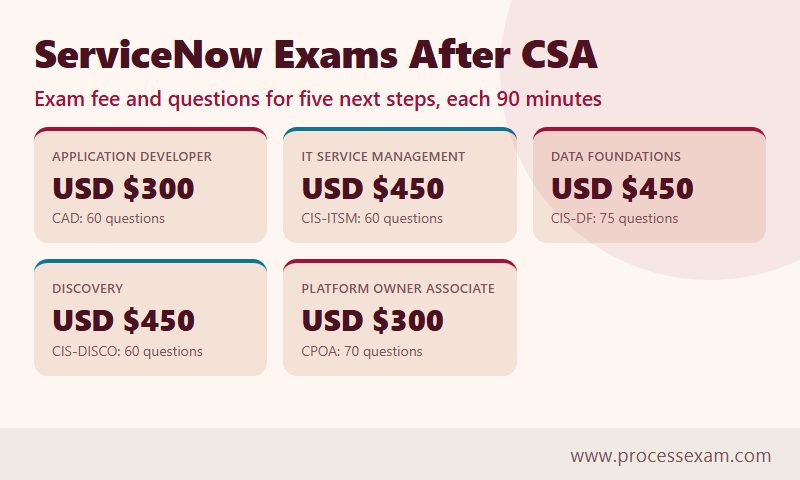
Should your next exam be CAD, an implementation specialist or something else?
Choose by the work you will do in the next twelve months, not by which title sounds grandest. The fee, question count and duration matter less than whether the next credential describes your actual week. Here is a way to decide.
| Your work in the next year | Next exam | Fee | Questions | Duration |
|---|---|---|---|---|
| Building and extending custom applications | ServiceNow Certified Application Developer (CAD) | USD $300 | 60 | 90 minutes |
| Running IT service management day to day | Implementation Specialist, IT Service Management (CIS-ITSM) | USD $450 | 60 | 90 minutes |
| Owning the CMDB and its data quality | Implementation Specialist, Data Foundations (CIS-DF) | USD $450 | 75 | 90 minutes |
| Mapping infrastructure with discovery | Implementation Specialist, Discovery (CIS-DISCO) | USD $450 | 60 | 90 minutes |
| Deciding what the platform should do and why | Certified Platform Owner Associate (CPOA) | USD $300 | 70 | 90 minutes |
All five are scored Pass / Fail. Prerequisites differ between exams and ServiceNow changes them from time to time, so confirm them on ServiceNow's credential path page instead of relying on a blog, ours included.
Pick CAD if your tickets are becoming projects
If the requests reaching you are "we need a small app to track this" rather than "reset this user", the developer credential is the honest next step. It checks scoping, scripting choices and application security, which a CSA only touches lightly. It also costs the same as the CSA, which makes it the cheapest large step available.
Pick an implementation specialist exam if you own one module
The CIS family certifies depth in one product area. The best choice is the module your employer already runs and you already touch. A specialist credential in a module nobody at your company uses is a line on a CV; one in the module you administer changes how colleagues treat your opinion. The fee is higher, USD $450, and the questions are scenario based, so hands-on time in that module matters more than any reading.
Pick CPOA if you are moving towards ownership
Administrators who end up owning the platform for a department or business unit spend more time deciding than configuring: which requests to accept, how to govern change, how to keep an upgrade from breaking customisations. CPOA certifies that judgement. It suits the administrator who is being asked to speak for the platform in meetings.
Wait, and do neither
There is a fourth choice that gets too little credit: stay with the CSA for six months and get better at it. If you passed on the strength of a training instance and have never handled a live upgrade, an access review or a broken import, a second exam will not fix that. Real incidents on a real instance will.
What should you learn in the 90 days after you pass?
The weeks straight after an exam are when knowledge fades fastest and motivation is highest. Use them to convert exam knowledge into habits. The plan below assumes you can spend a few hours a week on it; it needs a Personal Developer Instance, which ServiceNow offers free through its developer site, and your employer's instance where policy allows.
Days 1 to 30: make your own instance boring
Tidy the instance you look after. Review who holds elevated roles and why. Look for lists that nobody can read, forms with fields nobody uses and notifications that fire twice. Write down every setting you had to look up. Each one is a gap between passing the exam and doing the job, and closing gaps is exactly what a senior administrator does all day.
Days 31 to 60: learn one automation tool properly
Pick the automation feature your team uses most, and rebuild one real process in it from scratch on your developer instance. A leave request, an equipment loan, an onboarding checklist: anything with an approval and a notification will do. The point is to feel the difference between configuring a form and designing a flow, because that difference is the one that separates administrators who are asked to build things from those who are not.
Days 61 to 90: read what changes between releases
Open the release notes for the family your instance runs and read the sections for the modules you support. Note three changes that affect your users, and test each on a developer instance before your organisation upgrades. Most administrators learn about a release when something breaks; the ones who read the notes are the ones asked to plan the upgrade.
How to ask your employer to fund the next exam
Exam fees are small next to the cost of a project that goes wrong, and managers know it, but they still want a reason. Bring three things to the conversation. First, the piece of work the credential supports: a module rollout, an upgrade you will lead, an application the business has asked for. Second, the fee and the study time in plain numbers, using the table above. Third, what you will hand back afterwards, such as a short internal session or a written guide to the module. A request framed as "here is the work and here is what the team gets" is approved far more often than "I would like another certificate".
If your employer will not pay, the same logic still applies to your own money. Spend it on the credential that matches work you already do, because that is the one you can talk about with evidence in your next interview.
What separates a junior administrator from a senior one?
Titles vary, but the pattern is consistent across employers. Seniority comes from how you handle change, not from how many features you know. Five habits show up again and again.
- You test before you touch production. Every change is tried on a sub-production instance and moved deliberately, never edited live because it is quicker.
- You can explain a decision. When someone asks why a role was granted or a rule was built one way, you have a reason and a record.
- You reach for configuration before code. Code adds maintenance. A senior administrator solves the problem with the least custom work that survives an upgrade.
- You know the data. You understand which table holds what, how records relate, and what a report is really counting.
- You say no with an alternative. Not every request should be built. Senior people turn "we need a custom field" into "here is what already does this".
None of these is examined directly, and all of them are things a CSA-level knowledge base lets you practise. That is the real value of the credential in a career: it gives you the vocabulary to have these conversations with confidence.
What to put on your profile and in interviews
Describe the credential in terms of outcomes. "ServiceNow CSA" alone is a label; "CSA holder who cut duplicate notifications and tightened elevated roles on a production instance" is a story. Keep two or three specific examples ready: a problem you found, the smallest fix you chose, and how you tested it before release. Interviewers for administrator roles listen for exactly this, because it shows judgement, and judgement is what the exam cannot measure.
Be honest about scope, too. If you have administered one module, say so and say what you learned from it. Hiring managers on ServiceNow teams know how uneven instances are, and they trust candidates who describe theirs accurately far more than those who claim everything.
Which mistakes stall a career after the CSA?
The exam is rarely the problem. The stalls happen afterwards, and they are surprisingly consistent.
Collecting badges instead of scope
Three credentials in six months with no change in what you do looks like exam-taking, not experience. Interviewers ask about a project, not a badge. Each certification should follow a piece of work you can talk about.
Picking a module nobody uses
Choosing a specialist exam because it looks impressive, then having no access to that module at work, leaves you unable to answer the practical questions the interview will ask. Choose from what is running on your instance.
Treating the developer instance as optional
Reading is cheaper than practising, and that is the trap. A free instance costs nothing but time, and it is where the skills that carry into the next exam and the next job are built.
Ignoring the people side
Administrators sit between users, managers and developers. The ones who progress write short clear notes about what they changed, tell affected teams before a release, and keep a list of open requests where others can see it. It is not glamorous, and it is noticed.
Letting the knowledge age
A twice-yearly release cycle means what you passed on is not what your instance will look like in a year. People who stop reading release notes are quietly out of date long before their credential is.
How do you keep up when ServiceNow releases twice a year?
Treat every release as a small, scheduled learning project. ServiceNow's documentation publishes release notes for each family, and the exam blueprint on ServiceNow's site is where changes to certification scope appear. A simple routine works: when a new family becomes available, read the notes for the areas you own, test the changes on a developer instance, and check whether the exam blueprint for your credential or your next one has been revised.
Also check your own ServiceNow University account after each release for anything it says is due on your credentials. Do it every time; the notices are easy to miss, and it takes two minutes. Exact requirements are ServiceNow's to set and change, so trust the account over any article.
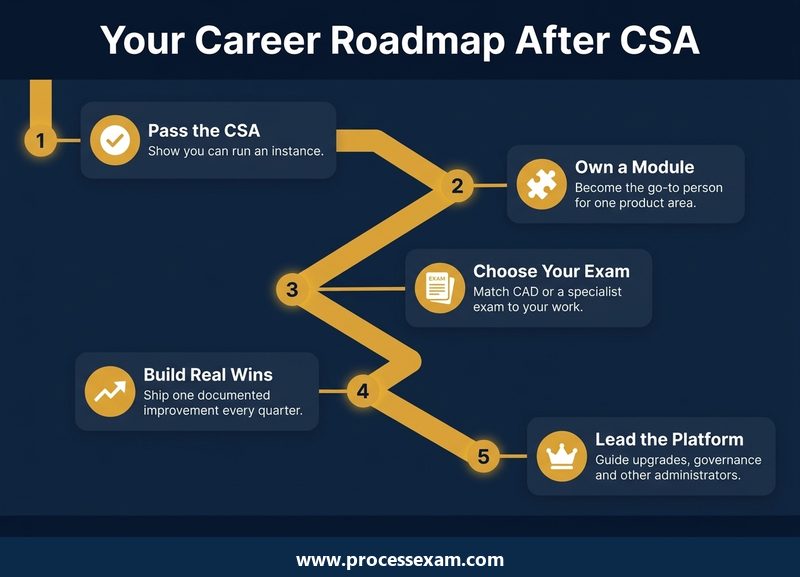
What does a 12-month plan after the CSA look like?
Here is a route that fits a working administrator. It is deliberately modest, because the people who follow a plan are the ones whose plan fits their calendar.
- Months 1 to 3: consolidate. Follow the 90-day plan above. Finish with a short written summary of what you improved on your instance. It doubles as a portfolio piece.
- Months 4 to 6: choose a direction. Sit down with your manager and name the module or skill the team most needs. Pick the exam that matches it from the table earlier. Book it only when you have handled real work in that area.
- Months 7 to 9: prepare and practise. Study the blueprint for the chosen exam, build on your developer instance, and use timed practice tests to find weak areas. Our CSA practice exam page covers the foundation exam; the same discipline transfers to the next credential.
- Months 10 to 12: apply it and mentor. Take the exam, then use it: propose an improvement in that module, and help someone else through the CSA. Teaching what you have just learnt is the fastest way to keep it.
At the end of that year you hold two credentials, you have one documented improvement per quarter and you have helped a colleague pass. In an interview, that is a stronger story than any single certificate.
Frequently Asked Questions
How much does the ServiceNow CSA exam cost?
The CSA exam fee is USD $300. Prices and voucher offers can change, so confirm the current fee on ServiceNow's learning site before you book. The exam is delivered through Pearson VUE and is scored Pass / Fail, so there is no percentage to target.
How many questions are on the ServiceNow CSA exam?
The CSA exam has 60 questions and a time limit of 90 minutes, which leaves about a minute and a half per question. Questions are practical and describe administrator tasks, so hands-on time with a ServiceNow instance helps more than memorising definitions.
What is the passing score for the CSA exam?
ServiceNow scores the CSA as Pass or Fail and does not publish a percentage. The best readiness check is your own result on timed practice tests, together with being able to explain why each wrong answer is wrong before you book.
What certification should I take after the CSA?
Choose by your work. Developers and builders usually take the Certified Application Developer exam; people who own one module take the matching implementation specialist exam; those moving into ownership can consider Certified Platform Owner Associate. Check prerequisites on ServiceNow's credential path page.
Is the ServiceNow CSA worth taking for a career?
Yes, when it follows real hands-on work. It gives employers independent evidence that you can configure and maintain the platform, and it is the base for developer and implementation specialist credentials. On its own it will not create a job, so pair it with documented improvements.
- ServiceNow System Administrator Test Questions |
- CSA Question Bank |
- ServiceNow System Administrator Book |
- System Administrator Certification Cost |
- System Administrator Certification Requirements |
- ServiceNow System Administrator Sample Questions |
- CSA Exam Questions Download |
- CSA Test Questions |
- System Administrator PDF |
- Platform and AI


