
SAFe RTE Certification: Course, Exam Format, Cost and Career Value
Updated on 21 September 2026. What’s new: updated for the AI-Empowered RTE exam, with the pass mark corrected to 82% and its eight current domains.
It is the afternoon of PI Planning. The payments team has committed to a feature that needs a new API from the platform team, and the platform team has just put that API in its last iteration. Nobody wrote the dependency on the board, so nobody owns it. Spotting that thread and getting two teams to settle it before the confidence vote is the Release Train Engineer's job. The SAFe RTE certification tests exactly that work: 60 questions, 120 minutes, 82% to pass.
This article follows that afternoon outward. It explains what an RTE is accountable for on an Agile Release Train, what the current AI-Empowered RTE exam looks like, how its eight domains are weighted, how the course, exam attempts and renewal fit together, and how to study so that the scenario questions read like situations you have already lived through. It closes with an honest look at whether the credential is worth the course fee for your career.
Who owns the dependency nobody owns, and what does a Release Train Engineer actually do?
An Agile Release Train, or ART, is a long-lived team of agile teams that plans, commits and delivers together on a shared cadence. Five to a dozen teams can sit on one train. Each team has a Scrum Master or team coach and a Product Owner, and the train as a whole has Product Management, a System Architect and business owners. What it does not have, without the RTE, is anyone whose job is the train itself.
Scaled Agile describes the Release Train Engineer role as a servant leader and ART coach who facilitates the train's events and processes and supports the teams in delivering value. In practice that means the RTE owns the system the teams work inside, not the work the teams do. The RTE does not assign stories, does not approve designs and does not decide what gets built. The RTE makes sure the train can plan, see its own flow and improve.
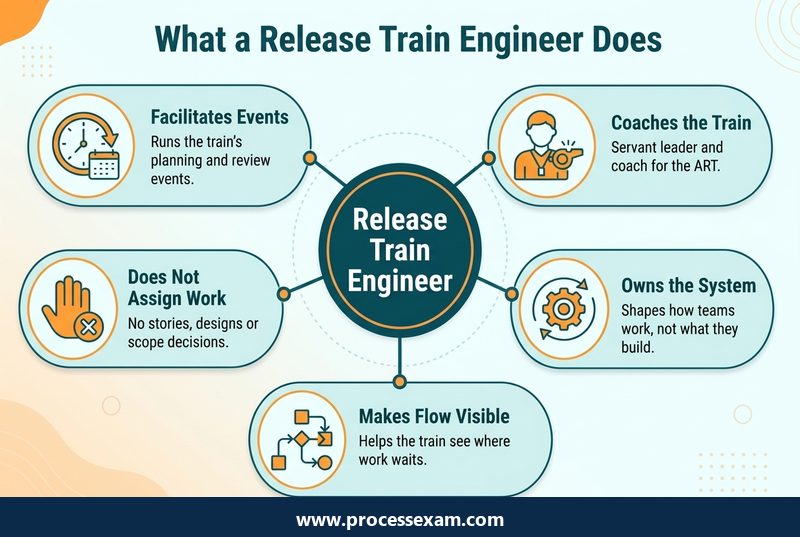
Go back to the payments and platform teams. A project manager would probably take the dependency, chase both sides and report on it. An RTE does something different. During the planning breakout, the RTE notices the missing string on the ART planning board, brings the two Product Owners and the System Architect together for ten minutes, and asks the question the teams have avoided: can the API move earlier, can the feature move later, or does the train accept the risk and say so? Whatever the answer, it goes on the board, it goes into the risk review, and the teams leave planning knowing who carries it. The RTE facilitated the decision; the teams made it.
That pattern repeats across the whole interval. The recurring responsibilities fall into five groups:
- Preparing and running PI Planning. Readiness of the vision and features, logistics for a large event, the planning agenda, the ART planning board, risk review and the confidence vote.
- Keeping execution visible. Running or coaching the ART Sync, where the Coach Sync and PO Sync surface impediments and dependencies before they become late surprises.
- Measuring and optimising flow. Watching flow metrics across the train, spotting bottlenecks and coaching teams on the practices that shorten the path from idea to delivered value.
- Driving relentless improvement. Facilitating Inspect and Adapt, turning its problem-solving workshop into backlog items, and sharing what the train learns with the organisation's transformation leaders.
- Coaching people. Scrum Masters, Product Owners, business owners and managers who are still learning how a train behaves.
Notice what is missing from that list: authority. An RTE influences rather than instructs, which is why the exam leans so heavily on questions where every option sounds reasonable and only one respects the teams' ownership of their own work.
What does the AI-Empowered SAFe RTE certification exam look like in 2026?
Scaled Agile no longer labels its courses as SAFe 6.0. The framework has moved to date-based releases, and the RTE course is now the AI-Empowered SAFe Release Train Engineer course. Its exam details page, effective 9 June 2026, is the reference for everything below. We checked it in September 2026.
| Item | What Scaled Agile publishes for the RTE exam |
|---|---|
| Vendor | Scaled Agile, Inc. (SAFe) |
| Exam code | RTE |
| Current release | AI-Empowered SAFe Release Train Engineer, exam details effective 9 June 2026 |
| Number of questions | 60 |
| Duration | 120 minutes |
| Passing score | 82% |
| Question type | Multiple choice, single select |
| Delivery | Web-based, closed book, no outside assistance |
| Exam fee | Covered by the course fee when sat no later than 60 days after the course ends; $50 for every further attempt |
| Renewal | Yearly |
Two numbers in that table shape your preparation more than the rest. The first is the pass mark. At 82% of 60 questions you need roughly 50 correct answers, which leaves room for about ten misses across the whole paper. That is a thin margin on a paper where most items sketch an untidy moment on a train and want the most sensible next move, not a definition.
The second is the clock. 120 minutes for 60 questions averages two minutes per item. The average hides the spread: a question on flow metrics can take thirty seconds, while a six-line story about a frustrated business owner, with four responses an RTE could defend, can swallow four minutes. Time slips away not on comprehension but on rereading, hunting for a certainty the question never offers. Practise committing to an answer, marking it, and carrying on.
If you studied from an older guide, note what has changed. Earlier versions of the RTE outline used four broad areas and a different pass mark, and the RTE page on many third-party sites still shows them. The current outline has eight domains, one of which is entirely new: applying AI to the RTE role. Scaled Agile's AI-Empowered RTE exam details page lists them with their weightings, and that page, not a cached study guide, is what the exam is written against.
Which eight domains does the RTE certification exam cover?
The weightings are published as ranges, so treat them as proportions rather than exact question counts. Multiplied across 60 questions, they tell you where the marks cluster. Our SAFe RTE exam syllabus page breaks each domain into its learning objectives, which makes a useful checklist once you have read the overview below.
| Domain | Weighting | Roughly how many of 60 questions |
|---|---|---|
| Exploring the RTE Role and Responsibilities | 16-18% | 10-11 |
| Organizing the ART | 7-9% | 4-5 |
| Facilitating PI Planning | 9-11% | 5-7 |
| Supporting PI Execution | 12-14% | 7-8 |
| Optimizing Flow | 6-8% | 4-5 |
| Fostering Relentless Improvement | 16-18% | 10-11 |
| Coaching the ART | 12-14% | 7-8 |
| Applying AI to the RTE Role | 14-16% | 8-10 |
The estimate column is our arithmetic on the published ranges, not a figure Scaled Agile publishes.
Exploring the RTE Role and Responsibilities (16-18%)
This is the domain that sets the tone for the rest. Expect questions about the RTE as a servant leader, how the role differs from a traditional program or project manager, and how the Lean-Agile mindset, SAFe core values and principles shape the RTE's choices. A common question shape describes a manager asking the RTE to take over a decision that belongs to a team, and asks what the RTE should do.
Organizing the ART (7-9%)
What makes a train effective, and who sits on it. You should be able to describe the key ART roles, how teams are organised around value rather than around technology layers, and what the RTE watches for when a train is being launched or reshaped. It is a small domain, so learn it well enough to collect its marks and move on.
Facilitating PI Planning (9-11%)
Preparing for and running PI Planning: the readiness checks before the event, the agenda across its two days, draft plan review, management review and problem-solving, the ART planning board, risk review using ROAM, PI objectives with business value, and the confidence vote. The scenario that opened this article belongs here, and so do questions about what to do when the confidence vote comes back low.
Supporting PI Execution (12-14%)
Everything between one planning event and the next. The ART Sync, the system demo at the end of each iteration, how the RTE keeps dependencies and risks visible, and how PI objectives are tracked. Questions often hinge on whether a problem should be escalated, handled at a sync, or left with the team that owns it.
Optimizing Flow (6-8%)
How the train measures flow and what it does with the numbers. Know the flow metrics SAFe uses, what each one reveals, and the practices that improve flow, such as limiting work in process, reducing batch size and making queues visible. The trap in this domain is choosing an answer that uses a metric to judge a team rather than to improve the system.
Fostering Relentless Improvement (16-18%)
One of the two heaviest domains. It covers the Innovation and Planning iteration, the Inspect and Adapt event and its three parts, the problem-solving workshop with root-cause analysis, and how improvement items find their way back into the backlog so they are actually done. If you have ever run a retrospective whose actions vanished by the next sprint, this domain is about preventing exactly that at train scale.
Coaching the ART (12-14%)
Group facilitation, coaching conversations and the RTE's work with Scrum Masters, Product Owners and leaders. Expect scenarios where the right answer is a question rather than an instruction, and where the RTE helps a group reach its own decision instead of handing it one.
Applying AI to the RTE Role (14-16%)
The new domain. It covers AI basics and prompting, the risks and responsible use of AI tools, and practical ways an RTE can use them: drafting event agendas, summarising sync notes, preparing data for a problem-solving workshop. The questions test judgement more than tool knowledge. When an option hands a decision to an AI tool without human review, or feeds it confidential train data carelessly, it is usually the distractor.
What does a Planning Interval look like from the RTE's seat?
Most of the exam's scenarios sit somewhere on one Planning Interval. SAFe renamed the Program Increment to the Planning Interval, but kept the abbreviation PI, so both names still appear in older study material. Following one interval in order is the fastest way to connect the eight domains to real work.
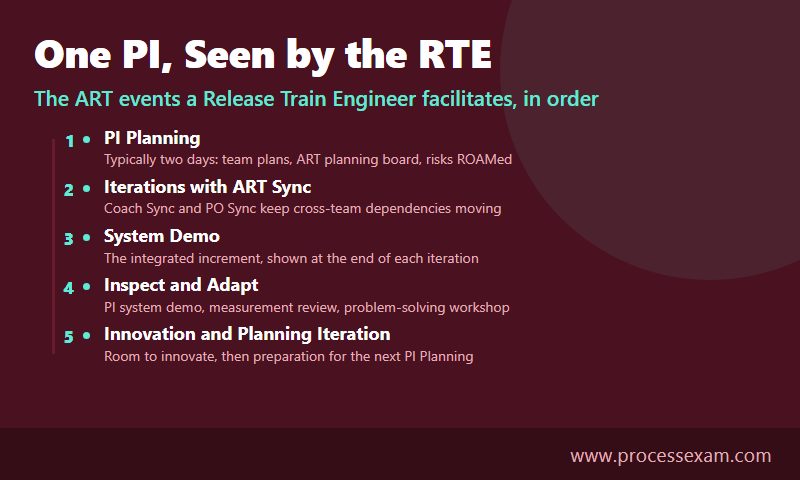
Before and during PI Planning
Weeks before the event, the RTE checks that Product Management has a vision and a prioritised set of features, that business owners will attend, and that the logistics work for co-located or remote teams. During the event, the RTE keeps time, watches the ART planning board as it fills, and pays special attention to the strings between teams. At the end come the risk review, where each risk is Resolved, Owned, Accepted or Mitigated, and the confidence vote. A low vote is not a failure; it is information, and the RTE's job is to make it safe to give.
Iterations and ART Sync
Once teams are executing, the RTE runs or coaches the ART Sync. The Coach Sync brings Scrum Masters together on impediments and dependencies; the PO Sync keeps scope and priorities aligned. The API that nobody owned in the opening scenario would appear here first if planning had missed it, which is why the RTE treats these meetings as an early-warning system rather than a status report.
System demo
At the end of each iteration the train shows the integrated increment, not a collection of team demos. The RTE helps make that possible and uses what the demo reveals: integration problems, features that looked done in one team's environment and broke in the combined one.
Inspect and Adapt
At the end of the interval, Inspect and Adapt brings the PI system demo, a quantitative and qualitative review of how the train performed, and a problem-solving workshop that chooses one or two systemic problems and digs to their root cause. The RTE facilitates, and the outputs become backlog items for the next interval rather than good intentions.
Innovation and Planning iteration
The final iteration gives teams room to innovate, finish learning activities and prepare for the next PI Planning. It also acts as an estimating buffer. An RTE who lets it fill with overflow feature work has quietly removed the train's only slack.
How do the RTE course, exam attempts and certification cost fit together?
The RTE exam is not sold on its own. You take it after completing the AI-Empowered SAFe Release Train Engineer course, which Scaled Agile and its training partners run in person and online. Scaled Agile's RTE certification page expects candidates to be familiar with the SAFe Agilist and SAFe Scrum Master roles before they start, and the course is aimed at people who already work on or around a train: Scrum Masters stepping up, program managers moving into SAFe, and agile coaches.
What the course fee covers
The course price is set by the training provider, so it varies by country, format and provider. What Scaled Agile does fix is what comes with it: your first exam attempt is folded into the course fee, provided you sit it no more than 60 days after the course ends. The course also gives access to a practice test with unlimited attempts that mirrors the exam's format and domain coverage.
Retakes and the waits between them
Each attempt after the first costs $50, and Scaled Agile spaces them out:
- The first retake is available immediately after an unsuccessful attempt.
- The second retake is available 10 days after the first retake.
- The third retake is available 30 days after the second retake.
- Any further attempt needs a 30-day wait after the one before it.
The spacing is the real cost. A candidate who fails twice in quick succession can be looking at more than a month before the next try, so the second attempt deserves the same preparation as the first rather than a rushed rebooking the same evening.
Keeping the certification
The RTE certification is renewed yearly through Scaled Agile. If you already hold the SAFe 6 RTE certification, Scaled Agile offers an upgrade path to the AI-Empowered credential through a short self-paced SAFe Skill rather than a repeat of the full course; check your SAFe Studio account for the current terms before paying for anything.
What is the smartest way to use the 60 days after the RTE course?
The 60-day window is the planning constraint. Most candidates do best by sitting the exam two to five weeks after the course, while the class discussions are still fresh, rather than leaving it to the last week of the window. The plan below is organised by the kind of thinking each stage builds rather than by calendar week, so it stretches or compresses to fit the time you have.
Stage one: rebuild the interval from memory
Within a few days of the course, close the workbook and write out one Planning Interval from start to finish: every event, who attends, what goes in and what comes out. Then open the workbook and mark what you missed. Most people discover that they remember PI Planning in detail and Inspect and Adapt only vaguely, which is a problem, because Fostering Relentless Improvement carries as much weight as the role domain.
Stage two: study the heavy domains through situations
Put most of your time into the four domains that together make up well over half the exam: the RTE role, relentless improvement, coaching the ART and applying AI. For each, write three short situations from your own work or from the course, and answer them the way an RTE would. For example: a business owner wants to add a feature in the middle of the interval; a Scrum Master keeps escalating team issues to the ART Sync; a team wants to paste its whole backlog into a public AI tool to rewrite the stories. Writing the situation yourself trains the recognition the exam depends on.
Stage three: learn the smaller domains to the point of speed
Organizing the ART, Optimizing Flow and Facilitating PI Planning are smaller, but they are also the most factual. You should be able to name the ART roles, the flow metrics and the steps of PI Planning without hesitation, so that questions from these domains take a minute and bank time for the long scenarios elsewhere.
Stage four: rehearse the pace
This is where timed practice earns its place. Start with the practice test that comes with the course, then add a second source so you are not simply remembering answers you have already seen. When you want fresh scenarios, work through our RTE practice test in timed sittings, and after each one sort every wrong or guessed answer by domain. A domain that keeps appearing in that list is telling you where to spend your next study session, and a list that keeps shrinking is the clearest signal that exam day can go in the calendar.
The night before and the hour itself
The exam runs in your browser with no notes allowed, so test the laptop, the connection and the room a day early, not minutes before the start. Once the clock is running, look for the verb in each item before the story around it: is it asking what the RTE does first, does best, or should not do? Those three readings lead to different answers from the same scenario. When an item starts to drag, mark it, pick your best guess so nothing is left blank, and spend the minutes saved on the quick factual items coming back to it.
Where do RTE candidates lose the marks they needed?
With room for only about ten misses, a handful of repeated errors is enough to fail. Here are the patterns that recur in RTE preparation.
- Answering as a project manager. Options where the RTE assigns work, sets team priorities or makes a technical decision are almost always wrong. The RTE facilitates the people who own those decisions.
- Escalating too early. Many scenarios reward helping the teams resolve something at the right level first, whether that is inside a team, at the Coach Sync or at the PO Sync, before involving leadership.
- Treating PI Planning as the whole job. Planning is one domain of eight and carries about a tenth of the marks. Relentless improvement and coaching carry far more.
- Studying from a superseded outline. Guides built on the four-domain outline, or on SAFe 6.0 course material, miss the AI domain entirely and use older terms such as Program Increment and program board.
- Using metrics as a scorecard. Flow metrics exist to improve the system, not to rank teams. Answers that compare teams' velocity or punish a slow team are distractors.
- Letting AI make the call. In the new domain, the safe answer keeps a human accountable for the decision and protects confidential information.
- Letting the 60-day window lapse. Miss it and the first attempt is no longer included, so book the exam date when you finish the course, not when you feel ready.
Who gains most from the RTE credential, and when is it the wrong choice?
For the right person, yes. The credential makes most sense if you already work on an Agile Release Train, or in an organisation that is adopting SAFe, and you want to move from coaching one team to enabling many. It is less useful if your organisation runs a different scaling approach, because the exam is written in SAFe's vocabulary and much of its value comes from speaking that vocabulary fluently with other SAFe practitioners.
What it proves to an employer
It shows that you understand how a train is meant to run: how planning, execution, demos and improvement fit together, and how to facilitate them without taking ownership away from the teams. For hiring managers filling an RTE, Solution Train Engineer or agile program role, that is a shared baseline they do not have to test from scratch in the interview.
Where it leads
The RTE role is a common step between team-level coaching and wider transformation work. People who hold it move towards Solution Train Engineer roles on large solutions, towards agile coaching across several trains, and towards the SAFe Practice Consultant path for those who want to teach and lead SAFe implementations. The certification does not make that move for you, but it gives your experience a name that recruiters and SAFe organisations recognise.
Its limits
No certificate stands in for experience. A newly certified RTE who has never facilitated a large planning event will still find the first one hard, and interviewers for senior roles tend to ask about trains you have actually supported. The strongest profile pairs the certification with specific stories: the dependency you caught at planning, the Inspect and Adapt workshop that fixed a recurring integration problem, the coaching conversation that changed how a team escalated. Those stories are also, not by accident, the best preparation for the exam.
If that describes the work you do or want to do, the course, the included first attempt and a steady few weeks of preparation are a reasonable investment. If it does not, spend the same effort on the credential that matches the framework your organisation actually uses.
Frequently Asked Questions
How much does the SAFe RTE certification cost?
The course fee is set by the training provider and varies by country and format. Scaled Agile covers the first exam attempt through the course fee, as long as you sit it within 60 days after the course ends. Each retake or later attempt costs $50, and the certification is renewed yearly.
How many questions are on the RTE certification exam, and what is the pass mark?
The AI-Empowered SAFe RTE exam has 60 multiple-choice, single-select questions in 120 minutes, and you need 82% to pass. That means roughly 50 correct answers, so there is room for only about ten misses across the eight domains of the exam outline.
Can I take the SAFe RTE exam without attending the course?
No. The RTE exam is taken after completing the AI-Empowered SAFe Release Train Engineer course, which Scaled Agile and its training partners deliver. Scaled Agile also expects candidates to be familiar with the SAFe Agilist and SAFe Scrum Master roles before starting the course.
Is the RTE certification exam taken online?
Yes. Scaled Agile delivers it on the web, closed book and with no outside assistance, so you sit it on your own computer rather than at a test centre. Check your device, connection and a quiet room before you start, because the 120-minute clock runs continuously.
Which domains carry the most weight in the RTE exam?
Exploring the RTE Role and Responsibilities and Fostering Relentless Improvement each carry 16-18%, followed by Applying AI to the RTE Role at 14-16%. Supporting PI Execution and Coaching the ART each carry 12-14%, and the remaining three domains make up the rest.
- Scaled Agile |
- SAFe Release Train Engineer Test Questions |
- RTE Question Bank |
- SAFe Release Train Engineer Book |
- Release Train Engineer Certification Cost |
- Release Train Engineer Certification Requirements |
- SAFe Release Train Engineer Sample Questions |
- RTE Exam Questions Download |
- RTE Test Questions |
- Release Train Engineer PDF


