
PSD I Exam Guide: Focus Areas, 85% Pass Mark and Study Plan
No. You will not write a line of code on the PSD I, because it is a multiple-choice assessment of 80 questions in 60 minutes, and you need 85% (68 correct answers) to pass. What it does test is whether you understand how Developers build, test and release work inside a Scrum Team. Experienced programmers lose marks by trusting habit, and newcomers pass by reading the right two documents carefully.

Scrum.org describes the Professional Scrum Developer certification as evidence that you can deliver quality software with the Scrum framework while working in Scrum Teams, including modern Agile and DevOps practices. The word "Developer" in Scrum is wider than "programmer": it means anyone on the team who builds any part of a usable Increment, so testers, designers, data engineers and architects sit in the same group. This guide is written for those people. It explains what the assessment really measures, which questions are easy to lose, and how to prepare in two to four weeks.
Is the PSD I a coding exam, and who is it really for?
It is not a coding exam. Scrum.org's page lists the format as multiple choice, multiple answer and true/false, delivered in English, so there is no editor, no compiler and no whiteboard problem. The assessment sits in a family of Professional Scrum certifications that all test judgement: given a situation inside a Scrum Team, what does the Scrum framework say a Developer should do, and why?
That is why the audience is broader than software engineers. The credential suits four groups:
- Working programmers who have used Scrum for years but never checked their habits against the Scrum Guide.
- Testers and quality specialists who want proof that they belong inside the Sprint, not after it.
- Architects and technical leads who need to show they can guide design without becoming a manager of the team.
- Career changers and graduates who want independent proof of Scrum knowledge before their first team job.
Scrum.org says attending a class is not a prerequisite, although it highly recommends its Applying Professional Scrum for Software Development course. A free Credly digital credential is included when you pass.
What do you get for $200, and how many answers must be right?
The figures below come from our exam database and match Scrum.org's own certification page, which we read on 3 October 2026.
| Detail | PSD I |
|---|---|
| Exam code | PSD I |
| Certification | Scrum.org Certified Professional Scrum Developer (PSD I) |
| Questions | 80 |
| Time limit | 60 minutes |
| Passing score | 85% |
| Fee | $200 USD per attempt |
| Question types | Multiple choice, multiple answer, true/false |
| Language | English |
Three details around those numbers matter more than they look. First, 85% of 80 is 68, so you can afford twelve wrong answers and no more. Second, each Scrum.org password is valid for one attempt only and has no expiry date, so you can buy it early and sit the test when you are ready. Third, the credential is for life: Scrum.org states that no annual renewal fee is required. You pay once and keep the result.
We found no published pass rate for this assessment, so treat any percentage you read elsewhere as a guess. A better measure of readiness is how you score on timed practice, which we cover later in this guide.
Where do the 80 questions come from?
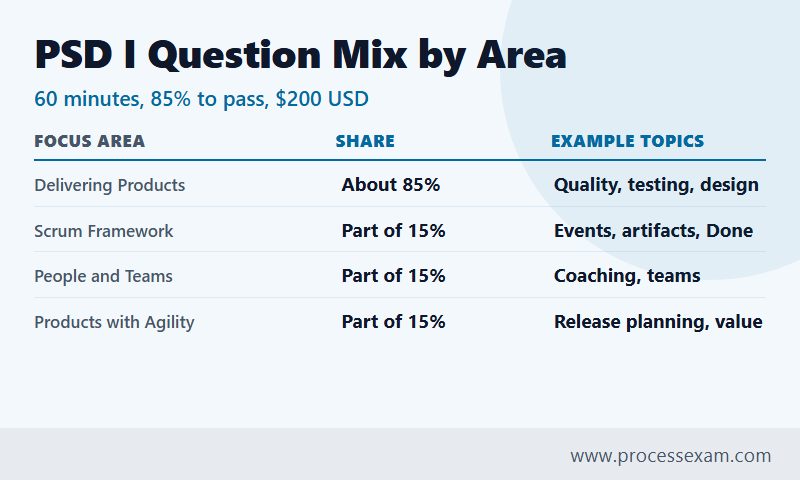
Scrum.org draws the questions from the focus areas defined in its Professional Scrum Competencies and says so on the certification page. About 85% of them are selected at random from one focus area, Developing and Delivering Products Professionally. The remaining 15% come from three other areas and are designed to confirm that you understand the core concepts of Scrum.
| Focus area | Share of the questions | Topics Scrum.org lists |
|---|---|---|
| Developing and Delivering Products Professionally | About 85% | Backlog refinement, cross-functional and self-managed development, design and architecture, programming, quality, testing |
| Understanding and Applying the Scrum Framework | Part of the other 15% | Empiricism, Scrum values, Scrum Team, events, artifacts, Done |
| Developing People and Teams | Part of the other 15% | Self-managing teams, facilitation, coaching and mentoring |
| Managing Products with Agility | Part of the other 15% | Forecasting and release planning, product value, Product Backlog management, stakeholders and customers |
In practice, "about 85%" of 80 questions is roughly 68 questions on technical delivery and about 12 on everything else. That split is the most useful planning fact in this article: a candidate who knows the Scrum events perfectly but has never thought hard about technical debt, Definition of Done or test automation is revising the small part of the paper. You can see how these areas map onto study topics in our PSD I syllabus outline.
What does "developing and delivering products professionally" ask of a developer?
This is the heart of the paper, so it deserves a section for each topic Scrum.org names. The assessment never asks you to prefer one tool or language. It asks whether your working habits support the Scrum accountabilities.
Backlog refinement
Refinement is the ongoing work of breaking big Product Backlog items into smaller, clearer ones. In the 2020 Scrum Guide there is no required meeting for it, and the Scrum Team decides how much to do. For Developers the key idea is that refinement is shared with the Product Owner: the Product Owner owns the ordering and the value, while the Developers bring the sizing and the technical knowledge that makes an item small enough to finish inside a Sprint.
Cross-functional and self-managed development
A cross-functional team holds every skill needed to create value each Sprint. A self-managed team decides who does what, when and how. Situations in this topic often describe someone outside the team assigning tasks, a lead acting as a gatekeeper, or a team that waits for another department to review its work. The Scrum-correct reading is nearly always that the Developers decide how to turn Product Backlog items into an Increment, and that a dependency on an outside group is a problem to make visible, not a normal part of the process.
Design and architecture
Scrum has no separate design phase and no up-front architecture sign-off. Design emerges and is refined Sprint by Sprint, and a Developer who uses that freedom to build something sensible is meeting the framework's intent. Expect to reason about when a little design is enough, and about how a team keeps a product able to change without a big rewrite.
Programming and quality
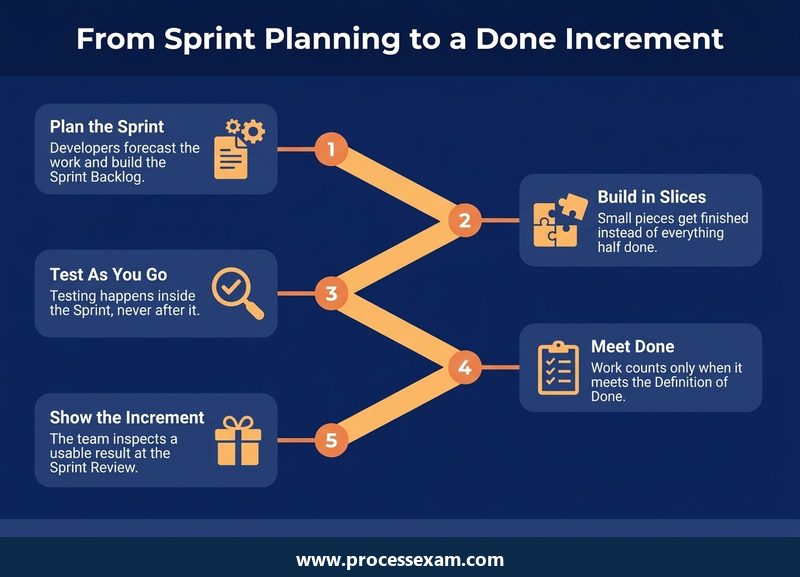
Quality is the topic where the Scrum Guide is most direct. Developers are accountable for instilling quality by adhering to a Definition of Done. If an Increment does not meet that definition, it cannot be released, and it cannot be presented at the Sprint Review as finished work. Scenarios probe what Developers do when quality is under pressure: they do not lower the Definition of Done to fit more into the Sprint.
Testing
The Scrum Guide has no testing phase. Testing happens during the Sprint as part of building the Increment, and unfinished testing means unfinished work. If you have worked in a team where a separate group tests after the "development Sprint", this is the topic where your experience can mislead you.
Technical debt and DevOps practices
Scrum.org places modern Agile and DevOps practices inside the certification's description, so be ready for the vocabulary around them. Technical debt is the cost of shortcuts that make future change slower. Continuous integration means merging work often and checking each merge automatically. Test automation means repeatable checks that run without a person. None of these is a Scrum rule on its own, but each is a way for Developers to keep the promise in the Definition of Done. When a scenario mentions growing debt or a fragile release, ask which practice would make the Increment cheaper to finish, and which choice keeps the problem visible to the whole Scrum Team.
How does the Scrum Guide describe the Developer's job?
Because 15% of the paper checks the framework itself, and because the technical questions are written in the same vocabulary, reading the Scrum Guide is non-negotiable. It is short, free and the source that the whole assessment grows from. For a Developer, four duties carry most of the weight. Developers are the people committed to creating any aspect of a usable Increment each Sprint. They create the plan for the Sprint, the Sprint Backlog. They instil quality by adhering to a Definition of Done. And they adapt their plan each day toward the Sprint Goal, holding one another accountable as professionals.
Read those four duties as a checklist and several answer patterns appear:
- If a choice has the Product Owner or Scrum Master telling the Developers how to build, it is almost certainly wrong.
- If a choice reduces the Definition of Done to meet a date, it is wrong.
- If a choice hides a problem from the Sprint Review, it is wrong, because Scrum rests on transparency.
- If a choice has the Scrum Team inspecting and adapting together, it is usually the strongest one.
The smaller 15% asks you to know the events and artifacts well. Remember that the Daily Scrum is a 15-minute event for the Developers, that the Sprint Backlog belongs to them, and that Done is a commitment attached to the Increment, not a loose feeling about finished work.
What do Scrum-correct answers look like in a developer's day?
Worked examples are the quickest way to feel the gap between what you do at work and what Scrum asks. The three situations below are our own illustrations of the competencies, not questions from the assessment. Try to answer before reading the reasoning.
Example 1: the separate test team
Your Sprint ends on Friday. The code is merged on Thursday and a separate test group checks it the following week. Is the work Done on Friday? No. If testing is part of what makes the Increment releasable, then the Increment is not Done until that testing is complete, and the Definition of Done should say so. The fix is not to ask the test team to move faster; it is to bring testing into the Sprint, for example by testing each item as it is built and automating the checks that repeat.
Example 2: the item that will not fit
Halfway through the Sprint the Developers see that the planned work will not all fit. What should they do? They should talk with the Product Owner about what can be dropped or renegotiated while protecting the Sprint Goal, and they should not quietly cut testing or skip the Definition of Done. Scope can be negotiated; quality cannot.
Example 3: the senior engineer who assigns the work
A well-respected engineer starts assigning tasks to the other Developers each morning. Is that acceptable? Not under Scrum. Developers manage their own work, and the Scrum Team has no sub-teams or hierarchies. An experienced person can coach, share a technique or propose a plan, but the Developers decide together. A good answer also considers raising the pattern in the Sprint Retrospective instead of arguing it out in the Daily Scrum.
Notice that none of those answers is a technique. They are about accountability, transparency and who decides, and that is the kind of reasoning the assessment rewards.
Which of your habits will help or hurt on the day?
Your professional background shapes where you are likely to pick up and lose marks. The table below describes common patterns, so use it as a prompt for your own revision rather than as a rule.
| Your background | Where it helps | Where it can mislead |
|---|---|---|
| Experienced programmer | Quality, programming and design topics feel familiar | Habits from project teams, such as assigned tasks and handoffs, may feel normal |
| Tester or QA specialist | You understand testing and Definition of Done well | A separate testing phase after the Sprint is not part of Scrum |
| Architect or technical lead | Design and architecture reasoning is strong | Decisions the Developers should make together may feel like yours to make |
| Former waterfall engineer | You know why discipline and documentation matter | Up-front design and sign-offs conflict with Sprint-by-Sprint work |
| Graduate or career changer | Few bad habits to unlearn | Technical delivery topics may be less familiar than the Scrum events |
Look for your own row and give that column extra revision time. The "can mislead" column is where well-informed candidates lose the points they thought they had, so write down one example from your own workplace for each point that applies to you and check it against the Scrum Guide.
How do you prepare in two weeks, or in four?
A working developer who already uses Scrum can be ready in about two weeks of daily study of 45 to 60 minutes. If Scrum is new to you, plan on four weeks and spend the first of them on reading.
The two-week route for working developers
- Days 1 and 2. Read the Scrum Guide twice. On the second pass, mark every sentence that is about the Developers.
- Days 3 and 4. Read the Professional Scrum Competencies for Developing and Delivering Products Professionally, and write one sentence per topic on how your own team handles it.
- Day 5. Take the Scrum Developer Open assessment, the free practice assessment Scrum.org lists for this certification, and note every wrong answer with the reason.
- Days 6 to 8. Study the gaps: Definition of Done, technical debt, test automation, continuous integration and the difference between work that is finished and work that is releasable.
- Days 9 and 10. Take the Scrum Open assessment, the second practice assessment Scrum.org lists, to check the framework basics behind the 15% area.
- Days 11 to 13. Practise on timed sets and review every miss against the Scrum Guide, not against someone's summary.
- Day 14. Rest, then sit the assessment.
The four-week route if Scrum is new
In week one, read the Scrum Guide slowly and learn the vocabulary: accountabilities, events, artifacts, commitments. In week two, add the Competencies and the Developer-specific topics. In week three, work through both Scrum.org practice assessments and a first set of practice questions. In week four, repeat timed sets until your scores sit steadily above the 85% line. The course Scrum.org recommends, Applying Professional Scrum for Software Development, is the best option if you can afford the time, because you build a realistic system as a team over a series of Sprints.
When the reading is done and you want to see how you score under the clock, take a timed PSD I practice exam and keep a note of why each wrong choice was wrong. A score that climbs on questions you have not seen before is a far better sign than a high score on a set you have memorised.
How should you handle 80 questions in 60 minutes?
The time limit works out at 45 seconds per question, which is generous for true/false items and tight for long scenarios. A pace plan prevents the usual late rush.
- First pass, about 40 minutes. Answer everything you are sure of, flag anything that needs more than a minute, and keep moving.
- Second pass, about 15 minutes. Return to the flagged questions with fresh eyes.
- Last five minutes. Check that no question is left blank.
Read multiple-answer questions with extra care and select exactly as many options as the prompt asks for, committing only to options you can defend from the Scrum Guide. Restate a long scenario in one sentence of your own before looking at the choices, and treat words like "always" and "never" with suspicion, since Scrum rarely uses absolutes.
If you plan to use a translation plugin, follow Scrum.org's instructions for it exactly, and remember that Scrum.org does not guarantee translation quality. For accommodations, Scrum.org asks you to contact its support team about your circumstances. Sit the assessment in a quiet room with a stable connection.
If you do not pass, the password is spent and another attempt needs a new purchase, so do not treat the first try as a rehearsal. Scrum.org gives you a breakdown of your performance by Professional Scrum Competency afterwards, and that breakdown is the best guide to what to revise for the next attempt.
Is the PSD I worth adding to a developer's profile?
For a developer, the case rests on three points. It is an independent test of knowledge rather than a certificate for attending a class, which is the distinction Scrum.org draws about all its certifications. It does not expire and carries no annual fee, so the $200 is the whole cost. And it speaks to a specific gap: many teams call themselves Agile while still working in stages, and a Developer who can explain Definition of Done, quality and self-management in Scrum's own terms is useful in refinement and retrospective discussions.
We do not quote salary figures here, because we found no reliable source for PSD I holders and would not guess. What the credential reliably does is show a hiring manager that you know the framework your team claims to use, and it gives you a vocabulary for raising quality concerns without making them personal.
After the PSD I, many developers add the Professional Scrum Master or Professional Scrum Product Owner assessments to understand the other accountabilities, since a Developer who knows what the Product Owner and Scrum Master are accountable for works with them more smoothly. Which one you pick depends on where your team needs help. Whichever route you choose, the habit that carries you through the PSD I carries over: read the Scrum Guide, check your own working habits against it, and practise under the clock.
Before you book, confirm the current fee, rules and focus areas on the Scrum.org PSD I certification page, since Scrum.org can change them at any time.
Frequently Asked Questions
How many questions are on the PSD I exam?
The PSD I has 80 questions and a 60-minute time limit, which works out at 45 seconds per question on average. The format mixes multiple choice, multiple answer and true/false items, all in English, and there is no coding task.
What is the passing score for the PSD I?
Scrum.org sets the passing score at 85%, which means 68 correct answers out of 80. You can afford twelve wrong answers. Scrum.org does not publish a pass rate, so measure your readiness with timed practice scores instead.
How much does the PSD I cost, and does it expire?
The fee is $200 USD per attempt, and additional taxes may apply at checkout. Each password is valid for one attempt and has no expiry date. The certification is for life, and Scrum.org states that no annual renewal fee is required.
Do you need coding experience to pass the PSD I?
No. The assessment is multiple choice and tests how Developers work in a Scrum Team: quality, testing, self-management, refinement and the Definition of Done. Testers, architects and graduates can pass it, though technical delivery topics make up about 85% of the questions.
Are there free practice assessments for the PSD I?
Yes. Scrum.org lists the Scrum Open and Scrum Developer Open assessments as practice for this certification. Take them early to find gaps, then review every wrong answer against the Scrum Guide before moving on to timed practice sets.
- Scrum |
- Scrum.org Professional Scrum Developer Test Questions |
- Scrum.org Professional Scrum Developer Book |
- Professional Scrum Developer Certification Cost |
- Professional Scrum Developer Certification Requirements |
- Scrum.org Professional Scrum Developer Sample Questions |
- Professional Scrum Developer PDF |
- PSD I Question Bank |
- PSD I Exam Questions Download |
- PSD I Test Questions


