
PRMIA ORM Certificate: Cost, Exam Format and Study Plan
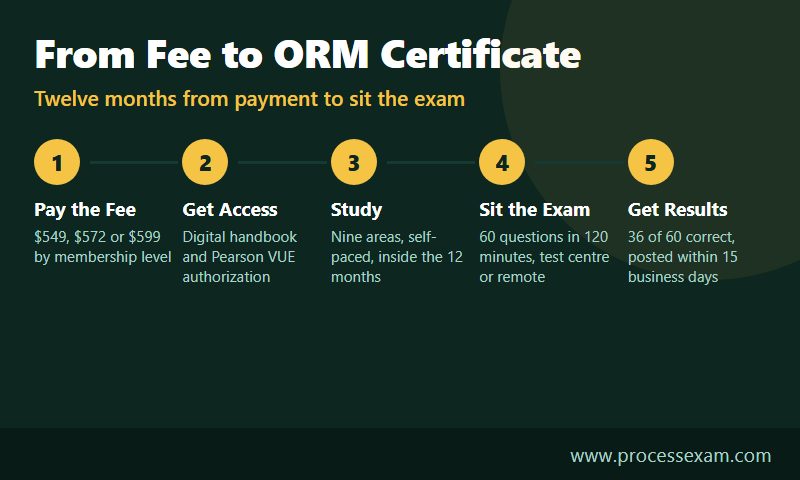
It is worth sitting if your work touches operational risk in financial services, and it costs less than many people assume: PRMIA charges $549 for Sustaining members, $572 for Contributing members and $599 for non-members, and that one payment covers the handbook and the exam sitting. You then have twelve months to answer at least 36 of 60 multiple-choice questions correctly within two hours.
This guide goes through what the money buys, how the paper is divided, what each area expects from you, how to share your study time, and what happens on the day and afterwards. The figures come from PRMIA's own certificate page and candidate guidebook, which I checked in October 2026; the exam is still on sale and the fee levels on the page match the ones quoted here.
Is the PRMIA ORM certificate worth taking, and who is it for?
The Operational Risk Management certificate, run by the Professional Risk Managers' International Association (PRMIA), tests whether you understand how a financial firm identifies, measures, reports and governs the risk of loss from failed processes, people, systems and external events. It is a knowledge certificate rather than a professional designation, a distinction PRMIA draws itself when it asks candidates whether they want validation of their knowledge or a designation.
PRMIA describes the programme as intended for staff with at least two years of experience in finance or risk management. That is a recommendation about who gets the most from it, not a gate: the three requirements the guidebook lists are a PRMIA account, a commitment to PRMIA's standards of conduct and ethics, and passing the exam. Nobody checks your job history before you pay.
The people who tend to benefit most are:
- operational risk analysts and officers who already run risk and control assessments but have never had their vocabulary checked against a published syllabus;
- financial controllers and operations or technology managers whose teams own the controls that operational risk staff test;
- compliance and legal officers who need to see where conduct and compliance risk sit inside the wider framework;
- front-line staff in client-facing roles, because PRMIA points out that process and conduct awareness now matters well beyond the risk department.
PRMIA's guidebook reported more than 1,700 holders in 98 countries as of May 2023, drawn from banks, corporates and government bodies. There is also a public directory of holders on prmia.org, so an employer can check the credential without you sending a document.
What it is not
It is not a quantitative modelling qualification. The capital section introduces risk modelling at an awareness level, and the weight sits on frameworks, assessment and information. If you want deep statistical treatment of loss distributions, this is the wrong shelf; if you want to be the person who can run a control self-assessment cycle and explain it to a board, it is the right one.
What does the ORM programme cost, and what is included in the fee?
PRMIA calls the payment a programme fee, and it covers more than the sitting. After you pay, you receive access to the digital handbook, Risk Management Frameworks and Practices for Operational Risk Management, through your PRMIA profile, and within two to three business days an exam authorization is sent to Pearson VUE so you can book. The authorization is valid for twelve months from purchase.
| Item | Detail |
|---|---|
| Exam | PRMIA Operational Risk Management (ORM) |
| Vendor | PRMIA |
| Fee, Sustaining member | $549 |
| Fee, Contributing member | $572 |
| Fee, non-member | $599 |
| Delivery | Pearson VUE, test centre or remote proctoring |
| Questions | 60 |
| Duration | 120 minutes |
| Passing score | 60% (36 of 60) |
Three details about the money are easy to miss. First, PRMIA states that all programme fees are final sales and are neither refundable nor transferable, so be sure of your start date before paying. Second, PRMIA mentions discounts for groups, which employers training several people should ask about through the contact address on its page. Third, the gap between the cheapest and dearest tier is only $50, so joining as a paying member just to save on this certificate would not make sense on its own; the case for membership is the optional eCoach course, which Sustaining members get included.
The eCoach course is an on-demand course of over two hours that follows the handbook, and PRMIA lets you try the first lesson free before deciding whether to buy the rest. Treat it as a way to hear the material explained once, not as a replacement for the handbook, because the exam draws its questions from the reading list.
One regional point: PRMIA says its exams are not offered in Quebec because of the province's language rules, and that candidates there must travel elsewhere to sit. The exam is available in English only.
How is the ORM exam built, and where do its 60 questions sit?
The paper is all multiple choice: four options per question, a single right answer. PRMIA's guidebook splits the 60 questions across nine rows, although the text above its table speaks of eight domains plus case studies; what matters for you is the count in each row.
| Area | Questions | Handbook chapter |
|---|---|---|
| A. Introduction | 2 | Chapter 1 |
| B. Risk Governance | 6 | Chapter 2 |
| C. Risk Management Framework | 10 | Chapter 3 |
| D. Risk Assessment | 10 | Chapter 5 |
| E. Risk Information | 10 | Chapter 6 |
| F. Compliance Risk | 6 | Chapter 4 |
| G. Operational Risk Capital | 6 | Chapter 7 |
| H. Operational Resilience | 4 | Chapter 8 |
| I. Case Studies | 6 | Web resources |
| Total | 60 | - |
Three areas, framework, assessment and information, carry 30 of the 60 questions between them. Add governance, compliance, capital and the case studies at six each and the picture is clear: there is no single heavy chapter you can skip your way around, and no area so small that it can be ignored for free. Even the two-question introduction is cheap marks if you have read it once.
Note the chapter numbering too. Compliance risk is Chapter 4 in the handbook but appears after Risk Information in the exam table, so if you read in book order you meet it before the assessment material, not after. Keep your notes by exam area instead of reading order, so you can count questions against pages later. The full topic list is on the ORM syllabus page, which follows the same area structure.
What does each ORM area actually ask you to do?
The syllabus headings can look like abstract nouns. Here is what each one means in practice, reading from PRMIA's own objectives.
Introduction and governance
The introduction asks for an appreciation of risk management after the financial crisis, including how frameworks have widened to cover ESG and climate risk. Governance goes deeper: where corporate governance comes from, how the board, the chief risk officer and wider reporting lines divide responsibility, and how the risk management process turns a policy into results. Expect questions that describe a firm with a muddled reporting line and ask which role should own the fix.
The risk management framework
This area is about the building blocks a firm chooses: risk capacity, risk appetite, risk policies, risk pricing and risk culture. Capacity is what the firm can absorb, appetite is how much of that it chooses to take, and policies translate both into rules people can follow. Candidates often blur capacity and appetite. A clean test: capacity is a limit set by resources and stress testing; appetite is a decision made inside that limit. The culture sections ask who shapes behaviour, from leaders to the risk function to ordinary staff, and how a firm would evaluate it.
Risk assessment
PRMIA's objective here is that you can manage an assessment programme and apply it at work. The syllabus separates two directions of travel. The top-down route starts with risk scenarios, usually developed in workshops. The bottom-up route starts from process models and links controls to the risks they address. The two meet when controls identified from the process side are tied back to the scenarios from the top. After that comes issue management: raising issues, designing action plans, measuring residual risk and having management validate the fix. Two extra topics, new and expanded products and third-party services, are the sort of subject that suits a scenario question.
Risk information
Risk information starts from risk appetite and the risk profile, then expected and unexpected loss. It moves to loss investigations: capturing incidents, collecting and quantifying loss data, boundary issues (for example, an event that looks like credit risk but began as a process failure) and external loss data. Key risk indicators follow, including how to select them, why some depend on one another, and how to build a framework around them. The last strand is reporting and tools: data models, workflows and the reports a risk team produces.
Compliance risk
This area defines compliance risk, explains what drives regulatory change, and separates codified rules from non-codified expectations. Topics include consumer protection, financial crime, systemic risk, enterprise controls over compliance, and conduct and culture. The distinction between written rules and expected behaviour is worth rehearsing, because it is easy to confuse in a scenario where a firm technically complied but still harmed customers.
Operational risk capital and resilience
The capital section places operational risk capital within wider risk capital, touches on modelling, and covers Basel III developments. Resilience, the smallest area at four questions, covers how operational resilience is defined, the regulatory developments around it, including the EU's DORA regulation, and the process a firm follows to build it. Both are shorter reads than the framework chapters, which makes them efficient places to gain marks.
Case studies
Six questions come from case studies hosted on PRMIA's web resources page rather than from the handbook. Candidates who skip these give away up to 10% of the paper. Read each case once for the story and once for the lessons about controls, culture or reporting, because the questions ask what went wrong and why, not what the case says on page one.
How should you divide your study time across the nine areas?
The simplest defensible plan follows the blueprint: give each area study time in proportion to its question count, then move hours towards the areas where your practice scores are weakest. The table below is a starting split, not a PRMIA figure.
| Area | Questions | Suggested share of study time | Adjust upwards if |
|---|---|---|---|
| Introduction | 2 | 3% | you skipped the foreword |
| Governance | 6 | 10% | you have not worked near a board or risk committee |
| Framework | 10 | 17% | capacity and appetite still blur together |
| Assessment | 10 | 17% | you have not run a workshop or control review |
| Information | 10 | 17% | KRIs and loss data are new to you |
| Compliance | 6 | 10% | you come from a non-regulated sector |
| Capital | 6 | 10% | you avoid anything quantitative |
| Resilience | 4 | 7% | you have not met DORA or similar rules |
| Case studies | 6 | 9% | you read them only once |
How long the plan lasts depends on where you start. A risk analyst who runs assessments every quarter can plan on a few weeks of evening reading. Someone from compliance or operations, meeting the capital and information chapters for the first time, should allow longer. PRMIA itself says some candidates are ready to sit with little study, but gives you twelve months so you do not have to rush. Use that room, but set a booking date in your first week, because open-ended study rarely finishes.
A three-pass routine for each chapter
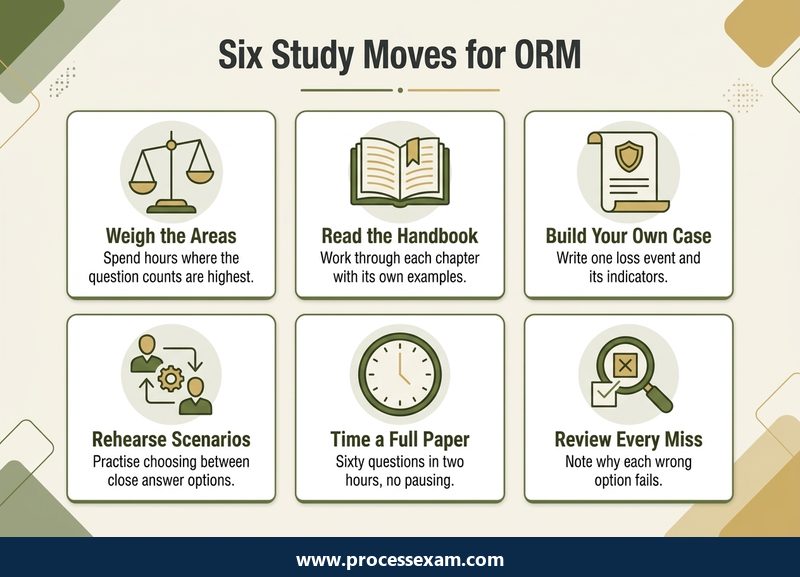
Pass one is a straight read, with no notes, to learn the shape. Pass two is a rewrite: summarise each chapter heading in one sentence of your own, and list any term you could not define aloud. Pass three is an application: take one real event from your workplace or the news and push it through the chapter. For the information chapter, that means writing up a loss event, deciding which indicator would have warned of it, and noting where the boundary with another risk type might confuse the record.
Where practice questions fit
Practice should start once you have finished the first read of an area, not at the end. Attempting questions early shows you how PRMIA phrases options, and the phrasing is half the skill. A timed set also tells you whether you are quick enough: 60 questions in 120 minutes is two minutes each, which is generous, so the more common problem is over-thinking close options, not running out of time. Two full timed runs on the ORM practice exam will show you which of the nine areas still drags your score down before you pay for the real sitting.
How do you pick the right answer when two options both sound sensible?
Operational risk scenarios are written so that several options are plausible. The reliable way through is to ask which option addresses the cause in the scenario and sits at the right level of the firm. Four habits help.
- Find the level. Is the question about the board, the risk function, a business line or an individual control? An answer that fixes a local symptom is usually wrong when the scenario describes a governance gap.
- Find the stage. Is the firm identifying, assessing, mitigating, monitoring or reporting? Options from a different stage are distractors even when they are good practice.
- Separate cause from event. A system outage is an event; weak change control is a cause. Questions often reward the answer that deals with the cause.
- Beware of absolute words. Options saying a control eliminates risk tend to be wrong, because operational risk is managed, not removed. Residual risk is a named concept in the syllabus for this reason.
A worked example
Imagine a payments team that discovers duplicate transfers after a software release. One option is to refund the customers affected, a second is to add a key risk indicator on duplicate payment counts, a third is to review the release testing process, and a fourth is to update the risk appetite statement. All four sound responsible. The question's wording decides: if it asks for the immediate response, refunds come first; if it asks how to detect a repeat early, the indicator wins; if it asks about the root cause, the testing process does. Reading the verb of the question before the options saves marks across the whole paper.
Expected and unexpected loss in plain terms
Since the information area leans on these two ideas, make them concrete. Expected loss is the average cost a firm anticipates from regular events, such as small processing errors each month, and is normally priced in or provided for. Unexpected loss is the rare, larger deviation that capital exists to absorb. If a question asks which one capital is meant to cover, the answer is the unexpected part.
What happens when you book and sit the ORM exam?
Booking runs through Pearson VUE. You create an account (or use an existing one) with details that match your PRMIA profile exactly, because that is how the two systems link your records. The Pearson VUE page for PRMIA lists the pre-approved exam once PRMIA has sent the authorization. You can choose a test centre or an online proctored sitting.
Rules to know before the day
- Moving an appointment costs nothing through Pearson VUE, provided you ask a full business day ahead; a later request means losing the whole exam fee.
- Arrive at a test centre at least 15 minutes early, or log in to the remote system 30 minutes before the start. A late arrival may be refused, and the fee is still charged.
- Bring two forms of ID. PRMIA wants the first to be a valid government photo ID showing your signature.
- No paper may be brought in; an erasable board is available on request.
- The system lets you mark questions and review them while time remains, so flag the ones you are unsure of and come back.
Calculators deserve a note, because PRMIA's guidebook is not consistent about them. One passage says an on-screen scientific calculator is part of the test system; another says calculators are neither needed nor provided. The arithmetic on this paper is light, so practise without one, and check the instructions on your Pearson VUE confirmation before test day.
Results and retakes
PRMIA posts results to your profile within 15 business days of the test, and emails you when they are available. A pass needs 36 correct answers out of 60. If you fall short, you can retake 90 days after the previous attempt, and PRMIA sends a notice at the start of the month you become eligible, with instructions to buy the retake. The programme fee does not cover a second sitting, so the first attempt is worth preparing for properly. PRMIA also treats copying or sharing exam questions as an ethics breach that can cost you the certificate, so use only legitimately written practice material.
Holders receive a digital certificate and a place in the public ORM directory. PRMIA states there are no maintenance or recertification requirements for the ORM certificate, although holders are expected to keep to its standards of conduct.
Where does the ORM certificate take a risk career, and when is another route better?
The credential helps most in three situations. It gives a common vocabulary when an operations or technology manager joins a risk conversation, which makes challenge sessions shorter. It supports a move into a second-line operational risk role by showing the candidate has covered the whole cycle from governance to reporting. And it gives a regulated-sector employer something checkable in a public directory. This guide does not quote salary figures, because no salary survey I found isolates this certificate, and an invented number would mislead.
Consider another route if you need a full professional designation, in which case PRMIA's broader Professional Risk Manager programme is the better comparison, or if your daily work is mainly credit or market risk, where PRMIA's other certificates may fit better. For general background on the discipline itself, this Wikipedia overview of operational risk is a useful orientation before opening the handbook, though it is not a substitute for it.
A short checklist before you pay
- You can name the tier you qualify for and have confirmed the fee on PRMIA's ORM certificate page.
- You have chosen a target month for the exam, inside the twelve-month window.
- You know where you will do timed practice and how often.
- You have read PRMIA's ORM candidate guidebook end to end, because it holds the rules about refunds, rescheduling and results that are summarised here.
If those four are in place, the certificate is a modest, well-defined project: nine areas, one handbook, one two-hour paper. Start with the framework, assessment and information chapters, because they hold half the marks, and let the shorter areas fill the gaps in your week.
Frequently Asked Questions
How much does the PRMIA ORM certification cost?
PRMIA's programme fee is $549 for Sustaining members, $572 for Contributing members and $599 for non-members. The fee includes the digital handbook and the exam authorization, is non-refundable and non-transferable, and PRMIA mentions group discounts for employers through its contact address.
How many questions are on the PRMIA ORM exam and what is the passing score?
The ORM exam has 60 multiple-choice questions to answer in 120 minutes, each with four options and one correct answer. Passing needs 36 correct, which is 60%. Results are posted to your PRMIA profile within 15 business days of the sitting.
How long does it take to prepare for the ORM exam?
It depends on your background. PRMIA says some candidates are ready with little study, while others use much of the twelve-month enrollment period. A risk analyst may need a few weeks of evenings; someone new to capital and loss data should allow longer and set a booking date early.
Do you need work experience to take the PRMIA ORM exam?
PRMIA describes the certificate as intended for staff with at least two years in finance or risk management, but the requirements it lists are a PRMIA account, a commitment to its ethics standards and passing the exam. Paid membership is not required to enrol or to earn the certificate.
What happens if you fail the PRMIA ORM exam?
You can retake the exam 90 days after the previous attempt. PRMIA sends a notice at the start of the month you become eligible, with instructions to buy the retake, which is not covered by the original programme fee. All fees are final, so a retake is paid for separately.
- Risk Management |
- PRMIA Operational Risk Management Test Questions |
- ORM Question Bank |
- ORM Body of Knowledge (BOK) |
- Operational Risk Management Simulator |
- Operational Risk Management Mock Exam |
- PRMIA Operational Risk Management Book |
- PRMIA ORM BOK PDF |
- Operational Risk Management Certification Cost |
- Operational Risk Management Certification Requirements |
- PRMIA Operational Risk Management Sample Questions |
- ORM Exam Questions Download |
- ORM Test Questions |
- Operational Risk Management PDF


