
How to Prepare for the ASQ CMQ/OE While Working Full Time
Yes, a working manager can prepare for ASQ's CMQ/OE in roughly ten weeks of evenings and weekends, as long as those weeks go to the Body of Knowledge's heaviest areas and not to the topics you already run every day. The exam is open book, has 180 questions and passes at 550 out of 750, so preparation is part knowledge and part a reference kit you can search quickly.
| Exam detail | CMQ/OE |
|---|---|
| Exam name | ASQ Certified Manager of Quality/Organizational Excellence |
| Exam code | CMQ/OE |
| Vendor | ASQ |
| Number of questions | 180 |
| Exam duration | Total appointment time - 270 minutes Exam time - 258 minutes |
| Passing score | 550/750 |
| Exam fee | ASQ MEMBERS - $485 NON-MEMBERS - $585 RETAKES - $385 |
| Format | Multiple choice, open book |
This guide is written for the person who already has the job, the team and the calendar, and now has to fit a management-level exam into the gaps. It covers who can sit the exam, what the sitting is like, how the 2026 syllabus divides its questions, why the questions feel like decisions and not definitions, a study rhythm that survives a busy diary, what to put in the binder you carry into the room, and the habits that sink prepared candidates. ASQ's own pages are linked where a rule comes from them, and every ASQ rule quoted here was read in October 2026.
Who can sit the CMQ/OE, and what should you settle before you open a book?
Settle eligibility first, because it is the one part of this exam that cannot be fixed by studying harder. ASQ wants a decade of working experience that touches one or more of the Body of Knowledge's subject areas. Five of those ten years must have been in what ASQ calls a decision-making position, defined as having the authority to define, execute or control projects and processes and to be responsible for the outcome. A formal qualification can shorten the ten years, with reductions running from one year for a technical or trade school diploma to five years for a master's degree or doctorate, but ASQ lists them as alternatives, not as something you add together.
For a manager the useful exercise is to write the claim before you pay for anything. List the roles, the dates, and for each one a sentence beginning "I decided" or "I controlled". If you cannot finish that sentence for five of your years, the application is weak however well you know the syllabus. ASQ says that if it reviews you and finds you do not meet the requirements, it refunds the fee minus a $130 processing charge, so a doubtful claim has a price, though a small one next to the exam fee.
Two more things belong on the same checklist. First, ASQ runs computer-based exams in month-long windows, and each has an application deadline that falls weeks before the window opens, at 11:59 p.m. US Central time on the day, with no exceptions for late applications. When the ASQ dates page was read in October 2026, the November window was already closed to new applications. The next two open ones were January 1 to 31, 2027, with applications due by December 7, 2026, and March 1 to 31, 2027, with applications due by February 8, 2027. Dates move, so check the ASQ exam dates and deadlines page before you plan backwards from one. Second, decide whether you will join ASQ as a member, because the member and non-member fees in the table differ by $100.
What does a CMQ/OE sitting look like from the first question to the last?
The computer-based paper is 180 multiple-choice questions, delivered in English only. Of those, ASQ counts 165 towards your result and treats the other 15 as unscored trial items, and the screen never says which is which, so every question deserves a real answer. The appointment is four and a half hours and the exam clock itself runs for four hours and eighteen minutes, which leaves the rest of the appointment for check-in. ASQ's page also describes a paper version for certain locations: 165 scored questions, four hours, offered in English and Mandarin. Most working managers will sit the computer version at a Prometric centre.
It helps to turn the clock into checkpoints before the day. The exam time works out at a little under a minute and a half for each of the 180 questions, but the questions are not equal. Definition questions go quickly, and scenario questions, where several answers are defensible, can take three times as long. A workable rule is to be past question 90 when half the clock has gone and past question 135 with an hour left, and to flag any item that is still undecided after two reads instead of sinking time into it. Open-book exams punish the candidate who looks everything up, so the rule also has to include this: if the answer is not in your head within twenty seconds of reading the stem, you are about to spend lookup time and should decide whether the question is worth it.
The practical details around the sitting are mundane, but they have ended attempts. ASQ tells candidates to arrive 30 minutes before the appointment and says a late arrival is turned away and loses the fee. Changing an appointment must be done at least five days ahead and carries a $130 fee. Results on the computer-based exam appear on screen as soon as you submit. A candidate who does not pass can reapply at the retake fee in the table, and that price is the reason to prepare properly the first time.
How is the 2026 Body of Knowledge weighted, domain by domain?
ASQ's 2026 Body of Knowledge, effective July 1, 2026, splits the 165 scored questions across seven domains. The table below adds three columns that the document itself does not print, all calculated from its numbers: each domain's share of the scored questions, how many lettered areas sit inside it, and the average number of scored questions per lettered area. The last two columns show how thin or thick the coverage is, which matters when you are choosing where to spend scarce evenings.
| Domain | Scored questions | Share of 165 | Lettered areas | Average per area |
|---|---|---|---|---|
| IV. Quality Management Tools | 31 | 18.8% | 3 | 10.3 |
| I. Leadership | 28 | 17.0% | 4 | 7.0 |
| III. Management Elements and Methods | 26 | 15.8% | 5 | 5.2 |
| II. Strategic Plan Development and Deployment | 23 | 13.9% | 3 | 7.7 |
| V. Customer-Focused Organizations | 22 | 13.3% | 2 | 11.0 |
| VI. Supply Chain Management | 19 | 11.5% | 7 | 2.7 |
| VII. Training and Development | 16 | 9.7% | 4 | 4.0 |
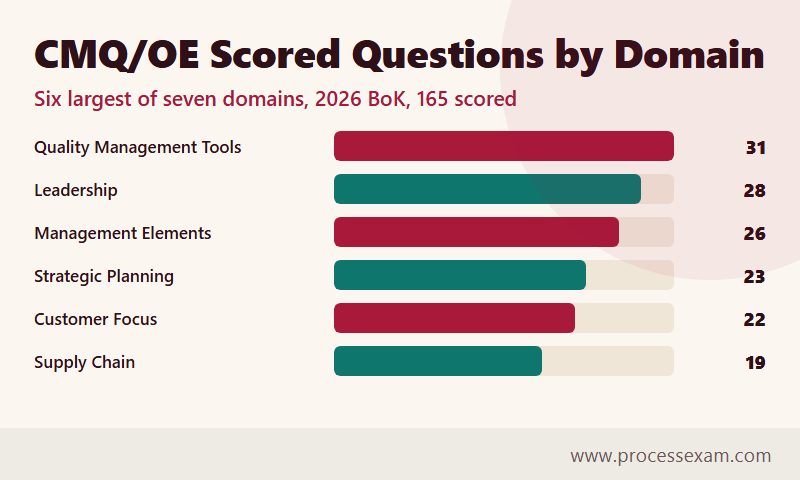
Three readings of that table should shape the plan. The first is concentration: tools, leadership and management elements together carry 85 of the 165 scored questions, just over half the paper, so a candidate who is solid on those three starts with a large head start. The second is density: customer-focused organizations has only two lettered areas, customer identification and segmentation and customer relationship management, so each one is worth about eleven questions. Skipping either is expensive. Supply chain is the opposite, with seven lettered areas, from supplier selection through to logistics and material acceptance, sharing 19 questions, so any single area is worth about three. You need breadth there, not depth.
The third reading is about who you are. Managers who came up through audit or engineering usually find tools and supply chain familiar and leadership, strategic planning and training strange. Managers who came up through operations or people leadership meet the reverse. The weights tell you what each gap costs: a blank spot in tools or customers loses more questions than one in training. ASQ publishes the 2026 CMQ/OE Body of Knowledge as a free PDF, and it is the document to print first, because the item descriptions under each topic are the guidelines the exam writers use.
Why do the questions feel like management decisions instead of definitions?
Because ASQ tags every entry in the Body of Knowledge with the highest level of thinking it may be tested at, using the revised Bloom's taxonomy: Remember, Understand, Apply, Analyze, Evaluate and Create. Counting the tags in the 2026 document gives 82 tagged entries. None is at the Remember level. Ten are Understand, 25 are Apply, 14 are Analyze, 27 are Evaluate and 6 are Create, so 33 of the 82, about 40 percent, ask you to judge or design. That count is our own tally of ASQ's tags, not a figure ASQ states.
The spread differs by domain. Quality management tools has eight entries tagged Evaluate, including the seven classic quality tools, the management and planning tools, process improvement methods such as root cause analysis, 8D, CAPA and A3, and cost of quality. In practice that means you are given a situation and asked which tool fits and what its output says, not asked to define a Pareto chart. Management elements has the highest count of Evaluate or Create tags, six, among them the principles of management, project monitoring, and the quality mission, policy and plan, which the document tags at Create.
Three ways a question can be built
Here are the shapes you will meet, with invented examples to practise on. A selection question gives a plant whose scrap varies between shifts and asks which tool should come first. The point is that a control chart answers a stability question and a Pareto chart answers a priority question, and the stem tells you which question is being asked. A consequence question says a company cuts appraisal spending and asks what you expect to happen to the other cost-of-quality categories, which tests whether you know that a move in one category shifts the rest. A response question describes a supplier whose late deliveries have become routine and asks for the best next step, where the best answer is usually the one that fits where the relationship stands, not the harshest one.
The common thread is that more than one option can look reasonable. When two answers survive, return to the stem and look for the word that fixes the level: first, best, most appropriate, most likely. Those words are where a manager's habit of defending a favourite approach costs points.
How does a full-time manager fit ten weeks of study into the diary?
Work backwards from the application deadline and forwards from your week. If the January 2027 window is the target, the December 7 deadline sits about five weeks away at the time of writing, and an online application is reviewed within one to two business days, so there is room to apply early in December and keep studying while you wait. If that feels tight, the March window leaves about eighteen weeks, which allows a gentler pace. Whichever window you pick, the plan below is built around three short weekday sessions and one long weekend block, because a manager's calendar rarely allows more.
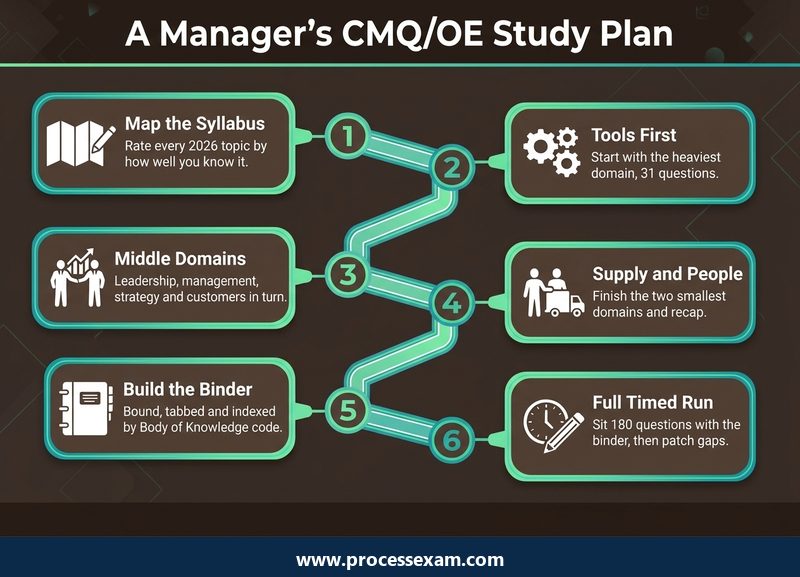
Weeks 1 and 2: read the document, then rate yourself
Print the Body of Knowledge. Go down it entry by entry and mark each as know, partly know or never done. Do it honestly, because over-rating yourself on the topics you use daily is how people arrive at the exam underprepared on the topics they do not. Add one line for each entry you marked "know": a real project of yours that proves it. Those lines become your worked examples later.
Weeks 3 to 5: start with tools, then management elements
These two domains hold 57 scored questions, over a third of the paper, and they contain the most computation and the most named methods. Use the weekday sessions for one method at a time: read it, work one example, then write a three-line card that states when to use it and what its output tells you. Use the weekend block for mixed problems, so that you practise choosing among methods and not only applying one you were told to use.
Weeks 6 to 8: leadership, strategy and customers, then supply chain and training
These domains reward judgement and vocabulary, so they suit shorter sessions. Read a topic, then answer for your own organisation: how would your company's structure change a change-management plan, which stakeholders would a strategic plan have to survive, which customer segment would a complaint trend point to. Supply chain and training are broad and shallow, with long lists of supplier activities and the stages of a training plan, so a recap sheet per domain is enough.
Weeks 9 and 10: assemble the binder, then rehearse with it
Build the reference kit described in the next section in week 9, then spend week 10 on full-length work with the binder on the desk. Do one complete run of 180 questions in a single sitting at the weekend and a half-length run midweek, and keep a log of every lookup you made, because the log tells you which tabs earn their place. Stop learning new material five days before the exam. The last days are for the log, the checklist and sleep.
The plan is a template and not a promise. Someone who already writes budgets and runs supplier reviews can shorten weeks 3 to 8, and someone coming from a technical specialism may need to extend them. ASQ sets no minimum number of study hours, so the number that matters is the one your own rating in week 2 produces.
What belongs in the binder for an open-book exam, and what stays at home?
ASQ's rule is that every exam is open book, but the rule has teeth. The reference materials, including all forms of notes, must be bound and stay bound: permanently bound by stitching or glue, or fastened inside a cover with ring binders, spiral binders, plastic snap binders, brads or screw posts. Hand-stapled documents that are not securely fastened inside a cover are refused. Sticky notes are allowed only as book tabs, and they must be attached before you enter the test centre. Unbound notes, blank writing tablets and tablets with blank pages are on the prohibited list, and the test centre administrator inspects every reference before you go in. ASQ also says its CMQ/OE Handbook, a companion to the Body of Knowledge, may be used during the exam, and it publishes a list of references that the exam questions are based on, which is worth reading before you buy anything. You can read all of this on ASQ's CMQ/OE certification page.
Build it as an index, not a library
Carrying six textbooks is the usual instinct and it usually backfires, because every question becomes a search through six indexes. A better kit has three parts. The first is the Body of Knowledge itself, with each entry tabbed. The second is a thin personal binder with one page per method or concept, organised by Body of Knowledge number, so that a question about cost of quality takes you straight to IV.A.5. The third is a single reference book you trust for the topics your own pages cannot cover, with tabs on the pages you used during practice.
What the personal pages should hold
Fill them with things you forget under pressure, not things you know. Examples: the four cost-of-quality categories and what each includes; the phases of a project; the stages of team development and the leadership style that fits each; the order of the process improvement methods and what each is for; the questions that separate a leader from a manager; supplier selection criteria in the order a buyer applies them. If you already know it cold, leave it out, since every extra page slows the pages that matter.
Calculators and the rest of the desk
The computer-based exam has a basic scientific calculator on screen, and test centres can supply a hand-held basic one on request. Programmable and graphing calculators are not allowed; ASQ names the Texas Instruments TI-89 as an example. Prometric supplies scratch paper and pencils, so you do not need to carry your own. Practise with the on-screen calculator at least once so that its layout does not surprise you.
When the binder exists, put it to work by sitting the CMQ/OE practice exam with the binder open, then note every tab you reached for and every one you did not.
Where do busy managers go wrong while preparing?
The failures that recur are about habits more than knowledge. Here are the ones to check yourself against.
Answering from your own workplace
Your company's way of doing change control or supplier management may be good, but the exam asks for the approach in ASQ's Body of Knowledge. When your experience and the syllabus disagree, the syllabus is what is scored. Training yourself to ask what the Body of Knowledge would expect before you read the options is the cheapest habit change in the plan.
Studying the topics you enjoy
Leadership and strategy are interesting to read and quality tools are not, so people drift towards the first and skip the second. The weights table shows what that costs: tools is the single biggest domain.
Preparing from a pre-2026 syllabus
ASQ's page still offers the 2019 Body of Knowledge for download next to the 2026 one, and older books follow the earlier outline. The 2026 edition took effect on July 1, 2026, so check any study material against the current document before you rely on it. The CMQ/OE sample questions are a quick way to see the style of question before you commit to a book.
Skipping the full-length run
A candidate who has never sat 180 questions in one go finds out at question 120 what fatigue does to judgement questions. Do the long run at least once, ideally twice, and do it with the binder so that you learn how long your own lookups take.
Treating the application as an afterthought
Studying for a window you cannot enter is the most avoidable loss in this whole process. Put the application deadline in your calendar as the first date, and put the ID check next to it: ASQ requires a valid, government-issued photo ID, and the name on it must match the application.
Spending the unscored questions
Fifteen of the 180 questions do not count, but you cannot tell which. Treating a hard question as probably unscored and guessing quickly is a trap, because the one you skip may be one of the 165. Flag it, finish the paper, and come back.
Frequently Asked Questions
Is the ASQ CMQ/OE exam open book?
Yes. Every ASQ exam is open book, and you bring your own references. They must be bound and stay bound: ring binders, spiral binders or glued or stitched books are fine, loose or hand-stapled pages are not. Sticky notes are allowed only as tabs, attached before you enter. ASQ says its CMQ/OE Handbook can be used.
How many CMQ/OE questions are scored?
The computer-based exam has 180 multiple-choice questions, of which 165 are scored and 15 are unscored. Nothing on screen shows which is which, so answer every question properly. ASQ also describes a paper version for certain locations with 165 questions, all scored, in four hours.
Which CMQ/OE domain has the most questions?
Quality Management Tools has the most, with 31 of the 165 scored questions in ASQ's 2026 Body of Knowledge. Leadership follows with 28, then Management Elements and Methods with 26, Strategic Plan Development and Deployment with 23, Customer-Focused Organizations with 22, Supply Chain Management with 19 and Training and Development with 16.
How long should I study for the CMQ/OE while working full time?
ASQ sets no minimum number of study hours. A working manager can plan on about ten weeks of three short weekday sessions and one longer weekend block, then adjust after rating every Body of Knowledge entry. Those with strong tools and management experience can shorten it; others should extend it.
When can I take the next CMQ/OE exam?
When ASQ's dates page was checked in October 2026, the next open computer-based windows were January 1 to 31, 2027, with applications due December 7, 2026, and March 1 to 31, 2027, with applications due February 8, 2027. Deadlines are strict, so confirm them on ASQ's page before planning.
- ASQ Manager of Quality/Organizational Excellence Sample Questions |
- CMQ/OE Exam Questions Download |
- CMQ/OE Test Questions |
- Manager of Quality/Organizational Excellence PDF |
- ASQ Manager of Quality/Organizational Excellence Book |
- ASQ CMQ/OE BOK PDF |
- Manager of Quality/Organizational Excellence Certification Cost |
- Manager of Quality/Organizational Excellence Certification Requirements |
- ASQ Manager of Quality/Organizational Excellence Test Questions |
- CMQ/OE Body of Knowledge (BOK) |
- Management |
- CMQ/OE Question Bank |
- Manager of Quality/Organizational Excellence Simulator |
- Manager of Quality/Organizational Excellence Mock Exam |
- CMQ/OE Handbook


