
PMP Certification Benefits for Project Management Professionals
Updated on 22 September 2026. What’s new: PMP exam fee corrected to $425 for PMI members and $675 for others, and exam time updated to 240 minutes.
A senior coordinator has spent six years building schedules, chairing risk reviews and talking sponsors out of scope creep. When a project manager post opens on her own floor, the advert says “PMP preferred” and HR’s shortlist passes her by. That is the clearest benefit of PMP certification: it turns experience a recruiter cannot check into a credential they can. It also proves, since PMI’s July 2026 exam update, that you handle governance, risk and hybrid delivery.
Nobody on that hiring panel doubted the coordinator could run the project. They simply had no quick way to tell her apart from forty other applicants whose CVs said “managed stakeholders” and “delivered on time”. The Project Management Professional credential from the Project Management Institute exists to solve exactly that problem, and the rest of this guide looks at what it gives you in practice, what the current exam asks, whether your experience qualifies, what it costs, and how to prepare without stepping away from the job you already do.
Why does “PMP preferred” keep experienced coordinators off the shortlist?
Most project roles attract far more applications than a hiring manager can read. The first pass is done by an applicant tracking system or a recruiter scanning for a few signals, and a recognised credential is one of the fastest. “Preferred” sounds optional, yet when two hundred CVs arrive, the recruiter has every reason to start with the pile that already carries it. Your years of delivery never reach the interview stage where they would count.
Job titles make it worse. Many organisations call the person who actually drives a project a coordinator, analyst, lead or officer, and reserve “project manager” for a pay band. A title like that tells a recruiter nothing about whether you set the baseline or simply updated it. The PMP settles the question, because PMI does not take the job title at face value. Every applicant has to describe experience leading and directing projects, within the last ten years, and any application can be selected for audit, at which point you supply evidence of your education and your supervisors confirm the work.
That verification is the real product. The three letters tell an employer that an independent body has checked the hours, that you have completed structured training, and that you have passed a four-hour scenario exam built by practising PMP holders. For someone already doing the job, the certification does not add a skill so much as make an existing one visible.
What does PMP certification actually give a project lead who already does the work?
The benefits are practical rather than magical. None of them replaces a track record; each makes a track record easier to see, trust or move.
A credential that survives the first screen
The most immediate gain is simply getting read. Adverts for project manager, programme manager and PMO roles frequently list the PMP in the requirements or the preferences, and in regulated sectors and government contracting it often appears in the bid itself, because the client wants named, certified people on the team.
A common language with sponsors, PMOs and vendors
PMI’s terms – baseline, change control, risk register, stakeholder engagement, tailoring, value delivery – are used by PMOs and contract language across industries. Once you hold the credential, conversations with a new sponsor or an outsourced supplier start from shared vocabulary instead of a week of translating each other’s templates.
Proof that you work across predictive, agile and hybrid delivery
PMI’s outline states that roughly 40% of exam items represent predictive approaches and the remaining 60% are split between adaptive or agile and hybrid approaches. Passing therefore says you can run a stage-gated construction package and a two-week-sprint software release, and, more usefully, blend the two when a programme needs both.
A credential that travels between industries and countries
The PMP is accredited by ANSI against the ISO/IEC 17024 standard for bodies that certify people, and its outline is built from a global job task analysis. A coordinator moving from telecoms into healthcare, or from one country to another, carries the same credential, which is recognised by the same hiring conventions, without having to re-prove every year of experience.
A stronger position in pay and promotion conversations
We will not quote salary percentages here, because figures without a current survey behind them are guesses. The honest benefit is leverage: when a promotion or a pay review comes up, a verified credential that the job description itself asks for is harder to wave away than a list of projects your manager may not remember.
A structure for staying current
Holders renew every three years by earning professional development units. That sounds like admin, but it gives you a reason to keep learning in exactly the areas the latest exam added, such as AI-assisted delivery, sustainability and organisational change, rather than running projects the way you did a decade ago.
What does the July 2026 PMP exam now expect you to prove?
PMI replaced the exam content outline in July 2026, and the change is large enough that anyone who studied from older notes should start again. The new July 2026 PMP Examination Content Outline (checked September 2026) keeps the three familiar domains but moves the weight between them sharply.
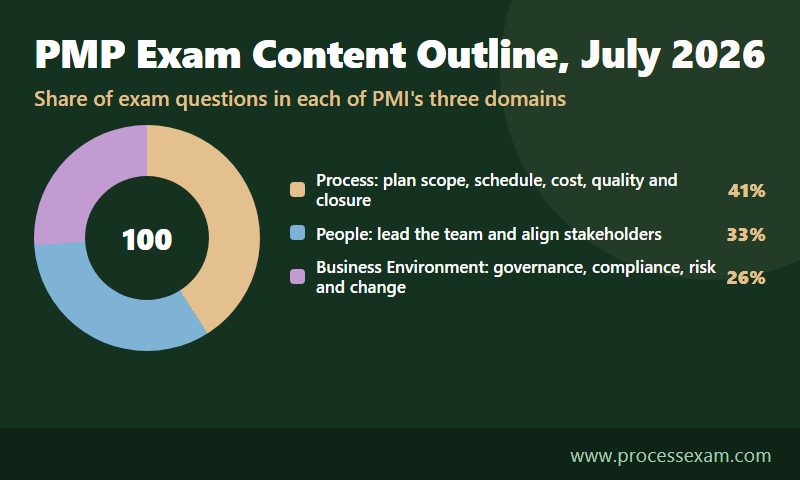
Under the previous outline, People carried 42% of the exam, Process 50% and Business Environment only 8%. Under the current one, People is 33%, Process 41% and Business Environment 26%. In other words, governance, compliance, risk, change control and the organisation around the project now account for roughly a quarter of the paper instead of a sliver. For a coordinator who has sat in steering committees and handled audit findings, that is good news; it rewards the organisational side of the work that older exams barely touched.
PMI also explains why. The job task analysis behind the outline took in trends the earlier exam did not address, naming artificial intelligence and sustainability, and it reframes project success as delivering value that was worth the effort and expense, not merely hitting schedule, budget and scope. Expect scenarios where the “right” answer is the one that protects the outcome for stakeholders, even when a milestone slips.
The question formats changed as well. Alongside multiple-choice single response, multiple response, matching, point-and-click and drag-and-drop items, the outline introduces case or scenario sets, where one detailed situation with charts or graphs supports a series of questions, and graphic-based questions that ask you to read a diagram or chart before answering.
| Exam detail | PMI PMP (current) |
|---|---|
| Certification | PMI Project Management Professional (PMP) |
| Exam code | PMP |
| Exam fee | Member Price: USD $425 Full Price: USD $675 |
| Duration | 240 minutes |
| Number of questions | 180 (PMI’s outline: 170 scored, 10 unscored pretest) |
| Passing score | Above Target / Target / Below Target / Needs Improvement |
| Domains | People 33%, Process 41%, Business Environment 26% |
| Delivery | Test centre or online with a remote proctor |
Results are reported in performance bands rather than as a published pass mark, and pretest items are scattered through the exam so you cannot tell which ones count. Treat every question as scored.
What do the People, Process and Business Environment domains ask of you?
Each domain is broken into tasks, and PMI states that every exam form includes questions covering all tasks within each domain. There are twenty-six tasks in total. The task-by-task syllabus breakdown lists the enablers under each one; here is what they mean for someone who already runs projects.
People – 33% of the exam, eight tasks
The tasks are: develop a common vision, manage conflicts, lead the project team, engage stakeholders, align stakeholder expectations, manage stakeholder expectations, help ensure knowledge transfer, and plan and manage communication. Notice how much of this is about stakeholders; three of the eight tasks sit there. A typical question describes a sponsor and a functional manager pulling a team member in opposite directions and asks what you do first. The expected instinct is to understand the root cause and bring the parties to a shared view of the outcome, not to escalate or to impose a ruling.
Process – 41% of the exam, ten tasks
This is the largest domain: develop an integrated project management plan and plan delivery, develop and manage project scope, help ensure value-based delivery, plan and manage resources, procurement, finance, quality and schedule, evaluate project status, and manage project closure. The planning task explicitly covers choosing between predictive, adaptive and hybrid delivery, so you will be asked when a backlog suits the work better than a fixed scope statement, and how you would prove value to a sponsor partway through. Finance and quality now mention sustainability and the cost of quality, which is new territory for many candidates.
Business Environment – 26% of the exam, eight tasks
The tasks are: define and establish project governance, plan and manage project compliance, manage and control changes, remove impediments and manage issues, plan and manage risk, continuous improvement, support organisational change, and evaluate external business environment changes. Change control and risk management have moved here, which is why the domain has grown so much. The enablers mention examples such as security, health and safety, regulatory compliance and geopolitical shifts, so expect questions where a new regulation or a market change lands mid-project and you must decide how the plan, the backlog and the risk register respond.
For the coordinator in our opening, this domain is where years of steering-committee packs, audit responses and change-request logs pay off. It is also where candidates who studied only scheduling and earned value lose the most marks.
Does your coordinator experience count toward PMP eligibility?
Very often it does, provided you can show you led and directed the work rather than supported it. PMI’s current outline sets four routes, each measured in non-overlapping months of project leadership accrued in the past ten years:
- Upper-secondary education (a high school diploma or equivalent, mapped to EQF Level 4): at least 60 months of experience leading projects.
- Associate-level or post-secondary short-cycle programme (EQF Level 5): at least 48 months.
- Bachelor’s degree or higher, or a qualification formally mapped to EQF Level 6: at least 36 months.
- A bachelor’s or postgraduate degree from a programme accredited by PMI’s Global Accreditation Center: at least 24 months.
Every route also needs 35 hours of project management training aligned to the exam content outline. PMI accepts training from its authorised training partners, universities, employer programmes, commercial training companies and self-paced courses that end with an assessment. The new outline adds a requirement that catches some international applicants: if your qualification does not state its framework level, an auditor can ask for a national qualifications register entry, a statement from the awarding body, or a formal evaluation.
How to describe coordinator work so it qualifies
The single most common reason a strong candidate struggles here is wording. “Supported the project manager with scheduling” describes a team member. “Built and maintained the integrated schedule, ran weekly status with the delivery leads and escalated variances to the sponsor” describes someone leading part of the work. For each project, write a short summary that names the objective, your role, the outcome, and what you did across initiating, planning, executing, monitoring and closing, or across the agile equivalents. Count months carefully, because two projects running in the same month count once, not twice.
Keep a contact for every project who can confirm your role. If the application is selected for audit, those people will be asked to sign off what you wrote, and a vague description is far harder for a former manager to confirm than a specific one.
What will the PMP cost you in fees, time and attempts?
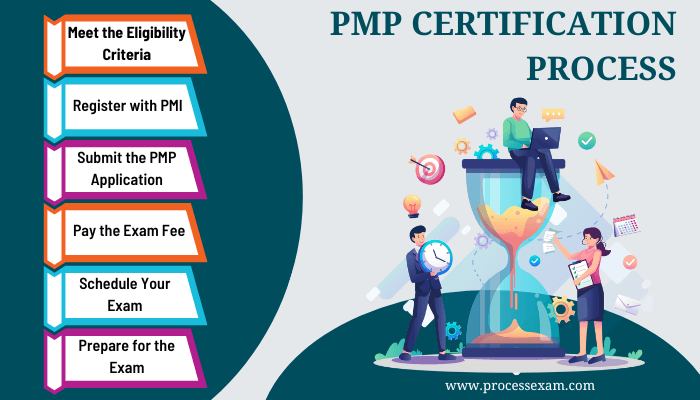
The route is the same for everyone: confirm you meet a route above, create an account with PMI, submit the application with your experience and training, wait for the review (and any audit), pay the exam fee, schedule a date, and prepare. The fee comes due only after PMI approves the application, which is why so many candidates are surprised by a gap between applying and booking.
The exam fee is Member Price: USD $425 or Full Price: USD $675, so the member rate is USD $250 lower. Whether membership pays for itself depends on the annual dues in your region, which PMI publishes on its own site; compare the two before you pay. Add the cost of your 35 training hours, which varies widely between providers, and any study material you buy.
Time is the bigger cost for a working lead. The exam itself runs 240 minutes for 180 questions, with two 10-minute breaks: the first after the case-study section, the second roughly halfway through the independent questions. Once you take a break, you cannot go back to the section you finished. An optional tutorial and survey sit outside the four hours. Candidates choose between a physical test centre and an online session watched by a remote proctor; the online option needs a system check and a lengthy check-in, and the proctor may ask to see your identification again when you return from a break.
If the first attempt does not go your way, PMI allows up to three attempts within the one-year eligibility period that starts when your application is approved. After a third unsuccessful attempt you wait one year before reapplying. If the eligibility year simply runs out, you reapply without a waiting period. Plan your first date early enough in that year to leave room for a second attempt if you need it.
The details, fees and rules are all on PMI’s PMP certification page and in the outline linked above; check both before you pay, because PMI adjusts regional pricing and procedures from time to time.
How should a working project lead prepare in ten to twelve weeks?
People who already manage projects usually do not lack knowledge. They lack PMI’s way of framing a situation, and they lack stamina for a four-hour exam. A plan of about ten to twelve weeks, at eight to ten hours a week, suits most candidates who hold a full-time role.
Weeks 1–2: map your own experience against the 26 tasks
Read the outline end to end and score yourself on each task: done it often, done it once, never done it. That gap list becomes your study plan. Most coordinators discover they are strong on scheduling, communication and status reporting and thin on procurement, finance, compliance and organisational change.
Weeks 3–5: study Business Environment first
It is the domain that grew the most and the one older study guides cover worst. Work through governance structures, compliance planning, change control, risk responses, continuous improvement and organisational change management until you can explain each in terms of a project you know.
Weeks 6–8: Process and the delivery approaches
Cover the ten Process tasks, with extra time on choosing and tailoring an approach. For every topic, ask how it looks on a predictive project and how it looks on an agile one: a scope statement versus a prioritised backlog, a change request versus a reprioritised sprint, earned value versus a burn-up chart.
Weeks 9–10: timed practice and case-study sets
This is where knowledge turns into pace. When you reach these weeks, a full-length PMP mock exam is the quickest way to see whether you can hold concentration for 180 questions and which domain still leaks marks. Afterwards, go back over each miss and each lucky guess, because the reasoning behind an answer teaches more than the total.
Weeks 11–12: close the gaps and rehearse exam day
Revisit your weakest tasks, work through PMI’s free sample questions to calibrate against the vendor’s own style, and sit one more full timed run with the same two breaks you will get on the day. If you are testing online, do the system check early in this fortnight rather than on the morning itself.
Which habits trip up experienced managers on the PMP, and how do you keep the credential afterwards?
Experience helps, but some habits formed on the job work against you in the exam. The ones that cost experienced candidates most are these:
- Answering the way your company works. The exam asks what a well-run project should do, not what your PMO’s template requires. If your organisation escalates everything to the sponsor, you will pick escalation too often.
- Escalating before understanding. Many scenarios reward the answer that gathers facts, meets the people involved or reviews the relevant plan first. Jumping to a formal change request or a sponsor escalation is usually premature.
- Treating Business Environment as a footnote. At 26% of the exam, governance, compliance, risk and change are no longer a handful of questions you can afford to skip.
- Memorising process lists. The outline says plainly that it differs from the PMBOK Guide and that questions test judgement in situations. Knowing names of inputs and outputs will not tell you what to do next.
- Ignoring the new formats. A case set asks several questions about one scenario, and a graphic item asks you to read a chart. Practise both, or the first ones you meet will eat your time.
- Underestimating the application. Vague experience descriptions invite follow-up questions and slow approval. Write them as carefully as you would a project charter.
Once you pass, the credential runs on a three-year cycle. To keep it, you earn 60 professional development units in each cycle and pay the renewal fee. Units come from courses, webinars, chapter events, reading, mentoring and giving back to the profession, and many of them fit around the projects you are already running. Record them as you go rather than in a rush before the cycle ends.
Back to the coordinator in the opening. Her experience was never the problem; the lack of a verified label on it was. The PMP does not teach her to run projects, but it does move her CV into the pile the recruiter reads, give her a shared language with every PMO she joins, and prove she can handle the governance, risk and hybrid delivery that the July 2026 exam now tests. For a project lead with the hours to qualify, that is the benefit worth paying for.
Frequently Asked Questions
Is a PMP certification worth it?
For someone who already leads projects, usually yes. It gets your CV past screens that list the PMP as required or preferred, gives verified proof of experience, and since July 2026 shows you handle governance, risk and hybrid delivery. If you cannot yet document the required months of leading projects, wait until you can.
How can I get PMP certification?
Meet one of PMI's education and experience routes, complete 35 hours of project management training, and submit an application through PMI. After approval, and any audit, you pay the exam fee, book a test centre or online proctored slot, and pass the 180-question, 240-minute exam.
How do I get project management experience for the PMP?
PMI counts months in which you led and directed project work within the last ten years, whatever your job title was. Coordinators, analysts and team leads often qualify if they owned schedules, risks, budgets or stakeholder communication. Describe each project by your role, outcome and the work you directed, and avoid double-counting overlapping months.
How much does the PMP exam cost?
The exam fee is Member Price: USD $425 or Full Price: USD $675, so PMI members pay USD $250 less. Budget separately for the 35 required training hours, study material and, if needed, a retake. Compare PMI's current regional membership dues with the saving before deciding whether to join.
What changed in the PMP exam in July 2026?
PMI moved the domain weights to People 33%, Process 41% and Business Environment 26%, up from 8% for Business Environment. The exam still has 180 questions in 240 minutes, but 10 are unscored pretest items, and new case-study and graphic-based questions appear. AI and sustainability now inform the tasks.
- PMP Certification |
- PMI Project Management Exam Questions |
- PMI Project Management Question Bank |
- PMI Project Management Questions |
- PMI Project Management Study Guide |
- PMI PMP Quiz |
- PMP Questions |
- PMP Practice Test |
- PMP Study Guide Material |
- PMP Sample Exam |
- Project Management Certification |
- PMI Project Management Book |
- Project Management Certification Cost |
- Project Management Certification Requirements |
- PMI Project Management Sample Questions |
- PMP Exam Questions Download |
- PMP Test Questions |
- Project Management PDF |
- PMI Project Management Professional


