
PMI-SP: Why Common Prep Fails (And What Works)
The PMI-SP (PMI Scheduling Professional) certification validates an individual's specialized expertise in developing, maintaining, and controlling project schedules. This credential is designed for project management professionals who hold a significant role in project scheduling and aim to enhance project efficiency and timely completion. This advanced guide delves into common pitfalls encountered during PMI-SP preparation and outlines proven strategies to overcome them, ensuring candidates are well-equipped to demonstrate their proficiency in this critical project management domain. It examines why typical study methods often fall short and provides an expert perspective on what truly works to achieve certification success with PMI, the leading global organization for project management.
Understanding the PMI-SP Certification's Core Value
The PMI-SP certification signifies a project professional's advanced skill set in project scheduling. Earning this credential confirms an individual's ability to manage project timelines effectively, utilize sophisticated scheduling tools and techniques, and contribute to overall project success through robust schedule development and control. In today's complex project environments, the demand for specialists who can navigate intricate scheduling challenges is higher than ever. Companies seek professionals who can mitigate delays, optimize resource allocation, and forecast project completion accurately. The PMI-SP credential directly addresses these needs, positioning certified individuals as indispensable assets in any project-driven organization. It underscores a commitment to professional excellence and a deep understanding of scheduling best practices, differentiating holders in a competitive job market.
Deciphering the PMI-SP Role in Project Scheduling
PMI Scheduling Professionals are crucial to a project's lifecycle, serving as the backbone for timeline management and resource optimization. Their responsibilities extend beyond merely creating a Gantt chart; they involve intricate schedule modeling, risk analysis related to timelines, and continuous monitoring to ensure adherence to planned milestones. These specialists often work closely with project managers, stakeholders, and team members to integrate schedule requirements with project scope and budget constraints. They are adept at employing various scheduling methodologies, adapting them to different project complexities and organizational contexts. The PMI-SP role demands not only technical expertise in scheduling software but also strong analytical and communication skills to interpret schedule data and articulate its implications to diverse audiences. For those looking to understand the full scope of this specialized role, visiting the official PMI-SP information page provides comprehensive details directly from the vendor.
Why Many PMI-SP Preparation Paths Fall Short
Many aspiring PMI-SP candidates underestimate the depth and breadth of knowledge required, leading to common preparation failures. A significant pitfall is the tendency to treat the exam as a test of memorization rather than a validation of practical application and critical thinking in scheduling. Without a holistic approach that integrates theoretical understanding with real-world scenarios, candidates often struggle to apply concepts under exam conditions. This leads to a superficial understanding that is easily challenged by the complex, scenario-based questions typical of advanced certifications. Another common mistake is failing to allocate sufficient time for review and practice, especially for the nuanced aspects of schedule analysis and reporting. The exam demands more than familiarity; it requires mastery.
Over-Reliance on Memory-Based Resources
One of the most detrimental preparation mistakes is an over-reliance on "brain dumps" or memory-based questions. While tempting for quick fixes, these resources often provide fragmented information without the necessary context or underlying principles. Candidates who use these exclusively develop a fragile understanding, unable to adapt to variations in problem statements or unforeseen question formats. The PMI-SP exam is designed to assess a candidate's ability to analyze, evaluate, and apply scheduling knowledge, not just recall facts. Ethical preparation emphasizes understanding concepts thoroughly, which builds a robust knowledge base applicable to diverse project challenges and exam questions. Relying solely on memorized answers can lead to significant gaps in comprehension, which are quickly exposed during the actual examination. Authentic learning, through official materials and reputable study guides, is paramount.
Neglecting Practical Scheduling Application
Another prevalent reason for preparation failure is the neglect of practical application. Many candidates focus heavily on theoretical aspects, reading textbooks cover-to-cover without engaging in hands-on exercises or simulating real-world scheduling scenarios. The PMI-SP certification is a practitioner's credential, meaning it validates the ability to perform scheduling tasks effectively in a project environment. Without applying learned concepts to practical problems, candidates miss out on developing the critical problem-solving skills necessary for the exam. This disconnect between theory and practice often results in confusion when presented with scenario-based questions that require nuanced judgment and an understanding of how scheduling decisions impact project outcomes. Integrating practical exercises, case studies, and hands-on tool usage into the study plan is essential for bridging this gap.
Constructing an Effective PMI-SP Study Strategy
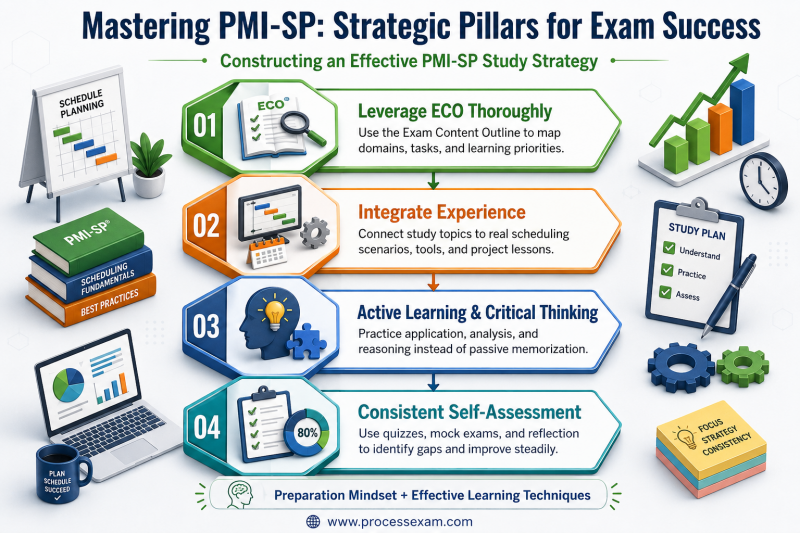
Developing an effective study strategy for the PMI-SP certification requires a structured and disciplined approach. It’s not just about accumulating hours but optimizing those hours for maximum retention and comprehension. Start by thoroughly reviewing the certification requirements and understanding the exam structure to tailor your study plan. Acknowledge that the PMI-SP demands a deep dive into scheduling processes, tools, and techniques, integrating them with broader project management principles. Effective strategies emphasize active learning, critical thinking, and consistent self-assessment to identify and address knowledge gaps before the exam. Prioritizing official resources and reputable training programs is crucial for foundational understanding and alignment with PMI's standards.
Leveraging the PMI-SP Exam Content Outline Effectively
The PMI-SP Exam Content Outline (ECO) is the most authoritative resource for understanding what the exam covers. Smart candidates treat the ECO not just as a list of topics but as a detailed blueprint for their study plan. Each domain and task listed within the ECO represents a specific area of knowledge or skill that will be assessed. Candidates should systematically go through each item, ensuring they understand the underlying concepts, relevant tools, and techniques. It's advisable to create a self-assessment checklist based on the ECO to track progress and identify areas requiring more attention. Ignoring or superficially reviewing the ECO is a common mistake that can lead to misdirected study efforts. A thorough understanding of this document, which can be found by reviewing the PMI-SP Exam Content Outline, is fundamental to effective preparation.
Integrating Experience with Foundational Knowledge
While academic study is essential, successful PMI-SP candidates also learn how to integrate their existing project scheduling experience with the foundational knowledge prescribed by PMI. The certification is designed for experienced professionals, and the exam often features questions that require not just theoretical understanding but also practical judgment. Instead of isolating study from work, candidates should actively seek connections between the concepts they are learning and their real-world project experiences. This approach solidifies understanding, makes abstract concepts more concrete, and hones the critical thinking skills necessary to navigate complex scenarios. Reflecting on past projects and identifying how PMI's best practices could have been applied (or were applied effectively) provides invaluable context and deepens learning. This synergistic approach ensures a well-rounded preparation that leverages both theoretical and practical dimensions.
Mastering Key Scheduling Domains for the PMI-SP Exam
Successful PMI-SP candidates develop a robust understanding across several key scheduling domains. While specific syllabus topics are not provided, general project scheduling expertise typically encompasses areas such as schedule creation, maintenance, analysis, and communication. Mastering these domains involves not only knowing the terminology but also understanding the interdependencies between various scheduling activities and their impact on overall project delivery. This includes familiarity with different scheduling models, critical path analysis, resource leveling techniques, and the ability to interpret and present complex schedule data clearly and concisely. A comprehensive grasp of these areas is essential for confidently addressing the multi-faceted questions on the PMI-SP exam.
Critical Path Method and Earned Value Management
At the heart of project scheduling are methodologies like the Critical Path Method (CPM) and Earned Value Management (EVM). CPM is fundamental for identifying the longest sequence of activities that must be completed on time for the entire project to be completed by its deadline. A deep understanding of how to determine the critical path, calculate float, and analyze network diagrams is non-negotiable for PMI-SP candidates. Similarly, EVM, while often associated with cost management, is intrinsically linked to schedule performance. Candidates must master how to calculate and interpret Schedule Variance (SV) and Schedule Performance Index (SPI) to assess project schedule health and forecast future performance. These techniques are cornerstones of effective schedule control and are heavily emphasized in advanced scheduling certifications.
Software Proficiency and Data Analysis
Modern project scheduling relies heavily on specialized software tools. While the PMI-SP exam does not test proficiency in specific software brands, a conceptual understanding of how these tools function and how to leverage them for complex schedule analysis is vital. Candidates should be familiar with the principles behind schedule modeling, scenario planning, and data integration within scheduling applications. Furthermore, the ability to analyze schedule data goes beyond simply generating reports. It involves interpreting trends, identifying potential risks, performing sensitivity analysis, and making informed recommendations based on the data. This requires strong analytical skills to translate raw schedule data into actionable insights for project stakeholders, enabling proactive decision-making and course correction.
The Transformative Benefits of PMI Scheduling Professional Certification
Earning the PMI-SP certification offers a myriad of benefits that extend beyond mere credentialing. It significantly enhances a professional's credibility and visibility within the project management community. Employers recognize the PMI-SP as a hallmark of specialized expertise in scheduling, often preferring certified individuals for critical project roles. This can translate into increased job opportunities, greater responsibility, and a competitive edge in career advancement. Furthermore, the certification often correlates with higher earning potential, reflecting the market value of specialized scheduling skills. Beyond tangible career benefits, the process of preparing for the PMI-SP exam itself deepens one's knowledge and refines practical application skills, fostering a profound sense of professional confidence. This dedication to advanced scheduling knowledge offers significant professional growth and a clear demonstration of capability to peers and superiors. To explore more about the career impact and value of this credential, candidates can find helpful resources on advanced certification pathways.
Navigating the PMI-SP Certification Requirements & Application Process
While specific exam details were not provided, candidates for the PMI-SP typically need to meet a combination of educational and professional experience requirements set by PMI. These prerequisites usually involve a certain number of hours or years spent specifically in project scheduling activities, alongside a foundational level of project management education. It's crucial for prospective candidates to consult the official PMI website for the most current and accurate eligibility criteria. The application process generally involves submitting detailed documentation of educational background and professional experience for validation. Understanding these requirements thoroughly from the outset can save significant time and effort, ensuring that a candidate is eligible before embarking on their preparation journey. PMI's commitment to maintaining the integrity of its certifications means strict adherence to these standards.
Preparing with Quality PMI-SP Practice Questions
A cornerstone of successful PMI-SP preparation is the consistent use of high-quality practice questions. These are invaluable for familiarizing candidates with the exam format, question types, and time constraints. Effective practice questions simulate the actual exam environment, allowing candidates to test their knowledge application, identify weak areas, and refine their test-taking strategies. It’s crucial to select practice questions that are aligned with the PMI-SP Exam Content Outline and reflect the complexity and nuance of the real exam. Merely memorizing answers to practice questions is not sufficient; the focus should be on understanding the rationale behind both correct and incorrect choices. This iterative process of practice, review, and learning from mistakes is fundamental to building the confidence and competence needed for exam day. For an effective preparation experience, consider exploring a wide range of PMI-SP practice questions to strengthen your understanding.
Sustaining Momentum: Continuous Learning Beyond Certification
Achieving the PMI-SP certification is a significant milestone, but it marks the beginning, not the end, of a professional's scheduling journey. The field of project management, and scheduling within it, is constantly evolving with new methodologies, tools, and best practices emerging regularly. Certified professionals are typically required to earn Professional Development Units (PDUs) to maintain their credential, which encourages continuous learning and engagement with the latest industry trends. This commitment to ongoing education ensures that PMI-SP holders remain at the forefront of their field, continuously enhancing their skills and contributing fresh perspectives to their projects and organizations. Engaging with professional communities, attending webinars, and reading industry publications are excellent ways to sustain momentum and further develop expertise.
Conclusion
The PMI-SP certification offers a clear path to demonstrating advanced expertise in project scheduling, a skill set critically valued in today's dynamic project environments. Success in this demanding certification hinges on avoiding common preparation pitfalls, such as superficial study and over-reliance on unreliable resources. Instead, a strategic approach that integrates theoretical understanding with practical application, rigorous self-assessment, and ethical preparation through quality materials is paramount. By focusing on mastering key scheduling domains and leveraging official guidance like the Exam Content Outline, candidates can build a solid foundation for success. The benefits of achieving this credential — from enhanced career prospects to deeper professional confidence — underscore the value of a well-executed preparation journey.
Embarking on the PMI-SP certification journey is a strategic career move for any project professional aiming for excellence in scheduling. By understanding the common challenges and adopting a disciplined, comprehensive preparation strategy, you can position yourself for success. Invest in your professional development and solidify your expertise with the right resources and mindset. Begin your structured study plan today and transform your approach to project scheduling by visiting comprehensive certification study resources for support.
Frequently Asked Questions
1. What is the PMI-SP certification and who is it for?
The PMI-SP (PMI Scheduling Professional) certification is a specialized credential from PMI that validates expertise in project scheduling. It is designed for project management professionals who have significant experience in developing, maintaining, and controlling project schedules.
2. What are the key benefits of earning the PMI-SP certification?
Earning the PMI-SP certification enhances career credibility, increases job opportunities in specialized scheduling roles, and often leads to higher earning potential. It signifies a deep understanding of scheduling best practices and a commitment to professional excellence.
3. How important is practical experience for PMI-SP exam preparation?
Practical experience is highly important for PMI-SP exam preparation. The exam tests not just theoretical knowledge but also the ability to apply scheduling concepts to real-world project scenarios. Integrating your experience with study materials strengthens understanding and problem-solving skills.
4. Are there any prerequisites for taking the PMI-SP exam?
Typically, candidates for the PMI-SP certification need to meet specific educational and professional experience requirements, including a certain number of hours dedicated to project scheduling. Always consult the official PMI website for the most current and detailed eligibility criteria.
5. What kind of study materials are recommended for the PMI-SP certification?
Recommended study materials include official PMI publications, reputable study guides aligned with the Exam Content Outline, quality practice questions, and potentially a formal training course. Avoiding memory-based dumps and focusing on comprehensive understanding is crucial.
- Project Management |
- PMI Scheduling Professional Test Questions |
- PMI-SP Question Bank |
- PMI Scheduling Professional Book |
- Scheduling Professional Certification Cost |
- Scheduling Professional Certification Requirements |
- PMI Scheduling Professional |
- PMI Scheduling Professional Sample Questions |
- PMI-SP Exam Questions Download |
- PMI-SP Test Questions |
- Scheduling Professional PDF


