
PMI-CP Certification: Cost, Course Modules and Exam Guide
Updated on 1 October 2026. What’s new: eligibility is four PMI course modules plus three years of construction or built-environment project experience in the past ten years
If you run site packages, subcontracts or a contractor's project team, the PMI Construction Professional (PMI-CP) is the PMI credential written for that work, and half of its 120 questions are about contracts management. Getting there takes four PMI course modules and three years of construction or built-environment project experience from the past ten years. The exam itself runs 230 minutes and costs USD $399 for PMI members or USD $499 at full price.
That first paragraph is worth reading twice, because the PMI-CP is not a general project management test with a construction label on it. PMI built it from a job task analysis of people who run capital projects: owners' representatives, contractors, programme managers and claims specialists. The questions reflect that. You will be asked what to do when a contractor's notice arrives, which delivery method moves risk to the right party, and how to keep fifteen packages talking to each other. A candidate who only knows scheduling and earned value will find a lot of the paper unfamiliar.
This guide covers what the credential is, who qualifies, how the exam is weighted, how it is delivered and scored, a six-week plan built on the weights, the mistakes site-trained candidates make, and what the credential costs and does for you. Figures come from our exam facts and PMI's own Examination Content Outline, dated February 2024, which was the current outline when we checked it in October 2026.
What does PMI-CP stand for, and is it the same as the other “CP” exams?
PMI-CP is the PMI Construction Professional certification. PMI's outline also calls it CPBEP, short for Construction Professional in Built Environment Projects, which is the name the credential carried when it launched. If you searched for “cp exam full form” and landed here, check which CP you meant, because several unrelated exams share the letters:
- The PMI-CP is a construction and built-environment credential from the Project Management Institute.
- The PMI-CPMAI is a different PMI credential, Certified Professional in Managing AI, with its own outline and fee.
- The APMP CP is a proposal-management practitioner exam from a different body, aimed at bid writers.
Here is the PMI-CP in one table, with the member and full prices side by side. PMI shows regional prices, so confirm the amount on PMI's checkout page when you book.
| Detail | PMI-CP |
|---|---|
| Exam code | PMI-CP |
| Full name | PMI Construction Professional |
| Awarding body | Project Management Institute (PMI) |
| Questions | 120 |
| Duration | 230 minutes |
| Fee | Member Price: USD $399 / Full Price: USD $499 |
| Scoring | Above Target / Target / Below Target / Needs Improvement |
| Delivery | Pearson VUE, test centre or online |
| Outline checked | Examination Content Outline, February 2024 |
PMI describes the credential as aimed at people who lead and direct construction and built-environment projects. In practice that includes project and construction managers, contract administrators, commercial managers, planners who sit close to claims, and owner-side programme staff. It does not need you to be a PMP, although the people who write and review the exam questions hold the PMP, and the outline says the exam reflects approaches across the whole value-delivery spectrum, predictive through adaptive, rather than one method.
What do the four course modules and three years of experience involve?
PMI-CP eligibility has two parts, and you need both before you can sit the exam.
The four course modules
You complete four PMI course modules in the built-environment curriculum. PMI built its exam from the content of that e-learning curriculum, which is why the outline's tasks read like chapter headings: risk, claims, contract lifecycle, interface management, communication tools, scope and change. The listed learning products include PMI's Digital Construction Practitioner Skills course among the learning products, and PMI lists instructor-led versions through its authorized training partners. Each module is self-paced, so the time depends on you, but plan for the modules to take longer than a weekend if you work full time.
One correction to older advice. Earlier posts on this site, including the version of this article that stood here before, described the route as seven modules made up of three micro-credentials plus four courses. PMI's current route is four course modules, and that is what we describe here. If you find a guide that still asks for seven, check its date.
Three years of project experience
PMI asks for three years of on-the-job experience on construction or built-environment projects, earned within the past ten years. The ten-year window matters if you changed careers: a decade-old site engineering job may no longer count, while recent owner-side work on a hospital build will. Keep a short record of the projects, your role on each and the dates, as you would for any PMI application. PMI's certification handbook sets out the general application, audit and conduct rules that apply to its credentials.
What counts as built-environment work
The outline mentions mega projects, capital projects and packages with interfaces between them, so the credential leans toward large, contract-heavy work. That does not exclude smaller jobs, but the exam will test large-project situations, and a candidate whose experience is entirely small domestic work should plan extra reading on delivery methods and interface management.
How are the PMI-CP exam questions weighted, and what does each domain ask?
PMI publishes four domains with fixed shares of the exam. The distribution is unusual: one domain is half the paper, and another is only five per cent.
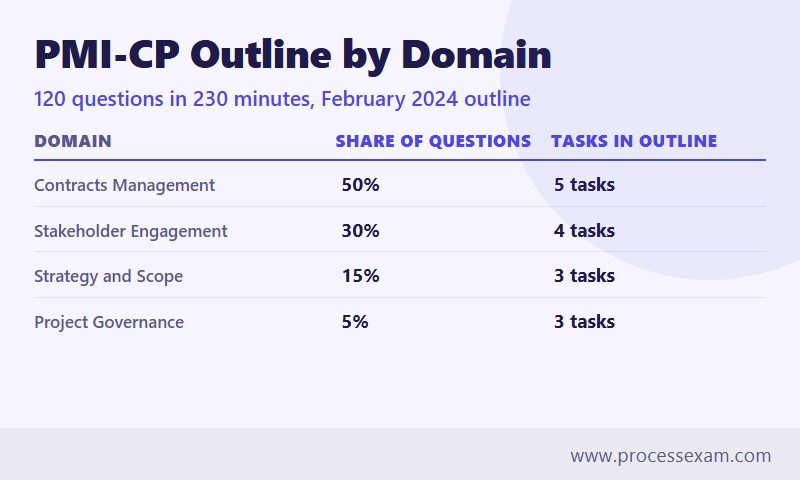
| Domain | Share of questions | Tasks | Roughly how many of the 120 questions |
|---|---|---|---|
| I. Contracts Management | 50% | 5 | 60 |
| II. Stakeholder Engagement | 30% | 4 | 36 |
| III. Strategy and Scope Management | 15% | 3 | 18 |
| IV. Project Governance | 5% | 3 | 6 |
The right-hand column is simple arithmetic on PMI's percentages, not a figure PMI publishes, and the real count of scored items per domain can differ slightly. It is still a useful way to decide where a study hour goes. Our PMI-CP syllabus page lays the domains out against the outline if you want them in checklist form.
Domain I: Contracts Management, 50 per cent
Five tasks, and the largest single block of marks. Expect to be tested on:
- Managing risk and the risk process. Positive risk as an opportunity, risk classification, and who must be consulted. The outline mentions prioritising risk during front end planning.
- Applying risk tools. The Integrated Project Risk Assessment (IPRA) tool, Monte Carlo simulation, probabilistic techniques and risk registers, plus starting a risk framework at the outset.
- Managing claims. Using lessons learned to spot where claims come from, how contract type and delivery method change claim frequency, the difference between a change or variation order and a claim, and the dispute-resolution techniques available, including dispute review boards and front end planning.
- Managing the contract lifecycle. From discovery to close-out, including Lean Integrated Project Delivery and integrated form of agreement (IFOA) contracting, key clauses, and advising senior stakeholders on which delivery method fits.
- Interface management. Setting out interface points between packages, classifying interfaces on mega projects, and leading and monitoring an interface plan.
Domain II: Stakeholder Engagement, 30 per cent
Four tasks about communication as a project control rather than a soft skill. The outline names project management information systems, a central communication platform, the Obeya or Big Room, Commitment-based Management and the Compass tool for finding communication gaps. Later tasks cover preventing communication problems, mitigating them when they emerge through feedback loops and action plans, and identifying and assessing stakeholders, including the role of culture.
Domain III: Strategy and Scope Management, 15 per cent
Three tasks: defining scope around outcomes and revising it as the project matures; building a change order process that closes at the right point in the lifecycle and copes with change quickly; and using tools such as scope evaluation, value engineering and cost-benefit analysis to find and manage gaps.
Domain IV: Project Governance, 5 per cent
Three tasks on implementing governance models and setting up scope governance on built-environment projects. It is small, and the published outline gives it no enablers, so use your marks elsewhere first and read the PMI course material on governance once you are comfortable with the rest. PMI's Examination Content Outline is the document to keep open while you study.
What happens on exam day, and how does PMI score the PMI-CP?
The exam is delivered by Pearson VUE, either at a test centre or online with a remote proctor, and it runs for 230 minutes across 120 questions. Divide it out and you have just under two minutes a question, which is generous by certification standards and reflects the length of the scenario stems. Many questions describe a contract situation in a paragraph, so reading time is the real constraint, not recall.
Scoring
PMI does not report a single pass percentage for this exam. The outcome scale is as Above Target, Target, Below Target and Needs Improvement, and PMI reports performance against the domains. Treat that as a signal to study every domain: a strong result in Contracts Management does not hide a weak showing in Stakeholder Engagement, because each domain is reported on its own. Any website that quotes a numeric pass mark for the PMI-CP is guessing.
If you do not pass
PMI's certification handbook (revised June 2026) gives you a one-year eligibility period after approval and up to three attempts inside it; fees are paid again for the second and third attempts. Treat each attempt as a fresh booking, so decide your booking date from practice results, not from the calendar. The domain feedback on a failed result is the best planning tool you will get: restudy the lowest-rated domain first and weight the hours by its share of the paper.
Practical points for the day
Read the last sentence of each scenario before the detail, so you know whether the question asks for the first action, the best action or the option to avoid. Flag a question after two minutes and move on. Online delivery needs a clear desk and a quiet room, and the check-in takes time, so log in early. A 230-minute session is long enough that a short break is worth taking if the rules for your delivery method allow one; confirm that in your booking confirmation rather than assuming.
How would a six-week plan weighted to the outline look?
If you already work on capital projects, six weeks of ten to twelve hours is a reasonable plan once the course modules are done. Candidates who are new to contracts should allow eight. The plan below spends the most time where the marks are, and it puts practice under the clock into the final two weeks, not the last night.
| Week | Focus | What to finish |
|---|---|---|
| 1 | Risk and risk tools | Positive risk, classification, IPRA, Monte Carlo and probabilistic ideas in plain words, a risk register built from a past project |
| 2 | Claims and disputes | Change order versus claim, contract type and delivery method effects, dispute review boards, front end planning |
| 3 | Contract lifecycle and interfaces | Discovery to close-out, IFOA and Lean IPD, key clauses, interface points and classification |
| 4 | Stakeholder engagement | Big Room and its pitfalls, Commitment-based Management, Compass, feedback loops, culture |
| 5 | Scope, change and governance | Outcome-based scope, change order process, value engineering, cost-benefit analysis, governance models |
| 6 | Timed practice and repair | Two long timed sets, error log reviewed, weakest domain revisited |
How to study each block
For every task, write one page in your own words: what the task is for, the situation in which it comes up, and two or three actions a good professional takes. Then attach a real example from your own work. The exam rewards recognition of situations, and a page built from your own project is easier to recall than a definition from a course slide.
Use the sample set from the start, not only at the end. Sample questions show how scenarios are phrased, which tells you what level of detail to learn. Ask of every answer you get wrong: did I misunderstand the concept, misread the stem or choose a plausible-but-late action? Those are three different problems with three different fixes, and mixing them up is the commonest reason practice scores stop improving.
A worked example: claim or change order?
Suppose a contractor writes that an owner-directed revision to the façade package has delayed the steel erection, and asks for more time and money. Is it a change or a claim? The outline's distinction points the way: a change order is an agreed adjustment to scope, time or price made under the contract's change procedure; a claim is a request for relief that the parties have not yet agreed. A good answer in the exam normally starts by checking the contract's notice and change provisions, recording the facts at once, and trying to settle the matter early, before turning to the dispute-resolution ladder. The wrong options usually jump straight to formal dispute or ignore the notice period.
A second example, on interfaces: two packages meet at a curtain wall and a structural frame, and each contractor assumes the other owns the tolerance between them. Interface management says list the interface point, name an owner on each side, record what passes across it and when, and track it. If you can state those four steps for any pair of packages, you can answer most interface questions from first principles.
Why does site experience alone not carry you through PMI-CP?
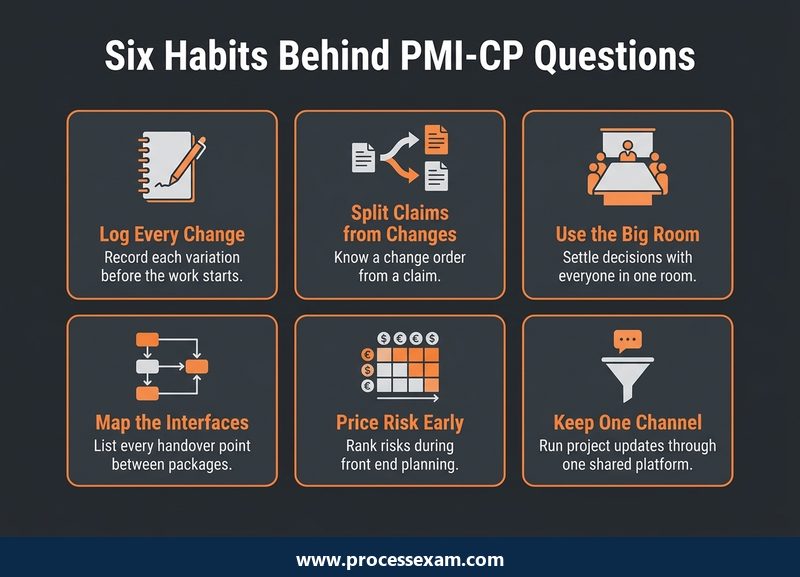
Experienced builders and engineers often fail on the exam for a reason that has nothing to do with competence: they answer the way the site actually does things instead of the way the outline frames them. The graphic below turns the outline's enablers into six habits to rehearse.
- Treating the exam as a scheduling test. Programme and cost control hardly feature. Contracts and communication are four-fifths of the paper. Candidates who spend most of their time on the critical path are studying the wrong thing.
- Answering with the quickest practical fix. On site, a verbal instruction solves a problem today. In the exam, the better answer usually records the instruction, checks the contract and uses the agreed process, because that is what protects the project when someone disputes it later.
- Mixing up claims and change orders. They look similar and sit in the same task. Learn the definition and the procedure for each.
- Skipping the interface material because it seems niche. It is a named task in the biggest domain, and mega-project interfaces are exactly what the exam describes.
- Memorising tool names without knowing when to use them. IPRA, Compass, the Big Room and Commitment-based Management come up as situations. Know what problem each one solves and what its common pitfalls are.
- Ignoring culture and communication style. The stakeholder domain is 30 per cent. Questions about resistance, misunderstanding and differing expectations have a right answer too, and it is rarely “escalate”.
- Booking before practice scores are stable. You get three attempts a year, each with a fee. Two timed sets in a row at a comfortable level beat optimism.
What does the PMI-CP cost in total, and what does it do for your career?
The exam fee is USD $399 (Member Price) or USD $499 (Full Price), a difference of USD $100. Whether membership pays for itself depends on the membership fee in your region and on whether you value the other member benefits, so look at PMI's current membership price before deciding; we do not quote it here. The exam fee is only part of the cost. The four course modules have their own price, which varies with the format you choose and whether you take them through an authorized training partner. Add your study time, and a second exam fee if the first attempt does not go your way.
What the credential gives you
The PMI-CP is a specialist signal. It shows that you can handle the contractual, communication and scope parts of capital delivery to a standard set by a body that also sets the PMP. That helps in three places. In recruitment, it separates you from candidates who list “construction management” without evidence of contract knowledge. In client and owner-side roles, it gives you a recognised vocabulary for risk, claims and interface planning that others on the team can share. And as a stepping stone, it pairs naturally with a PMP: the PMP covers general management, the PMI-CP the contract-heavy end of the built environment.
Be realistic about the limits. The credential is newer than the PMP and less widely known among recruiters, so its pull varies by region and employer. We do not quote salary figures for it because we found no survey we could cite. Ask whether your target employers or clients mention it before treating it as a requirement. If they do not, its value is in what you learn and in the discipline of the preparation, as much as the badge.
Renewal and keeping it current
PMI credentials run on a continuing certification cycle with professional development requirements. The details for this credential are in the PMI handbook and on the PMI-CP page, and we have not repeated the cycle length or hours here because they can change; check them when you pass, not when you are already late.
Where to practise before you book
When the course modules are finished and your plan is under way, switch to timed, full-length papers. Book a PMI-CP practice exam and sit it twice: once at the start of week six to find the weak domain, and again near the end to confirm it has moved. Keep the error log from both, because it is the document that tells you whether to book now or revise for another week.
Frequently Asked Questions
How many questions are on the PMI-CP exam?
The PMI Construction Professional exam has 120 questions and a time limit of 230 minutes, which works out at just under two minutes per question. The long stems reward careful reading, so practise full-length timed sets before you book rather than short topic quizzes.
How much does the PMI-CP exam cost?
The fee is USD $399 (Member Price) or USD $499 (Full Price). PMI shows regional prices, so confirm the amount at checkout. The four course modules you must finish first are priced separately by PMI or its training partners.
What are the PMI-CP eligibility requirements?
You complete four PMI course modules and show three years of on-the-job experience on construction or built-environment projects within the past ten years. Older articles that mention seven modules, including three micro-credentials, are out of date against PMI's current route.
What does the PMI-CP exam cover?
PMI's February 2024 outline has four domains: Contracts Management at 50 per cent, Stakeholder Engagement at 30 per cent, Strategy and Scope Management at 15 per cent and Project Governance at 5 per cent. Risk, claims, contract lifecycle and interface management sit inside the largest domain.
Is the PMI-CP the same as the CP APMP or PMI-CPMAI?
No. The PMI-CP is PMI's Construction Professional credential for built-environment projects. The PMI-CPMAI is PMI's separate credential for managing AI projects, and the APMP CP is a proposal-management exam from a different body. They share letters but have different outlines, fees and audiences.
- PMI-CP Question Bank |
- PMI-CP Exam Questions Download |
- PMI-CP Test Questions |
- Specialized |
- PMI Construction Professional Test Questions |
- Construction Professional Simulator |
- Construction Professional Mock Exam |
- PMI Construction Professional Book |
- Construction Professional Certification Cost |
- Construction Professional Certification Requirements |
- PMI Construction Professional Sample Questions |
- Construction Professional PDF


