
PMI Certifications Roadmap: Find the Right One for Your Career Stage
Updated on 22 September 2026. What’s new: retired Disciplined Agile credentials removed, and PMP and PMI-ACP eligibility updated to PMI's current experience rules
Many candidates picture PMI certifications as a ladder: CAPM at the bottom, the PMP in the middle, PgMP at the top. That picture sends people to the wrong exam. PMI's credentials work more like a map grouped by the work you do: one for newcomers, one core practitioner credential, one for agile delivery, several specialist ones, two for senior program and portfolio leaders, and one for AI projects. The right one is the credential that matches work you can already evidence.
That single rule settles most of the confusion behind searches for a PMI certification roadmap. The Project Management Institute does not make you collect its credentials in order, and none of its current exams asks you to hold another PMI credential before you apply. What each one does ask for is a particular kind of experience, and that is why the same person can be ready for the PMI-ACP years before the PgMP, or ready for the PMP while a colleague of the same age is better served by the PMI-RMP.
This guide walks through the map stage by stage. For each group it explains who the credential is written for, what PMI asks before you can apply, and what the exam looks like, with every exam figure taken from the fee and format data we keep for each PMI exam. The final section turns the map into a decision you can make this week.
How are PMI certifications organised, if not as a ladder?
The easiest way to read PMI's catalogue is to ask what kind of job each credential describes. PMI builds every exam from a job task analysis: it surveys people who do a role, lists the tasks they perform, and writes questions that test those tasks. So each credential is really a portrait of a role, and the groups below follow the roles rather than a seniority scale.
- Entry: the Certified Associate in Project Management (CAPM), for people who know the theory but have not yet led projects.
- Practitioner: the Project Management Professional (PMP), for people who lead and direct whole projects.
- Agile: the PMI Agile Certified Practitioner (PMI-ACP), for people who deliver through iterations, backlogs and self-organising teams.
- Specialist: the PMI-RMP for risk, the PMI-SP for scheduling, the PMI-PBA for business analysis, the PMI-CP for construction and the built environment, and the PMI-PMOCP for project management office staff.
- Program and portfolio: the PgMP for leaders of several related projects, and the PfMP for people who decide which projects and programs an organisation funds.
- AI: the PMI Certified Professional in Managing AI (PMI-CPMAI), for people who run projects that build or deploy AI systems.
Two consequences follow. First, moving between groups is sideways as often as it is upward: a PMP holder who becomes the organisation's risk lead gains more from the PMI-RMP than from the PgMP. Second, the entry credential is optional. Someone who already leads projects and can prove the months skips the CAPM entirely.
What happened to the Disciplined Agile certifications?
Older lists, including an earlier version of this page, still show four Disciplined Agile credentials: DASM, DASSM, DAC and DAVSC. PMI has retired all four. Its training partners stopped teaching the courses at the end of May 2025, and 30 November 2025 was the last day to sit any of those exams. DASM's place has been taken by the Disciplined Agile Foundations course, which is training rather than a certification exam. If you were planning a Disciplined Agile credential, the PMI-ACP is now PMI's agile certification (checked September 2026).
The current PMI credentials at a glance
Here is every PMI credential covered in this guide with its exam format and fee. Where two prices are shown, the first applies to PMI members and the second to everyone else.
| Credential | Career stage | Questions | Duration (minutes) | Exam fee | Result reported as |
|---|---|---|---|---|---|
| CAPM | Entry | 150 | 180 | Member Price: USD $225 Full Price: USD $300 |
Above Target / Target / Below Target / Needs Improvement |
| PMP | Practitioner | 180 | 240 | Member Price: USD $425 Full Price: USD $675 |
Above Target / Target / Below Target / Needs Improvement |
| PMI-ACP | Agile | 120 | 180 | Member Price: USD $435 Full Price: USD $495 |
Above Target / Target / Below Target / Needs Improvement |
| PMI-RMP | Specialist (risk) | 115 | 150 | Member Price: USD $520 Full Price: USD $670 |
Above Target / Target / Below Target / Needs Improvement |
| PMI-SP | Specialist (scheduling) | 170 | 210 | Member Price: USD $520 Full Price: USD $670 |
Above Target / Target / Below Target / Needs Improvement |
| PMI-PBA | Specialist (business analysis) | 200 | 240 | Member Price: USD $405 Full Price: USD $555 |
Above Target / Target / Below Target / Needs Improvement |
| PMI-CP | Specialist (construction) | 120 | 230 | Member Price: USD $399 Full Price: USD $499 |
Above Target / Target / Below Target / Needs Improvement |
| PMI-PMOCP | Specialist (PMO) | 120 | 165 | Member Price: USD $520 Full Price: USD $700 |
PASS or FAIL |
| PgMP | Program | 170 | 240 | Member Price: USD $800 Full Price: USD $1000 |
Above Target / Target / Below Target / Needs Improvement |
| PfMP | Portfolio | 170 | 240 | Member Price: USD $800 Full Price: USD $1000 |
Above Target / Target / Below Target / Needs Improvement |
| PMI-CPMAI | AI projects | 120 | 160 | Member Price: USD $699 Full Price: USD $899 |
PASS or FAIL |
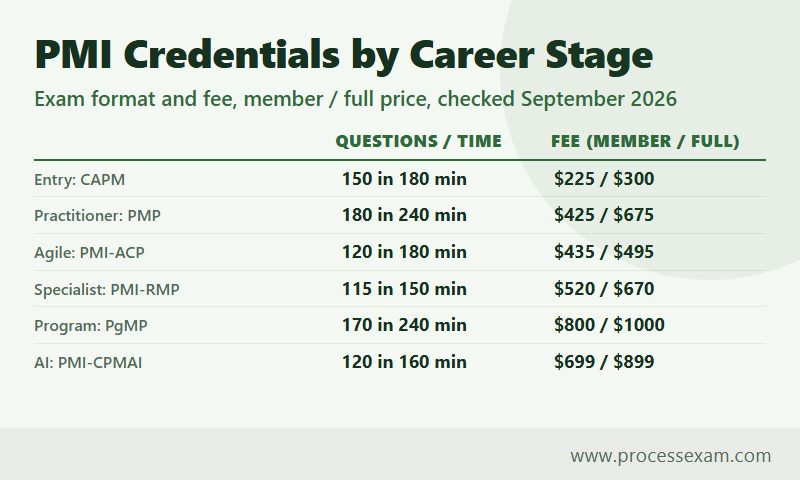
A few patterns stand out. Most exams report results in four performance bands rather than a published pass mark, while the PMI-PMOCP and PMI-CPMAI report a straight pass or fail. The two senior credentials carry the highest fees and sit among the longest papers. And the member discount varies a lot, from USD $60 on the PMI-ACP to USD $250 on the PMP, which matters when you plan more than one exam. Practice exams for each of these credentials sit on our PMI exam list, grouped by credential, if you want to see the question styles side by side before you commit.
Treat the table as a starting point. PMI adjusts regional pricing and occasionally renews an exam, so confirm the details on PMI's certifications page before you pay.
Which PMI certification fits someone who is just starting out?
If you have not yet led a project, your realistic choice is the CAPM. It is written for students, recent graduates, career changers and team members who contribute to projects without running them, and it tests whether you understand how projects are run across different delivery approaches.
What the CAPM asks of you
The eligibility bar is deliberately low. You need a secondary education, such as a high school diploma or its global equivalent, and 23 hours of project management education completed before the exam. There is no experience requirement at all. The exam has 150 questions in 180 minutes, and the fee is Member Price: USD $225 or Full Price: USD $300.
PMI's CAPM outline spreads the questions across four areas: project management fundamentals and core concepts, predictive plan-based methods, agile frameworks, and business analysis frameworks. That mix is useful in itself. A newcomer who prepares properly ends up able to talk about a work breakdown structure, a sprint backlog and a requirements traceability matrix in the same interview, which is exactly the range junior roles now expect.
When the CAPM is not the right first step
The CAPM is a starting credential, not a shortcut. It does not count toward the months of project leadership that the PMP requires later, so it earns its place only when it helps you get the job in which those months are built. If you already lead projects and can document three years or more, go straight to the PMP instead.
Two other credentials also accept people without project leadership behind them. The PMI-CPMAI, covered in its own section below, requires PMI's prep course rather than experience. And for sustainability work, PMI's Certified Sustainable Project Professional (CSPP), which has taken over from the GPM-b, is sold as a course and exam bundle with a standard route that asks only for a secondary diploma (checked September 2026).
When is it time for the PMP, and what changed in July 2026?
The PMP is PMI's core practitioner credential and the one most job adverts mention by name. It is time to apply when you can show that you have led and directed project work, whatever your job title, for long enough to meet one of PMI's routes. The months must fall within the last ten years and must not overlap.
- Upper-secondary education: at least 60 months leading projects.
- An associate-level or short-cycle post-secondary qualification: at least 48 months.
- A bachelor's degree or higher: at least 36 months.
- A degree from a programme accredited by PMI's Global Accreditation Center: at least 24 months.
Every route adds 35 hours of project management training aligned with the exam outline. The exam itself has 180 questions in 240 minutes, and the fee is Member Price: USD $425 or Full Price: USD $675.
What the July 2026 exam tests differently
PMI replaced the PMP outline in July 2026, and anyone mapping a route should know that the credential now reaches further into the organisation around a project. The July 2026 PMP Examination Content Outline keeps the People, Process and Business Environment domains but weights them 33%, 41% and 26%. Governance, compliance, risk and change control now carry roughly a quarter of the exam, and PMI names AI and sustainability among the trends behind the update. Of the 180 questions, 10 are unscored pretest items, and case-based sets and graphic-based questions join the familiar formats.
For route planning this shift matters in two ways. A PMP earned now overlaps more with the specialist credentials in risk and governance than older versions did, which makes the PMI-RMP or PMI-PMOCP a shorter step afterwards. And study material written before July 2026 no longer matches the paper, so check the publication date of anything you buy.
Signs you are ready
You own a schedule or a budget, not just a slice of one. Sponsors come to you for status, and you decide how to respond to a slipped milestone. You can name, for each project, the objective, your role and the result. If those three things are true for enough months, the PMP is the credential that makes that experience visible. Once PMI approves your application, a timed PMP practice test is a quick way to check whether your pace holds across four hours of questions.
After you pass, the PMP runs on a three-year cycle in which you earn 60 professional development units. Many of those units can come from studying for your next PMI credential, which is one practical reason to plan the route rather than stop at one exam.
Should an agile team lead take the PMI-ACP instead of the PMP, or after it?
It depends on what your team actually does all week. The PMI-ACP certifies leadership of adaptive work: backlogs, short iterations, flow, team coaching and frequent delivery of value. The PMP now covers predictive, agile and hybrid delivery together. Neither replaces the other; they describe different centres of gravity.
What PMI asks before you can apply
Under the outline PMI introduced in 2024, you need 21 hours of formal training in agile practices and two years of agile experience within the past five years. PMI shortens that to one year if you hold a degree from a Global Accreditation Center programme or an active agile certification from another body that you have held for over a year. The exam has 120 questions in 180 minutes, and the fee is Member Price: USD $435 or Full Price: USD $495.
A simple way to decide the order
- Scrum master, agile coach or delivery lead on a product team: take the PMI-ACP first. It describes your job, and the experience is easier to document.
- Project manager running mixed programmes with some agile teams: take the PMP first, then the PMI-ACP if your organisation moves more work to iterations.
- Product owner or business-side lead: the PMI-ACP usually fits better than the PMP, because you shape the backlog rather than the plan.
- Former Disciplined Agile candidate: the PMI-ACP is the natural replacement now that those exams have closed.
A useful test is to list your last ten working days and mark each task as plan-driven or iteration-driven. If most marks land on the iteration side, the agile credential will describe you more honestly than the practitioner one, and it will be easier to evidence in the application.
Which specialist PMI credential suits risk, scheduling, analysis, construction or PMO work?
Specialist credentials suit people whose value to an organisation lies in one discipline rather than in running whole projects. Each asks for experience in its own area, measured by PMI in months, plus specialist education hours. PMI's requirements differ by credential and by education level, so read the current handbook for the one you choose before counting your months.
PMI-RMP: risk management
For risk leads, risk analysts and project managers who run formal risk processes on large or regulated work. The exam covers identifying, analysing and responding to risk and monitoring it through a project. It has 115 questions in 150 minutes, and the fee is Member Price: USD $520 or Full Price: USD $670. A PMP holder who already chairs the risk review is often closer to this credential than they think.
PMI-SP: scheduling
For planners and schedulers who build and maintain integrated schedules, often on engineering, energy or defence programmes where the schedule is a contractual document. Expect questions on schedule strategy, baselines, critical path analysis, schedule control and stakeholder reporting. The exam has 170 questions in 210 minutes, at Member Price: USD $520 or Full Price: USD $670.
PMI-PBA: business analysis
For business analysts who elicit and manage requirements on projects and programmes. The reference behind it is The PMI Guide to Business Analysis. At 200 questions in 240 minutes it is the longest paper in the family by question count, and the fee is Member Price: USD $405 or Full Price: USD $555. Analysts who already hold a CAPM will find its business analysis domain a helpful first taste.
PMI-CP: construction and the built environment
For project professionals in construction, infrastructure and real estate development. PMI's outline for it centres on contracts management, stakeholder engagement, strategy and scope, and project governance, which reflects how often construction projects are won or lost on contract terms. The exam has 120 questions in 230 minutes, at Member Price: USD $399 or Full Price: USD $499.
PMI-PMOCP: the project management office
For people who design, run or improve a PMO. According to PMI's PMI-PMOCP exam content outline, you need 36 months in a project-related profession within the last eight years, or a PMP in good standing instead of that experience, plus 10 contact hours of PMO education. Its six domains run from organisational alignment and PMO strategy through service design, operations and people. The exam has 120 questions in 165 minutes, is reported as PASS or FAIL, and costs Member Price: USD $520 or Full Price: USD $700.
Specialist first, or PMP first?
If your whole career sits inside one discipline, a specialist credential can come first and may be the only one you need. If you expect to lead projects later, the PMP usually comes first because it opens more roles, and the specialist credential follows as the thing that sets you apart from other PMP holders. The PMI-PMOCP is the one place where PMI rewards that order directly, by letting the PMP stand in for the experience requirement.
What do the PgMP and PfMP ask of senior leaders?
These two credentials sit at the far end of the map, and they describe roles that most project managers never hold. Both exams have 170 questions in 240 minutes and cost Member Price: USD $800 or Full Price: USD $1000, the highest fees in PMI's catalogue.
PgMP: leading a program
A program is a group of related projects managed together so that the organisation gets benefits none of them would deliver alone: a hospital network rolling out a new patient record across ten sites, say, or a bank replacing its core platform in stages. The PgMP is for the person accountable for those benefits. PMI's application asks for substantial project experience plus years of program management experience, and the exam draws on The Standard for Program Management - Fifth Edition. Questions centre on benefits, stakeholder engagement across many teams, governance and the program life cycle.
PfMP: choosing what to fund
A portfolio is everything an organisation invests in to reach its strategy: projects, programs and operational work competing for the same money and people. The PfMP is for those who decide what enters, continues or stops in that portfolio, often in a strategy office or an enterprise PMO. PMI asks for long professional business experience plus years of portfolio management experience, and the reference is The Standard for Portfolio Management - Fourth Edition. The questions are about strategic alignment, governance, portfolio performance and risk, not about running any single project.
How to tell whether you are near either one
Ask what you are measured on. If it is the combined outcome of several projects you coordinate, you are moving toward the PgMP. If it is whether the organisation invested in the right things at all, you are moving toward the PfMP. If it is still delivering one project on time and within budget, both are some years away, and the PMP or a specialist credential is the better use of your next exam fee. PMI reviews these applications closely, so collect evidence of the programs or portfolios you have run, with the decisions you owned, well before you apply.
Where does the PMI-CPMAI fit for people running AI projects?
The PMI-CPMAI is the newest branch of the map and the one with the fewest entry barriers. It certifies the ability to run AI projects with the CPMAI methodology, which treats data work, model development and deployment as iterative phases rather than a single build. The exam has 120 questions in 160 minutes, is reported as PASS or FAIL, and costs Member Price: USD $699 or Full Price: USD $899.
What makes it unusual is the eligibility rule. PMI's PMI-CPMAI exam content outline states that completing PMI's CPMAI prep course is required before you can schedule the exam, and that no prior project management, technical or AI experience is needed. The same outline groups the questions into five domains: supporting responsible and trustworthy AI, identifying business needs and solutions, identifying data needs, managing model development and evaluation, and operationalising the AI solution.
Who gains most from it
- Project and product managers whose next piece of work involves a model, a data pipeline or an AI vendor.
- PMP holders who want to show that their governance and risk skills extend to AI-specific issues such as bias checks, data quality and model monitoring.
- Data and analytics team leads who already understand the technology but have no project credential.
Because it has no experience requirement, the PMI-CPMAI can sit anywhere on your route. For a newcomer it can run in parallel with building project experience; for a senior PMP holder it adds a current specialism on top of the core credential. What it does not do is replace the PMP for general project leadership roles, where job adverts still ask for the practitioner credential by name.
How do you choose your next PMI certification and plan the route?
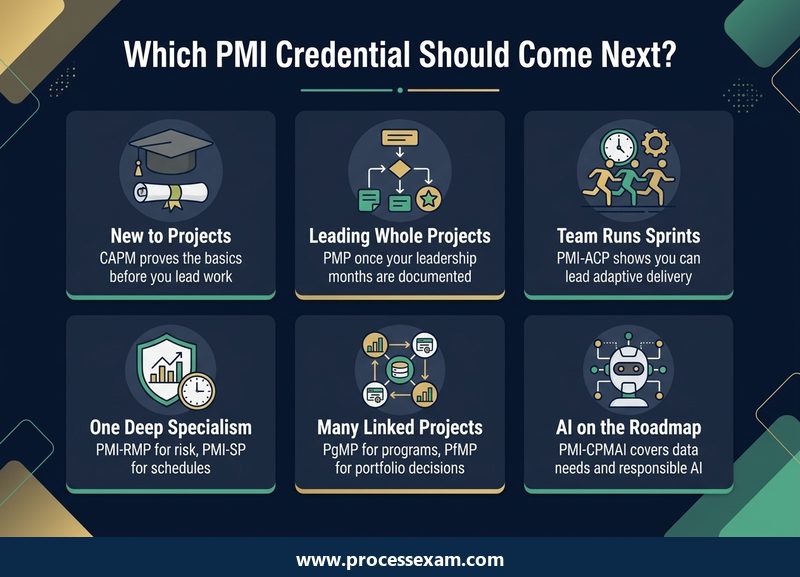
Turn the map into a decision with five steps. None of them takes long, and together they stop you from paying for an exam you cannot yet apply for.
- List the work you can evidence. For each project or role in the last ten years, write what you led, for how long, and who can confirm it. This list, not your job title, decides which applications will succeed.
- Match the list to a group on the map. Mostly contributing: entry. Leading whole projects: practitioner. Iterative teams: agile. One discipline: specialist. Several related projects or investment decisions: program or portfolio. AI work: the PMI-CPMAI.
- Check the current requirements for that credential. Read the handbook or outline for the exact months and training hours, and note the date you will meet them if you do not yet.
- Cost the whole route, not one exam. If you plan two credentials in the next few years, compare PMI's annual membership dues in your region with the member discounts on both exams before deciding whether to join.
- Book inside the eligibility year. For the PMP, PMI-PMOCP and PMI-CPMAI, PMI's outlines allow up to three attempts within one year of approval. Schedule early in that year so a second attempt still fits if you need one.
Four example routes
- A graduate joining a project team: CAPM now, PMP once the leadership months are documented, then a specialist or agile credential that matches the job at that point.
- A scrum master on a software product: PMI-ACP first, then the PMP if the role grows into coordinating several teams and budgets.
- A PMO analyst: PMP, then the PMI-PMOCP, which the PMP makes easier to apply for, and eventually the PfMP if the role moves into portfolio decisions.
- A site project manager in construction: the PMI-CP if the work stays in the built environment, or the PMP first if moving into other sectors is likely.
Mistakes that make the route longer
- Collecting credentials for their own sake. A fourth acronym rarely helps as much as experience in the role the next credential describes.
- Applying before the months are there. An application that is short on experience or vague about your role invites follow-up questions and can be selected for audit.
- Studying from outdated material. The PMP changed in July 2026 and the PMI-ACP in 2024; older guides test a different exam.
- Planning around retired exams. Lists that still show Disciplined Agile certifications are out of date.
- Ignoring renewal. Each credential needs professional development units to stay active, so a route with three credentials means planning three renewal cycles.
Choosing a PMI certification comes down to honesty about the work you do now and the work you want next. Find your place on the map, pick the one credential that describes it, and let the next step follow once the experience for it is real.
Frequently Asked Questions
What certifications does PMI offer?
PMI currently offers the CAPM for newcomers, the PMP for practising project managers, the PMI-ACP for agile work, specialist credentials in risk, scheduling, business analysis, construction and PMOs, the PgMP and PfMP for program and portfolio leaders, the PMI-CPMAI for AI projects and the CSPP for sustainability. Its Disciplined Agile certifications have been retired.
Which PMI certification should I get first?
Start with the credential that matches work you can already document. With no project leadership yet, that is usually the CAPM. If you have led projects for three years or more, go straight to the PMP. Agile team leads often start with the PMI-ACP, and specialists with their own discipline's credential.
Is there a fixed PMI certification path or set of levels?
No. PMI's credentials are grouped by role rather than stacked as levels, and none requires another PMI credential before you apply. Each has its own education and experience rules. The PMI-PMOCP is the exception that rewards order: a PMP in good standing can replace its experience requirement.
How much do PMI certification exams cost?
Fees range from Member Price: USD $225 or Full Price: USD $300 for the CAPM up to Member Price: USD $800 or Full Price: USD $1000 for the PgMP and PfMP. The PMP is Member Price: USD $425 or Full Price: USD $675. Membership lowers every fee, so compare dues with the savings.
Are the Disciplined Agile certifications still available?
No. PMI retired DASM, DASSM, DAC and DAVSC. Training partners stopped teaching those courses at the end of May 2025, and 30 November 2025 was the last day to sit the exams. The Disciplined Agile Foundations course replaced DASM as training, and the PMI-ACP is now PMI's agile certification.
- PMP Certification |
- PMI Project Management Exam Questions |
- PMI Project Management Question Bank |
- PMI Project Management Questions |
- PMI Project Management Study Guide |
- PMI PMP Quiz |
- PMP Questions |
- PMP Practice Test |
- PMP Study Guide Material |
- PMP Sample Exam |
- Project Management Certification |
- PMI Project Management Book |
- Project Management Certification Cost |
- Project Management Certification Requirements |
- PMI Project Management Sample Questions |
- PMP Exam Questions Download |
- PMP Test Questions |
- Project Management PDF |
- PMI Project Management Professional


