
PMI-ACP Study Plan: How to Prepare for the Exam
Updated on 23 September 2026. What’s new: rewritten for the four-domain exam content outline PMI introduced on 8 November 2024, with the current retake limits and exam delivery arrangements.
Most PMI-ACP study plans still circulating online were built for the seven-domain exam PMI stopped offering after 7 November 2024. The exam you will actually sit has four domains – Mindset 28%, Leadership 25%, Product 19% and Delivery 28% – delivered as 120 questions in 180 minutes. This plan rebuilds preparation around that outline, from the first reading session to your pacing on the day.
The rebuild was not cosmetic. PMI moved the credential away from a checklist of agile techniques and towards a set of behaviours an agile practitioner is expected to show: experimenting early, shortening feedback loops, coaching rather than directing, and keeping value flowing. Study material written for the old blueprint still teaches useful agile theory, but it points you at the wrong proportions and the wrong verbs.
Everything below is drawn from PMI's own exam content outline and certification handbook, with the fee, question count and timing taken from the exam details we publish for the credential. Figures were checked in September 2026 against the outline PMI currently serves, which carries a March 2026 revision date on every page.
How long does it take to prepare for the PMI-ACP exam?
There is no single answer, and the honest version depends on two things: how much agile work you do in an ordinary week, and which eligibility route you are using. A delivery lead who runs sprints daily is revising vocabulary and calibrating judgement. A manager who has read about Kanban but never limited work in progress is learning a new craft.
Three rough profiles cover most candidates:
- You work on an agile team every day. Six to eight weeks of evening study is usually enough. Your weak spots will be the parts of the outline your organisation does not practise – often complexity models, flow metrics and inter-team coordination.
- You hold an active PMP and manage hybrid work. Allow ten to twelve weeks. The content is familiar but the expected behaviour is not, and unlearning takes longer than learning.
- You qualify through a third-party agile certificate. Eight to ten weeks. You will know one framework well; the exam deliberately refuses to sit inside one.
Two dates bound the calendar and people forget both. Your formal training hours must be finished before you submit the application, so a taught course adds its own weeks at the front. And once PMI approves your application you have a one-year eligibility period with a maximum of three attempts inside it, so booking a date early in that year leaves room to recover if the first sitting goes badly.
Here are the exam details to plan against:
| Detail | PMI-ACP |
|---|---|
| Certification | PMI Agile Certified Practitioner (PMI-ACP) |
| Exam code | PMI-ACP |
| Number of questions | 120 |
| Duration | 180 minutes |
| Exam fee | Member Price: USD $435 / Full Price: USD $495 |
| Result reported as | Above Target / Target / Below Target / Needs Improvement |
Which domains carry the most marks, and what do they ask you to do?
The outline splits 100 scored questions across four domains. Twenty further questions are unscored pretest items, mixed in at random and never identified, which is why the total is 120 while the weightings below describe the 100 that count.
| Domain | Share of items | Tasks in the outline | What it keeps asking |
|---|---|---|---|
| I. Mindset | 28% | 7 | Experiment early, build transparency, make it safe to disagree, shorten feedback |
| II. Leadership | 25% | 6 | Empower, coach, surface root causes, share knowledge, hold a common purpose |
| III. Product | 19% | 4 | Refine the backlog, define increment goals, visualise work, prove value landed |
| IV. Delivery | 28% | 7 | Seek feedback, choose metrics, remove impediments, cut waste, optimise flow |
Read the right-hand column again, because it is the single most useful thing in the outline. Every task is written as a verb aimed at the practitioner: Experiment Early, Foster Psychological Safety, Manage agile metrics, Optimize flow. Twenty-four of them in total. The exam is built from those verbs, so a study session that ends with “I can define a cumulative flow diagram” has stopped one step short of “I would use a cumulative flow diagram here, and here is what it would tell me”.
Notice the balance, too. Mindset and Leadership together account for more than half the scored questions, and neither is about tooling. They are about how you behave when a stakeholder demands a fixed scope, when two team members will not agree, or when a retrospective produces the same complaint for the third sprint running. Candidates who come from a delivery background often plan their study around Product and Delivery because that feels like the technical half, then lose marks in the two domains they skimmed.
Each domain in PMI's exam content outline for the PMI-ACP also lists enablers underneath each task – short illustrative examples such as the Stacey Matrix, Cynefin, information radiators, Ishikawa diagrams or generalising specialists. PMI is explicit that enablers are examples rather than a syllabus, so treat them as a vocabulary check: if a term appears and means nothing to you, that is a gap worth an hour.
What should you read, and in what order?
Order matters more than volume here. Reading a thick exam-prep book first gives you someone else's structure; reading the outline first gives you PMI's.
1. The exam content outline, cover to cover
It is a short document and it is free. Read the four domain descriptions, then copy the twenty-four task statements into a list of your own. Against each, write one sentence about a time you did that thing at work, or write “gap”. That list becomes the spine of the whole plan. Check the revision date printed in the page footer of whatever copy you download; the current file is labelled March 2026 and describes the November 2024 exam.
2. The Agile Practice Guide
PMI names it among the resources to review, and it is the closest thing the credential has to a set text. It is the right level for the exam: enough on life-cycle selection, servant leadership and measurement to answer scenarios, without the depth of a framework manual.
3. One framework each from Scrum, Kanban and Lean
The exam is deliberately framework-agnostic, and the Product and Delivery domains name Scrum, Kanban, Lean and SAFe as things a practitioner should be familiar with. You do not need certification-level depth in each. You need to know what a Scrum event is for, how a pull system with work-in-progress limits behaves differently from an iteration, and what Lean means by waste.
4. The tools and techniques list as a checklist
The outline closes with nine groups of tools and techniques: analysis and design, estimation, communications, metrics, planning and adapting, process improvement, product quality, risk management and value-based prioritisation. Go through them with a highlighter. Relative sizing, affinity estimating, osmotic communication, cycle time, cumulative flow diagrams, value stream mapping, risk-adjusted backlogs, MVP, MoSCoW, Kano analysis – anything you cannot explain in two sentences goes on the gap list.
5. A taught course, chosen against the outline
Your formal learning hours have to come from somewhere, and PMI sets quality criteria for what counts: the course should align to the exam content outline, include practical exercises, balance subject expertise with test-style content, and finish with an assessment and a certificate of completion. Hold any course you are considering against those four lines before you pay for it.
What to leave alone: anything organised around seven domains, and any question bank whose explanations quote weightings of 16%, 20% or 17%. Those numbers belong to the retired blueprint, and a question bank built on it will drill you on proportions that no longer exist.
How do you turn the outline into a week-by-week study plan?
The plan below assumes roughly five to seven hours a week, which is what most working candidates can protect. Each block ends with something you have written down, because a block that ends with “read chapter four” is impossible to revise from.
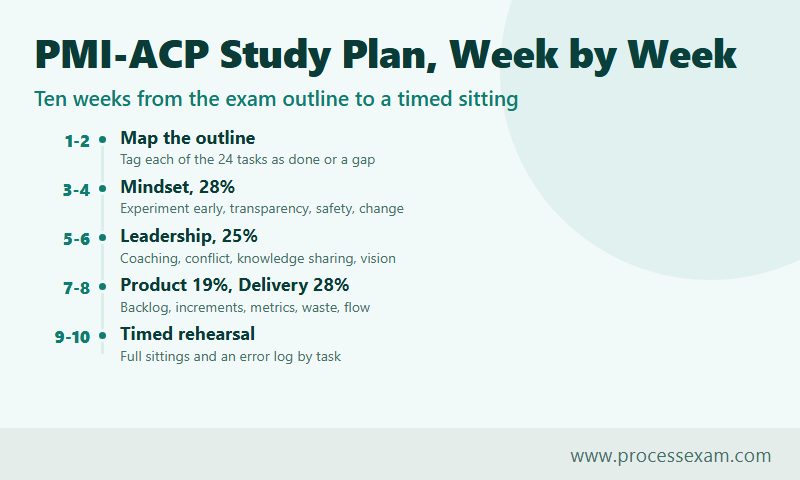
| Weeks | What you cover | What you finish with |
|---|---|---|
| 1–2 | The outline and your own history | A list of the 24 tasks, each tagged “done this” or “gap” |
| 3–4 | Mindset: experimentation, transparency, psychological safety, change | Your own explanation of complexity models and when each applies |
| 5–6 | Leadership: empowerment, coaching, conflict, knowledge sharing, vision | A worked example of a conflict you would handle differently now |
| 7–8 | Product and Delivery: backlog, increments, metrics, waste, flow | One page of metrics with what each one hides as well as shows |
| 9–10 | Full-length timed sittings and repair work | An error log sorted by task, not by domain |
Two habits make the difference between a plan that finishes and one that stalls. The first is a fixed slot rather than a fixed duration: three evenings of ninety minutes beats “an hour a day” that quietly becomes nothing on Thursday. The second is finishing every session by writing two lines about what you would now do differently at work. That is the closest thing to rehearsal the exam allows, because the questions are scenarios and the right answer is usually the one a practitioner would actually take.
If ten weeks is more than you have, compress the middle, never the ends. Weeks one and two are what make the rest efficient, and weeks nine and ten are where your judgement gets calibrated.
How should you practise so that your scores mean something?
Practice is where most preparation goes wrong, because a rising percentage on a familiar question set feels like progress and usually is not. Three rules keep it honest.
Grade the reasoning, not the answer
For every question, say out loud why each of the other options is wrong before you check. If you cannot, you guessed correctly rather than answered correctly. Scenario questions typically offer two defensible options and one that is right in PMI's terms, so the ability to separate “reasonable” from “what a practitioner does” is the skill being trained.
Keep the error log by task, not by domain
“I am weak on Delivery” is not actionable. “I keep getting Recognize and eliminate waste wrong because I look for delays rather than for work sitting in a queue” is. Sort your misses against the twenty-four task statements and patterns appear within two sessions.
Rehearse the formats, not just the content
The exam is not only multiple choice. PMI's outline lists multiple response items, drag-and-drop items and exhibits alongside standard questions. Multiple response is the one that catches people, because partial credit is not on offer and the instinct is to tick one more option than the question supports. Meet each format before exam day rather than on it.
When your reasoning is steady on fresh material, a full-length PMI-ACP practice test under the real clock is the check worth making, because it measures stamina and pacing as well as knowledge. If you want a smaller sample of the question style first, work through some PMI-ACP sample questions before you commit an evening to a full sitting.
One reassurance about odd questions: twenty of the 120 are unscored pretest items that PMI is trialling. They are not marked and you cannot tell which they are. If two or three questions feel strangely worded or unusually obscure, that is normal and is not a signal about your score.
Which route gets you through the PMI-ACP application?
Eligibility has three parts, and the third is where nearly all the confusion sits.
Education. A secondary diploma – a high school diploma, GED or global equivalent.
Formal learning. Twenty-one hours of training in agile practices, frameworks and methodologies, completed and evidenced before you apply.
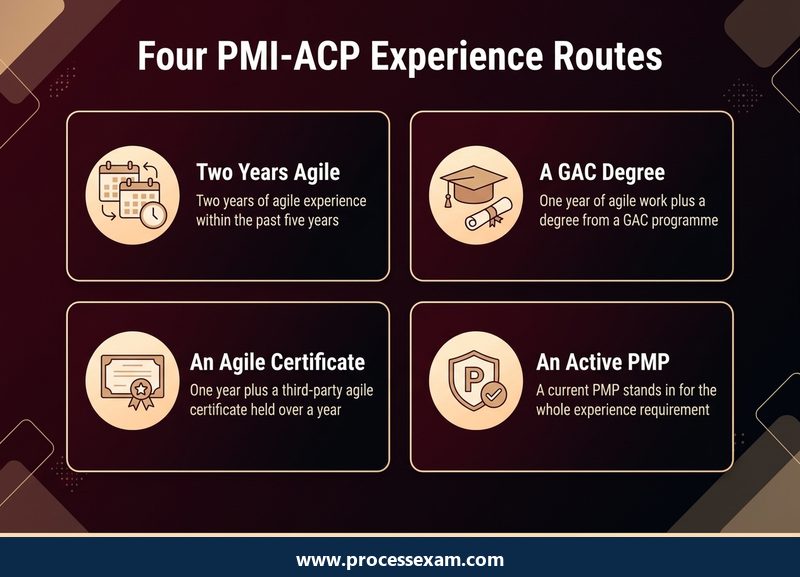
Agile experience. Four routes, and you need only one of them:
- Two years on agile work, anywhere inside the last five.
- One year on agile work, if your degree came from a PMI Global Accreditation Center programme.
- One year on agile work, if you also hold a live third-party agile certificate earned more than twelve months ago. PMI counts that certificate as one of the two years, which is why a Scrum or SAFe certificate gathering dust is worth digging out.
- An active PMP, which PMI accepts in place of the experience rule altogether.
There is a further convenience for people who already hold a PMI credential: recent agile and hybrid experience already recorded with PMI is carried into the PMI-ACP application rather than being written out again.
What the application and audit actually involve
You complete the application online, recording your training hours and your experience. Every application is subject to audit and a percentage is selected at random. If yours is picked, PMI asks for copies of your diploma, signatures from the supervisors named in your experience entries, and certificates or letters from each training provider. You have 90 days to send the documents and PMI takes roughly five to seven business days to process them. Your one-year eligibility period starts the day the audit clears – not the day you applied.
Two practical consequences. First, gather the evidence before you start typing: chasing a former manager for a signature is the step that quietly costs a month. Second, do not walk away from an audit. Failing to comply means failing the audit, and that carries a one-year suspension before you can reapply. The full policy sits in the PMI Certification Handbook, which is worth ten minutes of your time before you press submit.
Fees are payable once the application is approved: Member Price: USD $435 / Full Price: USD $495. PMI's own PMI-ACP page is the place to confirm the current figure and the membership arithmetic for your region before you pay.
How do you pace 120 questions across 180 minutes?
The arithmetic is simple and unforgiving: 120 questions in 180 minutes is an average of ninety seconds each. Scenario questions take longer than that, so the time has to come from the short ones.
Two structural details shape how you spend it. PMI's outline places a ten-minute break after item 60, offered once you have reviewed your answers for that first section – and once you start the break you cannot go back to those items. The optional tutorial at the start and the survey at the end sit outside the three hours, so they do not eat into your time but they do add to how long you are in the chair.
That gives you a workable shape for the sitting:
- Items 1–60. Aim to reach item 60 with about ten minutes of the first half still in hand. Flag anything that has taken more than two minutes and move on.
- Review, then break. Use that reserve on your flagged items, because the door closes behind you. Then take the break, even if you feel fine; the second half is where concentration slips.
- Items 61–120. Same rhythm, same flagging discipline, and keep a final reserve for the questions you deferred.
Technique matters as much as the clock. With a long scenario, jump to the question itself before you work through the set-up; you then read the detail already knowing what it has to settle. Discard options that put the practitioner in charge of a decision the team should own; PMI's tasks are written around empowering, coaching and facilitating, and an answer that escalates or directs is usually the distractor. Where two options both sound sensible, pick the one that shortens a feedback loop or makes something visible – that is the behaviour the outline rewards most often.
What should the last fortnight look like, and what happens if you do not pass?
The last two weeks are for consolidation. No new frameworks, no new books.
Fourteen to seven days out
Two full-length timed sittings on questions you have not seen, spaced apart, with a repair session between them aimed only at the tasks your error log names most often. Then build one page of final notes: the four domains and their weightings, the complexity models and when each applies, the flow metrics and what each one conceals, and the three or four tasks you keep getting wrong.
The final week
Sort the logistics early so they are not on your mind. Your identification must be current, government-issued and carry a photograph and signature, and the name on it has to match the name on your scheduling notification exactly. At a test centre you check in thirty minutes before the appointment; arriving late means not sitting the exam. If you are testing online, the system check and the longer check-in need time set aside in advance. You can reschedule or cancel up to 48 hours before the appointment, and a no-show forfeits the fee entirely.
If the result is not the one you wanted
Your score report gives diagnostic information for each domain alongside the overall result, so you will know whether the problem was spread across the exam or concentrated in one domain. Work from that report rather than from memory. You may sit the exam up to three times within your one-year eligibility period; after a third unsuccessful attempt you wait a year from the date of that attempt before reapplying, although you remain free to apply for a different PMI certification in the meantime. If the eligibility year runs out without a pass, the application itself has to be made again.
And once you do pass, the clock starts on maintenance: thirty professional development units every three years keeps the credential active. Most candidates find that the habits this plan builds – a task list, an error log, a page of notes – make that far less of a chore than it sounds.
Frequently Asked Questions
How long does it take to prepare for the PMI-ACP exam?
Most working candidates need six to twelve weeks. Six to eight is realistic if you work on an agile team daily; allow ten to twelve if your background is predictive and you are learning new behaviours rather than revising familiar ones. Your formal training hours must be completed before you apply, which adds time at the front.
What are the PMI-ACP certification requirements?
You need a secondary diploma, 21 hours of formal agile training, and agile experience. The experience rule is met by two years on agile work inside the last five, or by one year alongside either a PMI Global Accreditation Center degree or a third-party agile certificate held over a year, or by an active PMP.
How do I get PMI-ACP certified?
Finish your training hours, record your education, learning and experience in PMI's online application, clear the audit if you are selected, pay the fee, then book the exam with Pearson VUE at a centre or online. Passing 120 questions in 180 minutes earns the credential.
How does the PMI-ACP application audit work?
Every application can be audited and a share are chosen at random. PMI asks for your diploma, supervisor signatures for the experience you recorded and certificates from each training provider. You get 90 days to send them and PMI takes about five to seven business days to process them.
How hard is the PMI-ACP exam?
The difficulty is judgement rather than recall. Questions describe situations and offer more than one defensible answer, and over half the scored items sit in the Mindset and Leadership domains, which test behaviour. Candidates who only memorise agile terminology tend to struggle more than those with real team experience.
- PMI Agile Practitioner Test Questions |
- PMI-ACP Question Bank |
- PMI Agile Practitioner Book |
- Agile Practitioner Certification Cost |
- Agile Practitioner Certification Requirements |
- PMI Agile Practitioner Sample Questions |
- PMI-ACP Exam Questions Download |
- PMI-ACP Test Questions |
- Agile Practitioner PDF |
- Agile Practitioner Simulator |
- Agile Practitioner Mock Exam |
- Specialized


