
PMI-ACP Exam Scenarios: How to Pick the Best Answer
PMI-ACP practice questions are short workplace stories rather than definitions: a team stalls, a stakeholder pushes, a metric drifts, and you choose the response an agile practitioner would make next. Two options usually sound sensible, so reasoning decides the result, not recall. This guide shows what those scenarios look like in each of PMI’s four domains, the habits that pick the best answer, and how to review a miss.
What do PMI-ACP exam questions actually look like?
PMI’s own examination content outline describes the exam as multiple-choice, multiple-response and drag-and-drop-style items, plus items built around exhibits. Of 120 items, 100 are scored and 20 are unscored pretest items placed at random and never labelled. You cannot tell which is which, so every question deserves a full read.
| Detail | PMI-ACP |
|---|---|
| Certification | PMI Agile Certified Practitioner (PMI-ACP) |
| Exam code | PMI-ACP |
| Number of questions | 120 (100 scored, 20 pretest) |
| Duration | 180 minutes |
| Exam fee | Member Price: USD $435 / Full Price: USD $495 |
| Result reported as | Above Target / Target / Below Target / Needs Improvement |
| Reference | Agile Practice Guide |
The ordinary item has a consistent anatomy. A sentence or two sets the scene: a team, a product, a problem. A closing line asks for the best, first or next action, and four options follow. Read the stem for three things before you look at any option: whose problem it is, what stage the work is at, and which qualifier the question uses. “First”, “best”, “next” and “most” each change which option wins, because the same four actions can all be reasonable at different moments.
The outline also says the exam has a break after item 60, once you have reviewed those answers, and that you cannot return to that half afterwards. Practise in two blocks of sixty so that the first half is finished and checked before you leave it, rather than revisited at the end.
How do the four domains shape the questions you will meet?
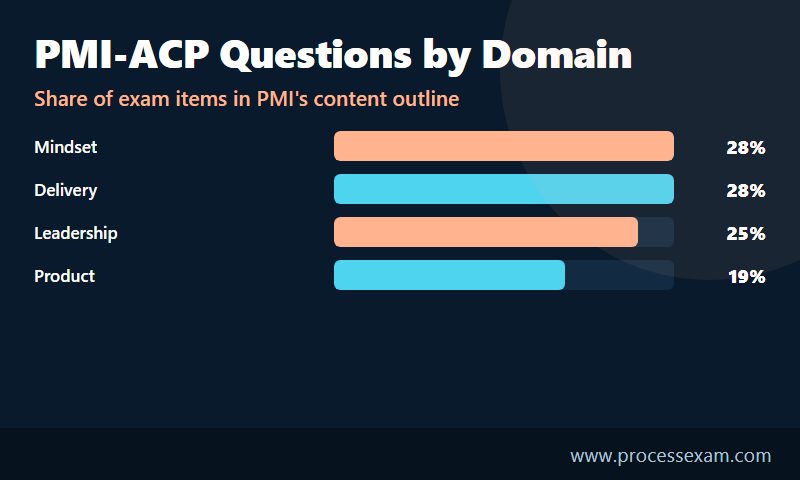
PMI publishes the proportion of items for each domain: Mindset 28%, Leadership 25%, Product 19% and Delivery 28%. Put another way, Mindset and Delivery each take a little over a quarter of the scored items, Leadership a quarter and Product just under a fifth. The share tells you how many questions to expect; the table below tells you what kind of story each domain tends to tell.
| Domain | The story it usually tells | The skill the answer shows |
|---|---|---|
| Mindset | A team resists change, hides problems or copies a ritual without its purpose | Applying agile values to a real situation |
| Leadership | A conflict, a silent team member or a leader who wants to decide everything | Serving and enabling rather than directing |
| Product | An oversized backlog item, a clash of priorities or a vague idea of value | Shaping work so it can be built and judged |
| Delivery | Work piling up, a metric nobody trusts or a risk that is still unowned | Keeping flow, feedback and quality healthy |
Notice that none of these stories asks you to recite a framework. The outline lists tools and techniques such as story points, WIP limits, cumulative flow diagrams, value stream mapping and MoSCoW, but they appear as the means of solving a situation. Knowing the vocabulary lets you recognise what the stem is describing; the question is what you do about it.
It also helps to know how much of the exam is about people rather than technique. Over half of the scored items sit in Mindset or Leadership, and both ask how a practitioner behaves around a team. A candidate who has memorised every metric but defaults to telling the team what to do will find those two domains uncomfortable.
What does a scenario look like in each domain, and how is it solved?
The four scenarios below are written for this article to show the pattern. They are not PMI items, and the reasoning labels are study aids rather than PMI statements. Try to choose before reading the explanation.
Mindset: the retrospective nobody wants
A team of seven has run the same retrospective format for months. Several members now say it changes nothing, because the same complaints return each time, and propose dropping retrospectives to save time. What should the Scrum Master do?
- A. Agree and cancel them, since the team knows best.
- B. Keep them, change the format, and have the team pick one improvement with an owner to try before the next one.
- C. Write the improvement list personally and assign each item.
- D. Ask the sponsor to require attendance.
The best answer is B. The outline names using retrospective findings to improve the team as part of the Mindset domain, and its enablers include shortening feedback loops. Option A confuses “the team decides” with “the team may drop the habit of improving”. Option C takes the decision away from the team, and D uses authority to fix a motivation problem. B changes something small and checks it at the next retrospective, which is the smallest step that produces feedback.
Mindset items also test whether you can classify a situation. The outline names complexity models such as Cynefin and the Stacey Matrix. In a Cynefin reading, unpredictable work calls for probing with a small experiment, sensing the result and responding, while a well-understood task can follow a known practice. If a stem describes an unclear problem and an option proposes a detailed up-front plan, that option is usually the trap.
Leadership: two experts, one disagreement
Two senior developers argue in each daily meeting about a branching approach. The rest of the team stops speaking when they start. As the agile coach, what do you do first?
- A. Ask the senior manager to decide between them.
- B. Ask the team to vote and move on.
- C. Meet both, learn whether the dispute is about the task or about the people, then bring the team together to compare options and agree a trial.
- D. Wait to see whether it settles itself.
The best answer is C. The outline lists identifying the root cause and the level of a conflict, then promoting a collaborative approach to solve it. B looks democratic but skips the root cause and can leave the losing side resentful. A hands the problem upward before the team has tried, and D lets a visible problem grow while others stay silent. The silent team members are also a clue: psychological safety is part of the Mindset domain, and a good Leadership answer repairs it.
Leadership questions often contain a second layer. The stem may be about conflict while the real test is whether you notice the quiet people, or about a struggling team member where the choice is between training, coaching and mentoring. The outline lists that distinction explicitly. Training transfers a skill in a structured way, coaching helps someone find their own answer, and mentoring shares experience from someone who has done the job. Match the response to what the person needs, not to the method you prefer.
Product: the epic that will not fit
The top backlog item is “customer self-service portal”. The team estimates it would take far longer than a sprint, and the stakeholder insists it be started this sprint. What should the product owner do?
- A. Extend the sprint until it is finished.
- B. Split it into thin slices that each deliver something usable, order them with the stakeholder, and size them with the team.
- C. Split it by layer: database this sprint, screens next.
- D. Ask the team to work longer hours.
The best answer is B. The outline’s backlog task asks you to decompose items as needed, prioritise them with the stakeholder and size work collectively. Option C is the classic near miss: it does decompose the item, but each layer delivers nothing a customer can use, so there is no early feedback. A and D protect the plan at the cost of the timebox and the team.
Product scenarios also turn on value. When a stem mentions several stakeholders who each want their item first, the outline’s prioritisation techniques come into play, such as MoSCoW, Kano analysis, the minimum viable product and the minimum marketable feature. The answer is rarely “the loudest stakeholder” or “the one the sponsor named”; it is the option that makes value explicit and lets the stakeholders see the trade-off.
Delivery: the column that keeps filling
A board shows nine items in “In test” while only two testers work, and the time from start to finish has risen for three weeks. A manager asks what to do. Which response is best?
- A. Start more items so developers are never idle.
- B. Set a limit on work in progress for the column, swarm on the oldest items, and watch cycle time and the cumulative flow diagram.
- C. Hire two more testers.
- D. Report individual tester output to the manager every day.
The best answer is B, matching the outline’s tasks to optimise flow, limit work in progress and use metrics to analyse and improve flow. Option A makes the queue longer. C may be reasonable later but is slow and does not address the cause. D measures people instead of the system, and it ignores the outline’s point about choosing metrics that suit their audience.
Delivery stems often hide the answer in a number. Rising cycle time, a flat velocity with growing defects, or a risk list nobody has touched in weeks all point at specific tasks in the outline: optimising flow, recognising and eliminating waste, managing impediments and risk. Ask what the number says about the system, then choose the response that acts on the system.
Which reasoning habits pick the best answer when two look right?
Six habits cover most scenarios. They are a way of reading the options, not a rulebook, and each should be checked against the stem before you rely on it.
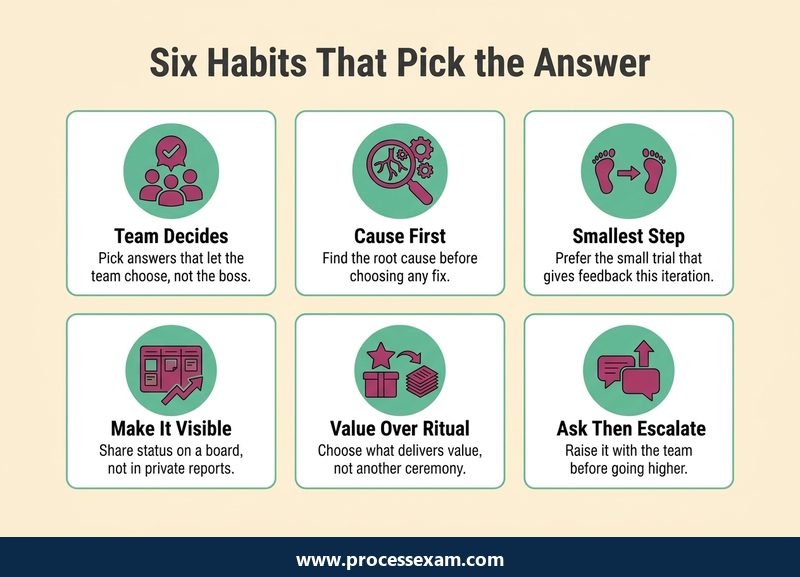
- Team before manager. Prefer the option that lets the team decide and own the outcome over one where a leader decides alone.
- Cause before cure. A response that investigates the root cause beats one that applies a fix to a symptom.
- Smallest useful step. Choose the small experiment that produces feedback this iteration over the large change.
- Make it visible. Boards, radiators and open conversations beat private reports.
- Value over ritual. Pick what delivers value to the customer, not an extra meeting or document.
- Ask, then escalate. Raise the issue with the team first, and take it higher only when the team cannot resolve it.
Five wrong answers you will see again and again
Wrong options tend to be recognisable types. Learning them helps most when you are unsure.
- The hero manager: the leader steps in, decides and assigns. It breaks the first habit.
- The early escalation: go to the sponsor or the steering group before the team has tried anything.
- The added process: a new template, approval or report. Agile answers usually remove friction rather than add it.
- The patient wait: do nothing and see. A visible problem needs a response now, usually a small one.
- The overcorrection: cancel the practice, drop the tool, replace the team. It treats a problem as a reason to abandon the approach.
When two options both avoid those traps, ask which one comes first in time. A scenario that says a conflict has just surfaced wants diagnosis before resolution, and one that says the team has already tried something wants the next step. The qualifier in the stem breaks the tie.
There is one more check worth making: the option that sounds most agile is not always the best one. A stem about a regulated product with a fixed compliance step does not reward “skip the sign-off to move faster”. The outline’s value tasks include compliance, security and privacy among the success criteria, so a good answer respects a real constraint while still keeping feedback short.
How do multiple-response, drag-and-drop and exhibit items change your approach?
Each format has the same reasoning behind it but a different way to lose marks. Practise each one on its own until it is routine.
Multiple response
The stem asks for two or three actions. Judge every option on its own against the stem, not against the others. A common trap is two strong answers that pull in different directions: if the stem asks how to shorten feedback, “demonstrate the increment to the customer this week” and “write a detailed status report for the sponsor” do not belong together. Take the number of correct answers from the stem and choose exactly that many.
Drag and drop
Typical tasks are ordering steps or matching a technique to a situation. For ordering, picture the sequence in a real team: for a rising defect trend you would show the data, find the cause, agree an action and then check whether it worked. Fix the first and last step, then place the middle. For matching, read the situation, name the practice in your own words, and only then look at the list.
Exhibits
An exhibit might be a burn-up chart, a cumulative flow diagram or a task board. Describe the picture in one sentence before reading the question. A burn-up chart whose work-done line climbs steadily while its total-scope line keeps rising tells you the team is not slow; the scope is growing. The best answer then involves showing that chart to the product owner and discussing scope, not pushing the team to go faster.
How should you review a wrong answer so it does not repeat?
Checking the right letter teaches little. What helps is working out how you were fooled, because that pattern will return in different words. Use this routine on every miss, and on correct answers you guessed.
- Restate the story. Before reading the explanation, say in one sentence whose problem it is and what stage the work is at.
- Name the pull. Write why your chosen option looked right. Was it familiar, decisive, polite or technically neat?
- Classify the miss. Use the table below. The point is to record how you missed, not only where.
- Tie it to the outline. Find the outline task the item tests, such as facilitating conflict management or managing impediments and risk.
- Rewrite it. Make up a new scenario that tests the same idea with a different team, product and setting, and answer it a few days later without notes.
| Type of miss | What it looks like | What fixes it |
|---|---|---|
| Vocabulary gap | You did not recognise a term such as risk-based spike or MMF | One-line definition plus a made-up example |
| Qualifier missed | You answered “best” when the stem asked for “first” | Underline the qualifier before reading options |
| Wrong role | You answered as a manager when the stem put you in the coach’s seat | Write your role beside the stem |
| Pattern trap | You chose one of the five wrong-answer types above | Name the type, then spot it next time |
| Real tie | Two answers were both defensible | Compare their order in time and their scope |
After a week, count your misses by type. If most are qualifier slips, another study session on content will not help; slowing the first read will. If most are pattern traps, rehearse the five types. That tally tells you what to change in how you practise, which a score by domain cannot.
A worked review
Suppose you chose option C, the layer split, in the portal scenario above. Restating the story gives: a product owner, an oversized item, a stakeholder pushing, backlog stage. The pull was that splitting by layer felt tidy and technical. The miss type is a pattern trap, close to the added-process family because it improves the plan without improving feedback. The outline task is refining the backlog. The rewrite: a booking app whose “online payments” epic must be sliced for a team of five, where each slice has to let a customer pay for something, however small. A few days later you answer it cold, and the logic should now come first.
How can you tell a useful practice test from a memorised question list?
PMI’s outline itself points candidates to PMI-authorised exam prep, PMI-ACP practice exams, PMI Study Hall and the Agile Practice Guide, and it says quality learning hours should balance subject expertise with practice exams. Whatever source you use, judge it by what it asks of you.
- Scenarios, not definitions. If most items ask what a term means, the set is training recall.
- An explanation for every option. You learn most from why the wrong answers fail.
- Coverage of all four domains in rough proportion to the weightings, and not only Scrum vocabulary.
- Several item formats, including multiple response and ordering.
- Written for the current outline. A set built for the earlier seven-domain exam teaches a different emphasis.
Memorised leaked items have a worse flaw than an ethical one: they build recall of a single wording, and the exam changes the story. A scenario you have never seen can only be solved by reasoning.
To practise the habits above on a full set of scenarios, work through the PMI-ACP practice exam and log each miss with the table in the previous section; you can preview the style first on the PMI-ACP sample questions page.
Read PMI’s page for the credential on pmi.org before booking, because fees, eligibility and delivery details are kept there. The exam is delivered through Pearson VUE, at a test centre or online. The details above were checked against PMI’s outline in November 2026.
What should your practice look like if scenarios are your weak point?
If the scenarios are what trouble you, shift your time from reading to reasoning. A short pass through the Agile Practice Guide and the outline is enough for vocabulary; the rest of the time should go to scenarios and the review routine. A workable rhythm is to answer a block of scenarios, review each miss within a day, and rewrite two or three of them as new stories. By the final week, your miss table should show fewer vocabulary gaps and fewer pattern traps, and your answers should start from the stem’s qualifier instead of the first appealing option.
Practise the two-block structure as well. Sit sixty scenarios, review your flagged answers, then take a real break before the next sixty, because the exam closes the first half once you leave it. If a practice session ends with the same two or three miss types repeating, spend the next day on those types alone rather than opening a new set.
Finally, do not mistake feeling decisive for being correct. Candidates who do well tend to slow down at the qualifier, picture the real team, and choose the quiet, collaborative step over the confident, directive one.
Frequently Asked Questions
What do PMI-ACP exam questions look like?
They are mostly short workplace scenarios that ask for the best, first or next action. PMI describes the exam as multiple-choice, multiple-response and drag-and-drop-style items, plus exhibits. Often two options seem reasonable, so you decide by reasoning about the team, the stage of the work and the agile principles involved.
How many questions are on the PMI-ACP exam and how long is it?
The exam has 120 items in 180 minutes. PMI scores 100 of them and uses the other 20 as unscored pretest items, mixed in at random and never marked. Because you cannot tell which is which, treat every question as one that counts.
How much does the PMI-ACP exam cost?
The fee is USD $435 for PMI members and USD $495 at full price. PMI’s regional pages can show the fee in local currency, so confirm the amount on PMI’s page for your country before you pay. Membership has its own fee, which is separate from the exam price.
How should I review wrong answers in PMI-ACP practice questions?
Restate the scenario, write why your answer looked right, then classify the miss: vocabulary gap, missed qualifier, wrong role, pattern trap or a real tie. Link it to an outline task and rewrite it as a new scenario. Counting misses by type shows how you miss, not only where.
How do I choose the best answer in a PMI-ACP scenario?
Read the qualifier first, such as first, best or next, and note your role. Then prefer answers that let the team decide, find the cause, take a small step, make information visible and deliver value. Be wary of options where a manager decides alone, the problem is escalated early or a new process appears.
- PMI Agile Practitioner Test Questions |
- PMI-ACP Question Bank |
- PMI Agile Practitioner Book |
- Agile Practitioner Certification Cost |
- Agile Practitioner Certification Requirements |
- PMI Agile Practitioner Sample Questions |
- PMI-ACP Exam Questions Download |
- PMI-ACP Test Questions |
- Agile Practitioner PDF |
- Agile Practitioner Simulator |
- Agile Practitioner Mock Exam |
- Specialized


