
PMBOK Guide Editions: What Changed From the 6th to the 8th
Updated on 15 October 2026. What’s new: the pmp exam now follows PMI's July 2026 content outline (People 33%, Process 41%, Business Environment 26%), and the PMBOK Guide is now in its Eighth Edition
The Sixth Edition of the PMBOK Guide is no longer the one to upgrade to: PMI has since published a Seventh Edition (2021) and an Eighth (November 2025), and the PMP exam is now written from PMI's July 2026 Exam Content Outline rather than from any single edition of the guide. What changed from one edition to the next, and what you should actually read for the PMP or the CAPM, is the question this article answers.
What changed between the Sixth, Seventh and Eighth editions of the PMBOK Guide?
Each edition changed the shape of the book, not just its page count. The Sixth Edition was organised by process: ten Knowledge Areas laid across five Process Groups, with inputs, tools and techniques, and outputs listed for each process. The Seventh Edition dropped that frame and rebuilt the guide around principles and performance domains. The Eighth Edition kept the principles-and-domains foundation but trimmed it and brought process guidance back in a less rigid form.
| Edition | Date | Organising idea | What a reader notices |
|---|---|---|---|
| Sixth | 2017 | Ten Knowledge Areas across five Process Groups | Detailed processes with inputs, tools and techniques, and outputs; agile considerations added to every Knowledge Area |
| Seventh | Available 1 August 2021 | Twelve principles and eight performance domains | A section on tailoring and a section on models, methods and artifacts; the process detail moved to a digital companion |
| Eighth | Published November 2025 | Six core principles and seven performance domains | 408 pages; expanded coverage of AI, PMOs and procurement; process guidance returns in a non-prescriptive form |
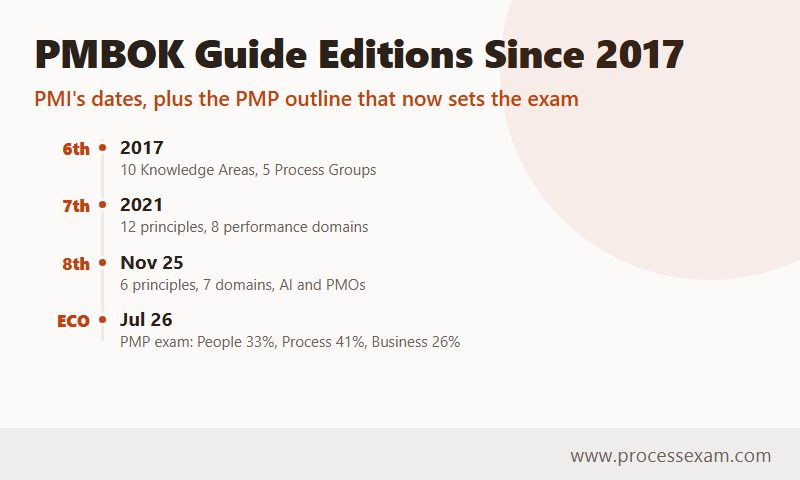
The dates come from PMI itself. Its FAQ for the Seventh Edition gives the August 2021 availability and cites the 2017 version of the Standard for Project Management as the one the new edition replaced, and its PMBOK Guide page lists the Eighth Edition's publication month, page count and a second-printing errata sheet last updated in April 2026. If you are comparing a study book with this table, check the edition printed on its cover before anything else.
The old advice on this page, to read the new Sixth Edition and learn its changes, belonged to its moment. It is worth knowing what that moment looked like, because the changes it describes are still visible in the later editions. The next three sections take the editions one at a time.
Is the Sixth Edition still worth keeping on your shelf?
Yes, as a reference and not as a syllabus. PMI says in its Seventh Edition FAQ that the key learnings and concepts of the Sixth Edition remain valid, even though the updated Standard for Project Management in the Seventh Edition supersedes the earlier version of the standard. It also says that elements of the Sixth Edition, such as the Process Groups, are kept as a valid model going forward, and that the Sixth Edition stopped being sold by PMI after 31 March 2022, though resellers may still hold copies.
What the Sixth Edition introduced
Four changes in that edition explain much of what you still hear in project offices today:
- Two renamed Knowledge Areas. Project Time Management became Project Schedule Management, and Project Human Resource Management became Project Resource Management. The second rename mattered more than it sounds: resources now meant equipment, materials and supplies as well as people.
- New material in every Knowledge Area. Each one gained sections on key concepts, trends and emerging practices, tailoring considerations, and considerations for agile and adaptive environments.
- A fuller treatment of the project manager's role. A section on the project manager's role set out the skills a project manager needs, grouped as technical project management, strategic and business management, and leadership.
- A companion book. PMI published the Sixth Edition alongside its Agile Practice Guide, a signal that the guide was no longer written for predictive projects alone.
The ten Knowledge Areas you will still meet
The ten areas are Integration, Scope, Schedule, Cost, Quality, Resource, Communications, Risk, Procurement and Stakeholder management. Job descriptions, interview questions and corporate templates still use these names. A candidate who has never seen the list will feel lost in a conversation with a colleague who trained in the Sixth Edition era, which is a good reason to learn it even though the newer editions no longer organise the book that way.
Where the Sixth Edition falls short for study
Two things count against it as a study source. It describes a process-driven world and says little about outcomes, value or sustainability, which are now central. And it cannot tell you what the exam looks like today, because the PMP exam was reorganised around three domains, a point taken up below. Read it for the vocabulary and the logic of planning; do not read it hoping to match the current exam.
How did the Seventh Edition swap processes for principles?
PMI described the Seventh Edition as a response to the way work is actually delivered. Its FAQ says practitioners now choose between predictive, adaptive and hybrid approaches, and that the guide was reshaped to serve all three. Three structural moves followed.
Twelve principles instead of a process list
The Standard for Project Management in the Seventh Edition set out twelve principles: stewardship, team, stakeholders, value, systems thinking, leadership, tailoring, quality, complexity, risk, adaptability and resiliency, and change. PMI's own FAQ stresses that these are not agile principles; it calls them universal regardless of approach. They read as statements of behaviour, such as engaging stakeholders proactively or continually evaluating alignment to business objectives, and not as steps. PMI's 12 principles explainer gives a short definition of each.
Eight performance domains instead of ten Knowledge Areas
The guide itself was organised into eight project performance domains: stakeholder, team, development approach and life cycle, planning, project work, delivery, measurement and uncertainty. The domains overlap and run in parallel; none of them is a phase. PMI notes that the concepts from the Knowledge Areas can be seen across several domains, so a topic like risk no longer has a single chapter and shows up in uncertainty, planning and delivery.
Tailoring, models and a digital companion
The edition added a full section on tailoring and a section titled Models, Methods and Artifacts, which lists tools by name without prescribing when to use them. The detailed inputs, tools and techniques, and outputs were no longer printed in full; PMI says they are referenced throughout and are made available through its PMIstandards+ digital offering. The Process Groups became one of the models in the Models, Methods and Artifacts section.
The effect on a reader is real. Someone who learned the Sixth Edition by memorising the process table found nothing to memorise in the Seventh. Someone who learned to think in terms of delivering value found the Seventh a better fit.
What does the Eighth Edition add, and do processes come back?
PMI's PMBOK Guide page, read in October 2026, describes the Eighth Edition as the most data-driven and community-informed update in the guide's history, drawing on thousands of project professionals and more than 48,000 data points. It says the edition retains the principles-and-domains foundation of the Seventh but simplifies and clarifies it.
| Part of the guide | Eighth Edition (PMI's description) |
|---|---|
| Core principles | Six: a holistic view, a focus on value, embedded quality, accountable leadership, integrated sustainability and empowered teams |
| Performance domains | Seven: governance, scope, schedule, finance, stakeholders, resources and risk |
| New or expanded topics | AI, PMOs and procurement |
| Process guidance | Reintroduced, but presented in an evolved, non-prescriptive way |
| Access | A free PDF for PMI members |
Two shifts stand out when you read the domain list against the Seventh Edition's. First, the domains name familiar management areas again: scope, schedule, finance and risk are back as headings. A project manager who has used Knowledge Area language all along will recognise more of the Eighth Edition than of the Seventh. Second, the principle count fell from twelve to six, and sustainability and accountable leadership moved to the front of the list.
The Eighth Edition does not undo the Seventh's thinking. It keeps tailoring and value delivery at the centre and adds the practical detail that readers of the Seventh said they missed. For a working project manager, it is the edition to skim first to see how PMI currently describes the profession.
Does the PMP exam test the PMBOK Guide edition you read?
No edition is the exam. PMI's Exam Content Outline for the July 2026 PMP says in plain words that there are noticeable differences between the outline and the PMBOK Guide. It explains that the exam's task force was asked to outline the critical job tasks of people who lead and direct projects, and that candidates apply project management concepts and their own experience to on-the-job situations through scenario-based questions. The guide, it says, supplies core knowledge; the exam assesses your ability to think critically and apply it.
That matters for how you spend study time. The outline sets the content, and the guide is one source of vocabulary and method. The July 2026 outline weights the exam across three domains:
| Domain | Share of the exam |
|---|---|
| People | 33% |
| Process | 41% |
| Business Environment | 26% |
PMI's PMP certification page and its page on the updated exam describe what moved. The Business Environment share rose from 8% to 26%, People fell from 42% to 33% and Process fell from 50% to 41%. PMI lists AI, sustainability and stakeholder engagement among the additions, and a shift of focus toward outcomes, value and business impact. Those themes line up closely with the Eighth Edition's language, which is a reason to read the Eighth Edition for context, but PMI also says that candidates already studying older materials should keep going because the core principles and approaches of the exam remain the same.
PMP facts to hold alongside the editions
| PMP exam detail | Value |
|---|---|
| Certification | PMI Project Management Professional (PMP) |
| Exam code | PMP |
| Vendor | PMI |
| Number of questions | 180 |
| Duration | 240 minutes |
| Exam fee | Member Price: USD $425; Full Price: USD $675 |
| Result reported as | Above Target / Target / Below Target / Needs Improvement |
PMI's exam-day notes add that the sitting includes two ten-minute breaks, that you can test in person at a Pearson VUE centre or securely online, and that you may take the exam up to three times in one year. For the full list of topics beneath the three domains, the PMP exam syllabus page sets them out task by task.
What should a PMP or CAPM candidate read today, and in what order?
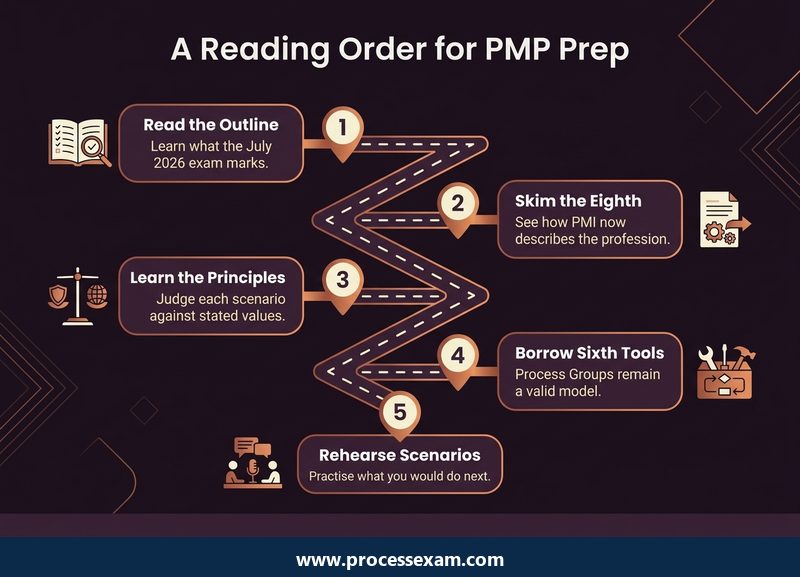
Start with the outline, because it defines what is marked. Then read the guide for context, and finish with practice in the style of the exam. A sequence that works for most candidates:
- The July 2026 Exam Content Outline. Read the three domains and their tasks once through, and mark the tasks you have never done at work.
- The Eighth Edition, skimmed. Read the six principles and seven performance domains, and the sections on tailoring and AI. Treat it as PMI's current account of the profession.
- The Seventh Edition's principles. The twelve principles are a short read and train the habit of judging a situation against stated values, which is what scenario questions reward.
- Sixth Edition process knowledge, as needed. If a question or a colleague uses the Process Groups or a Knowledge Area name, the Sixth Edition is where that vocabulary is laid out in full.
- Scenario practice. Because the exam is scenario-based, spend your last weeks on questions that ask what you would do next, and review every wrong answer for the reasoning behind it.
When you are ready to test that reading order against questions, the PMP practice exam covers the three July 2026 domains in scenario form.
Does the CAPM follow the same pattern?
The CAPM is the entry credential, and PMI's page lists it at 150 questions in 180 minutes. Its exam fee is Member Price USD $225 and Full Price USD $300. Check the content outline attached to your own application for the references it names, since the edition a CAPM reference list points to is something to confirm on PMI's site before you buy a book. One link between the two credentials is stated on PMI's PMP page: an active CAPM certification also fulfils the PMP training requirement.
PMP eligibility, in brief
PMI's page asks for one of these combinations of education and project-management experience: a high-school diploma with five years, an associate degree or vocational diploma with four years, a bachelor's degree with three years, or a bachelor's or postgraduate degree from a PMI Global Accreditation Center programme with two years. It counts experience from the last ten years and expects 35 hours of project professional training. From 1 December 2026, live instructor-led classes count only if delivered by a PMI Authorized Training Partner, a China Registered Education Provider or an eligible accredited higher education programme. Online, on-demand courses from any organisation still count as before.
Which old advice about upgrading to a new edition no longer applies?
Three pieces of Sixth Edition era advice have aged badly, and each is worth replacing with a current habit.
"The exam follows the newest edition"
It seemed to once: when the Sixth Edition arrived, the PMP changed and candidates credited the book. The July 2026 outline gives a better rule: the exam follows its own outline. The exam changed in July 2026 and the Eighth Edition arrived eight months earlier, so the two are linked in theme but not in structure.
"Memorise the process table"
Memorising inputs, tools and outputs was a Sixth Edition tactic. PMI's own FAQ says the Seventh Edition no longer prints them in full, and the Eighth Edition returns to process guidance only in a non-prescriptive way. Understand what each process is for; do not rely on reciting lists.
"Take any training course, it all counts"
The training rule is tightening. From 1 December 2026, a live class must come from one of the providers PMI names. Search PMI's directory before you pay for one, or choose an online, on-demand course.
How can you keep up when PMI revises the guide again?
The gap between the Sixth and Eighth editions was about eight years, and the Eighth followed the Seventh by about four. Another revision will come, so build a habit instead of chasing each one.
- Date-check every source. Before using a book, video course or question bank, find the edition or outline it was written for. Material that mentions only the Sixth Edition is a vocabulary resource now.
- Follow the outline, not the book. Download the current Exam Content Outline from PMI's PMP page before every study cycle, since that is the document that defines the paper.
- Read errata. PMI publishes printings and errata for the guide, and the Eighth Edition's sheet was last updated in April 2026. A printed copy from an early printing may differ from the current text.
- Use renewal as a learning loop. A PMP holder needs 60 professional development units in each three-year cycle, and each unit is an hour of learning, teaching, presenting, reading, volunteering or content creating. Reading about the latest edition counts as the kind of activity PMI describes.
- Tailor what you learn to the project you run. The common thread of all three editions is that no single method suits every project. The Sixth Edition added tailoring considerations, the Seventh made tailoring a principle, and the Eighth keeps it at the centre.
That thread is also the best answer to the question in this article's old title. You do not upgrade yourself to an edition. You learn how PMI describes good practice, test it against your own projects, and read the outline that governs the exam you are about to take.
Frequently Asked Questions
Which edition of the PMBOK Guide is current?
PMI's PMBOK Guide page lists the Eighth Edition, published in November 2025, as the current edition. It has 408 pages, six core principles and seven performance domains, and a second-printing errata sheet last updated in April 2026. The Seventh Edition arrived in 2021 and the Sixth in 2017.
Is the PMBOK Guide Sixth Edition still valid?
PMI says the key learnings and concepts of the Sixth Edition remain valid, and that elements such as the Process Groups continue as a valid model. The Standard for Project Management in the Seventh Edition supersedes the earlier version, and PMI stopped selling the Sixth Edition after 31 March 2022.
Does the PMP exam follow the PMBOK Guide?
Not directly. PMI's July 2026 Exam Content Outline says there are noticeable differences between the outline and the PMBOK Guide. The exam tests how you apply project management concepts and your own experience to scenario-based questions, so the outline sets the content and the guide is supporting reading.
How many questions and how much time does the PMP exam give?
The PMP exam has 180 questions and runs 240 minutes, with two ten-minute breaks. PMI lets you test in person at a Pearson VUE centre or securely online, and you may take the exam up to three times in one year. Member Price is USD $425 and Full Price is USD $675.
What are the PMP exam domains and their weightings?
The July 2026 PMP exam content outline has three domains: People at 33%, Process at 41% and Business Environment at 26%. PMI's page on the updated exam shows these replaced weightings of 42%, 50% and 8%, and lists AI, sustainability and stakeholder engagement among the additions.
- PMP Certification |
- PMI Project Management Exam Questions |
- PMI Project Management Question Bank |
- PMI Project Management Questions |
- PMI Project Management Study Guide |
- PMI PMP Quiz |
- PMP Questions |
- PMP Practice Test |
- PMP Study Guide Material |
- PMP Sample Exam |
- Project Management Certification |
- PMI Project Management Book |
- Project Management Certification Cost |
- Project Management Certification Requirements |
- PMI Project Management Sample Questions |
- PMP Exam Questions Download |
- PMP Test Questions |
- Project Management PDF |
- PMI Project Management Professional


