
PHR vs SPHR: Let Your Job Description Decide
Updated on 21 September 2026. What’s new: updated for HRCI's 2024 PHR and SPHR content outlines, with current fees, question counts and testing times.
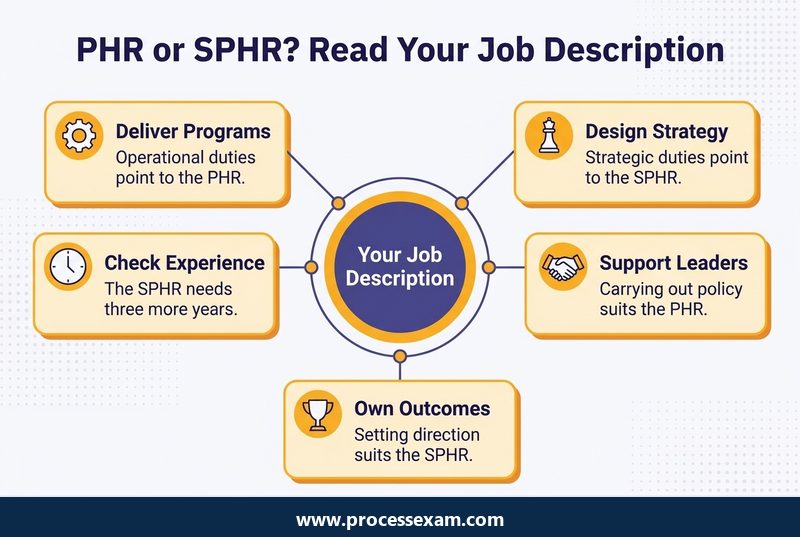
Put the job description for your current role, or the one you are chasing, on the desk in front of you and read only the verbs. If they are mostly implement, administer, support and process, the PHR is the credential that matches your work. If they are mostly design, develop, evaluate and lead, it is the SPHR. HRCI built its two flagship credentials on exactly that split, then stacked different experience thresholds, content outlines and renewal rules on top of it.

That is the short answer to the PHR vs SPHR question, and it holds for most readers. The rest of this article shows the evidence behind it and the cases where it needs a second look. It covers how HRCI's own outlines use those verbs, how the two exams compare on paper, the eligibility thresholds that keep them apart, where the content outlines overlap and where they part company, who should skip the PHR altogether, and the signs that it is time to book.
One thing this article does not try to do is sell you the bigger credential. The SPHR is not a better PHR. It is a different measurement, aimed at a different job, and a candidate who picks it for the letters rather than the work usually finds that out in the exam room.
What does your job description say about PHR vs SPHR?
HRCI describes the Professional in Human Resources (PHR) as designed for HR professionals "focused on implementing programs and supporting day-to-day operations", validating "technical and operational HR knowledge, including U.S. laws and regulations". It describes the Senior Professional in Human Resources (SPHR) as designed for leaders "who shape HR strategy and policy, align people practices with business goals, and guide organizational direction in the United States". Both descriptions sit on HRCI's own PHR certification page and SPHR certification page.
Those two sentences are tidy, but a job description is where they become useful, because a job description is written in the same grammar as an exam content outline. Both are lists of responsibilities. Both begin every line with a verb. And the verb tells you what level the line is pitched at.
Reading the verbs in HRCI's two outlines
We counted the opening verbs in the current exam content outlines for both credentials, the versions HRCI says took effect in 2024. The PHR outline lists 27 responsibilities across its seven functional areas. The SPHR outline lists 33 across five. The difference in vocabulary is striking once it is laid out:
- Design, develop or create opens 17 of the 33 SPHR responsibilities and none of the 27 PHR responsibilities.
- Evaluate appears in the opening verbs of 14 SPHR responsibilities and only one PHR responsibility.
- Support opens or sits in the opening verbs of five PHR responsibilities and none of the SPHR ones.
- Understand opens four PHR responsibilities and none of the SPHR ones.
- Implement appears on both sides, in four PHR and four SPHR responsibilities, but on the SPHR side it almost always shares the line with design, lead or evaluate.
In plain terms, the PHR outline is written for the person who makes a programme work once someone has decided it should exist. The SPHR outline is written for the person who decides it should exist, shapes it, and then judges whether it worked. Neither is more important to an organisation. They are simply different jobs, and HRCI examines them separately for that reason.
Running the same audit on your own role
You can apply the same test to your own job description in about ten minutes. Take two highlighters. Mark every line that starts with a delivery verb (implement, administer, process, maintain, support, coordinate, communicate, comply) in one colour. Mark every line that starts with an ownership verb (design, develop, create, evaluate, forecast, align, lead, advise) in the other. Then count.
A job description where delivery verbs outnumber ownership verbs by two to one or more is a PHR job, whatever the title on it. One where ownership verbs dominate is an SPHR job. A near-even split usually means a role in transition, and the right exam is the one that describes where the role will be in the next year or two, not where it was when the description was written.
To see how this works in practice, compare two lines you might find in real job descriptions. "Administer the annual open-enrolment process and resolve employee benefit queries" is a delivery line: the benefits strategy already exists and your job is to make it run. "Develop a benefits strategy that supports retention of critical roles within the approved budget" is an ownership line: nobody has decided what the strategy is yet, and the decision is yours. Each is a line from a very different candidate, and the two exams are written for those two candidates.
When the job description and the job disagree
Job descriptions age badly. Many were written for the person who held the role three hires ago, and plenty of HR professionals quietly do more, or less, than the document says. If your description no longer fits, run the same count on something more honest: your calendar or your sent emails from the last three months. What did people bring to you? Requests to carry out a plan, or requests to decide what the plan should be?
Title is the least reliable signal of all. An HR Manager who is the only HR person in a 60-person business may be writing every policy the organisation has, which is SPHR work. An HR Business Partner inside a large group may spend the year rolling out programmes designed at headquarters, which is PHR work. HRCI does not look at your title when it decides which exam you are eligible for, and you should not look at it either when you decide which exam to take.
How do the PHR and SPHR exams compare on paper?
Once you know which credential your work points to, the practical differences are easy to set side by side. These are the figures for both exams in one place.
| Exam detail | PHR | SPHR |
|---|---|---|
| Certification | HRCI Professional in Human Resources (PHR) | HRCI Senior Professional in Human Resources (SPHR) |
| Vendor | HRCI | HRCI |
| Exam code | PHR | SPHR |
| HRCI category | Professional Certification | Strategic Certification |
| Number of questions | 115 | 140 |
| Duration | 120 Minutes plus 30 minutes administration time | 150 Minutes plus 30 minutes administration time |
| Exam fee | Exam Fee: $395 Application Fee: $100 |
Exam Fee: $495 Application Fee: $100 |
| Passing score | 500 (on a scale of 100-700) | 500 (on a scale of 100-700) |
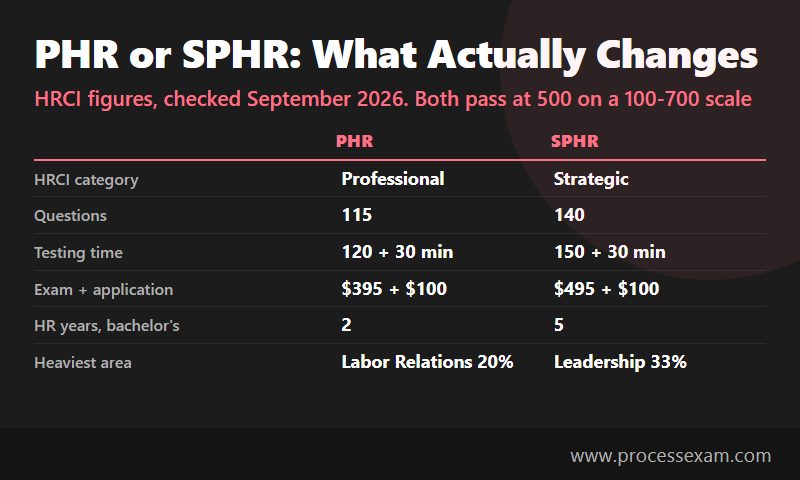
HRCI's certification pages add a detail that explains most of the gap in question count. The PHR is made up of 90 scored questions plus 25 pretest questions, and the SPHR of 115 scored questions plus 25 pretest questions. Pretest questions are new items HRCI is trialling; they are scattered through the exam, look like every other question, and do not count toward your result. So both exams carry the same 25 uncounted items, and the SPHR adds 25 more scored questions and 30 more minutes on the clock.
The same 500 is not the same bar
Both credentials report a scaled score, and both set the pass at 500. That makes the two exams look equally demanding, and it is the most common misreading of the comparison. HRCI sets each cut score with the modified Angoff method: a panel of subject-matter experts rates every question by how likely a "minimally competent candidate" for that credential is to get it right. The minimally competent PHR candidate and the minimally competent SPHR candidate are different people, so the 500 on each exam stands for a different standard, even though the number is identical.
Question formats you will meet on both
HRCI's certification handbook lists the same item types across its exams: traditional multiple choice with one correct answer, multiple response items that tell you how many options are correct, fill-in-the-blank, drag-and-drop, and scenarios that present an HR situation followed by a series of questions drawing on several subject areas. Every question is classified at one of three cognitive levels: knowledge and comprehension, application and problem-solving, or synthesis and evaluation.
HRCI does not publish how each exam divides its questions between those levels. But the outlines give a strong hint. An outline full of "evaluate", "design" and "create" is asking for synthesis and evaluation far more often than one full of "support", "understand" and "implement". Expect the SPHR to spend less time on what a law requires and more on which of several defensible plans an organisation should adopt.
Where and how you sit them
You take either exam on a computer through Pearson VUE, sitting it in a test centre or from home under OnVUE supervision. HRCI's exam availability and locations page states that online delivery of the PHR and SPHR is currently available to residents of the United States and Canada; everyone else tests at a centre. Appointments are first come, first served, so a candidate aiming for a specific week should book early.
Which eligibility thresholds separate the PHR from the SPHR?
HRCI sets both credentials on the same three education routes and simply moves the experience requirement up by the same amount on each one. Set side by side, the thresholds look like this.
| Highest education | PHR: professional-level HR experience | SPHR: professional-level HR experience | Gap |
|---|---|---|---|
| Master's degree or higher | At least 1 year | At least 4 years | 3 years |
| Bachelor's degree | At least 2 years | At least 5 years | 3 years |
| No degree required | At least 4 years | At least 7 years | 3 years |
The pattern is exact. Whatever your education, the SPHR asks for three more years of professional-level HR experience than the PHR. A degree does not need to be in HR, and HRCI notes that the experience does not need to be current or continuous, although recent experience helps an application.
What "professional-level" means for each credential
The word that matters in both rows is "professional-level", and HRCI defines it on its page on professional-level experience. HRCI counts experience as professional-level when you exercise your own judgement, hold some decision-making authority, do substantial analytical work with data, deal with a wide range of people up to senior staff, and answer personally for the outcome. HRCI says that HR clerks and assistants, managers whose main job sits outside HR, and people who are only planning to move into HR are unlikely to qualify for either exam.
That definition is the same for both credentials, which is worth noticing. HRCI does not demand that SPHR experience be "strategic" in its eligibility rules. It demands three more years of the same professional-level work. The strategic element is tested by the exam itself, not by the application form.
The three-year zone in between
Every HR professional passes through a stretch where they qualify for the PHR but not yet the SPHR. For a bachelor's degree holder, that is the period between two and five years of professional-level experience. In that zone there is no decision to make: the PHR is the only one of the two you can sit. Past it, you are eligible for both, and the verb audit from the first section becomes the deciding factor rather than the calendar.
HRCI audits applications at random, and a selected candidate must document the experience they claimed. So count your years honestly, against HRCI's definition, before you choose. An application that reaches for the SPHR on borderline experience is the one most likely to stall.
How do the PHR and SPHR content outlines differ?
HRCI publishes both outlines in full: the PHR exam content outline and the SPHR exam content outline. Both state that they took effect in 2024. Here are the functional areas and their weightings.
| Functional area | PHR weighting | SPHR weighting |
|---|---|---|
| Business Management | 14% | - |
| Leadership and Strategy | - | 33% |
| Workforce Planning and Talent Acquisition | 14% | 17% |
| Learning and Development | 10% | - |
| Talent Management | - | 23% |
| Total Rewards | 15% | 17% |
| Employee Engagement | 17% | - |
| Employee and Labor Relations | 20% | - |
| HR Information Management | 10% | - |
| HR Information Management, Safety, and Security | - | 10% |
Two readings of that table are worth making. The PHR spreads its weight across seven areas, with no area above 20%. The SPHR concentrates a third of the exam in a single area, Leadership and Strategy, and a further 23% in Talent Management. A PHR candidate can afford a weaker area; an SPHR candidate who is weak on strategy has a third of the exam working against them.
Three areas that share a name but not a level
Workforce Planning and Talent Acquisition, Total Rewards and HR information management appear in both outlines. Candidates who hold the PHR sometimes assume those areas are familiar ground for the SPHR. The responsibilities underneath the shared names say otherwise:
- Talent acquisition. The PHR asks you to "manage the talent acquisition lifecycle", from interviews and offers to background checks and onboarding. The SPHR asks you to "evaluate and forecast organizational needs throughout business cycles to develop or revise workforce plans", including restructuring, divestitures and expansion.
- Benefits. The PHR asks you to "implement benefit programs". The SPHR asks you to "create and evaluate benefit strategies that attract, reward, and retain talent".
- Succession. The PHR asks you to "contribute to succession planning discussions with management" by providing relevant data. The SPHR asks you to "analyze business needs to develop a succession plan for key roles".
- HR technology. The PHR asks you to use and manage HR databases and report from them. The SPHR asks you to "lead, implement, and evaluate HR digitalization initiatives".
The topic is the same in every pair. The question you are expected to answer about it is not. That is why the SPHR cannot be passed by re-reading PHR material more carefully.
What only the PHR outline spends time on
The PHR gives a fifth of its weight to Employee and Labor Relations and another 17% to Employee Engagement, and it names US federal law directly and repeatedly: Title VII, the FLSA, OSHA, workers' compensation, and the laws that apply to union and non-union workplaces. It also covers handling complaints and investigations, interpreting the employee handbook, and supporting corrective action and separations. This is the day-to-day compliance and case work of an HR function, and it is examined at the level of getting it right, first time, under the law in force on the day of your exam.
What only the SPHR outline asks for
Leadership and Strategy is the area with no PHR equivalent. Its twelve responsibilities include contributing to organisational strategy, reading financial statements and budgets alongside KPIs, assessing risks from business continuity to geopolitical change, designing change strategies, influencing stakeholders, and evaluating how US federal law bears on organisational strategy such as expansion or reduction. Talent Management adds leadership development, performance management design, labour strategy, and policies for employees returning from leave or layoffs. If you want to see how our pages break those areas down topic by topic, the SPHR exam outline on our site follows the same five functional areas.
Who should skip the PHR and go straight to the SPHR?
HRCI does not require the PHR as a step toward the SPHR. The two credentials have separate eligibility rules, and a candidate who meets the SPHR thresholds can apply for it directly. So the question is not whether you are allowed to skip the PHR, but whether you should.
You should go straight to the SPHR if
- You meet the SPHR threshold and your job is already an ownership job. If your verb count leans clearly toward design, develop and evaluate, and you have the years, the PHR would certify a level of work you have already moved beyond. It would also commit you to renewing a credential that describes your old job.
- You are the most senior HR person in the organisation. Heads of HR in smaller businesses often reach strategic work faster than the years alone suggest, because there is nobody above them to write the strategy. Once they meet the threshold, the SPHR describes them better.
- You are moving from a senior role outside HR into HR leadership and already have enough professional-level HR experience on record. The SPHR's weighting toward strategy, budgets and change rewards what that background brings.
You should keep the PHR in view if
- You have the years but not the scope. Seven years spent administering payroll or benefits meets the time requirement but not the kind of work the SPHR examines. Years are an entry ticket, not a readiness signal.
- Your working week is dominated by US compliance. Candidates whose daily questions are about what the law requires usually find the PHR's weighting a much closer match to what they already know and do.
- You are between two and five years in, with a bachelor's degree. The choice has already been made for you: only the PHR is open.
And who should skip both for now
If you do not yet have professional-level HR experience, neither exam is available to you, and HRCI points people at that point toward its associate-level credential, the aPHR, which has no experience requirement. And if you practise HR outside the United States, HRCI's international editions, the PHRi and SPHRi, keep the same split between operational and strategic work without the US legal content. The operational-versus-strategic logic in this article applies to them in exactly the same way.
A decision you cannot change later
One practical rule makes it important to settle the choice before you apply rather than after. HRCI's certification handbook states that once an exam is scheduled, changing the exam type is not allowed, and that once an application is approved, no refunds are made if a candidate withdraws. Choosing the wrong exam is therefore not a free mistake. It is a fee.
What do HRCI's own numbers say about how candidates choose?
HRCI publishes annual exam statistics as part of its accreditation with the National Commission for Certifying Agencies. According to HRCI's exam statistics page, between 1 January and 31 December 2025, 4,920 people tested for the PHR and 2,993 for the SPHR. As of 5 January 2026, there were 63,311 PHR holders and 40,672 SPHR holders.
Two things follow from those figures. First, the SPHR is not a niche credential: there are roughly two SPHR holders for every three PHR holders, so it is a mainstream choice among experienced HR professionals, not an elite exception. Second, more people still test for the PHR each year than for the SPHR by a wide margin. That fits the thresholds. Everyone who eventually qualifies for the SPHR spends years qualifying only for the PHR, and many HR careers stay in operational roles by choice, which is a perfectly sound career in its own right.
What the statistics cannot tell you is which exam you should take. A credential held by more people is not a safer choice, and one held by fewer is not a more impressive one. The only number that matters for your decision is the one from your own verb count.
What tells you it is time to book your chosen exam?
HRCI does not run testing windows for these two exams. Its exam fees page, checked in September 2026, says you can apply and test for the PHR and SPHR throughout the year. That removes one kind of deadline and replaces it with another. The handbook states that once HRCI approves your application, your exam eligibility is valid for 180 calendar days, and the exam must be scheduled and taken inside that period. If it lapses, you reapply and pay the fees again. So the real clock starts the day your application is approved, not the day you decide to study.
That makes the order of events matter. Prepare first, and apply once you are close to ready, rather than applying to create a deadline and then discovering the 180 days are not enough.
Three checks before you apply
- The verb check, turned on yourself. Read a scenario question and notice what your first instinct is. If you reach for the steps to implement a solution, you are thinking at PHR level. If you reach for which solution the organisation should adopt, and why the alternatives are worse for the business, you are thinking at SPHR level. On the SPHR, the implementation answer is often a distractor.
- The stamina check. The SPHR's 140 questions in 150 minutes leave little slack for rereading long scenarios. A full-length, timed run tells you whether your reasoning holds up in the second half of the paper, which is where tired candidates start choosing the answer that sounds decisive rather than the one that fits.
- The currency check. HRCI states that candidates are responsible for knowing the employment laws in force on the day of their exam. PHR candidates in particular should check that their materials reflect current federal law, not the law as it stood when a book was printed.
For SPHR candidates, the most useful of those three is the one you run under exam conditions. Working through a timed SPHR practice test before you submit your HRCI application shows you whether strategy questions feel like your own job or like someone else's, while you still have time to change your mind at no cost.
When your score says wait
If practice results show you are consistently strong on workforce planning and total rewards but losing marks on Leadership and Strategy, take that seriously. That area is a third of the SPHR. The fix is rarely more reading; it is more exposure to the decisions themselves: sitting in on budget discussions, drafting an HR plan for a business change, or asking to own the evaluation of a programme rather than its rollout. A few months of that work changes how the questions read.
Does the SPHR carry more weight than the PHR once you hold it?
It carries different weight, and the difference is clearest in what each credential commits you to after you pass.
Both are valid for three years. HRCI says a PHR holder must earn 60 HR recertification credits over that span, or retake the exam. An SPHR holder must also earn 60 credits, but HRCI specifies that 15 of them must be Business credits, with the other 45 in HR. That split is a small detail with a clear message: HRCI expects an SPHR holder to keep learning about the business the HR function serves, not only about HR itself. If you would not enjoy spending part of every renewal cycle on finance, strategy or operations, that is worth knowing before you choose.
In the job market, the two credentials tend to appear against different roles. Advertisements for operational HR roles more often name the PHR, and advertisements for roles that own HR direction more often name the SPHR. Holding the SPHR for a role written around implementation rarely hurts, but it can raise an interviewer's expectations about the strategic examples you will bring. Holding the PHR for a role written around strategy can leave you explaining why your credential describes a different level of work.
Neither credential replaces experience. An interviewer for a strategic HR role will still ask about the workforce plan you built and the programme you stopped because it was not working. The SPHR confirms that you understand how those decisions are made; your examples have to show that you made them. The same is true for the PHR at its level. The credential is strongest when it describes your job accurately, and that brings the decision back to where it started: the verbs on the page in front of you.
Frequently Asked Questions
What do PHR and SPHR stand for?
PHR stands for Professional in Human Resources and SPHR for Senior Professional in Human Resources. Both are awarded by HRCI. HRCI places the PHR in its Professional category, for HR work focused on implementing programmes and operations, and the SPHR in its Strategic category, for HR leaders who shape strategy and policy.
What is the difference between PHR and SPHR?
The PHR tests operational HR work under US law: 115 questions in 120 minutes plus 30 minutes of administration. The SPHR tests strategic HR leadership: 140 questions in 150 minutes plus 30 minutes. The SPHR puts 33% of its weight on Leadership and Strategy, an area the PHR outline does not have.
What are the PHR and SPHR eligibility requirements?
Both need professional-level HR experience. The PHR asks for one year with a master's degree, two with a bachelor's, or four without a degree. The SPHR asks for four, five or seven years on the same three routes, which is three more years whatever your education. The degree need not be in HR.
Do you need the PHR before taking the SPHR?
No. HRCI sets separate eligibility rules for each credential, and the PHR is not a prerequisite for the SPHR. If you meet the SPHR experience threshold, you can apply for it directly. Whether you should depends on whether your HR work is mainly operational or mainly strategic, not on which exam you sat first.
Is the SPHR certification worth it over the PHR?
It is worth it when your work is strategic. The SPHR suits people who design HR plans and policy, and it requires 15 of every 60 recertification credits to be Business credits. For someone whose work is mainly implementation and compliance, the PHR describes the job more accurately and is usually the stronger choice.
- HRCI HR Senior Professional Exam Questions |
- HRCI HR Senior Professional Question Bank |
- HRCI HR Senior Professional Questions |
- HRCI HR Senior Professional Study Guide |
- HRCI SPHR Quiz |
- SPHR Certification |
- SPHR Questions |
- SPHR Practice Test |
- SPHR Study Guide Material |
- SPHR Sample Exam |
- HR Senior Professional Certification |
- HRCI HR Senior Professional Book |
- HR Senior Professional Certification Cost |
- HR Senior Professional Certification Requirements |
- HRCI HR Senior Professional Sample Questions |
- SPHR Exam Questions Download |
- SPHR Test Questions |
- HR Senior Professional PDF |
- HRCI Senior Professional in Human Resources


