
PHR Practice Test: How the PHR Passing Score Works
Updated on 23 September 2026. What’s new: the passing score is corrected, since HRCI reports the PHR as a scaled score of 500 on a 100-700 scale, not as a percentage of questions.
A percentage on a PHR practice test proves less than most candidates assume, because HRCI does not set a percentage pass mark for the exam. Your result comes back as a scaled score somewhere between 100 and 700, and 500 is the line. Once you know that, a practice test stops being a number to chase and becomes what it should always have been: a way of finding which of the seven functional areas can still cost you the attempt.

Can a percentage on a PHR practice test tell you whether you will pass?
Not on its own, and the reason is worth understanding before you sit another timed set. Percentages circulate widely in study groups and on revision sites because they feel concrete, but HRCI has never published one for the PHR. What HRCI publishes is a scale. Its guidance on reading a results report is blunt about it: "The score will fall between a range of 100 and 700, and the passing score is set to 500." No percentage appears anywhere in that sentence, and none appears on the results report a candidate receives.
That matters in a very practical way. Suppose you score 72 per cent on a set of 60 revision questions. Nobody, including HRCI, can convert that into a scaled score, because the conversion depends on the difficulty of the specific exam form you draw on the day, and on the difficulty of the questions you happened to answer in your revision set. Two candidates can answer the same number of questions correctly on two different forms of the PHR and end up with different scaled scores, because one form asked slightly harder questions than the other.
So a percentage from a practice test is a measurement of one thing only: how you did on those questions, that day, under those conditions. It is still useful. It is simply not a prediction, and treating it as one is how candidates end up booking an exam on the strength of an encouraging number and discovering that their weakest functional area was barely sampled by the questions they practised.
| Exam detail | HRCI's figure | What it means when you practise |
|---|---|---|
| Certification | HRCI Professional in Human Resources (PHR) | US-focused HR law and practice, at operational level |
| Exam code | PHR | The code to quote when you book through Pearson VUE |
| Questions | 115 | Build your longest practice sets to this length, not to 50 |
| Testing time | 120 Minutes plus 30 minutes administration time | Roughly one minute per question once you subtract reading time |
| Result reported as | 500 (on a scale of 100-700) | A scaled score, so never set a percentage target |
| Fees | Exam Fee: $395, Application Fee: $100 | Both are payable before you can book a seat |
| Content outline | 2024 PHR Exam Content Outline, seven functional areas | Your practice results should be readable area by area |
Every figure in that table is HRCI's own, checked in September 2026. Keep the table beside you while you revise, because three of those rows quietly shape how a practice session should be run: the question count, the clock, and the fact that the last row of the score column is not a percentage.
Why does HRCI report your PHR result as 500 rather than a percentage?
Because HRCI runs more than one version of the PHR at a time. Each version is built from the same content outline, and each is assembled to the same specification, but no two sets of 115 questions are ever precisely equal in difficulty. If the standard were a fixed count of correct answers, a candidate who drew a marginally harder version would be held to a tougher standard than one who drew an easier version, for no reason other than luck of the draw.
Scaling removes that unfairness. HRCI describes the mechanism plainly: "A scaled score is the result of a transformation applied to the raw score." Your raw score is simply the count of scored questions you answered correctly. The transformation maps that raw count onto the common 100-700 scale, and the mapping is adjusted for the difficulty of the form you sat. A harder form needs slightly fewer correct answers to reach 500; an easier form needs slightly more. The reported number means the same thing either way, which is the entire point. As HRCI puts it, "Pass/did not pass decisions are made based on achieving a scaled score at or above 500 on the entire exam."
The words candidates most often mix up
- Raw score - the number of scored questions you got right. You are never told this figure.
- Scaled score - the transformed number between 100 and 700 that appears on your report.
- Passing score - a fixed 500 on that scale, identical on every version of the PHR.
- Pass rate - the share of candidates who pass. This is a statistic about other people, not a target for you, and it is not something HRCI asks you to plan around.
The last of those causes the most confusion. Search results are full of pass-rate percentages for HR credentials, and it is tempting to read one of them as "the score you need". A pass rate describes an outcome across a population; the pass mark describes the standard you personally have to reach. Only the second one is on your results report, and on the PHR it is always 500.
How many PHR questions do you actually have to get right?
There is no published answer, and any source that gives you one is guessing. What HRCI does tell you is how the 115 questions are made up. Its PHR exam page states that the exam contains 90 scored questions plus 25 pretest questions. The pretest items are candidates for future versions of the exam, they are indistinguishable from the scored ones while you are sitting there, and nothing you do with them affects your result.
Two consequences follow, and both are useful on exam day. The first is arithmetic: your scaled score is built from 90 questions, not 115, so a single awkward item carries a little more weight than the raw total suggests. The second is temperamental. If a question strikes you as bizarre, or as belonging to some corner of HR you have never worked in, there is a real chance it is one of the 25 being trialled. Answer it as best you can, flag it, and let it go. Candidates who spend four minutes wrestling with an item that was never going to count are trading minutes they will need later for nothing at all.
This is also why "how many do I need?" is the wrong question to bring to a practice session. The productive version is "which areas am I losing marks in, and why?" You can answer that one precisely, session after session, and unlike a percentage it converts directly into a revision plan.
Which functional areas does the 2024 PHR exam content outline weight most?
HRCI's 2024 PHR Exam Content Outline sets out seven functional areas and states the share of the exam each one carries. The outline notes that it "took effect in 2024", and it remains the current version as at September 2026. Because the weightings are published, you can work out exactly where your practice effort is worth most.
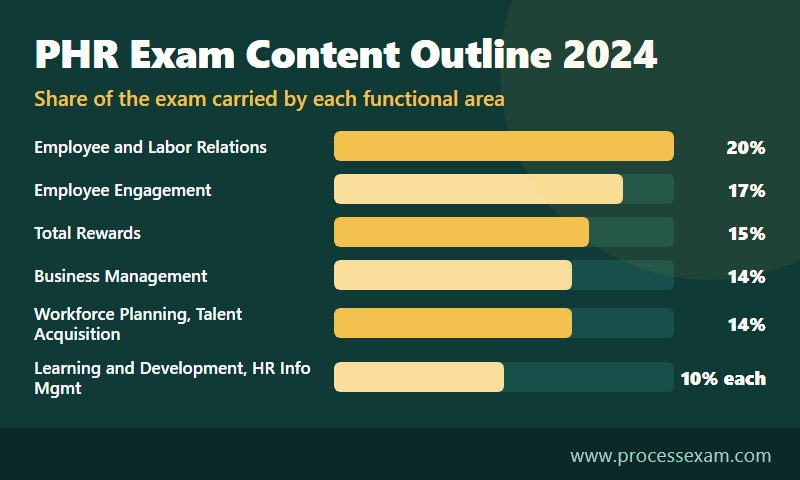
- Employee and Labor Relations (20%) - compliant programmes and policies, workplace investigations, complaints and conflict, health and safety, union and non-union workplaces.
- Employee Engagement (17%) - the employee lifecycle, engagement programmes, performance management, coaching, corrective action and separations.
- Total Rewards (15%) - compensation and payroll, non-monetary rewards, benefit programmes, pay equity and benchmarking.
- Business Management (14%) - the business environment, stakeholders, risk, HR metrics and organisational culture.
- Workforce Planning and Talent Acquisition (14%) - federal law in hiring, sourcing, and the talent acquisition lifecycle through to onboarding.
- Learning and Development (10%) - career development and training programmes, succession data, programme administration.
- HR Information Management (10%) - HRIS content and technology, reporting and analytics, access and data security.
Read those weightings as a guide to where marks live, not as permission to skip anything. The two smallest areas still add up to a fifth of the exam between them, and a candidate who writes off HR Information Management because it is "only 10 per cent" has given away roughly as much as Total Rewards is worth. A more sensible rule is that the heaviest three areas deserve the first pass of your revision and the last pass before exam day, while the lighter four deserve enough attention that no question in them surprises you.
If you want the same breakdown as a topic list rather than a set of percentages, the syllabus page for this exam on our site sets out what sits inside each area, which is easier to revise against than the outline's numbered responsibilities.
What score pattern on a PHR practice test means you are ready?
Since there is no percentage to hit, readiness has to be judged from a pattern rather than a number. Four signals together are far more reliable than any single result, and they are all things you can observe in your own practice history.
Consistency across sessions, not a single high score
One strong result proves you can have a good day. Three or four results clustered closely together, taken on different days and on different question sets, show a stable level of knowledge. A history that swings widely from session to session usually means you are recognising questions you have seen before rather than reasoning from what you know.
No functional area trailing the rest
Break every practice result down by the seven areas. The exam samples all of them, so a candidate who is strong in five and visibly weak in two is carrying an avoidable risk, and the risk is largest when a weak area is one of the heavier ones. Evenness across areas is worth more than a high average.
You can explain the wrong answers, not just the right one
PHR items are frequently written so that two options look defensible and one is correct for a reason rooted in law, policy or sequence. If you can say why the runner-up option fails, your understanding will survive a rewording. If you only recognise the right answer, it may not.
You finish inside the clock with time to review
Finishing 115 questions with ten or fifteen minutes spare, without rushing the last twenty, is a genuine readiness signal. Running out of time in practice almost always gets worse under exam conditions, not better.
When those four line up, book the date. Working through a full-length, timed PHR practice exam on our site is the quickest way to see whether they do, because it reports back by functional area rather than as one bare figure.
How do you run a practice test so it behaves like the real exam?
Most practice sessions are too short, too comfortable and too forgiving to tell you anything about exam day. The fix is not more questions, it is a closer imitation of the conditions HRCI actually imposes.
- Use the real length. Sets of twenty questions test recall. The PHR tests stamina across 115 items, and concentration in the final third is where marks are usually lost.
- Use the real clock. Set 120 minutes and do not stop it. The extra 30 minutes in your appointment is administration time for check-in, the tutorial and the closing survey, so it is not revision time and should not appear in your practice.
- Build a checkpoint habit. Decide in advance where you should be at the halfway mark and glance at the clock only there. Candidates who check the time every few questions lose more minutes to anxiety than to difficult items.
- Flag rather than stall. Give yourself a hard ceiling, around ninety seconds, before you flag an item and move on. Some of what you flag will be pretest material that was never going to count.
- Sit it where you will sit the exam. Candidates using remote proctoring should rehearse at the desk, screen and cleared surface they intend to use on the day. Anyone booked into a test centre should practise somewhere that cannot be paused.
- Record the breakdown before you look at anything else. Write down the seven area results the moment the session ends, while you still remember which questions felt shaky.
Run one session like that a fortnight before the exam and another a few days out. The gap between them is where the real work happens, and what fills that gap should come from the wrong answers rather than from more new material.
What should you do with every PHR question you got wrong?
A wrong answer is the most valuable thing a practice test produces, and most candidates waste it by reading the explanation, nodding, and moving on. Sorting mistakes by cause is what turns a practice result into a revision plan, because each cause needs a different remedy.
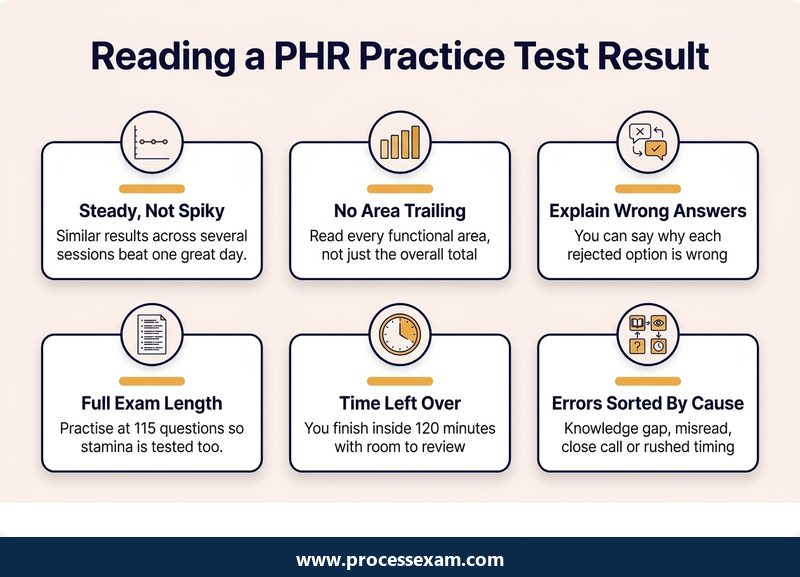
Work through your incorrect items and put each one into a category. A knowledge gap means you did not know the rule, the threshold or the process; that one is fixed by going back to the source material for that functional area. A misread means the knowledge was there but you responded to something the item never asked, usually because a qualifier such as "first", "best" or "except" slipped past you; slowing down on the stem fixes that, more study does not. A close-call loss means you narrowed it to two options and chose the weaker one; that is fixed by writing out why the option you rejected would have been correct in some other scenario. A timing loss means you rushed because the clock was against you, which points back to pacing rather than to content.
Keep a single running list of these, grouped by functional area, and revisit it rather than your notes. After three or four sessions the list stops being a record of errors and starts showing you a shape: a particular area that keeps appearing, or a particular kind of mistake that keeps recurring regardless of area. That shape is the most honest readiness assessment you will get. For a feel for how PHR items are worded before you commit to a full session, HRCI's own materials and our free PHR sample questions both show the question style you will meet.
What happens on results day, and how do you plan a retake?
You do not wait long. Candidates testing at a Pearson VUE centre are given a results report before leaving, and candidates testing under remote proctoring see their outcome in their HRCI account shortly after finishing, with formal confirmation following by email. The report itself is short. It states whether you passed, and if you did not, it shows the range of possible scores, the passing score and your score, alongside a chart of how you performed in each functional area.
That chart is the reason a "did not pass" result is not wasted. It is the same area-by-area view your practice sessions were giving you, produced by the exam itself, and it tells you precisely where the gap was. HRCI's guidance notes that a result below the line will sit somewhere between 100 and 499, so the number also tells you whether you were a little short or a long way off, which is the difference between a few weeks of targeted work and a genuine rebuild of one or two areas.
If you do need a second attempt, treat the area chart as the syllabus for it. Rework the weakest area first, then run a full timed session before you rebook rather than after, so that the decision to sit again is based on evidence and not on impatience. Check HRCI's current retake and application rules on its own site before you pay anything, since application and exam fees are separate and are both charged again.
Keeping the credential once you have it
Passing is not the end of the administration. The PHR is maintained through recertification on a three-year cycle, which is done either by earning recertification credits or by retaking the exam. HRCI publishes the current credit requirements and the categories of activity that count, and it is worth reading them in the month after you pass rather than in the month before your certification expires, because several of the easiest credit categories are things you are probably already doing at work.
Is the PHR worth the preparation this article describes?
For anyone doing operational HR work in a US-regulated environment, the PHR is the credential that most directly matches the job. It certifies that you can apply HR law and organisational policy correctly, which is exactly the judgement employers are buying when they list it on a vacancy. HRCI's eligibility routes reflect that operational focus: one year in a professional-level HR role if you hold a master's degree or higher, two years if your highest qualification is a bachelor's degree, or four years if you hold neither.
What the preparation actually buys you is narrower and more useful than a certificate. Working through the seven functional areas forces you to read the rules you have been applying by habit, and the practice sessions expose the areas where habit has drifted from what the law and the outline say. Most candidates find at least one topic they have been handling confidently and incorrectly for years. That, rather than any number on a scale of 100 to 700, tends to be what colleagues notice in the months after the exam.
Frequently Asked Questions
What is the passing score for the PHR exam?
The PHR passing score is 500 on a scale of 100 to 700. It is a scaled score, not a percentage of questions answered correctly, and it is the same on every version of the exam. HRCI converts your raw score onto that common scale so that all candidates meet an identical standard.
What do you have to score on the PHR to pass?
You need a reported score of at least 500. Because that figure is scaled rather than counted, HRCI does not state how many of the questions you must answer correctly, and the raw number needed varies slightly with the difficulty of the exam version you sit. No percentage target exists.
How many questions are on the PHR exam?
The PHR exam has 115 questions. HRCI states that 90 of them are scored and 25 are pretest questions being trialled for future versions, which do not count towards your result. Testing time is 120 minutes, with a further 30 minutes of administration time in the appointment.
Is the PHR pass rate the same as the passing score?
No. A pass rate is the share of candidates who pass, which says nothing about the standard you personally must meet. The passing score is the standard, and on the PHR it is a scaled 500. Plan against the 500, and treat pass-rate figures quoted elsewhere as background only.
How much does the PHR exam cost?
HRCI charges an exam fee of $395 and an application fee of $100, and both are payable before you can schedule a seat. If you need a second attempt, the fees are charged again, so confirm the current amounts and the retake rules on HRCI's own site before you book.
- HRCI HR Professional Exam Questions |
- HRCI HR Professional Question Bank |
- HRCI HR Professional Questions |
- HRCI HR Professional Study Guide |
- HRCI PHR Quiz |
- PHR Certification |
- PHR Questions |
- PHR Practice Test |
- PHR Study Guide Material |
- PHR Sample Exam |
- HR Professional Certification |
- HRCI HR Professional Book |
- HR Professional Certification Cost |
- HR Professional Certification Requirements |
- HRCI HR Professional Sample Questions |
- PHR Exam Questions Download |
- PHR Test Questions |
- HR Professional PDF |
- HRCI Professional in Human Resources


