
Open Agile Architecture Certification: Cost, Format and Study Plan
Updated on 8 October 2026. What’s new: the exam fee is now listed at USD 375, and the topic list was rebuilt from The Open Group's own learning-unit themes
Yes, the Open Agile Architecture Practitioner certificate is a sensible next step if you design systems, run agile teams or sit between the two. The Open Group's OGAA-001 exam is 40 multiple-choice questions in 60 minutes, you need 28 right (70%), and the fee is $375. Nothing has to be completed first, so the real work is learning a body of ideas that mixes agile practice with architecture thinking.

Is the Open Agile Architecture Practitioner certificate meant for you?
The credential comes from The Open Group, the consortium behind TOGAF and several other architecture standards. Where TOGAF speaks to enterprise architects, the Open Agile Architecture (O-AA) Practitioner certificate speaks to the people who have to keep architecture useful while delivery teams change course every few weeks. The Open Group describes certified people as able to deliver agile architecture in support of digital transformation and to share a common language with both enterprise architects and agilists.
That wording tells you who gets the most from it. It also hints at what the paper is really measuring: whether you can move between two professional vocabularies, explain each to the other side and choose sensible actions when their priorities collide. Candidates who treat it as a glossary test often find the scenarios harder than expected, while those who think in terms of trade-offs between speed and shared structure tend to find the answers more natural.
Roles that fit well
- Solution and enterprise architects who are being asked to justify long design documents to teams that release every sprint.
- Agile coaches and scrum masters who keep hitting the same wall: the platform, the integrations or the security model nobody owns.
- Product and delivery leads who need to explain why some architecture decisions cannot be left to emerge by themselves.
- Consultants working on digital transformation programs, where both vocabularies turn up in the same meeting.
When it is probably the wrong pick
If you want a credential that recruiters search for by name, check the job adverts in your market first. O-AA is a specialist certificate with a smaller audience than TOGAF, so its value depends on whether your employer or clients already talk about agile architecture. If they do, it gives you a shared vocabulary and a vendor-neutral proof that you studied it. If they do not, you may be better served by a broader architecture or agile qualification and by coming back to O-AA later.
What does the OGAA-001 exam look like on the day?
The Open Group's own examination fact sheet is short and worth reading once before you book. The paper is the English version of the Practitioner exam, OGAA-001; a Chinese version carries the reference OGAA-C01. Every item is simple multiple choice with a single point for each correct answer, and the questions test the Level 1 learning outcomes set out in the certification's Conformance Requirements document.
| Detail | Figure |
|---|---|
| Exam name | The Open Group Open Agile Architecture Practitioner |
| Exam code | OGAA-001 |
| Certification awarded | The Open Group Certified Open Agile Architecture Practitioner |
| Product version | Version 1.0 |
| Fee | USD 375 |
| Duration | 60 minutes |
| Number of questions | 40 |
| Passing score | 70% (28 of 40 questions) |
| Question type | Multiple choice, one point per correct answer |
| Prerequisites | None |
| Supervision | Supervised, closed book |
The same fact sheet, published as The Open Group's Open Agile Architecture examination data sheet, says the paper is delivered at authorized test centers and remotely by online proctoring. It also notes that the 60 minutes is the actual time allowed for questions. The booking system may quote a longer slot, because registration, a short tutorial and a survey add roughly another 15 minutes. Candidates taking the English paper who are not native English speakers may be given additional time, so ask the exam provider about it when you book instead of assuming.
Because nothing is open book, there is no reference material to lean on. You carry the terminology in your head, and that shapes how you should revise.
Which topics does the exam cover, and how do they fit together?
The Open Group defines the body of knowledge as a subset of the Open Agile Architecture standard, written up as learning units in the certification's Conformance Requirements document. Its first two units are the characteristics of agile and the role of architecture when deploying agile at scale. The Open Group's course summaries then name these themes: business agility, intentional architecture and continuous product development, the characteristics of an agile organization, the O-AA building blocks, the axioms and the mental model behind agile architecture, digital transformation and digital products, Lean value stream mapping, types of agile architecture, and agile security architecture. A fuller outline is on the OGAA-001 syllabus page.
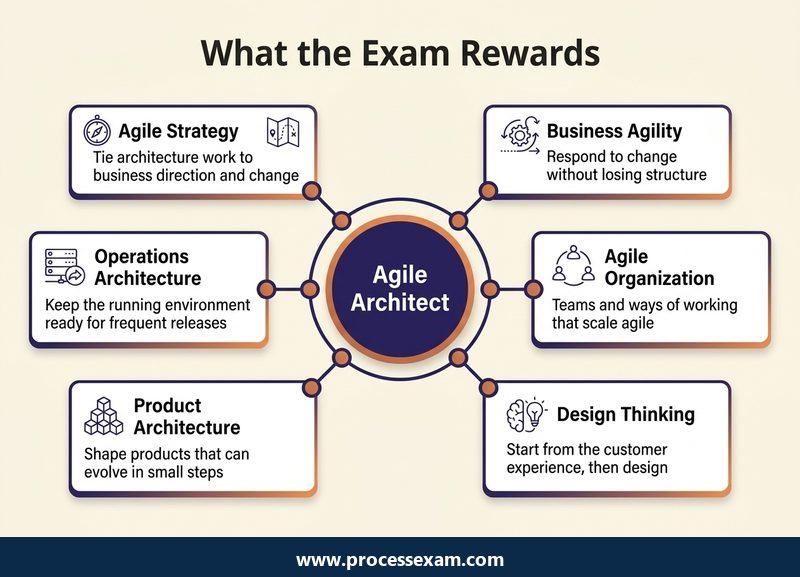
Learning those as a flat list of ten items makes them harder than they are. Group them in three layers instead.
Layer one: why agile needs architecture at all
This is the argument the whole certificate rests on. Teams that deliver in small increments still depend on shared platforms, data, interfaces and security rules. If nobody shapes those on purpose, each team makes locally sensible choices that do not fit together. Expect questions that describe a symptom, such as duplicated services, slow integration or teams blocked by a shared component, and ask which architecture response suits an agile context.
Layer two: how an agile organization works
Business agility, the characteristics of an agile organization and the digital transformation material sit here. They explain what changes around the architect: funding that follows products instead of projects, teams that own outcomes, feedback loops that reach the business. The exam tends to reward candidates who can say what an agile organization does differently and why that affects architecture decisions, rather than those who memorize definitions.
Layer three: the architecture toolbox
Here you find the building blocks, the axioms and the mental model, intentional architecture, the types of agile architecture, Lean value stream mapping and security. This is the most terminology-heavy layer and the one where a closed-book paper bites. Make a one-page glossary of each named term with a sentence on what problem it solves and a sentence on where it goes wrong, and learn to tell similar terms apart.
A useful test for each topic: can you explain it to a product owner in three sentences without the vendor's phrase? If you can, you understand it well enough to recognize it in a differently worded scenario on exam day.
What does it cost to get certified, and is training compulsory?
The listed fee for the exam is $375. That is the exam price; taxes and local pricing may change what you are charged at checkout, so confirm the figure when you book. The Open Group's fact sheet adds that its accredited training courses include the exam in the course fee, with a voucher code to take the exam at the exam provider's public test center. Candidates who prefer to pay the provider directly can do so at booking.
The certification route on The Open Group's Open Agile Architecture certification page asks you to complete the learning units and pass the exam. The Open Group recommends an accredited course before the exam, but states that taking one does not guarantee a pass. The certification has no prerequisite, so you decide whether a course, a self-study pack or your own reading is the better use of time and money.
A quick way to decide between a course and self-study
- Choose a course if your employer is paying, if you have never worked with architecture frameworks, or if you learn better from a trainer than from a standard.
- Choose self-study if you already work in architecture or agile delivery, are comfortable with dense reading, and only need to close gaps on the other half of the subject.
- Mix the two by reading the learning units first and then attending a course for the topics that stay unclear.
Whatever you pick, budget for one thing the fee does not cover: time. The syllabus is conceptual, so understanding takes longer than memorizing a list of commands would.
How do you stretch 60 minutes over 40 questions?
Sixty minutes for forty questions leaves ninety seconds per question. Passing needs 28 correct answers, so you can miss 12. That gap is more generous than it sounds, and it changes how you should sit the paper.
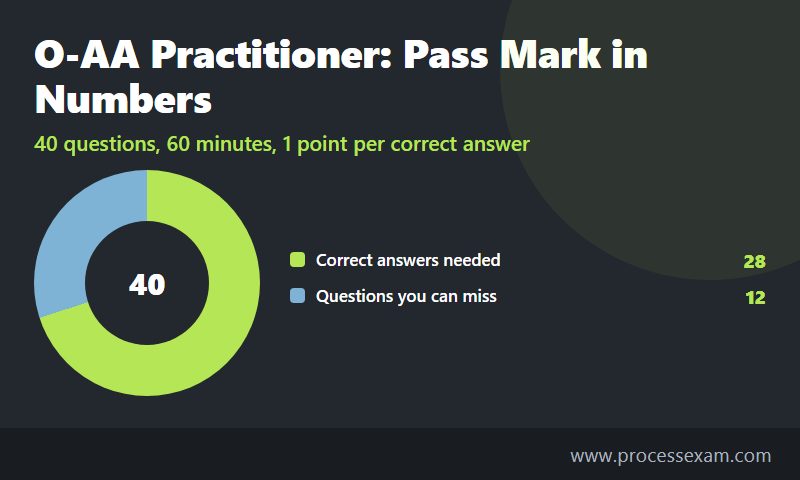
Use the margin on purpose
Because every correct answer carries the same single point, a hard question is worth no more than an easy one. Answer the ones you know quickly and bank the time. If a scenario takes more than about two minutes, pick your best option, mark it and move on. A second pass with ten spare minutes beats one long struggle early in the paper.
Read for the architecture response
Most O-AA questions describe a situation and ask for the best response. Wrong options are rarely absurd; they are answers from the wrong world, such as a heavy upfront design when the scenario calls for intentional, incremental architecture, or a pure team-level fix for a cross-team problem. Ask yourself what the situation is really about, whether delivery pace, shared structure, organization or security, and then pick the option that treats that cause.
Do not read more into the wording than it says
Closed-book multiple-choice papers tempt you to hunt for tricks. Take the question at face value, choose the answer that best matches the Open Group's own terminology, and resist importing practices you have seen at work if they differ from the standard. Your workplace's way of doing things may be good and still not be what the exam expects.
A worked example of the reasoning
The following scenario is invented for practice and is not an exam question. Three product teams share one customer-data service. Each sprint, one team changes the service and another team's release breaks. A process answer would be to add a change-approval board. A structural answer asks who owns the shared interface, how changes are signaled in advance and whether the service is shaped so teams can evolve it independently. In an agile architecture setting, the second kind of answer, a deliberate and light structure that keeps teams unblocked, is usually the better match than a heavier approval gate. Practicing that habit of naming the cause before choosing a remedy is worth more than another page of definitions.
What does a month of revision look like for this topic list?
Most people with a working background in either agile or architecture can cover the learning units in four focused weeks. Treat the plan below as a starting shape, not a promise: if you have never touched one half of the subject, add a week and put it at the front.
Week 1: the argument and the vocabulary
Read the characteristics of agile and the role of architecture at scale. Start your glossary on day one and add every named term as you meet it. Your test for the first week is simple: close the book and explain aloud, without notes, why agile at scale needs deliberate architecture.
Week 2: the organization
Work through business agility, the characteristics of an agile organization and digital transformation. Write a short comparison of how a traditional organization and an agile one handle planning, funding and decisions. Use real examples from your own employer, since they make abstract points stick.
Week 3: the toolbox
Spend the most time here. Cover the building blocks, the axioms, the mental model, intentional architecture and continuous product development, the types of agile architecture, Lean value stream mapping and security. Redraw the relationships between them from memory at the end of each study session, and compare with the source.
Week 4: rehearsal
Switch from reading to testing. Take a full forty-question paper in one sitting with a sixty-minute timer, and review every wrong or guessed answer by finding the passage that settles it. A practice set such as our OGAA-001 practice exam is useful at this point because it lets you rehearse the pacing and see which topic layer you still answer slowly, though it cannot replace reading the standard itself. Aim to be scoring comfortably above 28 out of 40 on fresh questions before you book, since nerves usually shave a few points.
The day before
Do light review of the glossary and stop early. Check your identification and your exam provider's instructions, and if you are testing at home, run the system check on the machine you will use.
Why do agile people and architects each find this paper awkward?
The two audiences fail the paper for opposite reasons, and knowing which group you belong to shows you where to put your hours.
If you come from agile delivery
You already know the ceremonies and the principles, but architecture vocabulary may feel like a different language. Expect to spend longer on the building blocks, the axioms and the types of agile architecture, and to need practice at reading a scenario for its structural problem instead of its team problem. Your natural answer is often a process fix; the exam may want a design or governance response.
If you come from architecture
You are comfortable with frameworks and structure, but the exam is built around agile ideas such as short feedback loops, continuous product development and empowered teams. A natural reflex is to answer with more upfront design, more review gates and more documentation. The certificate asks for the opposite balance: enough architecture, introduced deliberately, that does not stop teams from delivering. Read the agile organization material with care and resist the urge to translate it back into familiar frameworks.
If you come from both
Your risk is complacency. Familiarity with the subject can hide gaps in the exact terms The Open Group uses, so keep the glossary discipline anyway. A question can punish a plausible answer that uses your own organization's word instead of the standard's.
Does the credential expire, and what about the newer Standard 2.0?
The Open Group's badge listing states that the certification does not expire and has no renewal requirement, and that it applies to a specific version of the body of knowledge. So you pay once and hold it, but the certificate describes the knowledge as it stood when you passed.
That version point matters now. The Open Group published Version 2.0 of the Open Agile Architecture Standard in April 2026, and its publications page lists the first edition of the standard as a separate, earlier document. When this article was last checked, in October 2026, the Open Group's certification page and examination fact sheet still listed the Practitioner exam as OGAA-001 with 40 questions, 60 minutes and a 70% pass mark, and the Version 2.0 announcement did not mention certification. In other words, the exam is current and on sale, and nothing published says it has been replaced.
Two practical steps follow:
- Check before you pay. Open the examination fact sheet linked above on the day you book, and confirm that the exam reference and the figures are unchanged.
- Ask your course provider which edition of the standard they teach if you take training, and use the learning units in the Conformance Requirements document as your study boundary, because that document defines what the exam can ask.
If The Open Group later announces a new exam aligned to Version 2.0, expect it to carry a new reference and its own fact sheet. Until then, studying for OGAA-001 with the current learning units is the correct plan. To start this week, pick a sitting date four to six weeks away, read the fact sheet once and download the learning units. Write one glossary heading per named term from the three layers above, fill them in as you read, and book only when a full timed paper leaves you comfortably above the 28-question line.
Frequently Asked Questions
How many questions are on the Open Agile Architecture Practitioner exam?
The OGAA-001 exam has 40 multiple-choice questions and runs for 60 minutes. Each correct answer scores one point, and you need 28 correct answers, which is 70%, to pass. It is supervised and closed book, so no reference material is allowed during the sitting.
How much does the Open Agile Architecture Practitioner exam cost?
The listed fee is USD 375. The Open Group says its accredited training courses include the exam in the course fee, with a voucher for the exam provider's test center. Taxes or local pricing can change the final charge, so confirm the amount when you book.
Are there prerequisites for the Open Agile Architecture Practitioner certification?
No. The Open Group lists no prerequisite, so there is no earlier certification or minimum experience to show before booking. Familiarity with agile delivery and enterprise architecture helps, and an accredited training course is recommended, but neither is compulsory before you sit the OGAA-001 exam.
Does the Open Agile Architecture Practitioner certification expire?
According to The Open Group's badge listing, the certification does not expire and has no renewal requirement. It does apply to a specific version of the body of knowledge, so check whether a newer exam has been announced before you assume your credential covers the latest standard.
How long should I study for the OGAA-001 exam?
Four focused weeks suits most people who already work in either agile delivery or architecture. Add a week if one half of the subject is new to you. Book the exam once timed practice papers leave you clearly above the 28 out of 40 pass mark.
- Open Group Open Agile Architecture Test Questions |
- OGAA-001 Question Bank |
- Agile Architecture |
- Open Group Open Agile Architecture Book |
- Open Agile Architecture Certification Cost |
- Open Agile Architecture Certification Requirements |
- Open Group Open Agile Architecture Sample Questions |
- OGAA-001 Exam Questions Download |
- OGAA-001 Test Questions |
- Open Agile Architecture PDF


