
OMG-OCSMP-MBF200 Certification: Your MBSE Career Boost
Yes, the OMG-OCSMP-MBF200 exam is still worth taking in 2026. OMG continues to run the OCSMP Model Builder Fundamental exam on SysML v1.2, its SysML v2 series offers only a Model User exam so far, and OMG states that existing OCSMP certifications will not be superseded. If your team models in SysML v1 tools today, MBF200 is the credential that proves you can build those models, not just read them.

The question comes up because the modelling world is in the middle of a language change. SysML v2 was adopted as a new generation of the Systems Modeling Language, and OMG has launched a separate v2 certification track for it. Candidates who search for an MBSE certification now find two families side by side and reasonably ask whether the older one is about to disappear. This article answers that first, then covers everything a Model Builder candidate needs: the exam facts, the topic weightings OMG publishes, what each topic really tests, a study plan, the errors that cost marks and what the credential does for your career. Exam version checked on omg.org in September 2026.
Is OCSMP Model Builder Fundamental still worth taking now that SysML v2 has arrived?
For most working engineers, the honest answer is yes, and the reason is practical rather than sentimental. A great many production system models in aerospace, defence, automotive and rail programmes were built in SysML v1 tools, and they will be maintained for years. Teams that inherit those models need people who can extend a block definition diagram without breaking the internal block diagrams that depend on it, who can bind a parametric model to real value properties, and who know which relationship ties a requirement to the design element that satisfies it. That is exactly what the Fundamental exam measures.
OMG's own position supports this. On its SysML v2 certification page, OMG says both series will remain active during the transition and that existing OCSMP certifications will not be superseded. The same page lists the SysMLv2 Model User exam as the only v2 exam available today and describes a SysMLv2 Model Builder Fundamental exam as still in development, with release expected in 2027. So a candidate who wants to prove building skills, rather than reading skills, has no v2 option yet.
When would it make sense to wait?
Waiting is reasonable only in a narrow case: your organisation has already moved its modelling work to a SysML v2 tool, you do not maintain any v1 models, and you have no need to show a building-level credential before 2027. OMG encourages OCSMP holders to add v2 certification as the industry moves, which means the two are complementary. Earning MBF200 now does not block a later v2 exam; it gives you a verified baseline in the concepts that carry over, such as structure, behaviour, requirements and allocation, while the v2 building exam is being written.
What stays the same between SysML v1 and v2?
The notation and the textual syntax change a great deal in v2, but the engineering ideas that the Fundamental exam checks do not. You still decompose a system into parts, connect them through interfaces, describe what the system does over time, capture constraints for analysis and trace every requirement to the design. A candidate who truly understands why a composite association differs from a reference, or why a state machine and an activity describe different kinds of behaviour, will find those ideas waiting in v2 under new names.
Where does MBF200 sit in OMG's systems modelling certification path?
The OMG-Certified Systems Modeling Professional programme has four levels. Model User comes first and checks that you can read and interpret SysML diagrams. Model Builder Fundamental, the subject of this article, is the second step and checks that you can build a sound model with the basic set of SysML constructs. Model Builder Intermediate and Model Builder Advanced follow, each extending the language coverage and the depth of modelling judgement expected.
The order matters because it is enforced. OMG's Model Builder Fundamental exam information sheet lists a passing score on the SysML Model User exam as the prerequisite. You cannot book MBF200 as your first OCSMP exam, so plan the two exams as a pair if you are starting from nothing. Many candidates take them a few weeks apart while the notation is still fresh.
How long does the certification stay valid?
According to the same information sheet, OCSMP certifications expire three years after the exam date. You keep the credential current by passing the same exam or a higher-level one before it lapses. That rule gives MBF200 holders a natural route forward: sitting Intermediate within the three years both renews your standing and raises your level.
Who is this level written for?
The Fundamental level suits systems engineers who have moved beyond reading diagrams and now create them, requirements engineers who own the requirements model, architects who build the logical and physical structure of a product, and verification engineers who need to link test cases to requirements. It also suits software engineers joining an MBSE programme who know UML and want proof that they understand how SysML departs from it.
What should you expect from the MBF200 exam on test day?
The figures below come from ProcessExam's exam record, checked against OMG's information sheet. They are the details most candidates look for first, so it is worth confirming them on the OMG page again just before you book, because fees and delivery rules can change.
| Exam detail | OMG-OCSMP-MBF200 |
|---|---|
| Full name | OMG-Certified Systems Modeling Professional - Model Builder - Fundamental |
| Exam code | OMG-OCSMP-MBF200 |
| Language standard covered | SysML v1.2 |
| Exam fee | USD $350 |
| Duration | 105 minutes for residents of English-speaking countries; 135 minutes for all others |
| Number of questions | 90 |
| Passing score | 60 correct answers of 90 (67%) |
| Format | Multiple choice, with text and images |
| Prerequisite | A passing score on the SysML Model User exam |
| Languages | English and Japanese |
| Delivery | Pearson VUE, at a test centre or online |
| Validity | Three years from the exam date |
How the booking works
Everything runs through a Pearson VUE account: you buy the exam, choose a test centre or an online appointment, and later download your score report there. If you choose the online option, OMG asks you to run the system test on your computer before scheduling, which saves a lot of stress on the day. OMG notes that the extra time for candidates outside English-speaking countries is confirmed by email after you order the exam, so look for that message before you walk in.
Cancellation, retakes and your badge
OMG's sheet says an appointment cancelled through Pearson VUE more than 24 hours ahead is refunded in full; later than that, the fee is forfeited. If the result is a fail, the score report carries a 20% discount code for the retake, so keep that report safe. After a pass, a Credly digital badge arrives within hours, and you can print a certificate as well. Translation apps are not allowed during the exam, so if English is your second language the Japanese version or the longer time allowance may be the better choice.
Which SysML v1.2 topics carry the most marks in the Fundamental exam?
OMG publishes a weighting for every topic, and it is the most useful planning tool you have. Building behaviour and building structure together account for close to half the exam, so an hour spent on activity diagrams returns far more than an hour spent on stereotypes. The chart shows how the questions are shared.
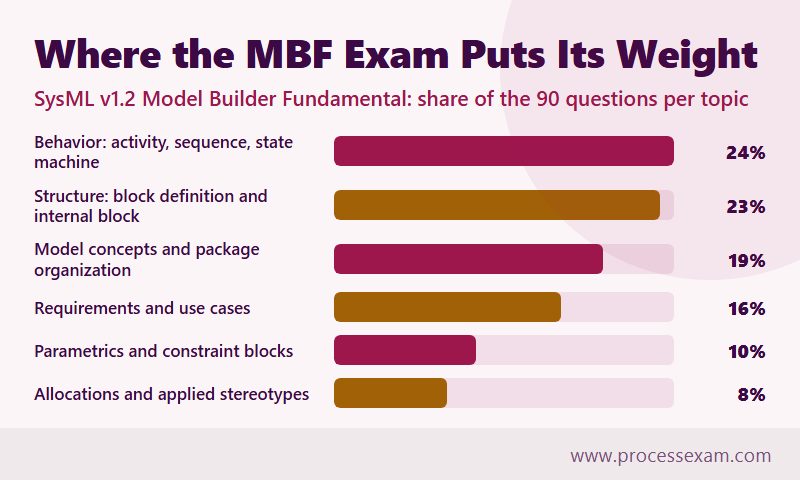
The groupings in the information sheet are Modeling Structure and Behavior (57%), The Model (19%), Modeling Requirements (16%) and Capabilities and Features (8%). Inside them, the individual weights are: behavioural model 24%, structural model 23%, parametric model 10%, model concepts 10%, organising the model 9%, requirements and use cases 16%, allocation relationships 4% and customising a model 4%. Our OCSMP Fundamental syllabus page lists the same topic areas, which makes it handy as a tick list while you study.
Behaviour (24%): activities, sequences and state machines
Three diagram kinds share this weight. On activity diagrams, expect questions on actions, control flow versus object flow, pins, fork and join, decision and merge nodes, and the difference between an activity final node, which ends the whole activity, and a flow final node, which ends only one path. Activity partitions and call behavior actions appear often because they are how you connect behaviour to the parts that perform it. On sequence diagrams, know lifelines, synchronous and asynchronous messages, replies, and the combined fragments alt, opt, loop and par. On state machine diagrams, be fluent with the trigger [guard] / effect syntax of a transition, entry, do and exit behaviours, composite states and the initial and final pseudostates.
Structure (23%): block definition and internal block diagrams
The block definition diagram defines types; the internal block diagram shows how the parts of one block are connected. Most structure errors come from mixing those two views. Know part properties shown by composite association (black diamond), reference properties, value properties typed by value types with units, generalisation, and operations. Because the exam covers SysML v1.2, ports mean standard ports and flow ports with flow specifications, not the full and proxy ports that later versions introduced. On the internal block diagram, know connectors, how item flows travel along them, and why the diagram frame represents the enclosing block.
The model itself (19%): concepts and organisation
This area tests whether you understand that a diagram is only a view into a model. A single block can appear on many diagrams; removing it from one diagram hides it there, while deleting it from the model removes it everywhere. Organisation questions use package diagrams: containment, the model hierarchy, dependencies between packages and package import. A good mental test is to ask, for any element, which package owns it and which diagrams merely show it.
Requirements and use cases (16%)
A requirement in SysML has an identifier and text, and its value comes from the relationships around it. Learn containment, deriveReqt, satisfy, verify, refine, trace and copy, and which direction each arrow points. Know that a test case verifies a requirement, that a design element satisfies it, and that requirements can be shown in tables and matrices as well as on a requirements diagram. The same weight covers use case modelling: actors, the subject boundary, and the include and extend relationships.
Parametrics (10%)
Parametric questions follow a fixed pattern. Constraint blocks are defined on a block definition diagram, with a constraint expression and parameters. Constraint properties that use those blocks then appear on a parametric diagram, where binding connectors attach each parameter to a value property of the system. If you can explain why a binding connector means the two ends are equal, and why it is not an ordinary connector, you will handle most of these questions.
Allocations and stereotypes (8%)
Allocation links elements across the model: a behaviour to the structure that performs it, a logical component to a physical one, or a flow to a connector. Know the allocate relationship, the allocatedFrom and allocatedTo compartments, and allocation through activity partitions. The customising topic is narrow on purpose: you are asked to apply an existing stereotype to an element, not to create profiles or new stereotypes.
What do Model Builder questions actually ask you to do?
Model User questions mostly ask what a diagram means. Model Builder questions ask what you would draw, or which of several fragments is valid. Many show an image and ask you to pick the correct element, relationship or notation. Three worked examples show the style of reasoning the exam rewards; they are written for this article and are not taken from any exam.
Example 1: a drone's battery and its frame
A Drone block owns a Battery that cannot exist in the model without it, and it refers to a charging Dock that exists independently. On the block definition diagram, the Battery should be a part property shown through a composite association, and the Dock a reference property. The trap answer uses composition for both. The builder's question is ownership: if the drone is removed, does this element go with it?
Example 2: a pump that must deliver a flow rate
A requirement says the coolant pump shall deliver a stated flow rate. The Pump block satisfies it, and a test case verifies it. A distractor answer draws a verify relationship from the Pump to the requirement. The rule to remember is simple: design elements satisfy, test cases verify, and a derived requirement relates to its source through deriveReqt.
Example 3: computing range from battery capacity
A Range constraint block holds an expression with parameters for capacity, consumption and range. To make it work on the drone, you add a constraint property typed by Range on a parametric diagram and use binding connectors to tie each parameter to the matching value property of the Drone and Battery. A wrong option uses a plain connector with an item flow. The builder's instinct is to ask whether you are moving something between parts or stating that two values are equal.
How should you plan eight weeks of study for the Fundamental exam?
Eight weeks of steady evening study suits most candidates who have already passed Model User and use a modelling tool at work. If you are newer to modelling, stretch each stage rather than skipping any. The plan follows the weightings, so the heaviest topics get the most time.
- Week one: model versus diagram. Read the first chapters of your main text, set up a free or trial modelling tool, and build a small package structure for a practice system such as a drone or a coffee machine.
- Weeks two and three: structure. Build the block definition diagram, then the internal block diagrams for two blocks. Add value types with units, flow ports and item flows, and check each connector against the part types.
- Weeks four and five: behaviour. Draw one activity, one sequence diagram and one state machine for the same practice system, so you feel how each describes behaviour differently. Put the activity into partitions for your parts.
- Week six: requirements and use cases. Write eight to ten requirements, derive two, connect them with satisfy and verify, and show them in a matrix. Add a use case diagram with include and extend.
- Week seven: parametrics, allocation and stereotypes. Build one constraint block and bind it, allocate activities to parts, and apply a stereotype from the tool's library.
- Week eight: timed practice and review. Answer full-length question sets under the real time limit and go back to the notation for every miss.
Which books does OMG point to?
OMG's information sheet recommends A Practical Guide to SysML, 3rd edition, by Friedenthal, Moore and Steiner, highlighting chapter 3 on getting started and chapter 4, an automobile example that uses the basic feature set. It also lists Weilkiens' Systems Engineering with SysML/UML, Delligatti's SysML Distilled, Perry's SysML for Systems Engineering, the OMG SysML tutorial and the hybrid SUV example model built in SysML v1.2. Read the automobile and hybrid SUV examples closely, because they demonstrate the basic construct set this exam is limited to. For the notation itself, the SysML specification page holds the standard.
How should you use practice questions?
Practice sets are most valuable in the final fortnight, once every topic has been studied. Use them to find the diagram types where you still hesitate and to train your pacing: with the English-speaking time allowance you have a little over a minute per question, and image-based questions take longer to read. When you reach that stage, the OMG-OCSMP-MBF200 mock exam gives you timed sets in the same multiple-choice format to rehearse with.

For each missed question, write down the rule you broke, not just the right option. After two or three sets, that list turns into a short revision sheet of your personal weak spots, which is more useful on the last evening than rereading a whole chapter.
Which mistakes cost Fundamental candidates the most marks?
The errors below come up again and again when engineers move from reading SysML to building it. Each is avoidable with a little deliberate practice.
- Studying a newer SysML version. The exam covers SysML v1.2. Reading only v1.6 material or v2 tutorials leads you to answer with full and proxy ports, or v2 textual syntax, which the exam does not use.
- Treating a diagram as the model. Questions that ask what happens when an element is removed from a diagram, or which diagrams can show a given element, test this directly.
- Drawing every association as composition. Composition means ownership and shared lifetime. Use a reference property when the element exists independently.
- Reversing requirement arrows. Satisfy points from the design element to the requirement, verify from the test case, and deriveReqt from the derived requirement to its source.
- Confusing the two final nodes. An activity final ends every flow in the activity; a flow final ends one path only.
- Using ordinary connectors in parametrics. Parameters are tied to value properties with binding connectors, which state equality.
- Misreading the time allowance. If you qualify for the longer time, make sure the confirmation email has arrived before exam day.
What does the Model Builder Fundamental credential do for an MBSE career?
Model-based systems engineering has moved from pilot projects to the normal way of working on many large programmes, and hiring managers need a quick way to tell a person who has seen SysML from a person who can model with it. The Model User credential answers the first question; Model Builder Fundamental answers the second. That difference is what an employer is checking when a job advert asks for OCSMP at builder level rather than user level.
Roles where it counts
The credential supports roles such as systems engineer, MBSE engineer, systems architect, requirements engineer and verification engineer, especially in aerospace, defence, automotive, rail, medical devices and energy. It is also useful for consultants and tool specialists who train client teams, because it shows they understand the language as well as the tool that implements it.
How it fits with other credentials
Many engineers pair OCSMP with a broader systems engineering certification, or with vendor tool training. OCSMP is tool-neutral: it tests the language, so it transfers between tools. Holding MBF200 also positions you well for the v2 series, since OMG encourages OCSMP holders to add v2 certification as their organisations switch. Details of the whole programme, including exam information sheets for every level, are on OMG's SysML certification page.
A realistic view of the payoff
The certification will not replace project experience, and interviewers will still ask you to talk through a model you built. What it does is make that conversation start from a verified level. For a systems engineer moving into a modelling role, or a team lead who wants every modeller on a programme working to the same standard, a pass at Fundamental level is a clear, affordable signal that stays valid for three years and leads naturally to the next level.
Frequently Asked Questions
How much does the OCSMP Model Builder Fundamental exam cost?
The OMG-OCSMP-MBF200 exam costs USD $350, plus any local taxes, paid through your Pearson VUE account. If you fail, OMG includes a 20% discount code for the retake in your score report. Check OMG's certification page before booking, because fees and discount offers can change.
Do I need to pass the Model User exam before MBF200?
Yes. OMG lists a passing score on the SysML Model User exam as the prerequisite for Model Builder Fundamental, so you cannot book MBF200 as your first OCSMP exam. Many candidates take the two exams a few weeks apart while the SysML notation is still fresh.
How many questions are on MBF200 and what is the passing score?
The exam has 90 multiple-choice questions, some with images, and you need 60 correct answers, which is 67%, to pass. You get 105 minutes if you live in an English-speaking country and 135 minutes elsewhere, with the longer time confirmed by email after ordering.
Is the OCSMP certification being replaced by SysML v2 certification?
No. OMG says both series stay active during the move to SysML v2 and existing OCSMP certifications will not be superseded. The v2 series currently offers a Model User exam, and a v2 Model Builder Fundamental exam is in development with release expected in 2027.
How long is the OCSMP Fundamental certification valid?
OCSMP certifications expire three years after the exam date. You extend them by passing the same exam again or a higher level, such as Model Builder Intermediate, before that date. Passing a higher level both renews your certification and moves you further up the programme.
- SysML Certifications |
- OMG OCSMP Fundamental Test Questions |
- OMG-OCSMP-MBF200 Question Bank |
- SysML MBF Simulator |
- SysML MBF Mock Exam |
- OMG OCSMP Fundamental Book |
- OCSMP Fundamental Certification Cost |
- OCSMP Fundamental Certification Requirements |
- OMG SysML MBF Question Bank |
- OMG SysML MBF Book |
- OMG SysML MBF Study Guide |
- SysML MBF Certification |
- SysML MBF Certification Cost |
- SysML MBF Certification Requirements |
- OMG OCSMP Fundamental Sample Questions |
- OMG-OCSMP-MBF200 Exam Questions Download |
- OMG-OCSMP-MBF200 Test Questions |
- OCSMP Fundamental PDF |
- OMG SysML MBF Exam Questions |
- OMG SysML MBF Sample Questions |
- SysML MBF |
- SysML MBF PDF


