
OMG-OCSMP-MBA400 (OCSMP Advanced): Cost, Syllabus and Pass Mark
Updated on 3 October 2026. What’s new: pass mark corrected to 64 of 90 correct answers (71%), as stated in OMG's current exam information sheet
Most of the OMG-OCSMP-MBA400 exam is not about drawing SysML. OMG gives 35% of the marks to methodology and model quality and 25% to adapting the language with profiles and metamodels. The last 40% asks how SysML meets UML, MARTE, UPDM, Modelica and other engineering tools. You need 64 of 90 answers correct (71%), and the exam costs US$350 plus taxes.
That split is why strong modellers still find the Advanced paper uncomfortable. The lower OCSMP levels centre on building and reading models correctly. This level adds judging how a whole modelling effort is set up, which is the thing OMG says the credential is for. This guide reads OMG's current exam information sheet for the OCSMP Model Builder Advanced exam, area by area, and turns it into a revision plan with the cost, prerequisites and pass line stated plainly. It was checked against OMG's pages in October 2026.
What is the OMG-OCSMP-MBA400 exam really about, if so little of it is diagram drawing?
OMG describes the Model Builder Advanced exam as testing the knowledge needed to establish and support a systems modelling culture and environment, using SysML and model-based systems engineering (MBSE) across an organisation. In plain terms, the question stops being "is this block definition diagram correct?" and becomes "how should this team set up its modelling, and what will break if it does not?"
The exam information sheet splits the paper into four weighted areas. The table also shows roughly how many of the 90 questions each share represents. The counts are our arithmetic from OMG's percentages, so treat them as a guide to effort rather than a promise about any single paper.
| Syllabus area | Share of marks | About how many questions | The skill it tests |
|---|---|---|---|
| Methodology-related concepts and practices, including assessment of model quality | 35% | 32 | Choosing and judging how a modelling project is run |
| Concepts for adapting SysML: metamodeling, profiles, model libraries and viewpoints | 25% | 22 to 23 | Extending the language without breaking it |
| Integrating SysML with other modeling languages: UML, MARTE, UPDM and Modelica | 20% | 18 | Moving models between languages |
| Integrating SysML modeling tools with other tools, and tool selection criteria | 20% | 18 | Connecting the model to the engineering toolchain |
Two things follow from the table. First, the biggest area is the one that cannot be revised from a tool's menu: methodology and quality are judgement topics. Second, the exam is written against SysML v1.2, the same version as the lower OCSMP levels, so the notation you learned for the Intermediate exam still applies. You can read the full list of examined standards and recommended books in OMG's own Model Builder Advanced exam information sheet, and see how our OMG-OCSMP-MBA400 syllabus page breaks the same four areas into topics.
The role OMG has in mind is worth keeping in view while you study. Its description of a Model Builder Advanced holder is someone who leads the establishment of SysML-based MBSE at an enterprise, extends it into new departments or product areas, and defines new projects and supports them through their lifecycle. Almost every question can be read as a small decision that person would make.
What does the OCSMP Advanced exam cost, and what must you hold before you can sit it?
The fee is US$350 plus taxes, with the regional currency equivalent applied at checkout. You book through a Pearson VUE account, either at a secure test centre or online, and OMG asks candidates to run the system test on their own computer before scheduling an online sitting. The Advanced exam also has an entry requirement that the lower exams do not: you must already hold passing scores on the SysML Model User, Model Builder Fundamental and Model Builder Intermediate exams.
| Detail | OMG-OCSMP-MBA400 |
|---|---|
| Full name | OMG-Certified Systems Modeling Professional - Model Builder - Advanced |
| Exam code | OMG-OCSMP-MBA400 |
| Fee | US$350 plus taxes |
| Questions | 90, multiple choice with text and images |
| Time allowed | 105 minutes in native English-speaking countries, 135 minutes in all others |
| Passing score | 64 of 90 correct answers, or 71% |
| Prerequisites | Passing scores on Model User, Model Builder Fundamental and Model Builder Intermediate |
| Language | English only; translation apps are prohibited during the exam |
| Validity | Three years from the exam date |
| Delivery | Pearson VUE, test centre or online |
Booking, extra time and refunds
The extra thirty minutes for candidates outside native English-speaking countries are confirmed by email after the exam order is completed, so do not assume they apply automatically on the day. An exam can be cancelled more than 24 hours before its scheduled time through Pearson VUE for a full refund; after that the exam price is forfeited. Technical problems go to Pearson VUE customer service, and accommodation requests for a learning or physical disability go to OMG at certification@omg.org.
If you do not pass the first time
Your score report carries a 20% discount code for retaking the exam. That softens the cost of a miss, but it is not a reason to treat the first sitting as a rehearsal. Since the three earlier exams are prerequisites, anyone reaching this level has already paid for four sittings in total, and a focused plan costs far less than a second attempt.
What a pass gives you
Within hours of passing, OMG sends a Credly digital credential that you can claim and share, and you can print a certificate. The certification expires three years after the exam date. To extend its validity you take the same exam or a higher-level one. Because Advanced is the top rung of the Model Builder series, in practice that means sitting the exam again or moving to another OMG series.
Is a SysML v1.2 exam still worth sitting now that SysML v2 has been adopted?
Yes, for practitioners whose organisations model in SysML v1 tools, and the evidence is on OMG's own pages. As of October 2026, the exam information sheet for MBA400 is still written against SysML v1.2. OMG's SysML v2 certification page states that the v2 series is independent of and complementary to the existing OCSMP series, that both series will remain active, and that existing OCSMP certifications will not be superseded.
The v2 series is also much shorter so far. OMG lists a SysML v2 Model User exam, priced above the OCSMP exams, and says the v2 Model Builder Fundamental exam is in development with a release anticipated in 2027. No v2 equivalent of the Advanced exam is described. Holders of a valid OCSMP certificate get a discount on the v2 Model User exam, so the two paths can be combined.
What does this mean for your decision? If your employer's tools and models are SysML v1, MBA400 is the only OMG exam that tests the organisation-wide setup topics at this depth. If your team is already moving to v2, the topics that transfer best are the methodology and tooling ones: how to choose a method, how to judge a model's quality, how to integrate with requirements and configuration tools. The profile and metamodel questions are tied closely to v1.2 and UML. For background on how the language itself developed, the SysML overview on Wikipedia is a useful neutral read, and the SysML specification page at OMG lists the versions.
How do you revise the 35% on methodology and model quality?
This is the largest area and the one where candidates who learned SysML only through tools lose the most. OMG describes it as understanding all the steps of a project from start to final design, understanding the aspects of a system development methodology, choosing a methodology, using the Object Constraint Language (OCL) to state formal constraints, and assessing model quality.
Methodology versus process, method and lifecycle
The recommended reading for this area includes a survey of MBSE methodologies by Estefan, and the sheet singles out its chapters that separate a methodology from a process, a method and a lifecycle model. Learn to make that separation in your own words. A process says what activities occur and in what order. A method says how to carry out a particular activity. A lifecycle model says how a system's life is divided into stages. A methodology bundles these with a modelling language and tooling. Questions often hand you a scenario and ask which of these a team is actually missing.
Choosing a methodology
Expect questions that ask you to match a project's situation to a methodology rather than recite one. Build a short comparison for yourself with four columns: what the methodology produces, what it assumes about the team, what it assumes about the tool, and when it is a poor fit. Estefan's survey and the IBM Rational and Hoffmann material on the reading list give you source material for this.
OCL for formal constraints
The sheet points to OCL v2.4, chapter 7 through section 7.3, so the depth needed is the language basics rather than the whole specification. Practise reading and writing small constraints: an invariant on a stereotype, a precondition on an operation, a navigation across an association. A habit that pays off is reading each constraint aloud as a sentence ("for every instance, the mass is greater than zero") before judging whether it is true for the example given.
Assessing the quality of a model
The reading list names several papers on model quality in model-driven engineering, including work by Mohagheghi and Aagedal and by Mohagheghi and Dehlen on existing model metrics. Treat quality as a set of questions you can ask of any model: does it conform to the language, does it follow the chosen method, is it complete for its purpose, is it consistent across views, and can someone else read it. A question that offers four possible "improvements" to a messy model usually has one answer that addresses the stated quality problem and three that merely look tidy.
What do profiles, metamodels, model libraries and viewpoints ask of you in the 25% section?
This area is about extending SysML on purpose. OMG's sheet lists five strands: the rationale for customising the language, metamodel-based extensions, profiles, model libraries and viewpoints.
Why customise at all
Know the motivations as well as the mechanisms. Teams extend SysML to give domain terms a precise meaning, to add properties that tools can check, to share reusable content, or to present the model to stakeholders who do not read diagrams. A scenario question may describe one of these needs and ask which mechanism fits.
Metamodel extension versus profile
Revise the layered view of modelling taught in the reading list, including Clark's chapters on metamodelling and a metamodelling facility, and Seidewitz's paper on what models mean. The trade-off to be able to state: a profile adds stereotypes to existing metaclasses and works inside existing tools, while a full metamodel-based extension gives more freedom but leaves you responsible for tooling and for keeping the extension consistent with the base language. The exam asks about capabilities and limitations, so for each approach prepare one thing it can do and one thing it cannot.
Creating and using a profile
You should be able to describe how a stereotype is defined, which metaclass it extends, what properties it carries, what constraints it imposes and what happens when the profile is applied to a model. Work through one example from start to finish, such as a stereotype for a safety-related block that requires a property for its integrity level.
Model libraries and viewpoints
A model library holds reusable elements, such as shared types, that many models import instead of redefining. Know how you would build one and how a project would consume it. A viewpoint states which stakeholders and concerns a view serves and how that view is built, and a view conforms to its viewpoint. The exam asks you to specify a viewpoint and use it to support model development, so practise writing one for a named stakeholder, for example a test lead who only needs requirements and their verification links.
How do you cover the 40% spent on other modeling languages and engineering tools?
The last two areas, worth 20% each, are about boundaries: where SysML hands over to another language, and where the model hands over to another tool. They are shallow per topic but broad, which makes them well suited to a one-page summary per standard.
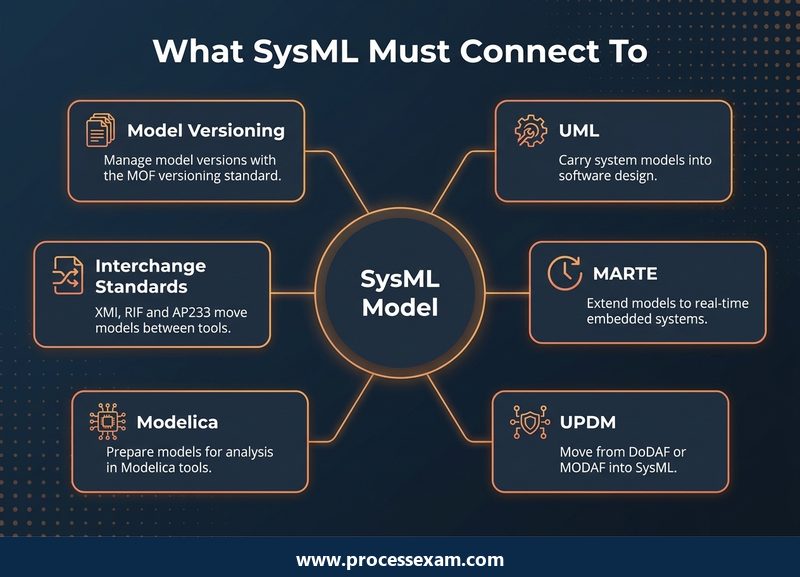
Other languages: UML, MARTE, UPDM and Modelica
- UML. The exam covers integrating SysML and UML models to support the transition from systems design to software design. Know which elements correspond and what is lost or added at the boundary.
- MARTE. This UML profile extends modelling to real-time and embedded hardware and software. The sheet lists only the scope, rationale and approach chapters of MARTE v1.0, so concentrate on what the profile is for and how it is organised.
- UPDM. The unified profile for DoDAF and MODAF, version 2.1.1, comes into the exam through its compliance levels and its philosophy and core principles, with the aim of moving from an enterprise architecture in UPDM into systems architectures in SysML. OMG now has a separate Unified Architecture Framework family of exams, but the MBA400 sheet still names UPDM.
- Modelica. The SysML-Modelica Transformation specification, version 1.0, is examined through its scope, its transformation approach and its examples and justification annexes. The idea to hold on to is preparing a SysML model so that a Modelica-based tool can run the analysis.
Other tools: integration, interchange and selection
The tool area has three parts. The first is integration approaches, meaning how a SysML tool connects to requirements management, software or hardware development and model analysis tools. The second is configuration management, including using the MOF versioning standard for model versions. The third is model interchange: why you would exchange models, what issues to consider, and which mechanisms and standards exist, named in the sheet as XMI, the Requirements Interchange Format and AP233. The sheet lists chapter 1 of RIF v1.2, so aim for the purpose and scope of each standard rather than its syntax.
Finally, the sheet includes tool selection criteria. Prepare a list of what you would ask before choosing a SysML tool: which standards it reads and writes, how it versions models, how it integrates with the requirements and configuration tools already in use, and how well it supports profiles and libraries.
How should timed mock papers fit into an eight-week plan for a 90-question paper?
Mock papers earn their place here for a reason that differs from lower-level exams. With a judgement-heavy paper you cannot tell whether you are ready from how familiar the material feels. A timed paper tells you, and the review afterwards shows whether you misread the question, lacked the concept, or fell for a plausible distractor.
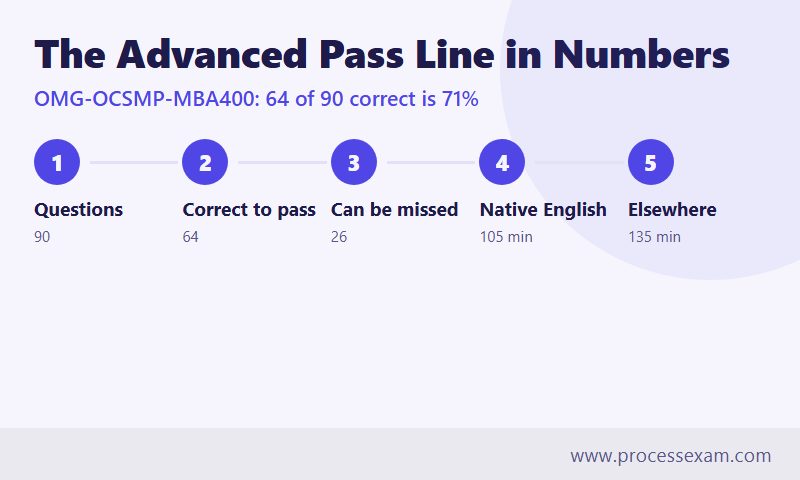
Work the arithmetic of the clock before you start. With 105 minutes for 90 questions you have about 70 seconds per question; with 135 minutes you have 90 seconds. Since 64 correct answers are needed, you can miss 26 and still pass. That is a useful number: it means a few unfamiliar questions on one standard cannot sink you, and it argues for guessing and moving on rather than spending four minutes on a single OCL constraint.
| Weeks | Focus | Practice to add |
|---|---|---|
| 1 | Read the information sheet; take one untimed diagnostic paper | Mark each wrong answer by syllabus area |
| 2 to 3 | Methodology and model quality (35%) | Write your methodology comparison; ten OCL constraints by hand |
| 4 to 5 | Adapting SysML (25%) | Build one profile, one library and one viewpoint on paper |
| 6 | Other languages (20%) | One-page summary each for UML, MARTE, UPDM, Modelica |
| 7 | Tool integration and selection (20%) | A tool-selection checklist; XMI, RIF, AP233 purpose notes |
| 8 | Timed full papers and review | Two papers at your real time limit, then fix the weakest area |
The order puts the largest area first on purpose, because it needs the most repeated exposure. If you are short of time, protect weeks 2 to 5 and compress 6 and 7, which are the most memorisable. When you are ready for the timed stage, run the OMG-OCSMP-MBA400 practice exam against a stopwatch at the time limit you will actually have, and keep an error log sorted by the four syllabus areas.
How to review a paper
For every wrong or guessed answer, write one line stating why the right option is right. Sort the lines by syllabus area. After two papers, the area with the most lines gets the next study block. If the same area comes up three times running, stop doing questions on it and return to the source, because repeating questions on a weak topic usually repeats the same misunderstanding.
The last 48 hours
Do not add new standards. Reread your one-page summaries, skim the error log and check your booking: the time zone, the identification you need, and for an online sitting a system test on the machine you will use. Confirm in advance whether your extra thirty minutes have been granted by email, since OMG says this is confirmed after the order is completed.
Who gains from the Advanced credential, and what does it tell an employer?
OMG positions the Advanced holder as a lead in establishing SysML-based MBSE: someone who can set up a modelling practice at an enterprise, spread it into new departments or product areas, and define new projects and support them through their lifecycle. That is a different claim from the Intermediate credential, which OMG describes as fitting a system modelling lead or top-ranked team member who contributes independently to the model.
The credential therefore suits people whose job is already moving from building models to deciding how models get built: lead systems engineers, MBSE champions, tool and process owners, and consultants who introduce SysML to client teams. For them the exam is useful mainly as a structured way to cover ground that daily project work skips, such as interchange standards and model quality metrics.
It is also fair to say what it will not do. The exam is multiple choice, so it does not prove you can lead an adoption, and OMG's own wording says the holder "will play" that role rather than that the credential makes one. Treat it as evidence of breadth. Pair it with a documented example, such as a profile you wrote or a tool evaluation you ran, when you talk to an employer.
The three-year validity also shapes the decision. Because renewal means taking the same or a higher exam, and Advanced is the highest in the Model Builder series, plan the next step early: another OMG series, the SysML v2 Model User exam, which OMG discounts for OCSMP holders, or a repeat sitting once the content outline has been reviewed again.
Frequently Asked Questions
How many questions are on the OMG-OCSMP-MBA400 exam?
The exam has 90 multiple-choice questions, which can include images as well as text. OMG allows 105 minutes in native English-speaking countries and 135 minutes in all other countries, which works out to roughly 70 and 90 seconds per question.
What is the passing score for OCSMP Advanced?
OMG sets the pass line at 64 of 90 correct answers, or 71% correct. That means you can miss 26 questions and still pass. Methodology and model quality carry the most marks at 35%, so weakness there is the hardest to offset.
How much does the OMG-OCSMP-MBA400 exam cost?
The fee is US$350 plus taxes, charged in the regional currency equivalent through Pearson VUE. If you fail, your score report includes a 20% discount code for a retake. OMG also runs periodic discounts and voucher options, so check its exam discounts page before paying.
What do you need before taking OMG-OCSMP-MBA400?
You must already hold passing scores on the SysML Model User, Model Builder Fundamental and Model Builder Intermediate exams. The Advanced exam is the last step in the Model Builder series, and the certification stays valid for three years from the exam date.
Is OMG-OCSMP-MBA400 still current now that SysML v2 exists?
Yes. As of October 2026 the exam is still based on SysML v1.2, and OMG states that its SysML v2 certification series is independent of the OCSMP series and that existing OCSMP certifications will not be superseded. No v2 Advanced exam has been announced.
- SysML Certifications |
- OMG OCSMP Advanced Test Questions |
- OMG-OCSMP-MBA400 Question Bank |
- SysML MBA Simulator |
- SysML MBA Mock Exam |
- OMG OCSMP Advanced Book |
- OCSMP Advanced Certification Cost |
- OCSMP Advanced Certification Requirements |
- OMG SysML MBA Question Bank |
- OMG SysML MBA Book |
- OMG SysML MBA Study Guide |
- SysML MBA Certification |
- SysML MBA Certification Cost |
- SysML MBA Certification Requirements |
- OMG OCSMP Advanced Sample Questions |
- OMG-OCSMP-MBA400 Exam Questions Download |
- OMG-OCSMP-MBA400 Test Questions |
- OCSMP Advanced PDF |
- OMG SysML MBA Exam Questions |
- OMG SysML MBA Sample Questions |
- SysML MBA |
- SysML MBA PDF


