
OGBA-101 Exam: Topics, Format and a 45-Day Study Plan
Updated on 1 October 2026. What’s new: exam fee corrected to USD $405, the figure The Open Group charges for OGBA-101 today
Forty-five days is a comfortable window for OGBA-101 if you already know some architecture or business analysis and can give it about an hour a day, and many candidates manage it in 30. The target is modest in size: 40 multiple-choice questions in 60 minutes, roughly 90 seconds each, with 24 correct answers (60%) to pass and a USD $405 fee. The plan below shows what to study in which week.

This credential, The Open Group TOGAF Business Architecture Foundation, suits people who plan, change or fund the business rather than build the systems: business analysts, strategy and transformation staff, product owners, portfolio managers and architects who want a shared vocabulary with them. The exam is closed book and tests knowledge and comprehension, so the work is learning a precise set of definitions and techniques and then recognising them in short scenarios.
Below you will find the exam format, a walk through all eleven syllabus topics, one worked example that ties the techniques together, a day-by-day 45-day plan, advice on turning practice questions into marks, and what the credential does for you afterwards.
What does the OGBA-101 exam look like on the day?
It is a single supervised paper with no case study and no open-book section. You sit it either at a Pearson VUE test centre or from home with an online proctor, and the Open Group datasheet says anyone may enter: there is no prerequisite certification, and training is optional because self-study is accepted. Here are the facts in one table.
| Detail | OGBA-101 |
|---|---|
| Exam name | The Open Group TOGAF Business Architecture Foundation |
| Exam code | OGBA-101 |
| Vendor | Open Group |
| Questions | 40 multiple choice |
| Duration | 60 minutes |
| Passing score | 60% (24 of 40) |
| Exam fee | USD $405 |
| Delivery | Pearson VUE test centre or online proctoring |
Read the Open Group's own certification datasheet for this exam before you book. It lists the ten competencies the credential claims, confirms the closed-book rule, and explains how certification works. Fees and delivery details are set by the vendor and its test provider, so check the booking page for the price you will actually pay on the day.
The pace is gentler than the clock suggests. Ninety seconds is plenty for a definition question and tight only for the longer scenario stems, so the habit to build is reading the last line of the stem first, ruling out the options that describe a process or a technology when the question asks about a business view, and moving on. A first pass that ends with ten minutes in hand lets you return to the flagged ones.
Which eleven topics make up the syllabus, and how deep does each go?
The syllabus has eleven topic areas. They are not equal in size: the first three recap the wider TOGAF Standard, the middle six are the Business Architecture techniques the credential is named for, and the last two connect everything back to the method and the certification scheme. The syllabus topic breakdown lists every learning outcome; this section tells you where to spend your hours.
Introduction and concepts, definitions, and the ADM
These three topics are the shared ground with every TOGAF exam. Introduction and concepts asks you to describe an enterprise, explain why Enterprise Architecture exists and what it gives a business, name the four commonly accepted architecture domains, and briefly explain principles, the Enterprise Continuum, the Architecture Repository, the Content Framework, architecture capability, risk management and gap analysis. Depth is shallow: you explain, you do not design.
The Definitions topic is a vocabulary test. The list includes business architecture, business model, capability, capability architecture, artifact, deliverable, gap, metamodel, requirement, role, stakeholder, segment, strategic and transition architecture, and work package. Write each in one sentence and learn to tell near neighbours apart, for example an artifact (a single model or document) from a deliverable (a contractually agreed work product).
Introduction to the ADM covers the cycle and its phases, the difference between draft and approved deliverables, why the method is iterative, how to scope an architecture, why alternatives and trade-offs are considered, and the purpose of the Preliminary Phase, Phase A and Phase B. You are not asked to memorise every phase in detail. You are asked to know where the business view lives and how iteration lets phases overlap.
Business modeling
Expect questions on what a business model is, the impact and benefits of having one, and example representations. The syllabus names the nine building blocks of the business model canvas as its worked example, so learn the blocks by name and what each one answers: who the customer segments are, what value proposition they get, through which channels and relationships, how revenue arrives, and which key resources, activities, partners and costs make it work. You should also be able to explain how business models relate to Business Architecture and why innovating on a business model should be done in a structured way rather than ad hoc.
Business capabilities
This is the heart of the credential. A business capability describes what a business can do, independent of who does it or how. You need its definition, how a capability is defined, its components, what a capability map is, how a map can be structured, and how capabilities map to other business perspectives. Two techniques sit on top: heat mapping, where you colour capabilities to show something such as maturity, risk or investment priority, and relationship mapping, where you show how capabilities connect to other things. A common question gives a heat map and asks what it implies, so practise reading one: the colour tells you where to look, and the interpretation depends on the dimension the map was drawn for.
Value streams
A value stream shows how a stakeholder gets something of value from end to end. The syllabus asks what value means in Business Architecture, the benefits of value stream mapping, how value streams differ from value chains, value networks and lean value streams, how a stream is defined and decomposed into stages, and how stages are mapped to capabilities. The mapping is where marks are won: each stage of a stream is enabled by one or more capabilities, and heat mapping can be applied on top to see which capabilities weaken which stages.
Business scenarios
A TOGAF business scenario is a structured way to discover and validate requirements so that the architecture fits the real business problem. Know its purpose, its benefits, where it is used in the ADM, how it is developed and validated, and where capabilities and value streams feed into it. It is a small topic with predictable questions, which makes it good value for revision time.
Information mapping and organization mapping
An information map shows the business concepts the enterprise cares about, such as customer, order or policy, and how they relate, without turning into a database design. Be ready to explain how it differs from a data model and how it is used with the ADM. An organization map shows the units, partners and roles involved in delivering the business and how they connect to capabilities and value streams, which is why the syllabus asks you to explain the difference between an organization map and an organization chart: the chart shows reporting lines, the map shows what is done and by whom.
Applying the techniques within the ADM, and the certification program
The applying topic asks how capabilities, value streams and organization maps are used to create the Architecture Vision in Phase A, how the Business Architecture is created in Phase B, and how information maps and modeling techniques are applied there. The last topic asks you to explain the TOGAF Certification Program and distinguish the levels. Both are short, and both are worth an evening each because they are very learnable.
How do capabilities, value streams and maps fit together in one worked example?
The techniques only make sense as a set, and exam scenarios often mix them. Take a regional bank that wants to cut the time it takes a small business to open an account. Walking through that one case covers most of the middle of the syllabus.
- Start with the value stream. The stakeholder is the small-business owner, and the stream is something like "Onboard a business customer". Its stages might be enquire, apply, verify, approve, set up and activate. Each stage is a step in how the customer experiences value, and it is described with a verb phrase.
- Name the capabilities that enable each stage. Verification depends on capabilities such as Identity Verification and Risk Assessment. Setup depends on Account Management and Payments Handling. Capabilities are stable and described as nouns: the bank had Risk Assessment ten years ago and will have it in ten years, even though the tools and teams change.
- Heat map the capabilities. Colour them by maturity or by how much they slow the stream. If Identity Verification is red and sits under the slowest stage, the programme has found a priority.
- Build the organization map. Show which units, partners and roles deliver each capability, including an external credit bureau if one is used. This shows who has to be involved, which a reporting chart would not.
- Add the information map. The business concepts involved, such as Customer, Application, Account and Beneficial Owner, and how they relate. This sets up the later data work without prescribing any database.
- Test the result with a business scenario. Describe the situation, actors and outcomes, then validate with stakeholders that the architecture solves the right problem.
A test question will usually cover one slice of this chain. If you can say which technique answers "what must we be good at", "how does value flow", "who delivers it", "what do we need to know" and "does this solve the real problem", you can pick the right answer even when the wording is unfamiliar.
One trap sits inside the example: process versus capability. "Verify the applicant" is a step in a process, while Identity Verification is a capability. If an answer option reads like an instruction, it is probably describing a process or a value stream stage, and that is often how distractors are written. Another trap is mixing up levels: a stage of a value stream is not a capability, even when the two have similar names.
What should each week of a 45-day plan contain?
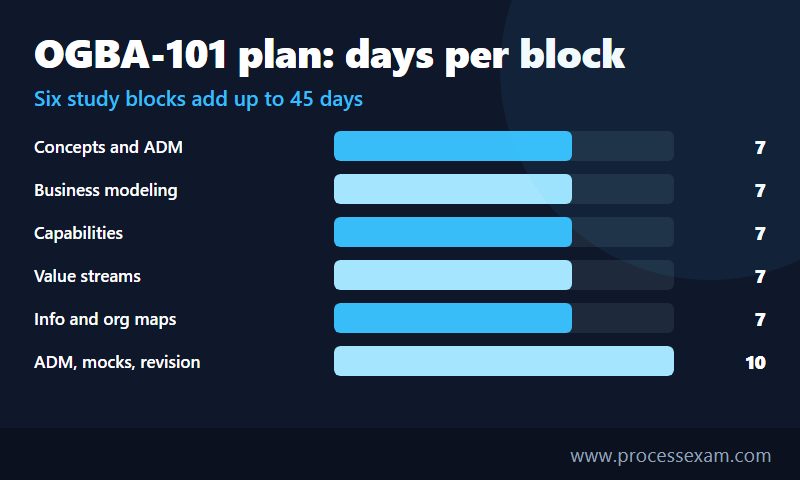
The plan assumes about an hour a day, six days a week, and a first-time learner of the TOGAF terminology. Shorten any block you already know well. Each week ends with a short self-test on that week's topics, so gaps surface early.
| Days | Focus | What to finish |
|---|---|---|
| 1-7 | Concepts, definitions, ADM overview | One-sentence definitions for the whole definitions list; sketch the ADM cycle from memory |
| 8-14 | Business modeling and the business model canvas | All nine canvas blocks with an example company; benefits of business models |
| 15-21 | Business capabilities | Build a capability map of an employer or a case company; add a heat map |
| 22-28 | Value streams and business scenarios | Decompose two value streams into stages; map stages to capabilities |
| 29-35 | Information and organization mapping | One information map, one organization map, one comparison with a data model and an org chart |
| 36-45 | Applying techniques in the ADM, practice, revision | Phase A and B usage, certification program, three timed mocks |
Weeks 1 and 2: language first
Do not start with techniques. The exam is written in TOGAF vocabulary, and candidates who use their company's internal definitions lose marks on questions that differ by a word. Spend week one on the concepts, the definitions and the ADM overview. Create a flashcard for every term in the definitions list and check yourself each morning. In week two, learn the nine building blocks of the business model canvas by drawing the canvas for a company you know, then explain out loud what a business model is and how it relates to Business Architecture.
Week 3: capabilities
Build a capability map for something real: your employer, a hospital, an airline. Aim for a dozen or so capabilities across three or four groupings. Write each as a noun phrase and check that none is really a process in disguise. Then add a heat map using one dimension, such as maturity, and write two sentences interpreting it. Finish by listing how capabilities map to other business perspectives.
Week 4: value streams and scenarios
Pick two value streams, for example "Fulfil a customer order" and "Onboard a new employee", and decompose each into five to eight stages. Map every stage to the capabilities from week three. Then read about value chains, value networks and lean value streams and write one line on how each differs from a value stream. Finish the week with the business scenario topic: its purpose, where it fits in the ADM, how it is developed and validated.
Week 5: information and organization maps
Build an information map of six to ten business concepts and mark the relationships. Compare it with a data model and write down three differences. Then draw an organization map for your case company and an organization chart for the same company, and note what each one can and cannot show. Revisit the capability map: link each capability to the unit that delivers it.
Weeks 6 and 7: applying the techniques, then exam sprint
Days 36 to 40 cover applying the techniques within the ADM: how capabilities, value streams and organization maps support Phase A, and how Phase B builds on them with information maps and modeling. Add the certification program topic. Days 41 to 45 are a sprint: three timed mocks of 40 questions in 60 minutes, with a day of review after each. Anything you got wrong twice goes on a single revision page.
Can you cut the plan to 30 days, and who needs the full 45?
Yes, if you already work with enterprise architecture or business analysis. The 30-day version drops the separate week for business modeling and combines the information and organization mapping weeks. It keeps all the practice. The 45-day version suits people who are new to TOGAF terminology, who study in short evening sessions, or who have not met capability mapping or value streams before.
- Already an architect or analyst: compress to 30 days, spend 70% of the time on definitions and mock questions.
- New to architecture: take all 45 days, and build the case-company artifacts yourself.
- Holding the older TOGAF Business Architecture Level 1 credential: read the vendor datasheet first. It notes that holders of that credential can take a short refresher course to move to this one, so check that route before you plan a full course of study.
If the exam date is fixed and sooner than 30 days, do not skip the definitions or the middle six topics. Cut back on the wider TOGAF recap, where the questions are shallow, rather than on capabilities, value streams or the two mapping techniques, where the questions go deeper.
How do you turn practice questions into marks?
Practice questions do three jobs: they show which topics are weak, they train your pace, and they teach you how the Open Group words its distractors. Start with a few free sample questions in week two or three so you know the style, then move to full-length timed sets in the last ten days.
Keep an error log
For every wrong or guessed question, note the topic, what you chose, why it was wrong and the rule that settles it. After two weeks the log shows a pattern, usually two or three confusions that keep recurring, such as capability versus process, organization map versus organization chart, or information map versus data model. Those confusions are your last-week revision list.
Practise the 90-second rule
With 40 questions in 60 minutes, set a target of 75 seconds on the first pass, leaving 10 minutes at the end. If you are still undecided at 90 seconds, flag the question and move on. Do not keep a mock open past the time limit; the point is to train a habit you will use in the real sitting.
Set your own readiness bar
The pass mark is 60%, but a mock score at the pass mark is not safe, because real wording differs from any bank. Many candidates aim for 75% or better on fresh questions across two timed mocks before booking the date. If your scores sit below that, return to the topic where the error log is thickest instead of taking more mocks. When you are ready to test your pace, sit a timed OGBA-101 practice exam with the same 40-question, 60-minute shape, then let your error log decide what to fix.
What goes wrong for OGBA-101 candidates, and how should exam day run?
- Using in-house terminology. If your employer calls a team a capability, the exam does not. Pick the answer that fits the TOGAF definition.
- Confusing capabilities with processes. Capabilities are stable nouns; processes and value stream stages describe how or when things happen.
- Treating a heat map as a plan. A heat map highlights where to look; it does not say what to do.
- Confusing the organization map with the organization chart. The chart is about reporting lines, and the map is about who delivers what.
- Skimming the ADM. Questions on Phase A and B reward knowing what each phase is for and how the techniques feed it.
- Memorising a single mock bank. Learn the reasoning, because the real wording will differ.
The last three days
Stop learning new material. Read the one-page error log, re-draw the ADM cycle, and restate the definitions list aloud. Check the booking time, the identification you need and, if you sit it online, your room and connection. Sleep matters more than another mock.
Inside the exam
Read the question's last line first. Remove options that describe tools, processes or reporting lines when the question asks about a business view. If two options remain, choose the one that matches the TOGAF wording. Flag anything that takes longer than two minutes; you will usually find the answer easier on the second look. Do not change an answer without a concrete reason.
What does the certification give you once you pass?
Passing earns The Open Group Certified TOGAF Business Architecture Foundation. According to the datasheet, certification is to a given version of the body of knowledge and does not expire, so there is no renewal fee or recertification requirement. The Open Group lists certified individuals in its directory and issues certificates and digital badges.
The datasheet suggests three next steps: the TOGAF Digital Specialist credential, the TOGAF Agile Specialist credential, or role-based badges that show complementary skills. If you want the wider enterprise route, the Open Group's TOGAF Standard pages and the general overview of the TOGAF framework explain how Business Architecture fits within the full framework.
In daily work the credential shows that you can speak the language that strategy, architecture and delivery teams share. You can map what the business is good at, trace how value flows to a customer and show who is involved, and those are the same skills used in capability-based planning, transformation roadmaps and investment prioritisation. It is a foundation-level credential: it proves knowledge and comprehension, not years of practice, so it works best as a first step alongside real project experience.
Frequently Asked Questions
How many questions are on the OGBA-101 exam?
The OGBA-101 exam has 40 multiple-choice questions and a 60-minute time limit, which works out to about 90 seconds per question. It is closed book, so you cannot refer to the TOGAF documentation during the test. Practise under timed conditions before you book.
What is the passing score for OGBA-101?
The passing score is 60%, which means at least 24 of the 40 questions must be answered correctly. Because real questions are worded differently from any practice bank, many candidates aim for 75% or better on fresh timed questions before booking the exam date.
How much does the OGBA-101 exam cost?
The OGBA-101 exam fee is USD $405. The Open Group and its test provider set the price and delivery terms, so confirm the amount on the booking page at the time you register, since fees can be revised and local taxes may apply.
How long does it take to prepare for OGBA-101?
Most candidates need 30 to 45 days at about an hour a day. People already working in architecture or business analysis can compress the plan to 30 days, while newcomers to TOGAF terminology, capability maps and value streams should take the full 45 days.
Is there a prerequisite for the OGBA-101 exam?
No. The Open Group datasheet states that certification is open to all applicants and requires no previous certification. Training is optional because self-study is accepted. Holders of the older TOGAF Business Architecture Level 1 credential can take a short refresher course to move to this one.
- Business Architecture |
- OGBA-101 Question Bank |
- Open Group TOGAF Business Architecture Foundation Test Questions |
- TOGAF Business Architecture Foundation Mock Exam |
- TOGAF Business Architecture Foundation Simulator |
- Open Group TOGAF Business Architecture Foundation Book |
- TOGAF Business Architecture Foundation Certification Cost |
- TOGAF Business Architecture Foundation Certification Requirements |
- Open Group TOGAF Business Architecture Foundation Sample Questions |
- OGBA-101 Exam Questions Download |
- OGBA-101 Test Questions |
- TOGAF Business Architecture Foundation PDF


