
OG0-093 Exam: How to Pass TOGAF 9 Combined in One Sitting
OG0-093 packs both TOGAF 9 levels into one 150-minute sitting: 40 closed-book questions, then eight open-book scenarios. Clear 55% on the first section and 60% on the second and you leave the test centre TOGAF 9 Certified after a single appointment. Miss one section and you resit that section alone. Preparing for this paper is therefore two jobs stitched together, not one long revision push.
The stitching is what catches people out. The two halves reward opposite habits. One wants fast, unaided recall of vocabulary and method. The other wants unhurried judgement with the standard open on screen. There is no break between them, and once the first half closes you cannot go back to it. What follows is the format, the money, the syllabus in the order worth learning it, a six-week plan, and the pacing that decides how the final forty minutes go.
How is the OG0-093 exam built, and what does it cost?
OG0-093 is The Open Group's combined paper for candidates who want Level 1 and Level 2 recognition from one appointment. Section 1 reproduces the TOGAF 9 Part 1 paper: forty straightforward multiple-choice items, closed book, one point apiece. Section 2 reproduces the Part 2 paper: eight scenario questions marked on a sliding scale, with an electronic copy of the standard available inside the exam window. Both sections run inside a single 150-minute clock, divided sixty minutes and ninety minutes, and the section boundary is one-way.
| Detail | OG0-093 |
|---|---|
| Exam name | The Open Group TOGAF 9 Combined Part 1 and Part 2 |
| Body of knowledge | TOGAF 9.2 |
| Total questions | 48 |
| Total time | 150 minutes |
| Section pass marks | 55% in Part 1, 60% in Part 2 |
| Exam fee | USD $570 |
| Prerequisites | None |
| Qualification earned | TOGAF 9 Certified |
Those section pass marks are worth pausing on, because they are not the same number. The closed-book half asks for 22 correct answers out of 40. The scenario half asks for 24 points out of 40, and its points come from ranked answers rather than right-or-wrong ones. You must satisfy both bars; a strong showing in one half cannot rescue the other. The Open Group spells the arrangement out in its examination datasheet, which also confirms that the English paper is OG0-093 and the Simplified Chinese paper is OG0-098.
Booking is straightforward once you know which paper you want. The exam is delivered at authorised test centres and by supervised online proctoring, so a candidate in a city with no nearby centre can still sit it from home provided the room and the machine meet the proctor's conditions. Whichever you choose, treat the 150 minutes as immovable: there is no scheduled break inside the appointment, and the online route in particular does not forgive a wandering candidate.
Having no prerequisite is the whole point of this paper. Nothing has to be earned before you book it, and nothing carries over if you skip it. That freedom has a price: you meet the entire standard on one afternoon, whereas the two-paper route lets you bank Foundation first and come back for scenarios several weeks later, better rested and with one syllabus already behind you.
Should you still sit a TOGAF 9.2 paper now that the 10th Edition exists?
If the architecture practice you work in still runs on TOGAF 9.2, yes. The Open Group has not withdrawn the paper. Its retail examination fee schedule, effective from February 2026, prices OG0-093 next to the 10th Edition papers, and the TOGAF 9 certification portfolio remains published on its site, checked in September 2026. The question in front of you is not current versus retired. It is which body of knowledge your daily work, your repository and your clients actually speak.
Choose OG0-093 when your employer's templates, governance boards and architecture repository were built on 9.2; when a training voucher you already hold was bought for the 9 series; or when a contract or job description names TOGAF 9 Certified by that exact title. Choose the 10th Edition combined paper, OGEA-103, when you are starting from nothing, because that is where The Open Group is adding its newer guidance and where most fresh course material now points.
Choosing 9.2 today does not strand you, either. The Open Group runs a short bridging paper for architects who hold the TOGAF 9 Certified title and later want the newer practitioner designation, and our guide to that shorter crossing exam sets out what it covers. Sit OG0-093 now for the credential your workplace recognises, and cross over when the work in front of you changes.
Is one combined sitting cheaper than two separate TOGAF 9 papers?
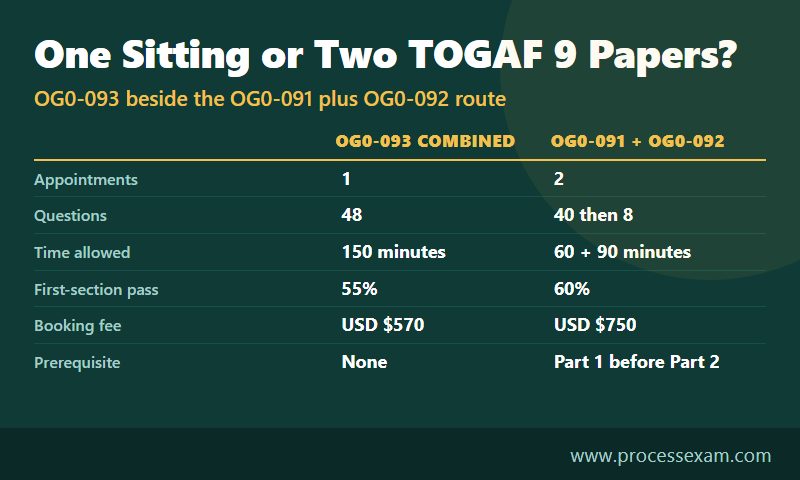
It is, by enough to matter. OG0-093 costs USD $570. The Open Group's published fee schedule prices the standalone TOGAF 9 Part 1 and Part 2 papers at USD $375 each when booked directly, so the split route reaches USD $750 before you add a second journey to a test centre or a second morning away from work. The combined paper therefore saves USD $180 and an appointment.
Two trade-offs come with the saving, and neither is obvious from a price list. The first is a bar that moves. Sat on its own, the Part 1 paper needs 60% to pass. Sat as the opening section of OG0-093, the same forty questions need 55%. Two extra questions of headroom is a small but genuine argument for the combined route if the vocabulary half is the part you dread.
The second trade-off is concentration. Ninety minutes of scenario judgement arrives immediately after sixty minutes of rapid recall, with nothing in between. Candidates who have only ever revised in half-hour stretches meet a kind of tiredness they have not rehearsed. Nobody solves that by reading more; you solve it by practising long.
Failure is handled kindly, which softens the risk of putting everything on one appointment. Clear the first section and fall short on the second and you do not repeat the whole paper. You book the section you missed as its own exam, at that exam's fee. The worst realistic outcome is one bad half, not a lost $570.
What must you know cold before the closed-book section?
Section 1 leaves you about ninety seconds a question with nothing to look up, so everything in it has to be recall rather than reasoning. Our OG0-093 exam syllabus page lists the thirteen learning units the first half draws on:
- Basic Concepts
- Core Concepts
- General Definitions
- Introduction to the ADM
- Enterprise Continuum and Tools
- ADM Phases
- ADM Guidelines and Techniques
- Architecture Governance
- Architecture Views, Viewpoints and Stakeholders
- Building Blocks
- ADM Deliverables
- TOGAF Reference Models
- TOGAF Certification Program
Vocabulary before anything else
Basic Concepts, Core Concepts and General Definitions look like a warm-up and behave like a trap. The examiners use precise words for things practitioners use loosely: an architecture is not a design, a building block is not a component, a baseline is not a current state you happen to have drawn. Write each definition once in your own words, then attach a real system you have worked on to it. Definitions with no example behind them evaporate under time pressure.
The method, phase by phase
Introduction to the ADM, ADM Phases, ADM Guidelines and Techniques and ADM Deliverables together make up the largest share of the first section. For every phase from Preliminary through H, you want three things at your fingertips: why the phase exists, what enters it and what leaves it. Deliverables are where marks quietly drain away, because several sound interchangeable until you can say which phase produces each one. Build a single sheet that runs down the phases and across those three columns, and rebuild it from memory rather than rereading it.
The estate the method operates on
Enterprise Continuum and Tools, Building Blocks and TOGAF Reference Models describe what an architecture practice accumulates and reuses. Questions here reward a clear mental picture of how generic assets become specific ones, and of where the technical reference model and the integrated information infrastructure reference model each sit. Draw the continuum once by hand; it sticks far better than a page of prose about it ever does.
Control and communication
Architecture Governance and the unit covering views, viewpoints and stakeholders are the two places where TOGAF talks about people rather than artefacts. Learn the difference between a view and a viewpoint properly, because a question on it appears in almost every practice set, and know what a governance board is accountable for as distinct from what a project manager is. The final unit, on the certification programme itself, is small and free: read it once the week before and move on.
One habit is worth more than any reading list for this section: test yourself before you feel ready. Close the book at the end of each unit and write down what you can recall, then check it. The gap between recognising a definition on a page and producing it under a ticking clock is exactly the gap the first forty questions measure, and rereading never closes it.
How should a six-week plan split between the two sections?
Six weeks at roughly eight hours a week suits someone already working in or near architecture. Give the first half of the plan to recall and the second half to judgement, and put a full-length rehearsal at the end so the 150-minute shape is familiar before it counts.
Weeks one and two: language and method
Work through definitions, core concepts and the ADM from end to end. Finish each session by reciting the phase you just read without notes. By the end of week two you should be able to name every phase in order and say what leaves it. The Open Group's TOGAF 9 Certified study guide follows the same units, which makes it easy to keep reading and revision aligned.
Week three: governance, continuum and a first timed run
Add governance, the continuum, building blocks and the reference models, then take your first forty-question run against the clock. Expect a mediocre score. Its purpose is a list of weak units, not a verdict.
Week four: turn towards scenarios
Switch to the Level 2 material: the preliminary phase in depth, business scenarios, the content metamodel, architecture partitioning and the repository. Read these knowing you will have them on screen in the exam, so aim to know where things live rather than to memorise them word for word.
Week five: scenario drills
Work single scenarios in isolation, one at a time, and grade yourself on ranking all four options rather than on picking the best one. A timed OG0-093 practice exam is the cheapest way to find out whether your reading has turned into decisions yet.
Week six: rehearse the whole afternoon
Sit one uninterrupted 150-minute rehearsal, sixty minutes then ninety, with no break and no phone. Spend the days that follow only on units the rehearsal exposed. Nothing new goes in during the final week.
How do you work a scenario when the standard is on screen?
Eight scenarios in ninety minutes leaves a little over eleven minutes each, and the electronic reference is the single biggest way to lose those minutes. Candidates who have not rehearsed with it start reading to learn. The reference is there to confirm wording you already half-remember, never to teach you a phase you skipped in week four.
Scoring rewards discrimination rather than luck. Each scenario carries one best answer worth five points, a defensible second worth three, a weak third worth one, and a fourth worth nothing. Since the difference between a pass and a near miss is often the gap between a five and a three, practise ordering all four options every time, and say out loud why the three-point answer is not the five-point one.
The scenarios themselves follow a recognisable shape. You get a paragraph or two describing an organisation, something it is trying to change, a complication, and a closing sentence asking what you should do next or which approach best fits. Almost everything decisive sits in that closing sentence and in the complication; the rest is scene-setting that tempts you into reading twice.
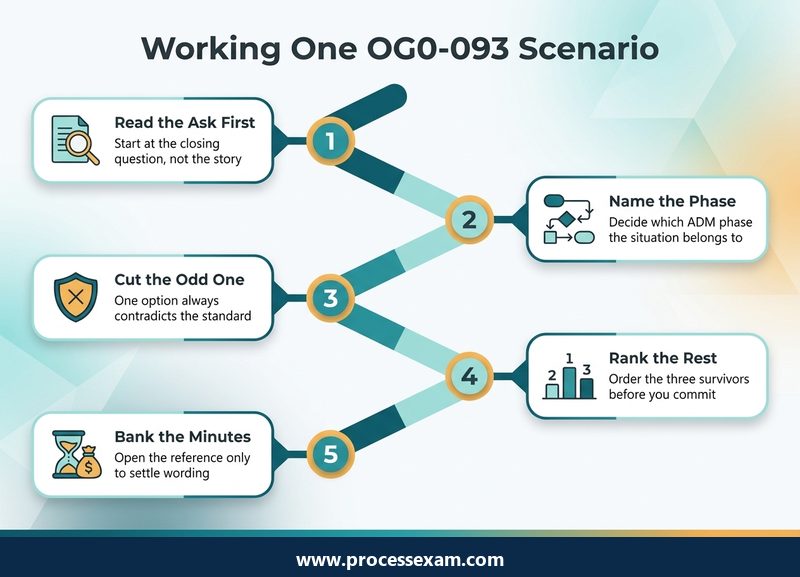
A repeatable sequence keeps the clock honest:
- Read the closing question first, so you know what the scene is being told for.
- Name the ADM phase the situation sits in before you look at any option.
- Strike out the option that contradicts the standard; there is usually exactly one.
- Rank the three that survive, and commit to the ranking rather than rereading.
- Open the reference only to settle a wording dispute, and only if minutes allow.
What goes wrong in the last forty minutes of the sitting?
Almost every avoidable mark is lost late. By minute 110 you have already answered forty questions at speed and reasoned through five scenarios, and the mind starts taking shortcuts it would never take in week five of revision. Three patterns show up again and again.
The first is the hunt. A phrase feels almost right, the reference is open, and seven minutes disappear into searching for a sentence that would have changed nothing. Give yourself a hard limit of one lookup per scenario and move on when it expires.
The second is drifting into practice. Scenario questions describe organisations that resemble places you have worked, and the answer your own employer would choose is frequently the three-point option rather than the five-point one. The paper asks what the standard prescribes, not what your last programme did.
The third is abandoning the ranking habit under fatigue. Tired candidates pick the first plausible option and click on. Slowing down for the twenty seconds it takes to order the remaining choices is usually worth more than any extra reading you could have done the night before.
One structural point deserves repeating, because it surprises people mid-exam: finishing the first section early does not bank the leftover minutes for later, and you cannot return to a closed-book question once you have moved on. Treat sixty minutes as a fixed box, use the spare time inside it to re-read flagged items, and then let it close.
What do you get when you pass, and what happens if you miss a section?
Passing both sections awards TOGAF 9 Certified, which covers Level 1 and Level 2 together. Your result appears in The Open Group's certification register, and you receive a digital badge you can attach to a profile or a proposal. For consultancies bidding on architecture work, a named certified architect on the team is often a tender requirement rather than a nice line on a CV, which is a large part of why this paper keeps selling alongside its newer sibling.
Missing a section is less expensive than candidates fear. No certification is awarded that day, but the section you passed is recognised, and you book only the paper matching the section you missed. In practice that means a candidate who scored well on vocabulary and ran out of judgement in the scenarios sits the Part 2 paper next, at the Part 2 fee, with ninety minutes and no closed-book warm-up in front of it.
What the title is worth day to day depends on where you sit. Inside an organisation that already runs the framework, it mostly buys you standing: your opinion in a governance meeting is read as the framework's position rather than your own preference. Moving between employers, it works as a filter, because recruiters screening architecture roles frequently list it as a requirement they can check quickly rather than a skill they can assess.
Whichever way the afternoon goes, decide what the credential is for before you book. If it is to formalise a vocabulary your team already uses, OG0-093 gets you there in one visit and at a lower price than two papers. If it is to learn enterprise architecture from scratch, the reading matters far more than the route, and the six weeks above are the part worth taking seriously.
Frequently Asked Questions
What is the OG0-093 exam and what does passing it give you?
OG0-093 is The Open Group's combined TOGAF 9 paper, taken in one appointment and based on TOGAF 9.2. It has 48 questions across two sections and lasts 150 minutes. Passing both sections awards TOGAF 9 Certified, covering Level 1 and Level 2 together, with no qualification required beforehand.
What score do you need to pass OG0-093?
The two sections are marked to different bars. The closed-book section needs 55%, meaning 22 points from 40. The scenario section needs 60%, meaning 24 points from 40, awarded on a sliding scale. Both bars must be cleared; a high score in one section cannot compensate for the other.
Is OG0-093 cheaper than sitting OG0-091 and OG0-092 separately?
Yes. The combined paper is USD $570, while The Open Group's retail fee schedule prices each standalone TOGAF 9 paper at USD $375, or USD $750 for the pair booked directly. You also save a second test-centre appointment, though you take on the whole syllabus in a single afternoon.
Can you use the TOGAF specification during the OG0-093 exam?
Only in the second section. The first forty questions are closed book. An electronic copy of the standard becomes available for the eight scenario questions and stays on screen until the end. No printed material may be brought in, so practise searching the electronic version before exam day.
Do you have to retake all of OG0-093 if you miss one section?
No. No certification is issued unless both sections are cleared, but the section you passed still counts. You book only the exam matching the section you missed and pay that exam's own fee, which keeps a single weak half from costing you the full combined price again.
- Enterprise Architecture |
- Open Group TOGAF 9 Combined Exam Questions |
- Open Group TOGAF 9 Combined Questions |
- Open Group TOGAF 9 Combined Test Questions |
- Open Group OG0-093 Quiz |
- OG0-093 Question Bank |
- OG0-093 Questions |
- OG0-093 Sample Exam |
- OG0-093 Exam |
- OG0-093 Study Guide PDF |
- Open Group TOGAF 9 Combined Book |
- TOGAF 9 Combined Certification Cost |
- TOGAF 9 Combined Certification Requirements |
- TOGAF 9 Part 1 and Part 2 Combined Simulator |
- TOGAF 9 Part 1 and Part 2 Combined Mock Exam |
- Open Group TOGAF 9 Part 1 and Part 2 Combined Questions |
- Open Group TOGAF 9 Part 1 and Part 2 Combined Question Bank |
- Open Group TOGAF 9 Part 1 and Part 2 Combined Book |
- Open Group TOGAF 9 Part 1 and Part 2 Combined Study Guide |
- TOGAF 9 Part 1 and Part 2 Combined Certification |
- TOGAF 9 Part 1 and Part 2 Combined Certification Cost |
- TOGAF 9 Part 1 and Part 2 Combined Certification Requirements


