
ASQ or IASSC: Which Six Sigma Certification Is Most Recognized?
Which Six Sigma certification is most recognized, ASQ or IASSC? Both are recognized, but they answer different needs: ASQ certifies experience and completed projects, IASSC certifies exam performance alone. If an employer wants proof that you have run improvement work, ASQ carries further. If you need an independent credential quickly, IASSC gets you there.
That one-line answer hides a lot of detail, and the detail is where candidates lose money. The two bodies price their exams differently, time them differently, allow different materials in the room, ask for different evidence before you apply, and treat renewal in completely different ways. This guide sets the two side by side across all three belt levels, using the figures we hold for each exam, so you can decide which route matches your job, your evidence and your budget rather than which brand sounds louder.
What does "most recognized" actually mean for a Six Sigma certification?
Six Sigma has no single authorizing body. Unlike project management, where one organization owns the standard that most employers quote, Six Sigma grew out of manufacturing practice and spread through consultancies, universities, in-house programmes and independent certifiers. That is why two candidates can both hold a "Black Belt" and have passed very different assessments.
Because of that, recognition is not one thing. It is at least three.
- Employer familiarity. Does the hiring manager in your industry and country know the body by name? In North American manufacturing, quality and medical device work, ASQ is the name that appears in job adverts. In training-led markets and in organizations that buy Lean Six Sigma courses from accredited providers, IASSC is the name attached to the exam at the end.
- What the credential proves. An ASQ Black Belt certificate says a candidate met an experience bar and documented completed projects. An IASSC certificate says a candidate passed a closed-book proctored exam on a published body of knowledge. Both statements are honest; they are simply different statements.
- Independence from training. IASSC positions itself as a certification body that does not sell training and instead accredits providers whose courses lead to its exams. ASQ is a membership society that publishes bodies of knowledge, sells handbooks and training, and also certifies. Some buyers prefer the separation; others prefer one organization to own the whole path.
So the honest answer to "which is more recognized" is: ask the people who will read your CV. Search the job titles you want in your region and count how often each body is named. Five minutes of that research beats any ranking an article can give you, including this one.
What does each body require before you can sit the exam?
This is the largest practical difference between the two, and it decides the route for most candidates.
ASQ asks for experience first
ASQ sets an eligibility bar before you are allowed to book. On its Six Sigma Black Belt certification page, ASQ states the requirement as "3 Years of on-the-job experience in one or more of the areas of the CSSBB Body of Knowledge & one completed project with signed affidavit, or two completed projects with signed affidavits". The experience must come from a full-time, paid role.
For the Green Belt, ASQ's Six Sigma Green Belt certification page asks for "3 Years of on-the-job experience in one or more of the areas of the Certified Six Sigma Green Belt Body of Knowledge", again in a full-time, paid role, and notes that no educational waivers are available for this certification. There is no project affidavit at Green Belt; the experience alone is the gate.
The Yellow Belt is the open door. ASQ's Six Sigma Yellow Belt certification page states plainly that "The Certified Six Sigma Yellow Belt has no experience or education requirements", which makes it the entry point for people who want the ASQ name on a credential before they have the years behind them.
Applications are reviewed before you are given eligibility to schedule, and exams are sat in testing windows rather than on any day you like, so ASQ needs planning. You apply through ASQ's certification application page, choose a window, and schedule once your application is approved.
IASSC asks for nothing but the exam
IASSC takes the opposite position. Its Lean Six Sigma Black Belt certification page states that there are no prerequisites required in order to sit the exam, and the same wording appears on its Lean Six Sigma Green Belt page and its Lean Six Sigma Yellow Belt page. Training and real-world experience are recommended, not mandatory. There is no application review, no affidavit and no project to submit. You buy a voucher and book.
Neither approach is better in the abstract. They optimise for different things. ASQ's affidavit makes the Black Belt hard to obtain without having genuinely led improvement work, which is exactly what some employers want to see. IASSC's open door makes the credential available to a consultant between engagements, a graduate, or someone whose project work is covered by a confidentiality agreement they cannot get signed off.
How do the six exams compare on fee, length and questions?
Here are the figures we hold for all six Six Sigma exams across the two bodies. ASQ quotes three prices for each exam, because members pay less than non-members and a retake is cheaper than a first attempt.
| Certification | Code | Questions | Duration (minutes) | Exam fee (USD) | Passing score |
|---|---|---|---|---|---|
| ASQ Certified Six Sigma Black Belt | CSSBB | 165 | Total appointment time - 270 Exam time - 258 |
ASQ MEMBERS - $485 NON-MEMBERS - $585 RETAKES - $385 |
550/750 |
| ASQ Certified Six Sigma Green Belt | CSSGB | 110 | Total appointment time - 270 Exam time - 258 |
ASQ MEMBERS - $383 NON-MEMBERS - $483 RETAKES - $283 |
550/750 |
| ASQ Certified Six Sigma Yellow Belt | CSSYB | 90 | 138 | ASQ MEMBERS - $334 NON-MEMBERS - $434 RETAKES - $234 |
550/750 |
| IASSC Certified Lean Six Sigma Black Belt | ICBB | 150 | 240 | 450 | 70 |
| IASSC Certified Lean Six Sigma Green Belt | ICGB | 100 | 180 | 350 | 70 |
| IASSC Certified Lean Six Sigma Yellow Belt | ICYB | 60 | 120 | 250 | 70 |
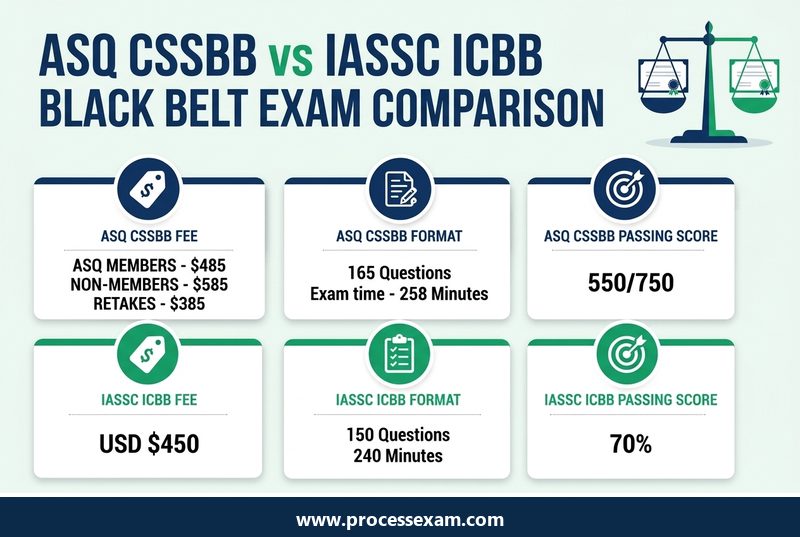
Three things in that table deserve a second look.
The passing scores are not comparable. ASQ reports a scaled score out of 750 with 550 as the pass mark; IASSC requires a minimum of 70 per cent. A scaled score is not a raw percentage, so you cannot say that ASQ's bar is higher or lower than IASSC's by comparing the two numbers. Judge your readiness against timed practice under each exam's own format instead.
The fees move in opposite directions. At Black Belt, a non-member pays more for the ASQ exam than for the IASSC voucher, while an ASQ member pays more than the IASSC voucher too; at Green Belt and Yellow Belt the IASSC voucher is the cheaper single purchase. But ASQ's retake price is markedly lower than its first-attempt price, which softens the cost of a second try, and ASQ membership pays for itself if you sit more than one exam.
Time per question is tighter than it looks. The ASQ Black Belt gives 258 minutes of exam time for 165 questions, a little over a minute and a half each. The IASSC Black Belt gives 240 minutes for 150 questions, which works out at much the same pace. Neither exam is generous, and both punish candidates who read every scenario twice.
What is inside each body of knowledge?
The two syllabuses overlap heavily in the DMAIC tools and diverge at the edges. That divergence is worth understanding before you pick, because it tells you what the certificate says about you.
ASQ's Black Belt reaches beyond DMAIC
ASQ's 2022 Certified Six Sigma Black Belt Body of Knowledge, which you can download from its certification page, is organized into nine sections: organization-wide planning and deployment; organizational process management and measures; team management; define; measure; analyze; improve; control; and design for Six Sigma frameworks and methodologies. Only five of those nine are the DMAIC phases. The rest test whether you can align a programme with business strategy, manage a team through a project, choose organization-level metrics and work within a design-for-Six-Sigma framework.
That shape matters. ASQ's Black Belt is written for someone expected to run a programme, not only a project. If your target role is a full-time improvement lead reporting to an executive sponsor, the extra sections are the part of the syllabus that reflects the job.
ASQ's Green Belt and Yellow Belt stay closer to the project
The Green Belt body of knowledge opens with an overview of Six Sigma and the organization and then works through the define, measure, analyze, improve and control phases. The Yellow Belt body of knowledge is built from five sections: Six Sigma fundamentals, define, measure, analyze, and improve and control together. Each step down the belt ladder narrows the scope and reduces the statistical depth rather than changing the subject.
IASSC stays inside the DMAIC toolset
IASSC organizes all three of its bodies of knowledge around define, measure, analyze, improve and control. Its Black Belt page describes an exam drawing approximately 30 multiple-choice and true-or-false questions from each major section, and its Green Belt page describes approximately 20 questions from each major section of a 100-question exam. There are no separate sections on deployment strategy or design for Six Sigma; the emphasis is on the Lean and Six Sigma tools themselves and on applying them correctly.
Put simply: an ASQ Black Belt syllabus asks "can you run improvement in an organization?", while an IASSC Black Belt syllabus asks "do you know the Lean Six Sigma toolset to Black Belt depth?". Both are legitimate questions. Which one your employer is really asking should drive your choice.
Open book or closed book, and why does it change your preparation?
This difference is easy to overlook and it changes how you should study for months.
ASQ states on each of its Six Sigma certification pages that all examinations are open book, and candidates bring their own bound reference materials into the room. IASSC's exams are described on all three of its certification pages as closed book and proctored, delivered at test centres or through online proctoring.
An open-book exam is not an easy exam. With a little over 90 seconds per question on the ASQ Black Belt, you do not have time to look anything up that you have not already indexed. Candidates who do well treat their reference set as a tool they have rehearsed with: tabbed, annotated, with formula tables and distribution tables in known places, and with every lookup practised until it takes seconds. Candidates who do badly bring an unmarked handbook and discover that finding a table costs them three questions.
A closed-book exam changes the target. For the IASSC route you are building recall: which tool fits which situation, which assumption underlies which test, what the control chart selection logic is, and what each Lean concept means. Formula recall matters more, and so does clean mental separation of tools that look alike.
The practical consequence is that these two exams should be revised differently even where the underlying content is the same. Building a reference index is wasted effort for IASSC; drilling pure recall is only half the job for ASQ.
Which Six Sigma certification actually fits you?
Work through it in the order below rather than starting from the brand. Four questions settle it for most people.
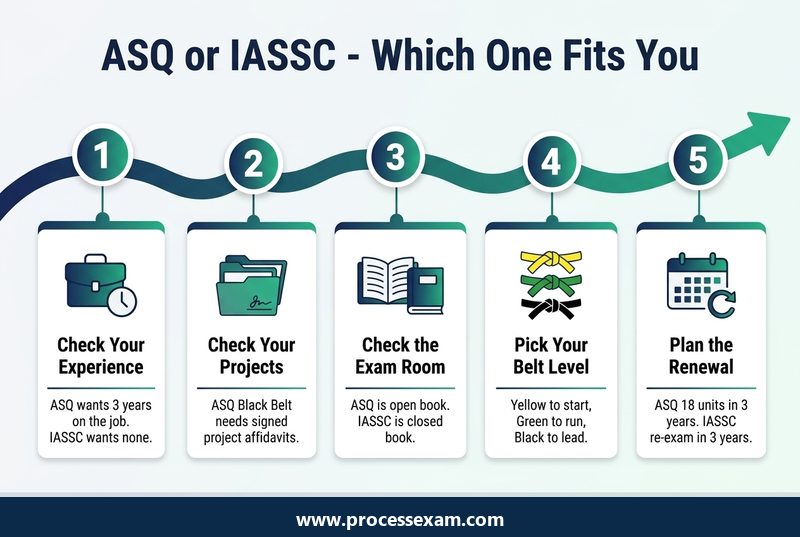
Do you have three years of on-the-job experience?
If yes, the ASQ route is open to you at Black Belt or Green Belt, and the credential will carry the weight of that experience. If no, the ASQ Black Belt and Green Belt are closed for now. That leaves ASQ's Yellow Belt, which has no experience or education requirements, or any of the three IASSC exams.
Can you get a project affidavit signed?
The ASQ Black Belt needs one completed project with a signed affidavit, or two completed projects with signed affidavits. Some candidates have the projects but cannot get a former employer to sign, or the work sits under a confidentiality agreement. If the affidavit is the blocker, the IASSC Black Belt tests comparable DMAIC depth without it.
Do you read better with your books or without them?
Be honest about this one. If your strength is structured reference work and you already own a handbook you know well, ASQ's open-book format plays to it. If you retain material by recall and dislike hunting through references under time pressure, IASSC's closed-book format will feel fairer to you.
Ready to find out where you stand?
Before you buy a voucher or open an application, sit a full-length timed test and see what your score looks like today. If you are heading down the IASSC route, our ICBB practice exam follows the 150-question, 240-minute shape of the real thing. If ASQ is your route, our CSSBB practice exam mirrors the 165-question format so you can rehearse the pace as well as the content. Either way, one honest timed attempt tells you more about your readiness than another week of reading.
And if you are just starting out?
At Yellow Belt level the decision matters least. Both the ASQ Yellow Belt and the IASSC Yellow Belt are open to anyone, both are the cheapest exam their body offers, and both prove foundational knowledge rather than capability. Pick the one whose parent body you expect to stay with, because the belt above it is where the real difference shows up.
What does it cost to keep each credential current?
Candidates compare exam fees and forget renewal. Over five years the renewal rules can cost more than the exam did.
ASQ
ASQ's recertification page sets out the requirement as obtaining 18 recertification units within a three-year recertification period, or retaking the certification exam. Units come from the professional activity you are doing anyway: employment in the field, training, courses, conferences, publishing and volunteering. You submit a journal documenting them, or you retake the exam within six months of your recertification date.
Importantly, this does not apply to every ASQ belt. ASQ lists the Six Sigma Black Belt among the certifications that require recertification, and states that the Six Sigma Green Belt and Six Sigma Yellow Belt are lifetime certifications with no recertification requirements. So an ASQ Green Belt is a one-off cost; an ASQ Black Belt is a commitment.
IASSC
IASSC's recertification page explains that a certification holds "Current" status for three years from the date it is awarded, after which it is classified as elapsed unless the professional recertifies. Recertification is done by a limited re-examination rather than by collecting units, and the fees listed are $235 for Black Belt, $175 for Green Belt and $115 for Yellow Belt. An elapsed certification is not revoked; a professional who lets it lapse can regain current status by passing a full certification exam again.
The difference in philosophy is consistent with everything else. ASQ recognises the work you do between exams; IASSC re-tests you. If you are in a role that naturally generates training hours and conference attendance, ASQ's journal is easy. If you are not, a shorter re-examination every three years may be simpler than documenting units.
How should you prepare, whichever body you choose?
The preparation problem is the same in shape for both exams: a wide body of knowledge, a tight clock and questions that punish shallow familiarity. A plan that works for either looks like this.
Start from the published body of knowledge, not a course
Download the body of knowledge for the exact exam you are taking and turn it into a checklist. Every line becomes a row you mark as "can explain", "can apply" or "not yet". This is the single highest-value hour in the whole process, because it converts a vague subject into a finite list. It also stops you studying a Green Belt syllabus for a Black Belt exam, which happens more often than you would think.
Fix the statistics early
For both bodies, the measure and analyze phases carry the most marks and the most pain. Hypothesis testing, measurement system analysis, capability indices, control chart selection and regression are where candidates lose exams. Work these in the first third of your plan while you still have time to repair gaps, and revisit them weekly rather than cramming them at the end.
Use real projects as your worked examples
Both exams ask you to choose a tool for a situation. The fastest way to build that judgement is to take improvement work you have seen, at any scale, and walk it through DMAIC properly: what was the problem statement, what was measured, what did the data say, what changed, and how was the change held. Candidates who do this answer situational questions on recognition rather than by reasoning from first principles, which is what saves time on the clock.
Rehearse the format, not only the content
Once you have covered the body of knowledge, shift to full-length timed attempts under the real conditions. For ASQ that means your reference set on the desk, tabbed as you intend to use it. For IASSC that means nothing on the desk at all. Score each attempt, sort every wrong answer by body-of-knowledge section, and study the section with the most errors before your next attempt. Two or three cycles of that will move a borderline score into a comfortable one.
Avoid the five habits that fail candidates
- Applying without checking eligibility. For ASQ, confirm the experience and affidavit requirements before you pay; an application that fails review costs you a testing window.
- Comparing 550/750 with 70 per cent. They are different scales. Track your readiness in practice scores under each exam's own format.
- Treating open book as a safety net. An unindexed reference costs you time you do not have.
- Skipping Lean content on the IASSC route. IASSC's credentials are Lean Six Sigma; the Lean material is examinable, not decoration.
- Ignoring renewal. Budget for 18 recertification units every three years on an ASQ Black Belt, or a re-examination fee every three years on any IASSC credential.
A realistic timetable
Most working candidates need eight to twelve weeks for a Black Belt at either body, and four to six weeks for a Green Belt, studying most evenings. Spend the first half on the body of knowledge section by section, the second half on timed practice and error review, and keep the last few days for your own notes rather than new material. If your practice scores are still drifting a week before the exam, move the date. Both bodies charge less for a retake than for a wasted first attempt is worth to you in lost time.
Whichever name ends up on your certificate, the market rewards what you can do with the method far more than the badge itself. Choose the body whose requirements you can actually meet, prepare against its published body of knowledge, and rehearse under its real conditions. That is what "recognized" turns into on the day someone reads your CV.
Frequently Asked Questions
Is ASQ or IASSC more recognized for Six Sigma?
Both are widely recognized, and neither owns the standard. ASQ is the name most often seen in North American quality and manufacturing roles, while IASSC is common wherever accredited training providers lead to an independent exam. Search job adverts in your own industry and region before deciding.
Does IASSC require work experience or a project?
No. IASSC states that there are no prerequisites required in order to sit its Lean Six Sigma Black Belt, Green Belt or Yellow Belt exams. Training and real-world experience are recommended but not mandatory, so certification depends entirely on passing the closed-book proctored exam.
What experience does the ASQ Black Belt require?
ASQ asks for three years of on-the-job experience in one or more areas of the CSSBB Body of Knowledge in a full-time, paid role, plus one completed project with a signed affidavit or two completed projects with signed affidavits. The Green Belt needs the experience without a project.
How much do the ASQ and IASSC Six Sigma exams cost?
ASQ lists CSSBB at MEMBERS $485, NON-MEMBERS $585 and RETAKES $385, CSSGB at $383, $483 and $283, and CSSYB at $334, $434 and $234. IASSC vouchers are $450 for ICBB, $350 for ICGB and $250 for ICYB.
Are the ASQ and IASSC passing scores the same?
No, and they cannot be compared directly. ASQ Six Sigma exams are reported as a scaled score with 550 out of 750 required, while IASSC requires a minimum of 70 per cent. A scaled score is not a raw percentage, so judge readiness by timed practice under each format.
Which Six Sigma exam is longer, CSSBB or ICBB?
The ASQ CSSBB has 165 questions with a total appointment time of 270 minutes and 258 minutes of exam time. The IASSC ICBB has 150 questions in 240 minutes. The pace works out similarly, at roughly a minute and a half per question on both.
Do Six Sigma certifications expire?
It depends on the credential. ASQ requires 18 recertification units every three years for the Six Sigma Black Belt, while its Green Belt and Yellow Belt are lifetime certifications. IASSC certifications hold current status for three years and are renewed by a limited re-examination.
- Lean Six Sigma |
- Six Sigma |
- ASQ Six Sigma Black Belt Sample Questions |
- ASQ Six Sigma Black Belt Test Questions |
- CSSBB Question Bank |
- CSSBB Exam Questions Download |
- CSSBB Test Questions |
- Six Sigma Black Belt PDF |
- IASSC Lean Six Sigma Black Belt Sample Questions |
- ICBB Exam Questions Download |
- ICBB Test Questions |
- Lean Six Sigma Black Belt PDF |
- Lean Six Sigma Black Belt Certification Requirements |
- IASSC Lean Six Sigma Black Belt Book |
- IASSC ICBB BOK PDF |
- Lean Six Sigma Black Belt Certification Cost |
- ASQ Six Sigma Black Belt Book |
- ASQ CSSBB BOK PDF |
- Six Sigma Black Belt Certification Cost |
- Six Sigma Black Belt Certification Requirements |
- IASSC Lean Six Sigma Black Belt Test Questions |
- ICBB Question Bank |
- ICBB Body of Knowledge (BOK) |
- CSSBB Body of Knowledge (BOK) |
- CSSBB Handbook


