
LEED Green Associate Exam Prep: 10 Tips for the LEED v5 Exam
Updated on 21 September 2026. What’s new: updated for the LEED v5 Green Associate exam, which replaced the LEED v4 exam in 2026.
Two office blocks on the same street can run up very different energy bills, and most of that gap was settled before anyone switched on a light: which way the building faces, how much glass it has, how well the envelope is sealed, how big the heating and cooling plant is, and whether anyone meters it. The LEED Green Associate exam tests whether you understand those choices. You pass with 170 out of 200 across 100 questions in two hours, now set on LEED v5.

Why does a building's energy bill explain what the LEED Green Associate exam tests?
An energy bill is where the design decisions show up. The meter can't tell a good architect from a careless one, but twelve months of bills can. A deep plan with no daylight needs electric lighting all day, and the lights add heat that the cooling system then has to remove. A west-facing glass wall with no shading lets in the low afternoon sun, and the cooling plant pays for it every summer. Oversized air handlers, sized for a worst case that never arrives, run inefficiently for most of their working life. None of these problems appears on the drawings as a line item. They turn up later as operating cost and as carbon.
LEED is a way of making those decisions on purpose, early, and with the whole project team in the room. The Green Associate credential is the foundation level: it does not ask you to model a building's energy use or run a commissioning plan. It asks whether you understand why each decision matters, how the decisions affect one another, and which part of the rating system deals with each one. A candidate who can look at that energy bill and say which design choices produced it is already thinking the way the exam wants.
The bill is only one of three impact areas
LEED v5 organises its intent around three impact areas: decarbonization, quality of life, and ecological conservation and restoration. The energy bill sits squarely in the first. But the same building choices reach into the other two as well. The daylight that cuts lighting energy also shapes how the people inside feel and work. The site that gives commuters a train instead of a car park reduces emissions and protects land that would otherwise have been paved. The exam rewards candidates who see those connections, because that is what a LEED project team has to do every day.
Why this matters for how you study
Candidates who memorise each credit category as a separate list tend to struggle, because many questions are not about a single category. They describe a situation and ask what follows from it. Keep one building in your head as you study, and ask of every topic what it would do to that building's bills, its occupants and its site. It is the quickest way to turn a long reference guide into something you can reason with under time pressure.
What changed when the exam moved to LEED v5 in 2026?
This is the single most important thing to know before you buy any study material, because a large share of what is still online describes an exam that no longer exists. According to USGBC's LEED v5 exam information page, 26 April 2026 was the last day to sit the LEED v4 Green Associate exam. A beta version of the LEED v5 exam ran from 28 April to 30 June 2026, and USGBC gives October 2026 for the final LEED v5 Green Associate exam. GBCI's LEED Green Associate Candidate Handbook, updated September 2026, states that the exam now assesses knowledge of green building practices and the LEED v5 rating system.
What is new in the content
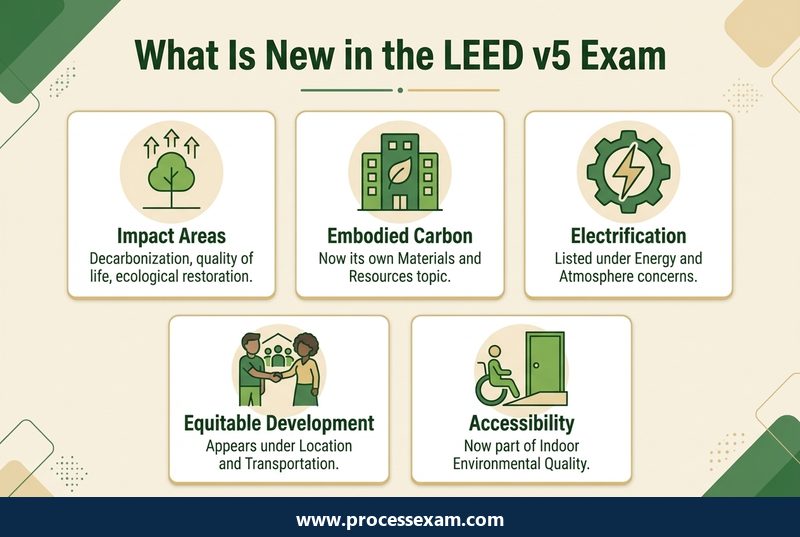
Several topics that were minor or absent in the older outline now appear by name in the v5 exam specifications. The three impact areas – decarbonization, quality of life, and ecological conservation and restoration – are part of the LEED Process domain. Embodied carbon is its own topic under Materials and Resources. Electrification and decarbonization appear among the environmental concerns in Energy and Atmosphere. Equitable development appears under Location and Transportation, and accessibility and inclusion under Indoor Environmental Quality. The list of LEED categories you are expected to know includes PR alongside the familiar EA, EQ, IP, LT, MR, SS and WE.
What did not change
The shape of the exam is the same: 100 multiple-choice questions, two hours, a scaled score with 170 as the pass mark, and no eligibility requirement. The fee on USGBC's credential page is also unchanged. So the logistics you may have read about in an older guide still hold. The content behind them is what has moved.
Language and references
The handbook says the exam is currently available in English only, with translated versions expected in 2027. It names the LEED Core Concepts Guide, 5th Edition (2026) as a reference, alongside Foundations of LEED, the Guide to LEED Certification: Commercial and USGBC's rating system selection guidance. If a book, course or question set you are considering still talks only about LEED v4 credits, treat it as background reading, not preparation. Where an older web page and the September 2026 handbook disagree, the handbook is the document to trust.
How is the LEED Green Associate exam structured and scored?
The core facts fit in one table. The figures below come straight from our exam records and agree with USGBC's LEED Green Associate credential page.
| LEED Green Associate exam detail | Value |
|---|---|
| Credential | Certified LEED Green Associate |
| Exam code | GA |
| Vendor | USGBC (exams administered by GBCI) |
| Rating system tested | LEED v5 (GBCI candidate handbook, September 2026) |
| Number of questions | 100 |
| Duration | 120 minutes |
| Passing score | 170 out of 200 |
| Exam fee | $250 ($100 for students, $200 for USGBC members) |
| Eligibility | None |
| Delivery | Prometric test center or remotely proctored online |
How the scaled score works
GBCI reports your result on a scale from 125 to 200, and 170 or higher is a pass. The score appears on screen as soon as you finish, and a score report follows by email. Within 72 hours your Credentials Dashboard is updated. Because the score is scaled rather than a raw count, there is no official number of correct answers to aim for, and trying to work one out is wasted effort. Aim for comfortable strength across all eight domains instead.
Scored and unscored questions
Not every question counts. The paper mixes scored questions with unscored ones that GBCI is testing for future use, and you are not told which is which. The eight knowledge domains add up to 85 scored questions, which leaves the rest of the 100 as unscored items spread through the exam. Answer everything: a question that looks unusually strange may be one of the unscored ones, or it may not, and a blank earns nothing either way.
Three kinds of question
The handbook describes three cognitive levels. Recall questions check facts from the references. Application questions give you a new situation and ask you to apply a familiar principle. Analysis questions ask you to break a problem into parts and weigh how they interact. The last two are where the energy-bill way of thinking pays off, and they are the reason reading alone rarely gets a candidate to 170.
Which knowledge domains carry the most questions?
The LEED v5 exam specifications divide the 85 scored questions across eight knowledge domains. The weighting is uneven, and knowing where the questions sit is the simplest way to decide where your hours go.
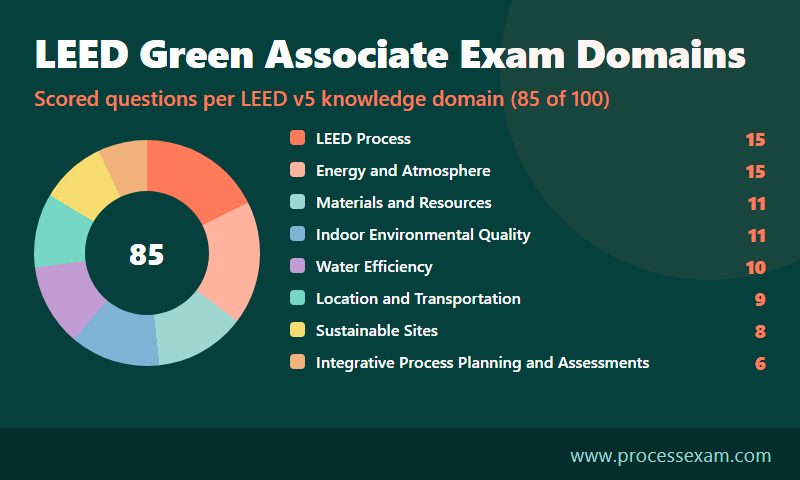
LEED Process – 15 questions
The rating system itself: what USGBC and GBCI each do, how LEED rating systems are structured with prerequisites, credits and Minimum Program Requirements, the rating system families such as BD+C, ID+C and O+M, how a project chooses between them, the certification process and its review phases, certification levels, addenda and LEED Interpretations, how LEED is developed by consensus, and the three impact areas. This domain is pure LEED knowledge, and experience in construction does not supply it.
Energy and Atmosphere – 15 questions
The energy bill domain. It covers building loads and what drives them, energy efficiency including energy modeling and passive design strategies, alternative and renewable energy practices such as energy storage, green power and renewable energy certificates, energy performance management through benchmarking, metering and commissioning, and environmental concerns including electrification, decarbonization, greenhouse gases, global warming potential and refrigerant management.
Materials and Resources – 11 questions
Life-cycle impacts and the idea of life-cycle assessment, embodied carbon, product purchasing and declarations including raw material sourcing and volatile organic compounds, reuse and recycling of buildings, furniture and materials, and waste through construction, operation and renovation.
Indoor Environmental Quality – 11 questions
Indoor air quality, from construction practice and filtration to ventilation and monitoring; lighting and glare; sound and acoustics; thermal conditions and occupant control; biophilic design; and accessibility and inclusion.
Water Efficiency – 10 questions
Outdoor water use and irrigation, indoor water use including low-flow and waterless fixtures and process water, and water performance management through metering, leak detection, cooling towers and water quality.
Location and Transportation – 9 questions
Site selection that avoids sensitive habitats and favours previously developed land and existing infrastructure, transportation demand management including alternative modes and vehicle miles traveled, and equitable development.
Sustainable Sites – 8 questions
Site assessment and site design: construction site measures, open space, habitat conservation and restoration, heat island reduction, light pollution reduction and rainwater management.
Integrative Process Planning and Assessments – 6 questions
The smallest domain, and the one that ties the rest together: early assessment, systems thinking, life cycle cost analysis, and who belongs on an integrative project team.
Two domains, LEED Process and Energy and Atmosphere, hold 30 of the 85 scored questions between them. Our LEED Green Associate syllabus page lists every subtopic under each of the eight domains in the same order as the handbook, which makes it a useful checklist to tick off as you study.
What are the 10 tips that actually move a LEED Green Associate score?
These ten are ordered roughly as you would use them: the first few shape what you study, the middle ones shape how, and the last ones cover the weeks and days before the exam.
1. Study from the September 2026 handbook, not a LEED v4 guide
Open GBCI's current candidate handbook before anything else and read its exam specifications and reference list. Then check every resource you plan to use against it. A guide organised around the old v4 outline will spend time on material that has moved and miss topics such as embodied carbon, the impact areas and equitable development that now appear by name. This one check saves more wasted hours than any study technique.
2. Learn the three impact areas before the credits
Decarbonization, quality of life, and ecological conservation and restoration are the frame LEED v5 hangs everything else on. If you know which impact area a strategy serves, you can often reason your way to an answer even when you cannot remember the exact credit. Learn them first and file each new topic under one or more of them as you go.
3. Put your hours where the questions are
LEED Process and Energy and Atmosphere carry 15 scored questions each. Integrative Process Planning and Assessments carries six. Spending equal time on every domain feels fair but is not efficient. Start with the two heavy domains, give the three mid-weight ones (Materials and Resources, Indoor Environmental Quality and Water Efficiency) the next share, and finish with the rest, without skipping anything, since every domain appears on the exam.
4. Read the LEED Process domain as a project timeline
Candidates with building industry experience often underrate this domain because it has nothing to do with construction. Turn it into a story you can retell: a project picks a rating system, registers, meets the prerequisites and Minimum Program Requirements, documents its credits, goes through review, and receives a certification level. Then add what can change along the way: addenda, LEED Interpretations and regional compliance. A timeline is far easier to recall than a list of terms.
5. Follow one building through all eight domains
Pick a building you know – your office, a school, a hospital near home – and walk it through each domain in turn. Where is it located, and how do people get there? How does it handle rainwater and heat? What does it use for water, and where could that use fall? What drives its energy bill? What is it built from, and where will those materials go? How does it feel to be inside? Once the concepts are attached to a real place, the scenario questions become much easier.
6. Keep a single sheet of terms and acronyms
The exam specifications are full of short forms and technical terms: VMT, REC, LCA, VOCs, global warming potential, heat island, graywater, monitoring-based commissioning, embodied carbon. Write each one on one running sheet with a plain-English definition and one example of where it would show up in a building. Revise from that sheet, not from the full reference guide, in the final week.
7. Treat synergies and trade-offs as a topic in their own right
The handbook lists synergies among the goals of the LEED categories, and many analysis questions are built on them. More glazing brings daylight but can add heat gain and glare. A dense urban site cuts driving but limits space for on-site rainwater management. Low-emitting materials help indoor air quality and can also change what you buy. Collect examples like these, in both directions, as you study. They are where recall questions turn into analysis questions.
8. Practise under the real clock
One hundred questions in 120 minutes gives you a little over a minute each, and some scenario questions take longer than that. Make the first full paper a timed one, not a relaxed one, so that pacing becomes something you have trained rather than something you discover on the day. If you plan to test online, remember there are no breaks, so practise sitting the full two hours without getting up. When you are ready to measure yourself against that clock, a timed LEED Green Associate (GA) mock exam will show which of the eight domains is costing you the most time and marks.
9. Diagnose every miss by domain and by question type
After each practice session, sort the questions you got wrong twice: once by domain, and once by whether they were recall, application or analysis. A cluster of recall misses in one domain means you need to reread it. A cluster of analysis misses anywhere means you need more synergy and scenario work, not more reading. Put the next study session where the worst cluster is.
10. Settle the logistics well before the exam
Your ID must exactly match the name you registered with, in Roman characters, and GBCI asks for at least 10 business days' notice to correct a mismatch. Decide early between a Prometric test center and an online exam, and if you choose online, run the system check well before the day. Book a date you can keep: rescheduling is free only 46 or more days ahead, as the next section explains. Plan to arrive, or log in, 30 minutes early.
What should you expect at the appointment, and how do retakes work?
The handbook asks you to allow 2 hours 20 minutes for the whole appointment, which covers more than the two hours of questions. At a test center you can take a break by raising your hand, but the clock keeps running. Online, breaks are not permitted, and leaving the webcam's view forfeits the session and the fee. In both settings you can flag questions, skip them and change answers before you finish, so a sensible pattern is a quick first pass, flagging anything that needs more than a minute or two, then a second pass through the flagged ones.
Rescheduling and cancelling
GBCI's refund policy, effective 1 January 2025, depends on how far ahead you act. Forty-six days or more before the exam, you can reschedule or cancel with no fee. From 30 to 45 days, a $30 fee applies. From 4 to 29 days, the fee is $60. Within three days of the exam you cannot reschedule or cancel, and missing the appointment forfeits the whole registration fee. After you register, you have 12 months to sit the exam before the registration lapses.
If the result is below 170
You can register and pay again in the same way as the first time. The limit comes later: after three unsuccessful attempts within 12 months, counted from the first failed attempt, you must wait 90 calendar days before registering again. Every attempt carries the full exam fee. Use the time to repeat tips 8 and 9: resit when your timed practice scores on questions you have not seen before have moved, not when the disappointment has faded.
If you think a question was wrong
Leave a comment on the question during the exam using the comment button, then tell GBCI within 10 business days. GBCI does not change scores; if an appeal succeeds, you are offered a free retest instead.
How do you keep the credential, and what is it worth to your career?
Passing gives you the right to call yourself a LEED Green Associate. Note that GBCI does not approve the abbreviation “LEED GA”, so use the full title on a CV or email signature. You can download your certificate from the Credentials Dashboard once your result has been processed.
The maintenance requirement
The credential runs on a two-year reporting period that starts on your exam date. Within it, you need 15 continuing education hours, reported in your Credentials Dashboard, before you renew. GBCI's credential maintenance program guide explains which activities count and how to report them. Fifteen hours over two years is a light load for anyone working in the field, but set a reminder the week you pass so that the deadline does not arrive unnoticed.
Who the credential is for
The Green Associate is the entry point to LEED credentials. It suits architects, engineers and interior designers early in their careers, contractors and site managers, facility and property managers, sustainability coordinators, product manufacturers and their sales teams, real estate and finance professionals who evaluate buildings, and students who want to show a green building grounding before their first role. It shows that you share a common language with the LEED project team, which is what makes you useful to one.
What it leads to
It is also the natural first step toward the LEED AP with specialty credentials, which go into one rating system family in depth. Because the Green Associate is now built on LEED v5, passing it in 2026 means your foundation matches the version new projects are moving to. That matters more than it sounds: a project team still arguing in v4 terms spends its first meetings translating.
What it does not do
It is not a licence, and it does not make you a building designer or an energy modeller. Nor does it guarantee a pay rise; what it does is show you can hold your own when the design team discusses the choices that will decide the building's energy bill for the next few decades. Back to the office blocks from the start of this article: a Green Associate can explain why one of those bills is higher and point to the decisions that caused it. That is the knowledge the exam checks, and the ten tips above are the way to build it.
Frequently Asked Questions
How hard is the LEED Green Associate exam?
It is a foundation exam, but it is not a formality. You need 170 on a 125 to 200 scale across 100 questions in two hours, and many questions ask you to apply or analyse rather than recall. Candidates who study the current LEED v5 outline and practise under time pressure are the ones who pass comfortably.
How do you become a LEED Green Associate?
Register for the exam in your USGBC Credentials account, pay the fee and schedule with Prometric at a test center or online within 12 months. There is no eligibility requirement. Score 170 or higher to earn the credential, then keep it by reporting 15 continuing education hours every two years.
How much does the LEED Green Associate exam cost?
The exam costs $250, with a reduced fee of $200 for USGBC members and $100 for students. Each attempt is paid separately. Rescheduling or cancelling is free 46 or more days ahead, costs $30 between 30 and 45 days and $60 between 4 and 29 days.
Is the LEED Green Associate exam based on LEED v4 or LEED v5?
LEED v5. The last LEED v4 Green Associate exam was on 26 April 2026, a beta LEED v5 exam ran from 28 April to 30 June 2026, and GBCI's candidate handbook, updated September 2026, sets the exam on the LEED v5 rating system across eight knowledge domains.
What is the passing score for the LEED Green Associate exam?
The passing score is 170 out of 200. GBCI reports results on a scaled range from 125 to 200, and your score appears on screen when you finish. Because the exam also contains unscored questions and the score is scaled, there is no fixed number of correct answers that guarantees a pass.
- USGBC LEED Green Associate Exam Questions |
- USGBC LEED Green Associate Question Bank |
- USGBC LEED Green Associate Questions |
- USGBC LEED Green Associate Study Guide |
- LEED Green Associate Certification |
- USGBC LEED GA Questions |
- USGBC LEED Green Associate Book |
- USGBC LEED GA Question Bank |
- USGBC LEED GA Book |
- USGBC LEED GA Study Guide |
- LEED GA Certification |
- LEED GA Certification Cost |
- LEED GA Certification Requirements |
- USGBC LEED Green Associate Sample Questions |
- LEED Green Associate PDF |
- USGBC LEED GA Exam Questions |
- USGBC LEED GA Sample Questions |
- LEED GA |
- LEED GA PDF |
- USGBC LEED Green Associate |
- LEED Green Associate Certification Cost |
- LEED Green Associate Certification Requirements


