
LEED AP Homes Exam: Questions, Cost and Study Plan
The LEED AP Homes exam is a 100-question, two-hour test that you pass with 170 out of 200. It is the USGBC specialty credential for people who design, build, rate or manage single-family houses and multifamily housing, and it still runs on the LEED v4 rating system rather than v5. The combined route costs $550 ($400 for USGBC members); specialty-only costs $350 ($250 for members).
Most of what you will read about LEED exams in 2026 concerns the new v5 versions of the Green Associate, BD+C, O+M and ID+C tests. Homes is the odd one out, and that changes what you should study. This guide sets out who the credential suits, how a residential LEED project differs from a commercial one, where the 85 scored questions come from, what the fees and rules are, and a six-week plan built around the topics that carry the most marks.
Who is LEED AP Homes for, and what must you hold before you book?
LEED AP Homes suits anyone whose day job puts them close to a house or an apartment block that is aiming for LEED certification. That includes residential architects, builders and site supervisors, framing, insulation and HVAC subcontractors, energy raters, developers, affordable-housing managers and the sustainability consultants who prepare the paperwork. Real estate agents who want to sell green homes credibly take it too, although the exam is written for people who work on projects rather than on listings.
Before you can register you need a current LEED Green Associate credential, or you must sit that exam at the same time. You also need to be at least 18. USGBC strongly recommends experience on LEED-registered projects; that is guidance, not a gate, but the questions are written as project scenarios, and candidates who have never seen a scorecard find them harder than they need to be. The facts every candidate asks about first are below.
| Detail | LEED AP Homes |
|---|---|
| Vendor | USGBC (registered through GBCI) |
| Exam code | AP Homes |
| Questions | 100 |
| Duration | 120 minutes |
| Passing score | 170 out of 200 |
| Fee, combined exam | $550 ($400 for USGBC members) |
| Fee, specialty only | $350 ($250 for USGBC members) |
| Prerequisite | Current LEED Green Associate, or take it at the same sitting |
USGBC keeps the current fees, eligibility rules and delivery options on its LEED AP with specialty page, and the exam outline itself in the LEED AP candidate handbook. Check both when you book, because fees are the detail most likely to change between one edition of a study guide and the next.
How does a LEED home project differ from a commercial LEED project?
The Homes exam does not test the commercial rating systems in miniature. It tests the residential system, which has its own project types, its own people and its own way of proving a credit was earned. If you come from commercial work, this is the section to read twice.
Three project types under one rating system
USGBC groups its residential rating into single-family homes, low-rise multifamily (one to three stories) and mid-rise multifamily (four stories and taller). The residential page also lists a multifamily core-and-shell option for buildings that are not fitted out. A scenario question will usually tell you which type you are dealing with, and the type changes the answer: a detached house on a private lot has no shared corridors to ventilate or common areas to meter, while a mid-rise building has both.
Verification is done on site, by a Green Rater
In commercial LEED the project team assembles documentation and uploads it. In residential LEED, a Green Rater is responsible for verifying every prerequisite and credit, holds preliminary rating meetings with the team, inspects the home during construction and runs diagnostic tests when it is finished. Some Green Raters are also HERS Raters, the professionals who rate a home's energy performance. A Provider organisation then checks the rater's work and submits the final package to GBCI. Once you can name who does what, a large share of the process questions become straightforward.
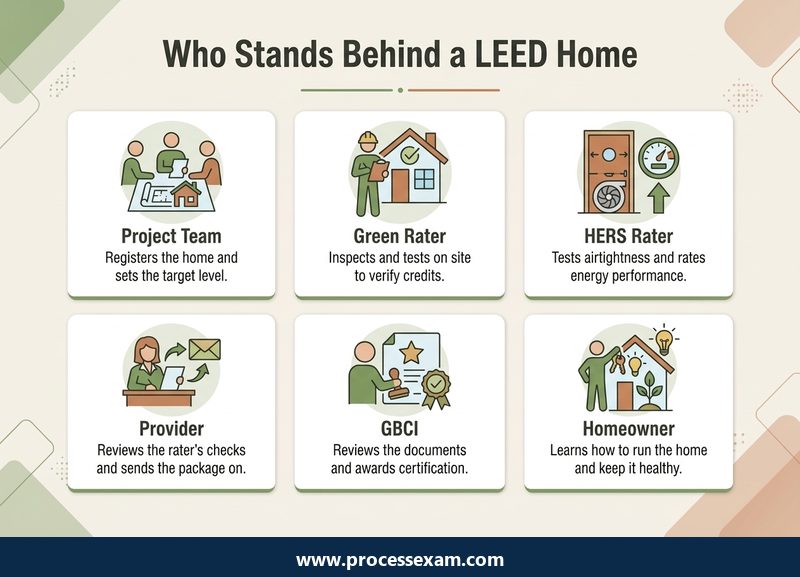
You can read the same structure on USGBC's LEED v4 Homes design and construction guide, which lists the eight credit categories and describes the rater's role. The exam expects you to know the people as well as the credits, because a question that asks who verifies a blower-door result is really a question about the Green Rater.
Certification levels and the scorecard
A home earns Certified, Silver, Gold or Platinum by adding up the points from the credits it pursues. Every prerequisite must be met first; points only count on top of them. The exam does not ask you to memorise the whole scorecard, but it does expect you to know which requirements are mandatory, which are optional, and how a team would trade one against the other when a design changes late.
Where do the 85 scored questions sit in a Homes exam?
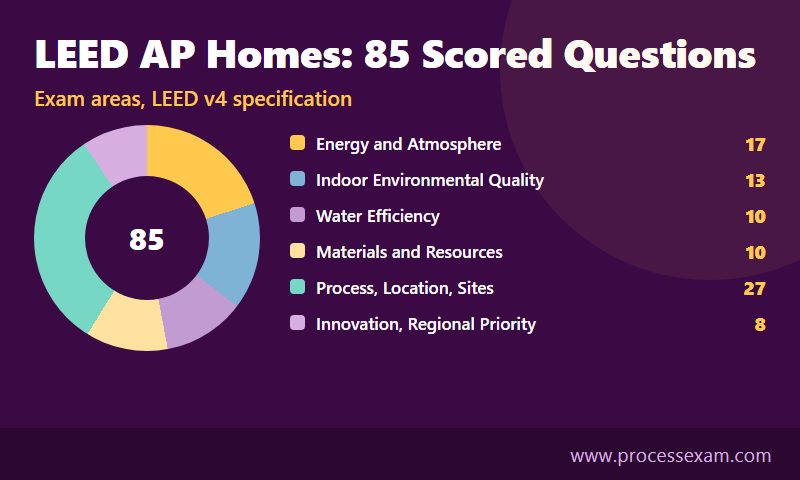
Of the 100 questions you see, 85 are scored and 15 are unscored trial items. The trial items sit at random among the rest, with nothing to mark them out, so answer every question in full. The handbook's specification for LEED AP Homes v4 divides the scored questions across nine areas, and the split is far from even.
| Exam area | Scored questions |
|---|---|
| Energy and Atmosphere | 17 |
| Indoor Environmental Quality | 13 |
| Water Efficiency | 10 |
| Materials and Resources | 10 |
| LEED Process | 9 |
| Location and Transportation | 9 |
| Sustainable Sites | 9 |
| Innovation | 5 |
| Regional Priority | 3 |
| Total scored | 85 |
Two areas together, Energy and Atmosphere and Indoor Environmental Quality, account for 30 of the 85 marks, roughly 35 percent. That is where a house differs most from an office: what happens inside the walls, in the air handling and around the combustion appliances matters more than the site plan. Innovation and Regional Priority together are worth eight marks, so they deserve a short, focused review and no more.
The LEED Process area covers registration, the roles of the team and the certification workflow, including the integrative process at the start of a project. Use the AP Homes syllabus page to line these areas up against your own revision notes.
Is the Homes exam still on LEED v4, and which texts belong on your desk?
The Homes exam is based on LEED v4. USGBC's LEED v5 exam information page names the professional exams rebuilt around v5 and says that Homes, alongside the Neighborhood Development specialty, keeps using the LEED v4 rating system. The handbook's outline is headed as the LEED AP Homes v4 exam specifications. We checked both in September 2026.
Three practical points follow. First, a v4 or v4.1 residential reference is the right reference, not an outdated one; the USGBC residential rating system page shows the current residential material. Second, anything that describes the eight-domain v5 outline, embodied carbon assessment or the v5 impact areas is about another specialty, and it will not help you on this exam. Third, USGBC has not announced when a v5 residential rating system and a matching exam will arrive. Treat today's position as stable for your booking window, and read the v5 page again a fortnight before your date in case that changes.
Your study set can be short: the current candidate handbook, the residential rating system text for the project types, and a scorecard you can fill in yourself. Add practice questions for retrieval, because the exam rewards recall of specific requirements. A residential-specific set such as the AP Homes practice exam lets you test that against a timed run.
What are the fees, format and retake rules on exam day?
You have two routes. The combined exam, at $550 ($400 for USGBC members), is the Green Associate and the Homes specialty in one booking, each part being 100 multiple-choice questions. Specialty only, at $350 ($250 for members), is for people who already hold the Green Associate. If you need both, compare the totals; if you already hold the Green Associate, the second route is the only sensible one.
You sit the exam either at a Prometric testing centre or at home under remote proctoring. Rescheduling and cancelling are allowed up to three days before your appointment, and fees may apply. The handbook adds a retake rule: after three unsuccessful attempts within twelve months, you must wait 90 calendar days before registering and paying again. That is not a reason to be casual about the first attempt, but it does mean one bad day is not final.
The at-home checklist
If you choose remote proctoring, treat it as a separate skill. A quiet room, a cleared desk, a working webcam and a stable connection are conditions of the sitting. Do a system check on the same computer the day before; candidates lose sleep and focus when the software fails on the morning. At a centre, arrive early with the identification your confirmation asks for, and use your first minutes to settle rather than to start.
How do you study each Homes credit category?
Work through the categories in mark order, and for each one build a one-page summary: what the intent is, which items are prerequisites, which credits are optional and what evidence proves each one. The list below is a route through the topics, not a substitute for the rating system text, so confirm every requirement against your reference.
Energy and Atmosphere (17 questions)
This is the heaviest area, and in a house it is about the envelope and the mechanical systems working together. Expect the HERS Index and how it is used to show energy performance, the role of a rater in testing airtightness and duct leakage, insulation quality, efficient hot-water systems, metering, and the education a homeowner or tenant must receive so the building is operated as designed. Learn the difference between a requirement met by design and one that is proved by a test on site; scenario questions often turn on that difference.
Indoor Environmental Quality (13 questions)
Homes are where people sleep, so the exam takes air quality seriously. Study ventilation requirements, combustion venting and how a home's fuel-burning appliances are kept from spilling gases indoors, protection from garage pollutants, radon-resistant construction, air filtering, and control of contaminants during and after construction. Low-emitting products belong here too. A frequent trap is to treat these as design features; several are verified by a test or an inspection before the home is signed off.
Water Efficiency and Materials and Resources (10 questions each)
Water questions cover metering, efficient fixtures and appliances, and outdoor water use through the choice of plants and irrigation. Materials questions cover construction waste management, durability planning, responsibly sourced wood and environmentally preferable products. Both areas reward exact wording: know which items are prerequisites and which earn points.
Location, Sites and Process (9 questions each)
Location and Transportation looks at where the home sits: floodplain avoidance, compact development, nearby community resources and transit. Sustainable Sites covers construction pollution prevention, plant choices, heat island reduction, rainwater management and pest control without toxic products. The Process area is the workflow described earlier, from registration through the rater, the provider and GBCI. These three areas are worth 27 marks between them, nearly a third of the exam, and they are the easiest marks to secure because they reward tidy recall.
Innovation and Regional Priority (8 questions together)
Learn what an innovation credit is meant to reward, how a team earns a point for going beyond a credit's requirements, and how regional priority credits depend on the project's location. Half an evening each is enough.
How to read a residential scenario question
Scenario questions on this exam usually follow one pattern: a short description of a home, a team member or a problem, then a request to choose the correct action. Take a builder who finishes the drywall and discovers that the ventilation fan was never commissioned. The wrong answers tend to be plausible-sounding shortcuts, such as noting it in the paperwork and moving on. The right answer usually sends the issue back to whoever verifies it, in this case the Green Rater, and corrects the work before the final test.
Read the last sentence first so you know whether the question asks who, what or when. Then check the project type, because a low-rise multifamily building and a single-family house can lead to different answers to the same question. Eliminate any option that skips a prerequisite, and prefer the one that keeps the rater's on-site verification in the chain. When two options both look defensible, the better one is normally the option that is verified rather than merely stated.
Finally, watch for absolute words. An option that says a credit is always required, or that a step is never needed, is rarely right in a rating system built on choices between prerequisites and optional credits. Practise this habit in your error log: for every miss, write down the single clue in the question you overlooked.
How should you divide your study weeks, and what can you skip?
This plan assumes about six hours a week and some exposure to residential construction. If the vocabulary is new, add a week at the start and read the handbook outline before anything else.
| Week | Focus | What you finish |
|---|---|---|
| 1 | Process and roles | Project types, the Green Rater, the provider, GBCI and the certification path |
| 2 | Energy and Atmosphere | HERS Index, testing, hot water, metering and homeowner education |
| 3 | Indoor Environmental Quality | Ventilation, combustion venting, garage and radon protection, contaminants |
| 4 | Water, Materials, Sites, Location | One-page summaries and a list of every prerequisite |
| 5 | Practice under time | Two full 100-question runs, with every wrong answer logged |
| 6 | Repair and rest | Rework the errors you made twice, then stop adding material |
Using timed practice from week five gives you a realistic idea of pace: 100 questions in 120 minutes leaves a little over a minute for each. Take one full practice exam at your usual working hour, without notes, and mark every question you guessed rather than only those you got wrong. A lucky guess hides a gap.
Mistakes that cost marks
- Studying commercial material. Rating-system logic from BD+C or ID+C does not carry over to houses, and v5 wording will mislead you on a v4 exam.
- Ignoring the people. Many process questions are really asking who verifies, who reviews and who submits.
- Mixing up prerequisites and credits. A requirement that must be met is not a point you can trade away.
- Skipping the test-based items. Airtightness, duct leakage and ventilation are proved on site, and the exam treats the test as part of the answer.
- Spending evenings on Innovation and Regional Priority. Eight marks do not justify three hours.
- Leaving all practice to the last weekend. Errors you find in week five can still be fixed.
Whatever practice material you use, the rule is the same: every wrong answer goes in a log, tagged by exam area, and the area with the longest list gets your next session.
Is the credential worth holding, and how do you keep it?
For people in residential work, LEED AP Homes is a clear, recognisable signal that you can guide a home through a green rating rather than simply build to a specification. Builders use it to bid on projects that require LEED experience, raters use it to widen their services, and developers and housing managers use it to manage certification of a portfolio. We do not quote salary figures here, because the credential's effect on pay depends on local markets and roles, and we would not want to invent a number.
The credential is not permanent. To keep it active, a LEED AP must earn and report 30 hours of continuing education inside the first two years after passing. Plan CE around the work you actually do: courses on residential ventilation, energy rating or affordable-housing programmes count for more, in practical terms, than a generic seminar. If you plan to add another specialty later, remember that BD+C, O+M and ID+C now sit on LEED v5 while Homes sits on v4, so a second credential means learning a different version of the framework.
When your first pass through the notes is done, run one full timed practice exam and compare the score with your week-five result. If the score has risen and the error log is shorter, book the exam. If the same areas keep appearing, spend a few more evenings on them, then book anyway; more reading rarely closes a gap that practice has already located.
Frequently Asked Questions
What is the LEED AP Homes exam?
LEED AP Homes is a USGBC specialty credential exam for professionals who work on single-family and multifamily LEED projects. It has 100 multiple-choice questions in 120 minutes and needs 170 out of 200 to pass. You must hold, or sit at the same time, the LEED Green Associate exam.
How many questions are on the LEED AP Homes exam?
The specialty exam has 100 multiple-choice questions, of which 85 are scored and 15 are unscored trial items placed at random. You cannot tell which are which, so answer all of them. The largest scored area is Energy and Atmosphere with 17 questions.
How much does the LEED AP Homes exam cost?
The combined exam, which includes the Green Associate, costs $550, or $400 for USGBC members. The specialty-only exam costs $350, or $250 for members. Confirm the current fee on USGBC's LEED AP page when you book, since fees can change between editions of any guide.
What score do you need to pass LEED AP Homes?
You need at least 170 out of 200 to pass. The score is scaled, so it is not a simple percentage of correct answers. Timed practice tests and an error log by exam area give a better readiness signal than any fixed percentage you may see quoted elsewhere.
Is the LEED AP Homes exam based on LEED v4 or v5?
It is based on LEED v4. USGBC keeps Homes on the LEED v4 rating system, together with Neighborhood Development, while Green Associate, BD+C, O+M and ID+C moved to v5. Check USGBC's exam information page before booking.
- LEED Accredited Professional |
- USGBC LEED Accredited Professional Homes Test Questions |
- AP Homes Question Bank |
- LEED AP Homes Simulator |
- LEED AP Homes Mock Exam |
- USGBC LEED Accredited Professional Homes Book |
- LEED Accredited Professional Homes Certification Cost |
- LEED Accredited Professional Homes Certification Requirements |
- USGBC LEED AP Homes Question Bank |
- USGBC LEED AP Homes Book |
- USGBC LEED AP Homes Study Guide |
- LEED AP Homes Certification |
- LEED AP Homes Certification Cost |
- LEED AP Homes Certification Requirements |
- USGBC LEED Accredited Professional Homes Sample Questions |
- AP Homes Exam Questions Download |
- AP Homes Test Questions |
- LEED Accredited Professional Homes PDF |
- USGBC LEED AP Homes Exam Questions |
- USGBC LEED AP Homes Sample Questions |
- LEED AP Homes |
- LEED AP Homes PDF |
- USGBC AP Homes Handbook


