
Kaizen vs Six Sigma: Daily Habit or Data Project?
Walk through almost any plant or office improvement programme and you will hear Kaizen and Six Sigma used as if they were two words for the same thing. They are not. Kaizen is a habit the whole workforce keeps, in which small changes are made continuously by the people doing the work. Six Sigma is a method a trained team applies, in which data has to prove that the cause of a defect was found before anybody claims a fix.
Both end with a better process, so the muddle is forgivable. What it costs is time. Teams charter a four-month statistical project to solve something an operator could have fixed on Tuesday, or run a week of workshops at a defect whose cause nobody has measured and watch it return by the next quarter. This article sets the two side by side on origin, practice, evidence, cadence and scope, shows where a kaizen event genuinely belongs inside a DMAIC project, and ends with the belt exams that test both.

Where did Kaizen and Six Sigma come from, and why does the origin still show?
The two approaches were born in different decades, in different industries, to solve problems their founders described in different language. That history is not trivia. It explains why one of them needs nobody's permission and the other arrives with a charter.
Kaizen grew out of rebuilding Japanese industry
Kaizen is a Japanese word that translates as improvement, or change for better. After the Second World War, American advisers helped rebuild Japanese manufacturing; the statistician W. Edwards Deming arrived in 1947 to work on production processes and brought the Plan-Do-Check-Act cycle with him. The wartime Training Within Industry programme had already taught the habit of improving in small steps, and a 1951 training film titled Improvement in Four Steps put the word in front of Japanese managers. Toyota then made it the spine of the Toyota Production System, and Masaaki Imai's 1986 book Kaizen: The Key to Japan's Competitive Success carried the idea to the rest of the world. Wikipedia's account of kaizen traces that chain of events and names the tools that travelled with it.
Six Sigma grew out of an engineering quality department
Six Sigma appeared the same year on the other side of the Pacific. Bill Smith, an American engineer at Motorola, introduced it in 1986; Motorola registered the name as a service mark in 1991 and as a trademark in 1993. Jack Welch made it central to General Electric's business strategy in 1995, and by 1998 GE announced 350 million dollars of cost savings from it, which is the moment the approach stopped being a manufacturing speciality and became a board-level programme. The name itself is statistical: it refers to the fraction of a normal curve lying within six standard deviations of the mean, and a six sigma process is defined as one running at long-term defect levels below 3.4 defects per million opportunities, as the Six Sigma entry sets out.
Read those two paragraphs again and the difference in temperament is already visible. One approach came from training the people on the floor, so it assumes everybody improves and nobody needs approval to tidy a bench. The other came from an engineering department at a company losing market share, so it assumes specialists, evidence and a number in the annual accounts. Thirty years later, both still behave that way.
What does Kaizen ask a team to do every day?
Kaizen asks for participation before it asks for technique. The principle is that everyone takes part in improving the work, from the chief executive down to the person on the assembly line, and that the improvements are small enough to be made without a budget request. A team practising it well produces a steady stream of minor changes rather than an annual list of large ones.
The loop is deliberately small
The engine is Plan-Do-Check-Act, also known as the Shewhart or Deming cycle. Plan a change to one step of the work, do it on a limited scale such as one shift or one machine, check what actually happened rather than what was expected, then act by adopting it, adjusting it or dropping it. Because the loop is small, a wrong guess costs a day, which is exactly why people are willing to guess.
The tools are simple on purpose
The best known is 5S, from the Japanese seiri, seiton, seiso, seiketsu and shitsuke, which orders a workplace by sorting out what is not needed, giving everything that remains a place, cleaning so that abnormal conditions are visible, writing the result down as the standard and then keeping to it. Alongside it sit standard work and suggestion systems, and a prompting checklist sometimes written as the 7M list, covering man, machine, material, method, milieu, management and measurability, which stops a team blaming the operator before it has looked at the fixture.
The kaizen event packages the habit
Where the daily habit is not yet established, organisations run a kaizen event, also called a kaizen blitz, which takes one particular issue over the course of a week. A lighter quick kaizen variant is finished within a few weeks and needs only limited involvement from the team. The pattern in either case is the same: the people who do the work rearrange it while the improvement adviser keeps the room honest, and the new standard is written down before anybody goes home. Nothing in that week requires a statistical test, and that is the point.
The failure mode is equally predictable. Kaizen dies wherever an hour spent improving the work is counted as an hour not producing. No statistical method can rescue it, because the missing ingredient is permission, not technique.
What does Six Sigma do with variation that Kaizen does not?
Six Sigma begins from a colder premise: your explanation for the defect is a hypothesis until it has been measured. Where kaizen treats the operator's judgement as the best available evidence, Six Sigma treats it as the thing to be tested. That single difference generates the whole apparatus of phases, measurement checks and statistics.
DMAIC, and its design-side twin
An existing process is improved through DMAIC: define, measure, analyze, improve and control. A process or product that does not exist yet is created through DMADV -- define, measure, analyze, design and verify -- also known as Design for Six Sigma. The phase gates matter as much as the phase names, because each gate asks for evidence before the project is allowed to move on, which is precisely what stops a team jumping to its favourite solution in week two.
Measure before you argue
The measure phase does something kaizen almost never does: it checks the instrument. Measurement system analysis asks whether two inspectors, or the same inspector twice, agree with each other and with the truth. If a gauge cannot reliably separate a good part from a bad one, every number collected afterwards describes the gauge instead of the process, and an improvement project built on it will chase noise for months.
Analyze before you fix
The analyze phase studies patterns of variation and uses inferential statistics -- hypothesis tests on normal and non-normal data, and regression where several inputs move together -- to separate a real effect from ordinary fluctuation. This is the slowest part of a Six Sigma project and the part that earns its keep, because it is the only stage capable of telling a team that the cause it has believed in for two years does not actually move the output.
Control before you celebrate
The control phase hands the improved process back with statistical process control charts, a control plan and a named owner, so that a drift is detected as a signal rather than discovered as a customer complaint. A Six Sigma project that skips control is simply an expensive kaizen event.
The people follow the same logic. Champions sponsor projects and choose which ones are worth running, Master Black Belts coach the statistics, Black Belts give all their working time to improvement work, and Green Belts take on Six Sigma projects alongside their other job responsibilities. Yellow Belt team members are the ones who know how the process actually behaves and collect the data that the analysis depends on.
Where do Kaizen and Six Sigma pull apart on scope, speed and proof?
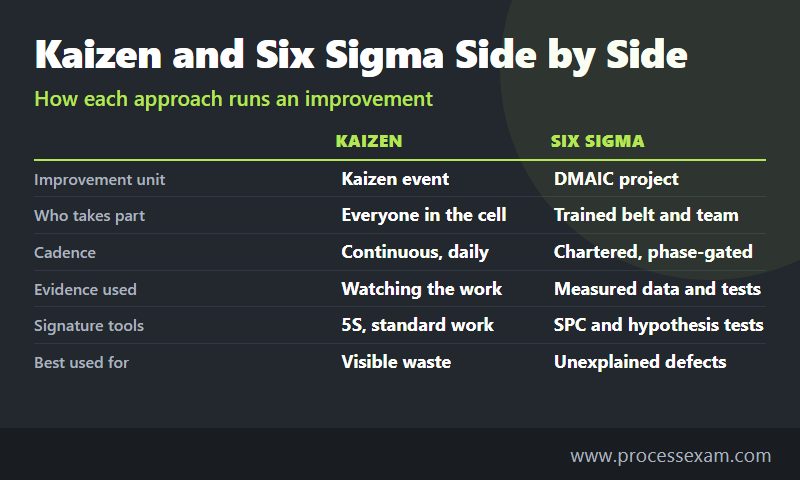
Put the two approaches beside each other and the differences are consistent enough to predict how each will behave on a problem you have not yet described to them.
Scope
Kaizen is content inside one cell, one shift or one desk, and it improves whatever is in front of it, including work that a strategist would have deleted. Six Sigma normally crosses departments, because the cause of a defect is rarely sitting where the defect is noticed; a sealing fault at final assembly often traces back to a purchasing decision or an upstream drying time.
Speed and cadence
Kaizen has no start date. It runs continuously, and a change trialled on Tuesday is standard work by Friday. Six Sigma is episodic: a project is selected, chartered, staffed and closed, and the calendar is measured in months because the evidence takes that long to collect honestly. Neither cadence is superior; they simply suit different problems.
What counts as proof
For kaizen, the proof is that the work is visibly easier, shorter or safer and the people doing it agree. For Six Sigma, the proof is a measured shift in the output, tested against the chance that the shift is random, and usually converted into money by somebody outside the project team. A kaizen team that asked for that level of evidence would stop improving; a Six Sigma project that accepted the kaizen standard would keep declaring victories that do not survive the quarter.
Where each is blind
Kaizen can spend a year polishing a process that should have been eliminated, because nobody inside the cell is asked whether the cell should exist. Six Sigma can spend four months proving something an experienced operator would have told an investigator in an afternoon, because the method does not weight experience until it has been quantified. Knowing both blind spots is most of the skill in choosing between them.
Who leads a kaizen event, and who leads a DMAIC project?
The organisation charts are different, and the difference explains most of the arguments that break out when a company tries to run both at once.
Round a kaizen event
A kaizen event needs a sponsor whose only real job is to free the time and remove the obstacle that nobody in the room can remove, a facilitator who keeps the week moving and prevents it turning into a complaints meeting, and the people who actually do the work. Decisions are made in the room. Nothing waits for a steering committee, the revised standard work is written and posted before the week ends, and the handful of items that could not be finished leave with a name and a date against each one.
Round a DMAIC project
A DMAIC project needs a champion who charters it and states the problem in money, a Green Belt or Black Belt to lead it, a Master Black Belt to check that the statistics say what the team thinks they say, team members who know the process and can collect data without disturbing it, a process owner willing to accept the control plan afterwards, and somebody in finance prepared to validate the saving. It is a heavier structure because it is carrying a heavier burden of proof.
This is why the two die of different causes. Kaizen dies of no time. Six Sigma dies of no sponsor -- a belt without a champion collects data for six months and then watches the recommendation sit unread, which is also why the belt credential is worth more to a candidate whose employer already runs improvement projects than to one whose employer does not.
Which problems belong to Kaizen, and which need Six Sigma?
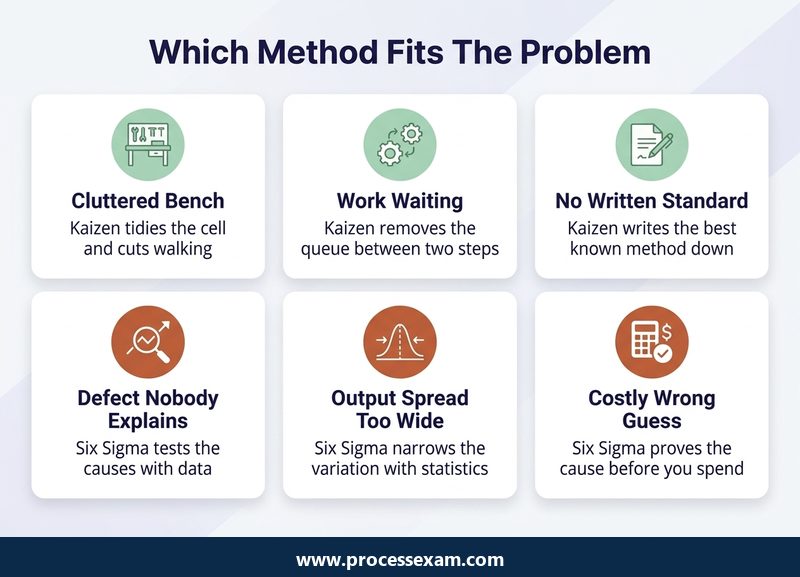
A rule of thumb settles most cases. If you already know what to change and could try it this week, it is a kaizen. If you hold three plausible theories and no evidence for any of them, it is a Six Sigma project. The difficulty is that teams under pressure always believe they are in the first case.
Send it to Kaizen when
The waste is visible without measuring it: clutter round a bench, walking between machines, items waiting between steps, a form that three people fill in and nobody reads, a changeover that every shift performs differently, a safety irritation everyone has learned to live with, or a standard that exists on paper and nowhere else. These share a property: the improvement can be tried tomorrow and reversed just as fast, so debating it costs more than testing it.
Send it to Six Sigma when
The defect has survived every obvious fix, or the output spread is too wide even on days when everything looks right, or several inputs appear to interact so that changing one alone never settles the question, or the fix would be expensive enough that being wrong matters. A process that has already been made lean but still behaves inconsistently is the classic candidate, because all the easy explanations have been used up.
And when neither applies yet
There is a third case that swallows a surprising number of projects. If the team cannot agree on what the current performance even is, neither approach can start. Fix the measurement first, check that two people inspecting the same item reach the same verdict, and only then decide which route the problem takes. Many organisations also sequence the two deliberately: clear the visible waste with kaizen, because doing so removes the noise that was hiding the real variation, and then point the statistical work at what is left.
Does a kaizen event fit inside Lean Six Sigma?
It does, and the combination is not a compromise invented by consultants. Practitioners merged Six Sigma with lean manufacturing to create Lean Six Sigma, and the two are treated as complementary disciplines rather than competing ones -- Lean supplying the waste, flow and workplace-organisation side, Six Sigma supplying the variation and evidence side. Kaizen is the practice that keeps the Lean half alive between projects.
Kaizen is examinable inside Six Sigma
This is easiest to see in the syllabuses themselves. ASQ's Yellow Belt body of knowledge places kaizen and kaizen blitz inside its improve and control section and asks candidates to define and distinguish the two, and to describe how each can improve any process in an organisation; the improve and control topics in the Yellow Belt syllabus show where it sits among the other improvement techniques. IASSC approaches the same ground from the Lean side, opening its Green Belt body of knowledge with a Lean Enterprise section covering the seven elements of waste and 5S, then returning to Lean controls including kanban in the control phase, as its Green Belt certification page describes.
Where the event belongs in DMAIC
In a real project the improve phase is where a kaizen event earns its place. Once analyze has named the few causes that genuinely move the output, a week-long event is often the quickest way to redesign the work around them, because the people who will run the new method are the ones rearranging it. The control phase then needs the kaizen habit rather than the kaizen event, since a control chart tells you the gain is slipping but only a team in the habit of adjusting the work will stop the slip.
The mistake to avoid
The commonest error is running a kaizen event instead of the analyze phase. It feels faster and it usually is, right up to the point where the room brainstorms causes that were never measured, picks the most popular one and builds a month of work on it. If the cause is genuinely unknown, the week is spent generating opinion, not evidence.
Which certification matches the way you want to work?
Kaizen has no certifying body, so a reader who wants a credential for this way of working takes a Six Sigma belt, which is also where the kaizen material is formally examined. Three exams cover the ground at different depths, and the figures below come from our exam summaries for each one.
| Exam | ASQ CSSYB | ASQ CSSGB | IASSC ICGB |
|---|---|---|---|
| Questions | 90 | 110 | 100 |
| Exam time | 138 minutes | 258 minutes, in a 270-minute appointment | 180 minutes |
| Passing score | 550/750 | 550/750 | 70% |
| Fee | Members $334, non-members $434, retakes $234 | Members $383, non-members $483, retakes $283 | $350 |
| Body of knowledge | Six Sigma | Six Sigma | Lean Six Sigma |
If your improvement life is kaizen events and project teams
The ASQ Certified Six Sigma Yellow Belt is the closer match. ASQ states on its Yellow Belt certification page that the credential has no experience or education requirement and that the computer-delivered exam is open book, which suits a supervisor or team member who already takes part in improvement work and wants the vocabulary and the formal grounding without leaving the job to get it. The improve and control questions are the ones that reward someone who has actually sat through a kaizen week.
If you want to lead the projects
The IASSC Certified Lean Six Sigma Green Belt puts more weight on the statistical half. IASSC says there are no prerequisites and no mandatory training, but the exam is closed book and proctored, so the hypothesis testing and regression content has to be genuinely known rather than looked up. ASQ's Green Belt is the parallel route and keeps the open-book format, with a longer sitting and a broader body of knowledge; candidates usually choose between them on whether their employer values a verified project record or a clean exam result.
Whichever you pick, sit a timed rehearsal before booking. Working through a CSSYB practice test until the improve and control questions stop surprising you is the fastest way to find out whether you understand kaizen as a technique or only as a slogan.
The honest summary is that the choice between Kaizen and Six Sigma is rarely a choice at all. An organisation that only runs events improves quickly and then plateaus at the limit of what can be seen without measuring. An organisation that only runs projects improves twice a year and lets everything between the projects slowly decay. The useful question is not which approach is better but which one the problem in front of you is asking for, and the answer is usually obvious once you have checked whether the cause is known or merely suspected.
Frequently Asked Questions
Is Kaizen part of Six Sigma?
Kaizen predates Six Sigma and stands on its own, but Six Sigma has absorbed it. ASQ examines kaizen and kaizen blitz within the improve and control section of its Yellow Belt body of knowledge, and in practice a kaizen event is a common way to carry out the improve phase of a DMAIC project.
What is the main difference between Kaizen and Six Sigma?
Kaizen is continuous, involves everybody and relies on the judgement of the people doing the work, so changes are small and made quickly. Six Sigma is project-based, led by trained belts and relies on measured data to prove a cause before a change is made, so it is slower and better evidenced.
How is Kaizen different from Lean?
Lean is the wider system for removing waste and improving flow, covering pull, levelling, value stream design and workplace organisation. Kaizen is the improvement habit inside it, the mechanism by which a Lean system keeps getting better. You can practise kaizen without a full Lean programme, but not the reverse.
Can Kaizen and Six Sigma be used together?
Yes, and most mature programmes do. Kaizen clears visible waste continuously, which makes the remaining variation easier to see, while Six Sigma projects attack the chronic defects that resist obvious fixes. Lean Six Sigma is the formal combination of the two, treating waste and variation as complementary targets.
Which Six Sigma certification covers Kaizen?
The ASQ Certified Six Sigma Yellow Belt lists kaizen and kaizen blitz explicitly, and the Green Belt bodies of knowledge from both ASQ and IASSC cover the Lean tools kaizen uses, including 5S and the seven wastes. IASSC's syllabus teaches them as Lean Enterprise and Lean control content.
- Six Sigma |
- ASQ Six Sigma Yellow Belt Sample Questions |
- ASQ Six Sigma Yellow Belt Test Questions |
- CSSYB Question Bank |
- CSSYB Exam Questions Download |
- CSSYB Test Questions |
- Six Sigma Yellow Belt PDF |
- ASQ Six Sigma Yellow Belt Book |
- ASQ CSSYB BOK PDF |
- Six Sigma Yellow Belt Certification Cost |
- Six Sigma Yellow Belt Certification Requirements |
- CSSYB Body of Knowledge (BOK) |
- CSSYB Handbook


