
ITIL Certification Path After Foundation: Which Level Fits Your Job
Updated on 30 October 2026. What’s new: the path after ITIL Foundation now runs through PeopleCert's designations, not v3 Intermediate and Expert credits, and the Foundation fee is USD 463
After ITIL Foundation the path no longer runs through Intermediate and Expert. PeopleCert's current scheme, ITIL (Version 5), splits into three designations, Practice Manager, Managing Professional and Strategic Leader, and awards ITIL Master to anyone who holds all three. ITIL 4 stays on sale beside it until PeopleCert's planned retirement on 31 December 2027, so the route you take depends on the version you hold today.
A reader who earned ITIL Foundation a few years ago, or who found a blog that talks about credits and an Expert title, usually asks the same thing: which certificate comes next, how many exams is that, and does it suit my job? This article answers those three questions from PeopleCert's own pages, checked in October 2026. It leaves the practices themselves to other posts and concentrates on the structure of the path, what each stage asks of you and who it is built for. Where the choice of stage is a judgement, rather than something PeopleCert states, the text says so.
Is the old Intermediate and Expert route still the way forward?
No. The Intermediate modules, the Expert title and the credit-counting scheme belong to ITIL v3, and PeopleCert does not accept v3 Foundation or v3 Intermediate certificates as prerequisites for the Version 5 advanced modules. Its ITIL FAQ tells holders of those certificates to start again at ITIL Foundation (Version 5). A v3 Expert can move across through a single transition module, covered below.
Two other claims in older articles have also expired. The first is that AXELOS owns ITIL. PeopleCert acquired AXELOS in 2021 and now runs the framework, the accredited training organisations and the exams itself. The second is the idea that a candidate collects a fixed number of credits and is then "ITIL Expert". Credits belonged to the v3 scheme. In ITIL 4 and Version 5 the unit of achievement is a designation, and a designation is a defined set of modules.
Three generations are therefore in circulation, and a job advert or a colleague may use any of the names:
- ITIL v3 (2011): Foundation, Intermediate, Expert and a Master tier, built on credits. Retired, and not accepted as a stepping stone to Version 5 apart from the Expert and Master routes.
- ITIL 4: Foundation, then Specialist, Strategist and Leader modules that combine into Managing Professional, Strategic Leader, Practice Manager and Master. Still examined, with a planned sunset date of 31 December 2027.
- ITIL (Version 5): Foundation, then modules that combine into the same four designation names, with Transformation as a universal module. PeopleCert says it is being released in phases.
PeopleCert describes Version 5 as an evolution, not a reset, and says existing certificates remain valued. The detail of what changed inside the Foundation exam is the subject of a separate article on this site about where ITIL is heading, so this one stays on the path above Foundation. If you want the Foundation-level syllabus itself, the ITIL 4 Foundation syllabus page lists it topic by topic.
What does each ITIL designation actually require?
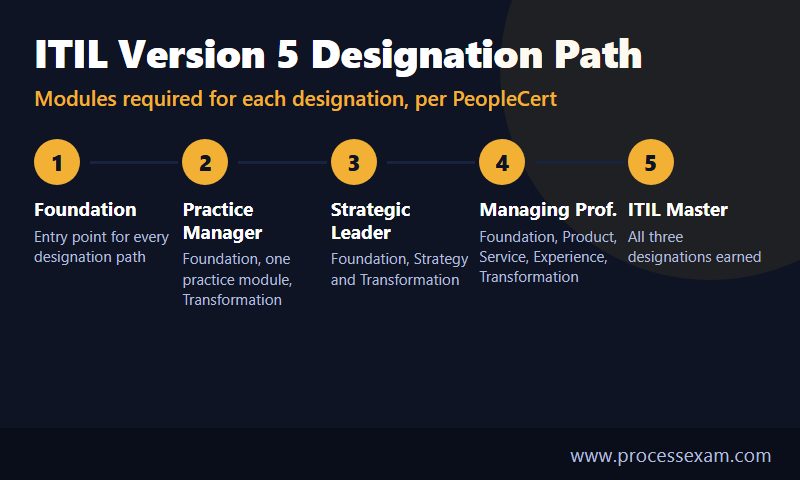
A designation is earned by completing named modules, and PeopleCert's qualification scheme page and FAQ set out the Version 5 combinations. The table below restates them. The column on the right is the part candidates tend to overlook: how many of the modules are your own choice.
| Designation (Version 5) | Modules required | What is your choice |
|---|---|---|
| ITIL Practice Manager | Foundation, one practice module, Transformation | Which of three practice modules: Monitor, Support and Fulfil; Plan, Implement and Control; or Collaborate, Assure and Improve |
| ITIL Managing Professional | Foundation, Product, Service, Experience, Transformation | Nothing; all five are fixed |
| ITIL Strategic Leader | Foundation, Strategy, Transformation | Nothing; the shortest of the three in module count |
| ITIL Master | All three designations above | Which designation to earn first |
Four details change how you plan.
Transformation counts once, for every designation
ITIL Transformation (Version 5) is a core module in each of the three designations, and PeopleCert says you only take it once. Passing it moves you towards all three paths at the same time, which makes it a sensible first advanced module if you are undecided. The FAQ also confirms there is no prescribed order for the modules, so Transformation can follow Foundation straight away.
The Practice Manager path needs only one practice module
The practice modules bundle five practices each. Monitor, Support and Fulfil covers the service desk, incident, problem, service request and monitoring and event management. Plan, Implement and Control covers change enablement, deployment, release, service configuration and IT asset management. Collaborate, Assure and Improve covers relationship, supplier and service level management, continual improvement and information security management. PeopleCert states that passing one of the three, plus Transformation, is enough for the designation. The single-day practice courses from the ITIL 4 era are not part of the Version 5 scheme.
AI Governance sits outside every designation
ITIL AI Governance (Version 5) is an extension module with no prerequisite, and PeopleCert states it is not linked to any designation. It is an add-on for anyone involved in AI initiatives, not a rung on the ladder. The ITIL 4 extension modules, such as the cloud and sustainability ones, are no longer part of the Version 5 scheme.
ITIL Master is a result, not an exam
PeopleCert's ITIL Master page says you begin with Foundation, earn the three designations, and are then awarded the Master designation. There is no separate Master sitting in that description. In module terms it is the longest route in the scheme: Foundation, one practice module, Product, Service, Experience, Strategy and a single Transformation, which is why the universal Transformation module matters.
Which designation fits which job level?
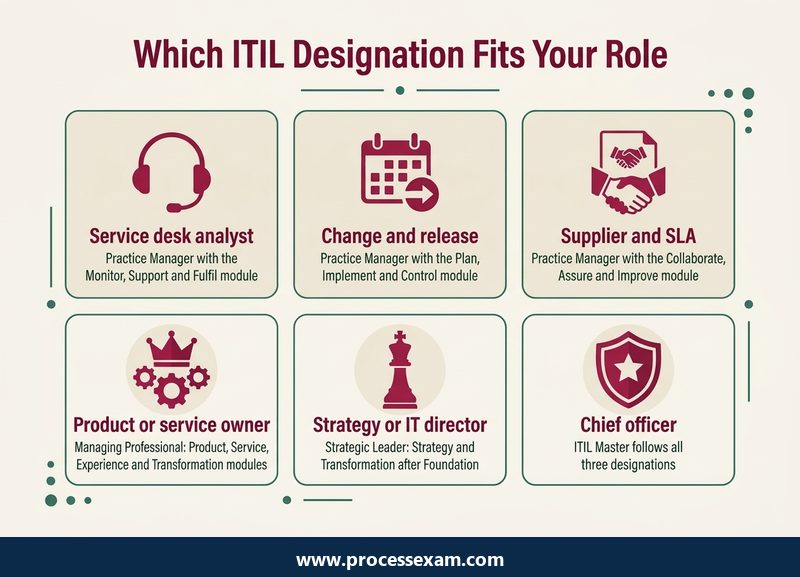
PeopleCert does not assign designations to job grades, but its pages list the roles each module is aimed at, and those lists make a workable map. The mapping in the table below is a reading of those lists, not a PeopleCert statement, so treat it as a starting point and check the module pages before paying.
| Where you are | Designation that fits | Roles PeopleCert names for the modules |
|---|---|---|
| Hands-on support, operations or change work | Practice Manager | The Service module lists service desk analyst, incident specialist, process owner and SRE; the practice modules are built around the support, change and supplier practices those roles run |
| Running a product or a service line | Managing Professional | The Managing Professional page lists product manager, product owner, portfolio manager, IT operations manager, service delivery manager and customer experience lead |
| Setting direction for IT or digital | Strategic Leader | The Strategy module lists strategy manager, portfolio manager, enterprise or business architect, IT director and C-suite roles |
| Senior executive across all of it | Master | The Master page lists chief information, digital and technology officers, directors of service management and digital products, and heads of IT governance |
Early in a support or operations career
The Practice Manager designation is the natural first target because it asks for the fewest modules and lets you pick the module that matches your daily work. Someone on a service desk takes Monitor, Support and Fulfil. A change analyst or release coordinator takes Plan, Implement and Control. An account or supplier manager takes Collaborate, Assure and Improve. Each one is paired with Transformation, which also doubles as your first step toward the other two designations later.
Managing a product, a service line or a team
Managing Professional suits people who own outcomes across a whole product or service, because it combines product, service, experience and transformation thinking. It carries the heaviest workload of the three, with four advanced modules after Foundation, and PeopleCert's own FAQ puts the regular route at eight to twelve days of training, which the transition module compresses to as little as five. Read that as a signal about commitment: it fits someone whose employer will fund the time, not a side project for a quiet month.
Directing strategy or running IT as a business
Strategic Leader is the smallest set of modules after Foundation: Strategy and Transformation. That makes it the quickest way to a senior-sounding designation, and also the one most worth reading carefully before buying, because the Strategy module is written for people who set direction, weigh investment and govern risk. A junior analyst gains little from it.
Treating Master as a long-term outcome
Few careers need all three designations. PeopleCert's roles for Master are executive and director posts, and the designation arrives only after the others. Treat it as something that accumulates over years of promotion, not a goal to plan in the first twelve months.
What do the advanced modules cover, and how are they examined?
The module list below is drawn from PeopleCert's Version 5 pages. The format column matters as much as the topics, because a closed-book Foundation and an open-book advanced exam reward different preparation.
| Module | What PeopleCert says it covers | Exam format stated |
|---|---|---|
| Foundation | Core principles and practices of digital product and service management | Closed book, multiple choice; self-study allowed |
| Product | Digital products as integrated value streams across their lifecycle | Open book; training required |
| Service | Service relationships, service levels, operational reliability and improvement | Open book; training required |
| Experience | Human-centred, AI-aware design that aligns trust, perception and value | Open book; training required |
| Strategy | Developing and delivering strategy, operating models, governance, risk and sustainability | Open book; training required |
| Transformation | Embedding and sustaining change, the ITIL Transformation Model, measurement and learning | Open book; training required |
| Practice modules (three) | Five practices each, listed in the previous section | Open book is currently planned and the format is being finalised |
| AI Governance (extension) | Oversight, accountability, risk management and trust for AI use | Training optional; no prerequisite |
The open-book format is worth noticing. PeopleCert says it is intended to support understanding, applying concepts and making informed decisions, rather than memorisation. In practice that means the preparation shifts from recalling definitions to reading a scenario and choosing between defensible actions. The Foundation exam stays closed book, so memorising its terms still pays off at the first step.
Training is part of the cost. For every module except Foundation and AI Governance, PeopleCert says training through an accredited training organisation or official eLearning is required. Budget for the course, not only the exam fee, and ask a provider for the full price of the designation, not of one module. PeopleCert also lists the 34 ITIL practices as available through its Plus membership, with the 15 practices inside the Practice Manager modules supplied with the matching courses.
What does the ITIL 4 route look like for someone still on it?
ITIL 4 is the scheme most existing certificates were issued under, and it works differently. Its Managing Professional designation, according to PeopleCert's credential page, needs ITIL 4 Foundation plus three Specialist modules (Create, Deliver and Support; Drive Stakeholder Value; High-Velocity IT) and the Strategist module, Direct, Plan and Improve. That is Foundation plus four. Its Strategic Leader designation needs Foundation, the same Strategist module and the Leader module, Digital and IT Strategy. The Strategist module is the shared piece, much as Transformation is in Version 5.
On the Strategist module page PeopleCert states 40 multiple-choice questions, a closed-book paper lasting an hour and a half and a 70 percent pass mark. The same page lists the entry requirement as any ITIL v3 certificate, ITIL 4 Foundation or ITIL 4 Managing Professional, with training through an accredited organisation or official eLearning. Its Specialist pages repeat that format, and the Leader module is a 30-question paper of one hour at the same pass mark. Those figures are for those ITIL 4 modules, so do not carry them across to the Version 5 modules, whose formats are open book.
Whether it is sensible to begin an ITIL 4 designation today depends on timing. PeopleCert's plan is to sunset ITIL 4 modules on 31 December 2027, and voucher validity dates were still to be announced when this was checked. If you are one module short of ITIL 4 Managing Professional, PeopleCert recommends finishing it and then using the transition route. If you are starting from nothing, the Version 5 route avoids a conversion step.
How do you move from an older credential into Version 5?
PeopleCert's FAQ is specific about every starting point, and the table gives each one in a line.
| You hold | PeopleCert's route into Version 5 |
|---|---|
| ITIL 4 Foundation | No retake needed to progress; the Foundation Bridge is an optional one-day course with a short exam that awards the Version 5 Foundation certificate |
| One ITIL 4 certificate, no designation | Treated as a valid prerequisite; choose the Version 5 path that matches your role |
| ITIL 4 Managing Professional | Managing Professional Transition, two open-book exams, upgrades the designation and earns Transformation |
| ITIL 4 Strategic Leader or Practice Manager | Complete Transformation (Version 5) to upgrade; with Managing Professional also held, the transition module upgrades all of them |
| ITIL 4 Master | Managing Professional Transition awards the three Version 5 designations and the Version 5 Master |
| ITIL v3 Expert or Master | Managing Professional Transition |
| ITIL v3 Foundation or Intermediate | Start at ITIL Foundation (Version 5); not accepted as prerequisites |
Two of these lines save real money and time. The transition module is described as a fast-track with two required exams, one attempt each, and an optional Take2 add-on that gives a resit per exam. Its recommended training is as little as five days, against eight to twelve through the regular route. And a holder of any ITIL 4 qualification, apart from the Cloud and Sustainability ones, is the audience for the Foundation Bridge. Those two routes are the reason the ITIL 4 credentials you already own are worth finishing rather than abandoning.
How long do certificates last, and what keeps them current?
Version 5 certificates are issued with a three-year renewal date. PeopleCert gives three ways to renew: log 20 continuing professional development points a year for three consecutive years as a Plus member, pass another certification from the same product suite, or retake the same certification. Because every ITIL certificate belongs to one suite, passing any Version 5 exam also renews an ITIL 4 certificate you hold.
That last rule turns the path into a maintenance plan. A candidate who wants a designation within three years does not need a separate renewal exam; the next module on the route does that work. Someone who stops after Foundation can renew through CPD points instead, so the choice is between a continuing activity log and further study, not a mandatory exam.
Which first step makes sense if you only hold Foundation today?
The sensible order for most readers follows from the structure, rather than from a rule PeopleCert sets. First decide your target designation from the table of roles. Next pick the module that appears in more than one path. Transformation is the only such module in Version 5, so passing it first keeps all three designations open. Last, take the module that matches your current work, so that the open-book scenarios resemble your own day.
- Support, operations or change role: Foundation, then a practice module of your choice, then Transformation. That is a complete Practice Manager designation.
- Product, service or team ownership: Foundation, then Service or Product first, then Experience and Transformation, with employer funding for the training days.
- Strategy or IT leadership: Foundation, Strategy and Transformation; consider a practice module first if you have not run operations yourself.
- Undecided: Foundation and Transformation only, then decide with a year of evidence about which parts of the job you enjoy.
Foundation remains the doorway for all of them. PeopleCert lists the Foundation exam (Version 5) as 40 multiple-choice questions, one hour, closed book and a 65 percent pass mark, the same shape as the ITIL 4 Foundation paper below. Anyone starting from zero should expect to cover the syllabus before anything else.
What does it take to pass the entry exam that unlocks the path?
Every designation above begins with a Foundation exam, and the figures for ITIL 4 Foundation are these.
| Exam detail | ITIL 4 Foundation |
|---|---|
| Exam code | ITIL 4 Foundation |
| Vendor | PeopleCert |
| Questions | 40 |
| Duration | 60 minutes |
| Passing score | 65% |
| Price | USD 463 |
Because the Foundation paper is closed book and every module after it rewards judgement, the best use of preparation time is to practise reading scenarios against the guiding principles, not to memorise lists. Candidates still on ITIL 4 Foundation can rehearse the 40-question format with the ITIL 4 Foundation practice exam before sitting PeopleCert's paper. Passing it opens every route in this article, for either version, since PeopleCert treats ITIL 4 qualifications as valid prerequisites for the higher Version 5 modules.
The path above is long, but it does not have to be rushed. A first designation within a year is realistic for a working professional, and the structure lets each module count towards more than one end point. Choose the designation that matches the job you want in three years, not the one that sounds most senior today.
Frequently Asked Questions
What comes after ITIL Foundation?
After Foundation you choose one of three designation paths in PeopleCert's ITIL (Version 5) scheme: Practice Manager, Managing Professional or Strategic Leader. Each combines Foundation with named advanced modules and the universal Transformation module. Holding all three awards ITIL Master. ITIL 4 modules remain available until PeopleCert's planned sunset on 31 December 2027.
Is ITIL Expert still available?
ITIL Expert, Intermediate and the credit system belong to ITIL v3 and are retired. PeopleCert tells v3 Expert holders to use the Managing Professional Transition module to reach the Version 5 designation, and says v3 Foundation and Intermediate certificates are not accepted as prerequisites for Version 5 advanced modules.
Do I have to retake ITIL Foundation to move to Version 5?
No. PeopleCert states that ITIL 4 qualifications are recognised as prerequisites for every higher-level Version 5 module, so an ITIL 4 Foundation holder can go straight on. The Foundation Bridge is an optional one-day course with a short exam for anyone who wants the Version 5 Foundation certificate.
How many modules does ITIL Managing Professional need?
In Version 5 the designation needs five modules: Foundation, Product, Service, Experience and Transformation. In ITIL 4 it needed Foundation, three Specialist modules and the Strategist module. A certified ITIL 4 Managing Professional can upgrade through one transition module containing two exams.
Do ITIL certificates expire?
Version 5 certificates carry a three-year renewal date. PeopleCert allows renewal by logging 20 CPD points a year for three years through Plus membership, by passing another ITIL certification in the same suite, or by retaking the same exam. Passing any Version 5 exam also renews ITIL 4 certificates.
- ITIL 4 Foundation Question Bank |
- ITIL 4 Foundation Test Questions |
- ITIL 4 Foundation Body of Knowledge (BOK) |
- ITIL 4 Foundation Certification Cost |
- ITIL 4 Foundation Certification Requirements |
- ITIL 4 Foundation PDF |
- PeopleCert ITIL 4 Foundation Test Questions |
- ITIL 4 Foundation Simulator |
- ITIL 4 Foundation Mock Exam |
- PeopleCert ITIL 4 Foundation Book |
- PeopleCert ITIL 4 Foundation BOK PDF |
- PeopleCert ITIL 4 Foundation Sample Questions |
- ITIL 4 Foundation Exam Questions Download


