
Benefits of ITIL for an Organization: What Changes, How to Measure It
Adopting ITIL 4 changes a service desk week more than any slide deck can. The outage that used to produce three emails, two arguments and a vague apology produces one record, a named owner and a fix that stops it returning. Organisations gain clearer ownership, safer changes and numbers they can defend. They stall when the framework arrives as paperwork. This guide follows one week, then the measures and the stalls.

It is about what happens inside an organisation, not about the exam. The people who run the work are the ones whose habits change, so that is where the article stays, and the exam gets one short section near the end.
What does the same service desk week look like before and after ITIL 4?
The week below is a composite built from the way support teams commonly describe their work, not a case study of any real company, and it contains no statistics on purpose. What it shows is a pattern: the same five events, handled two ways.
| Day | Before | After |
|---|---|---|
| Monday: a payroll export fails for finance | Finance emails an engineer they know. He fixes it from memory. Nobody else learns how, and the ticket is typed up afterwards, if at all. | The desk logs an incident, sets priority by the effect on payroll, and follows a knowledge article. The fix is written down before the record closes. |
| Tuesday: the same export fails again | Reported to a different person, fixed again, put down to bad luck. | The desk links it to Monday's record. A problem record opens, a workaround is published and someone owns finding the cause. |
| Wednesday: a developer changes a setting that touches payroll | It lands with no warning, and Thursday's calls come as a surprise. | A low-risk, well-understood change takes a pre-agreed route. The riskier one is assessed by someone with authority, and the schedule is visible to the desk. |
| Thursday: a new starter needs system access | The request sits in the same queue as outages and is chased by email for days. | It is a service request with defined steps and an expected time, handled in its own flow so outages do not push it back. |
| Friday: a director asks how IT is doing | The answer is whichever complaint was loudest that week. | The answer is restore times, repeat faults, change results and user ratings, plus one improvement item with a name against it. |
What did not change in that week
The people are the same. The monitoring tool and the ticketing system may well be the same. The budget did not double. That matters because the most common objection to ITIL is that it needs a new department, a new platform and a consultant. The week above needed none of those. It needed four decisions: that every interruption gets a record, that someone is accountable for each repeat fault, that changes are sorted by risk, and that Friday's answer comes from data.
What took the real effort
Writing down what the team already knew. Monday's fix lived in one head. Making it a knowledge article cost twenty minutes the first time and saved every later incident, and that trade is the pattern behind most of what follows. ITIL 4 is mostly a set of habits for turning private skill into shared capability, and an organisation that adopts it finds the habits more valuable than the vocabulary.
Which parts of the organisation actually change when a team adopts ITIL 4?
ITIL 4 describes a service value system: guiding principles, governance, the service value chain, practices and continual improvement, all aimed at turning demand into value. Read as an organisational chart rather than a diagram, it points at four places where behaviour shifts.
Ownership
Before adoption, a fault belongs to whoever picked up the phone. Afterwards, each practice has someone accountable for how it performs, and each service has an owner who answers for it. The value is not the title. It is that when something repeats, there is a person whose job includes asking why. Teams that skip this step end up with beautifully drawn processes that nobody is responsible for, which is the first stall described later.
Handoffs
The service value chain names six activities: plan, improve, engage, design and transition, obtain or build, and deliver and support. The organisational effect is to make the connections visible. Development knows what operations needs before release, not after the first outage. The desk hears about a change before the calls start. Suppliers are treated as part of the chain rather than a name on a contract. The guiding principle that does the most work here is collaborate and promote visibility, and it changes meetings more than it changes software.
Language
An incident, a problem, a request and a change mean different things in ITIL, and the discipline of using the words precisely is a bigger shift than it sounds. When a manager says "problem" and means "any ticket I am worried about", the team cannot prioritise. Once everyone uses the same terms, reports become comparable from one month to the next, and arguments about what to count shrink. The ITIL 4 Foundation syllabus is a convenient list of these shared terms and the practices that use them.
Governance and money
The framework treats value as something the customer perceives, which pushes costs, outcomes and risk into the same conversation. IT stops justifying itself with uptime alone and starts saying which outcome a service supports and what it costs to keep it healthy. Finance and IT then argue about the same numbers instead of different ones, and decisions about which services to retire become easier to defend.
How do incident handling and the service desk behave differently afterwards?
The incident practice has a narrow goal: restore normal service as quickly as possible. It does not ask the desk to find the cause. That separation, with the cause handed to the problem practice, is the biggest behavioural change in daily support, and it shows up in four ways.
Priority comes from business impact
Without a framework, priority follows the seniority of the person shouting. With one, it is set from the effect on the business and how fast that effect grows. A fault on a payroll run two days before pay day outranks a fault on a rarely used report, whoever reports it. Writing the rule down once removes a daily argument and protects the desk from favouritism, real or perceived.
Swarming replaces ping-pong
In many teams a hard ticket is passed from the first line to the second to the third, and each handoff adds delay and loses context. ITIL 4 describes swarming, where the people who might solve a difficult incident work on it together at the start, rather than one after another. It does not suit every ticket, and a desk that swarms on everything runs out of people. Used on the few incidents that matter most, it shortens the time to restore and spreads knowledge as a side effect.
The desk speaks first
The service desk practice is the single point of contact, and in a mature team it also becomes the single voice. Users hear about an outage from the desk, with an expected update time, before they have to ask. That sounds minor. In practice it moves the desk from a place users complain to a place users trust, and it cuts the duplicate calls that bury a team during an incident.
Closing a ticket includes capturing what was learned
The knowledge practice is the quiet engine of the whole system. If closing an incident includes updating or creating the article that would have solved it, the next person solves it faster, new starters ramp up faster, and the team stops depending on two veterans. A useful test of adoption is whether a new colleague can resolve a common fault in their first week by following written steps.
Requests leave the outage queue
Routine asks such as access, equipment and standard software are service requests, with predictable steps. Separating them from incidents has a practical payoff: an outage no longer delays a new starter's laptop, and the team can improve request flows by automating the repeatable ones. The mistake to avoid is making the request catalogue so detailed that nobody can find anything in it.
Does change enablement slow an organisation down or speed it up?
It can do either, and the difference is whether every change goes through the same gate. ITIL 4 calls the practice change enablement, not change control, and its aim is to maximise the number of successful changes by making sure risks are assessed, authorising changes to proceed and managing the change schedule. The framework describes three types: standard changes, which are low risk, well understood and pre-authorised; normal changes, which are assessed and authorised according to their risk; and emergency changes, which must be done fast. It also lets the authority to approve match the risk, so a team lead can approve a small change while a major one goes higher.
The gain for the organisation is speed where speed is safe. The loss to avoid is the committee that meets weekly and reviews every change, large or trivial, as if all were dangerous. Sorting a month of changes shows how this works in practice. The five examples below are illustrative.
| Change | Likely route | Why |
|---|---|---|
| Renewing a certificate using a documented, repeated procedure | Standard | Low risk, well understood, and the steps never vary, so approval is given once, in advance. |
| Adding a field to an internal form | Normal, low-risk authority | A team lead can assess and approve it without a meeting. |
| Replacing a core network switch | Normal, senior authority | Broad impact. Needs a plan, a back-out route and a time slot on the schedule. |
| Patching a vulnerability that is being actively exploited | Emergency | Delay is the larger risk, so it moves fast and is reviewed afterwards. |
| Retiring a legacy application | Normal, with business sign-off | The risk is to people who still use it, so the business owner must agree. |
The signs that the practice is working
Most changes are routine and take the fast route. The few that are risky get real attention. Failed changes are reviewed for what they teach rather than who to blame. The desk can see the schedule, so a Tuesday outage is no longer a mystery that someone caused on Monday night. If instead every change still waits for the same weekly meeting, the organisation has renamed its old gate and kept all its delay.
How do you measure whether adopting ITIL changed anything?
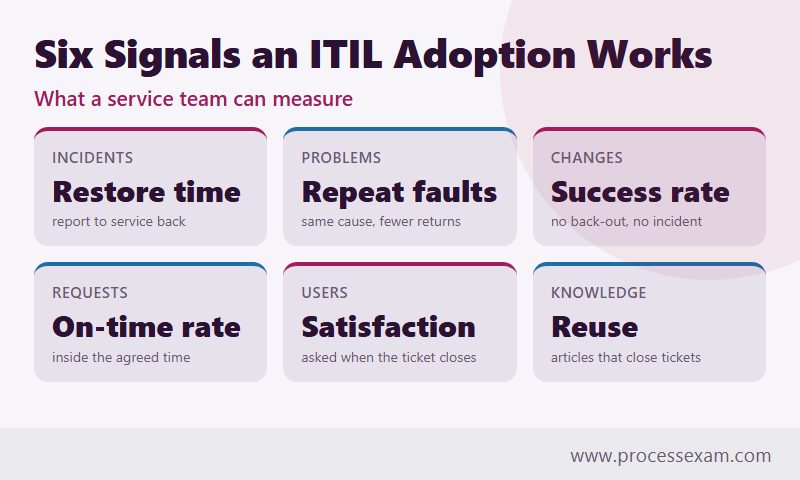
Measure outcomes the business would recognise, and agree what each number means before the first report. The table lists measures that suit a service team, each with what it tells you and the trap it sets.
| Measure | What it shows | The trap |
|---|---|---|
| Time to restore service | How quickly incidents end, from report to normal service | Closing tickets early to improve the number |
| Repeat incidents | Whether problem management removes causes | Counting only identical wording, so related faults hide |
| Change success rate | Whether changes work without back-out or incident | Avoiding risky but needed changes to keep the score high |
| Requests fulfilled on time | Whether routine asks meet the expected time | Setting targets so loose that everything passes |
| User satisfaction | How the service felt to the person who used it | Surveying only after good outcomes |
| Knowledge reuse | Whether written steps actually close tickets | Counting articles written, not articles used |
Take a baseline before changing anything
A number without a starting point proves nothing. Record two or three measures for a month before you change a process, even if the data is rough. Imperfect but consistent figures beat a polished dashboard that starts the day after the changes. They also protect the team: if the first month after a change looks worse because users are now reporting faults they used to ignore, the baseline explains why.
Pair every speed measure with a quality measure
A speed number alone invites gaming. If time to restore is the only target, tickets get closed before the user confirms the fix. Pair it with repeat incidents or user satisfaction, so that shortcuts show up somewhere else. The aim is for the numbers to disagree when someone cheats.
Watch for the watermelon report
A service level report that is green on the outside and red on the inside is a familiar problem: the agreed targets are met, yet users are unhappy. It happens when the target measures the team's convenience rather than the user's experience. The service level practice exists to prevent it by agreeing targets in the language of the business, and by reviewing them when users and reports disagree.
Ask the people who used the service
A short question at ticket close, such as whether the problem is solved and how the contact felt, catches what the system cannot see. Review the comments monthly, not only the score. A handful of sentences from real users usually points to the next improvement more clearly than a trend line.
Where do ITIL adoptions stall, and how do teams get moving again?
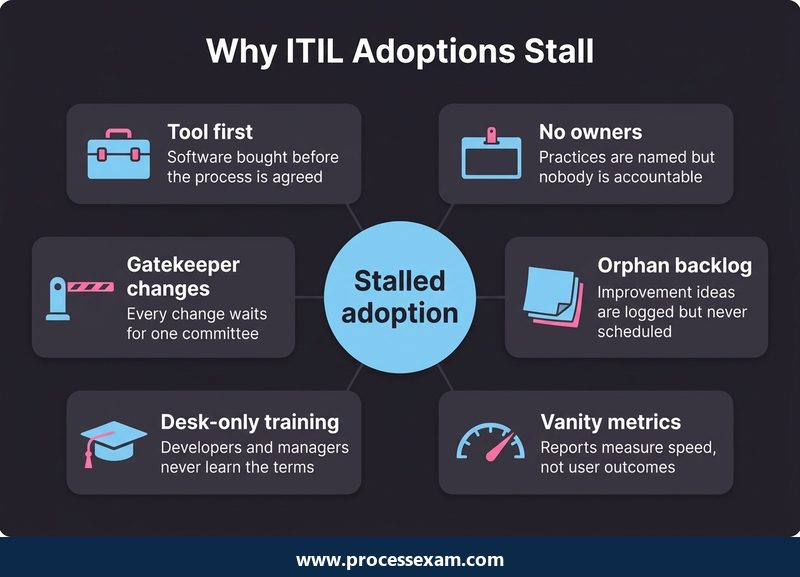
Most stalls are organisational, not technical. They share a pattern: the vocabulary arrives, the habits do not. Six of them recur.
The tool arrives before the process
A service management platform is bought and configured around whatever the vendor's template offers. The team then bends its work to the tool. The recovery is to write one process in plain words, on a page, with an owner, and only then decide what the tool must do. Starting where you are, as the guiding principle puts it, includes using what you already own.
Practices have names but no owners
Slides list incident management, problem management and change enablement, and nobody is accountable for how any of them performs. Meetings produce actions that nobody follows up. Name one accountable person per practice, give them a measure to report each month, and the drift stops.
The change meeting becomes a gatekeeper
Every change waits for the same committee, so people stop raising small ones or bypass the process. The fix is to move low-risk changes to a pre-authorised route and keep the committee for work that deserves it. Success looks like a shorter agenda, not a longer one.
Improvement ideas pile up in a log
Continual improvement fails quietly: ideas are recorded and never scheduled. A register is only useful if someone owns it, ranks the entries and reviews it on a fixed date. Pick the top two entries each month and finish them before adding more. A short list that gets done beats a long one that gets admired.
Only the service desk is trained
If developers, infrastructure staff and managers never learn the terms, the desk is alone in using them and its records are ignored elsewhere. Spread the basics to the people who send work to the desk and receive it from there. A half-day session on incidents, problems and changes does more than a long course for a single team.
Reports measure speed, not outcomes
Dashboards fill with response times, while the question the business asks, whether work got easier, goes unanswered. Add one outcome measure to every report and drop the figure nobody acts on. If a number changes no decision, it is clutter.
How should a small IT team begin without launching a programme?
Treat adoption as a series of small improvements rather than a project with a launch date. ITIL 4 itself suggests this: its guiding principles include starting where you are and progressing iteratively with feedback, and its continual improvement model asks seven questions, from the vision to how you keep the momentum going. A team of five can follow them in a quarter.
- Choose one pain. The repeat fault that annoys everyone, or the request that takes the longest. Not a whole framework.
- Take a baseline. Two measures from the table above, recorded for a month.
- Name an owner. One person accountable for the pain, with time in their week to work on it.
- Agree the words. Settle what counts as an incident, a request and a change, and write it on one page.
- Fix it in a small way. A knowledge article, a standard change, a clearer request form. Something finished in weeks.
- Look again. Compare the measures. Share the result, good or bad, with the people who raised the pain.
- Choose the next pain. Keep a short register and review it on a fixed day each month.
The order matters less than the rhythm. A team that finishes one small improvement a month is, a year on, in a very different place from one that spent the same year designing a complete model.
Where does ITIL 4 Foundation fit when a whole team is changing how it works?
The framework is guidance, and a team can use it without anyone holding a certificate. Certification helps in a narrower way: it gives the people who lead the change, such as the desk lead, the change owner and the manager who sponsors the work, the same vocabulary the team is adopting, with an independent check that they know it. The exam is PeopleCert's ITIL 4 Foundation, and the figures below are the ones to plan around.
| Detail | ITIL 4 Foundation |
|---|---|
| Exam code | ITIL 4 Foundation |
| Vendor | PeopleCert |
| Questions | 40 |
| Duration | 60 minutes |
| Passing score | 65% |
| Exam fee | USD $463 |
Candidates who want to rehearse the paper's question style before booking can do so on the ITIL 4 Foundation practice exam, and PeopleCert's own ITIL 4 Foundation page gives the current booking options. How the paper is built and how to prepare for it are covered in other guides on this blog, so this article stops here.
One note on timing. PeopleCert now also lists ITIL (Version 5), and its ITIL FAQ gives 31 December 2027 as the planned retirement date for the ITIL 4 modules, so read its current wording before you commit a whole team to either version.
Frequently Asked Questions
What are the main benefits of ITIL for an organization?
Clearer ownership of incidents, problems and changes, safer and faster routine changes, shared vocabulary between IT and the business, and measures that show whether service is improving. The benefits come from habits such as recording knowledge and reviewing repeat faults, not from the framework's name or from owning software.
How do you measure the success of an ITIL implementation?
Take a baseline first, then track time to restore service, repeat incidents, change success rate, requests fulfilled on time, user satisfaction and knowledge reuse. Pair every speed measure with a quality one, because a single target invites gaming, and read user comments alongside the scores.
Is ITIL only for large organizations?
No. ITIL 4 is guidance to adapt, and its principles include keeping things simple and practical and starting where you are. A small team can adopt one practice at a time, such as incident handling or knowledge capture, and gain without a dedicated process department or a full platform.
How long does it take to implement ITIL?
There is no fixed duration, because ITIL is not installed like software. A team can finish a first small improvement within weeks, while changing habits across departments takes longer. Treating adoption as continual improvement, with one finished improvement at a time, works better than setting a single launch date.
Does everyone in the team need an ITIL certification?
No. The practices can be used without certificates. Certification helps most for people leading the change, such as the service desk lead and change owner, because it gives them the shared vocabulary. Many teams train the leads first and spread the basics to everyone else through short internal sessions.
- ITIL 4 Foundation Question Bank |
- ITIL 4 Foundation Test Questions |
- ITIL 4 Foundation Body of Knowledge (BOK) |
- ITIL 4 Foundation Certification Cost |
- ITIL 4 Foundation Certification Requirements |
- ITIL 4 Foundation PDF |
- PeopleCert ITIL 4 Foundation Test Questions |
- ITIL 4 Foundation Simulator |
- ITIL 4 Foundation Mock Exam |
- PeopleCert ITIL 4 Foundation Book |
- PeopleCert ITIL 4 Foundation BOK PDF |
- PeopleCert ITIL 4 Foundation Sample Questions |
- ITIL 4 Foundation Exam Questions Download


