
Is ITIL Certification Worth It? Who Gains and Who Should Skip
Yes, ITIL certification is worth it if your work, or the work you want next, involves running IT services: answering tickets, handling incidents, approving changes or managing suppliers. It is not worth it if none of that applies to you. The exam most people mean is ITIL 4 Foundation from PeopleCert: 40 questions, 60 minutes, 65% to pass, listed at USD 463.

That one-line verdict hides a lot of nuance, and most articles on this topic skip it. They list "benefits" that would apply to any certificate, quote salary tables of unknown age, and never tell you when to save your money. This article takes the opposite approach. It explains what the credential proves, which jobs give it a use, what you pay against what you get back, how the arrival of ITIL Version 5 changes the choice (checked against PeopleCert's own pages in October 2026), and the situations where the sensible answer is no.
It is not a study guide. If you decide to go ahead, preparation material is covered elsewhere on this blog.
Is ITIL certification worth it for you, or only for some people?
The honest answer depends on the distance between your current work and the practices ITIL describes. ITIL is a framework for managing IT services from the moment a customer asks for something to the moment it is delivered, fixed or improved. A certificate in it has value in proportion to how much of that cycle you touch.
Where the answer is usually yes
- You work on a service desk or in IT support and want to move up. The certificate gives you the vocabulary your team leads and service managers already use, and it signals that you have read the framework rather than picked it up by osmosis.
- You are changing careers into IT operations. With no job history in the field, a recognised exam is one of the few things on a CV that a recruiter can check in seconds.
- Your employer says it follows ITIL, or a client contract requires it. Here the certificate is part of the job, and the fee is often paid by the company.
- You are a project manager, analyst or developer who hands work to an operations team. Knowing how incidents, changes and releases are governed stops you from designing things the operations team will reject.
Where the answer is usually no
- Your day job never touches service delivery. You write product code and never carry a pager or see a ticket.
- Your employer standardised on a different model and rewards its credentials instead.
- You already have years of visible service-management experience and are not job hunting.
- Your only reason is the hope of a pay rise. A certificate alone does not guarantee one, and no salary survey is quoted here, because the figures that circulate in older ITIL articles come from surveys of unknown age.
If you recognise yourself in both lists, the later sections give you a way to settle the question with evidence from your own job market rather than a general claim.
What does the ITIL 4 Foundation certificate prove to an employer?
It proves that you understand the framework's concepts and vocabulary. It does not prove that you can run a service desk, tune a change process or negotiate a service level. Foundation is a closed-book, multiple-choice exam, so a person who passes has demonstrated recall and comprehension of the material, and an interviewer who understands this will test the rest in conversation.
Here are the exam facts in one place, with the figures for ITIL 4 Foundation:
| Exam detail | ITIL 4 Foundation |
|---|---|
| Exam code | ITIL 4 Foundation |
| Vendor | PeopleCert |
| Certification | PeopleCert Certified ITIL 4 Foundation |
| Number of questions | 40 |
| Duration | 60 minutes |
| Passing score | 65% |
| Exam fee | USD 463 |
What the certificate gives an employer is a shortcut for screening. A hiring manager reading forty applications for a service-desk or service-delivery vacancy cannot interview everyone, and a recognised credential is a cheap first filter. That is the whole value proposition: it gets you into the conversation. The conversation itself still depends on your examples.
What it does not prove
It does not prove tool skills, because ServiceNow, Jira Service Management and similar platforms are separate subjects. It does not prove management ability, and it does not prove that your organisation's processes are good. Candidates who understand this talk about the framework as a language for describing their experience, not as a replacement for it.
The framework began in the UK and its ownership has since moved to PeopleCert, which now examines and certifies it. A neutral summary of its background is on Wikipedia's ITIL entry.
Which jobs make ITIL worth paying for?
A useful way to test any certification is to ask which daily tasks it maps onto. PeopleCert's own ITIL listing includes practitioner modules named after specific practices, among them incident management, problem management, change enablement, service desk, service request management, service level management, supplier management, release management and IT asset management. Those names are a map of the jobs where the framework is part of the work.
Run-the-service roles
Service desk analysts, incident coordinators and problem managers use ITIL language every day: an incident is an unplanned interruption, a problem is the underlying cause, a service request is a standard ask. If your team's tickets are sorted by those categories, the exam describes your own workplace and passing it is mostly a matter of putting names to things you already do.
Change and release roles
Change managers, release coordinators and deployment leads work inside an approval and risk process. The certificate helps here less because of the exam and more because the framework's view of change as a way to enable delivery, rather than block it, shapes how these roles are discussed in interviews.
Service delivery and vendor roles
Service delivery managers, service level managers and supplier managers negotiate what "good" means and check that it is delivered. These are the roles where ITIL knowledge shifts from vocabulary to leverage, because a written service level is a framework concept before it is a contract clause.
Roles that borrow the language
Project managers, business analysts and architects in IT departments rarely need the certificate to do their jobs, but those who have it avoid friction with operations teams. For them it is a nice-to-have, and the cost section below matters more than it does for the roles above.
A ten-minute test with real job adverts
Do not take any article's word for which roles ask for ITIL. Open a job board in the city or country where you want to work, search for the title you want next, and open ten recent adverts. Count how many name ITIL, how many call it required and how many call it preferred, and note which version they mention. If most of the ten ignore it, the certificate will not move your applications. If six or more mention it, you have found your reason. This takes ten minutes and replaces any statistic a blog could quote.
How to talk about the certificate in an interview
Candidates who benefit most from ITIL do not recite definitions. They pick one real episode, such as a recurring outage or a messy change, and describe it using the framework's terms: what the incident was, what the underlying problem turned out to be, and which practice would have prevented the repeat. That shows the vocabulary working on real evidence, which is what an interviewer wants from a Foundation holder.
What does it cost, and what do you get back?
The direct cost is the exam fee. Our sheet lists ITIL 4 Foundation at USD 463. PeopleCert's own pages show prices in pounds including VAT, and they vary with what you bundle with the exam, so check the price that applies to your country at checkout. In October 2026 the PeopleCert page lists these options:
| Option on PeopleCert's page | Price shown (incl. VAT) | Who it suits |
|---|---|---|
| Exam bundle | GBP 392 | Self-study candidates who only need the exam |
| eLearning | GBP 947 | People who want structured online material with the exam |
| eLearning+ | GBP 1,143 | People who want the largest package |
The gap between the cheapest and dearest option is a reminder that the biggest decision is not whether to certify but how much to spend around the exam. According to PeopleCert's FAQ, training is not mandatory for ITIL Foundation (Version 5), which means a self-study route exists, and a candidate who already works with ITIL practices can reasonably choose it.
The costs people forget
- Rescheduling. PeopleCert's Foundation page states that rescheduling is free up to 48 hours before the start, then carries a fee, and a larger one inside four hours. Plan the date, then keep it.
- A retake. A fail means paying again. A timed practice run before you book is cheaper than a second exam fee.
- Renewal. PeopleCert states renewal every three years, needing 60 CPD points, or passing another exam in the same product suite.
- Study time. Foundation is a modest exam, but evenings spent on it are evenings not spent on something else.
What comes back
The returns are real but narrow. First, access: more of your applications pass the first filter. Second, a base for the higher ITIL modules, since PeopleCert's FAQ says ITIL 4 qualifications are recognised as prerequisites for the higher ITIL (Version 5) certifications. Third, shared language with colleagues, which helps in meetings where people argue past each other about what a "problem" is. Fourth, for some, an employer who pays the fee, which changes the arithmetic entirely: always ask before you pay out of pocket.
A practical way to judge the return is to ask what the certificate would have to do for the fee to pay for itself. If you expect it to help you land one interview you would not otherwise have had, work out what that interview is worth to you. If you cannot name the role, you cannot value the certificate.
Should you buy ITIL 4 Foundation or the Version 5 Foundation?
This is the question older articles cannot answer, because it did not exist when they were written. In October 2026 PeopleCert's ITIL listing shows ITIL Foundation (Version 5) next to ITIL 4 Foundation, along with a Foundation Bridge (Version 5) for people who already hold ITIL 4. The listing also shows Version 5 modules at higher levels, among them ITIL Product, ITIL Service and ITIL AI Governance, while ITIL 4 Specialist, Strategist and Practitioner modules remain listed.
What the vendor says about the two exams
Both Foundation pages describe the same format: 40 multiple-choice questions, 60 minutes, closed book and a 65% pass mark. The Version 5 page lists the same three bundle prices as the ITIL 4 page. The difference is in content and horizon. PeopleCert's FAQ says ITIL 4 and Version 5 will run in parallel for a period, that ITIL 4 qualifications are recognised as prerequisites for higher Version 5 certifications, and that all ITIL 4 modules are planned to be sunset on 31 December 2027. Read PeopleCert's ITIL FAQ for the current wording, because dates like this can change.
What that means for your decision
- Your employer or the job adverts name ITIL 4. Take ITIL 4 Foundation. It is still listed and still recognised, and the ITIL 4 Foundation syllabus describes what it tests.
- The adverts name Version 5, or you want the newest credential. Look at PeopleCert's ITIL Foundation (Version 5) page and decide whether to sit that instead.
- You already hold ITIL 4 Foundation. You do not need to retake it. PeopleCert's FAQ describes the Foundation Bridge as the route to Version 5 for ITIL 4 holders.
- You cannot tell which your market wants. Run the job-advert test above and note the version. If the adverts are split, ask your manager or a recruiter before spending anything.
The figures in this article are for ITIL 4 Foundation. PeopleCert's ITIL 4 Foundation page still lists the exam as of October 2026, and the full scheme sits on PeopleCert's ITIL certification listing. A careful candidate reads both pages on the day they book.
When should you skip ITIL, or wait?
The skip cases matter as much as the yes cases, and they are the part that typical articles leave out.
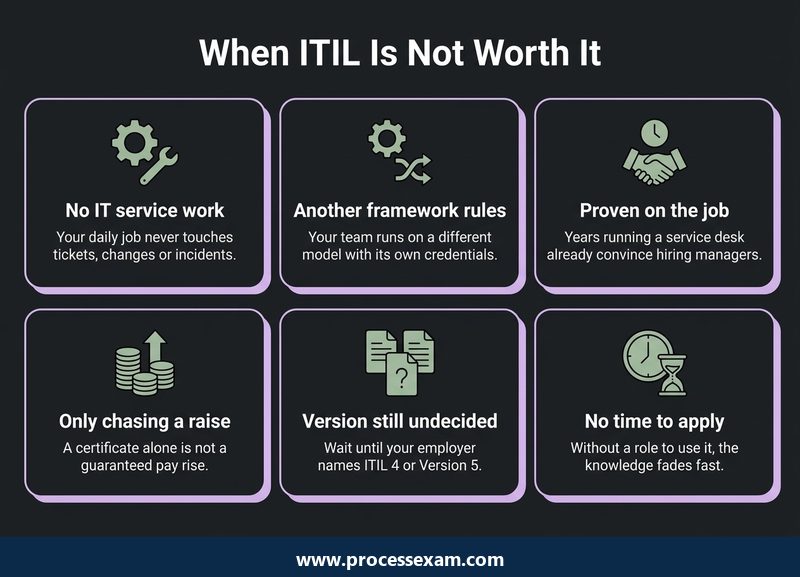
You have no IT service work and no plan to get any
A certificate in a framework you will never apply is a line on a CV that invites a question you cannot answer well. If you are a developer who never touches operations, a different credential serves you better.
Your employer follows another model
Some organisations build their processes around other frameworks and reward those credentials. The job-advert test shows it fast: if the roles you want name a different framework and never mention ITIL, that is your answer.
Your experience already speaks louder
A person who has run a service desk for ten years and is not changing jobs rarely gains from a Foundation certificate. If the credential is for a promotion inside your company, ask whether the promotion decision actually looks at certificates before you pay.
The only reason is a raise
Certificates do not set pay; employers do, and they usually pay for responsibilities. If you want a raise, the stronger move is to take on a visible responsibility such as owning the change calendar or a service-level report, and then add the certificate as supporting evidence.
You cannot say which version you need
With ITIL 4 Foundation and ITIL Foundation (Version 5) both listed, buying before you know what your employer or target employers expect is the most avoidable mistake of the moment. Waiting two weeks to find out costs nothing. Buying the wrong exam costs a fee.
You will not use it within a year
Knowledge that is not applied fades, and renewal comes round every three years. If you cannot name the role, project or conversation in which you will use the vocabulary in the next twelve months, put the money aside.
How do you decide before you spend anything?
Treat the decision as five checks that you run in order. Stop at the first one that gives a clear no.
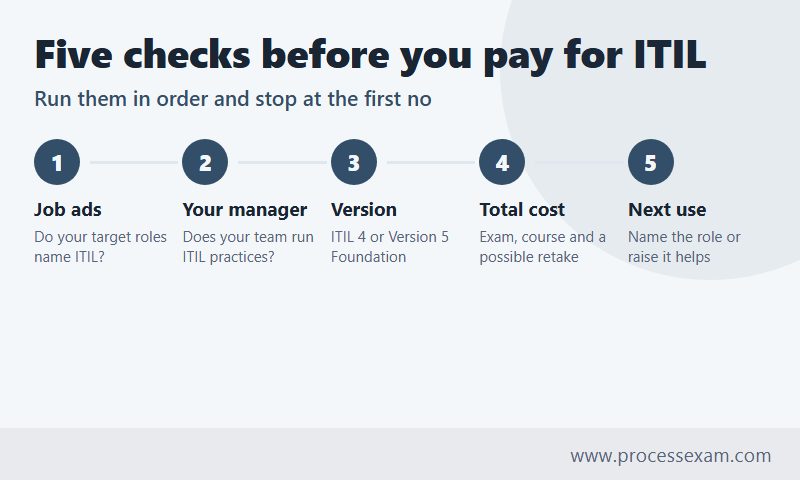
- Read ten job adverts for the role you want next. If few name ITIL, the certificate will not change your applications.
- Ask your manager what your team follows. If the answer is ITIL, you are likely to apply it at once, and the company may pay.
- Pick the version. Use the evidence from steps one and two, and read PeopleCert's pages for the exam you are choosing.
- Add up the whole cost. Exam fee, any course, the chance of a retake and the renewal that comes in three years.
- Name the next use. Write down the role to apply for or the conversation in which the certificate will help. If you cannot, wait.
When all five checks favour certifying, a timed run through the ITIL 4 Foundation practice exam shows quickly whether 40 questions in 60 minutes feel comfortable or whether you need more preparation before you book.
One last point on timing. The decision does not have to be made today. If your checks come out mixed, pick the cheapest next step: ask your manager, read PeopleCert's pages again in a month, or look at ten more adverts for a second role you might want. A certificate bought with evidence in hand rarely feels like a waste, while one bought on a hunch often does.
The certificate is a tool with a narrow job: it gets IT service professionals into conversations and gives them a shared vocabulary. Used for that, it is good value. Used as a general career boost by someone with no connection to service management, it is money spent on the wrong problem.
Frequently Asked Questions
Is ITIL certification worth it?
It is worth it if you work in or want to move into IT support, service delivery, change or supplier roles, or your employer follows ITIL. It is much less useful for developers and others who never touch IT service operations. Check ten job adverts for your target role before paying.
What are the benefits of ITIL certification?
The benefits are practical: it can help your application pass a first screening, it gives you the shared vocabulary that service teams use, and it is a recognised base for higher ITIL modules. It does not guarantee a salary rise, and it proves knowledge of the framework rather than hands-on skill.
How much does the ITIL 4 Foundation exam cost?
ITIL 4 Foundation is listed at USD 463 for a 40-question, 60-minute exam with a 65% pass mark. PeopleCert's own page shows prices in pounds including VAT, starting with an exam bundle and rising for eLearning packages, so confirm the price for your country at checkout.
Is ITIL 4 Foundation still worth taking now that ITIL Version 5 exists?
It is if your employer or target jobs name ITIL 4. PeopleCert lists both versions in October 2026, recognises ITIL 4 as a prerequisite for higher Version 5 modules and plans to sunset all ITIL 4 modules on 31 December 2027. If your market asks for Version 5, take that exam.
Does ITIL certification expire?
PeopleCert states that ITIL certificates are renewed every three years, needing 60 CPD points. Passing another exam in the same ITIL product suite before the renewal date also keeps the certification current. Check PeopleCert's ITIL FAQ for the exact renewal options that apply to your certificate.
- ITIL 4 Foundation Question Bank |
- ITIL 4 Foundation Test Questions |
- ITIL 4 Foundation Body of Knowledge (BOK) |
- ITIL 4 Foundation Certification Cost |
- ITIL 4 Foundation Certification Requirements |
- ITIL 4 Foundation PDF |
- PeopleCert ITIL 4 Foundation Test Questions |
- ITIL 4 Foundation Simulator |
- ITIL 4 Foundation Mock Exam |
- PeopleCert ITIL 4 Foundation Book |
- PeopleCert ITIL 4 Foundation BOK PDF |
- PeopleCert ITIL 4 Foundation Sample Questions |
- ITIL 4 Foundation Exam Questions Download


