
IIBA CBDA Certification: Is It Worth It and What Does It Prove?
Updated on 22 September 2026. What’s new: eligibility corrected, since IIBA sets no work-experience or education requirement for the CBDA, with its six knowledge areas and yearly renewal set out.
Picture the quarterly review where your churn analysis is on the screen and a finance director asks the question every analyst dreads: why should we believe this? The IIBA Certification in Business Data Analytics (CBDA) is built for that moment. It shows, through an independent 75-question exam, that you can frame the right business question, source and analyse data soundly, and turn the result into a decision people will act on. That is where its credibility comes from.
Credibility is not the same as a line on a CV. A credential earns trust only when the people around you know what it tested, how hard it was to get and whether the holder is still current. This article answers those three questions for the CBDA, using the May 2026 edition of IIBA's CBDA handbook, its August 2024 recertification handbook and the CBDA page on iiba.org, all checked in September 2026. It then turns to the practical side: the fees, who the credential suits, how to prepare and what happens on exam day.
It is written for business analysts who are being asked to work with data more than they used to, for reporting and BI specialists who want a business-facing credential, and for team leads deciding whether to fund the exam for someone on their team.
Why does a CBDA make people trust your analysis?
Trust in analytics work breaks down in predictable places. A dashboard answers a question nobody asked. A model is built on data that was never fit for purpose. A finding is technically correct but presented in a way the decision makers cannot use. The CBDA is designed around exactly those failure points, which is why it carries weight with people who have been burned by them.
It tests the whole chain, not one tool
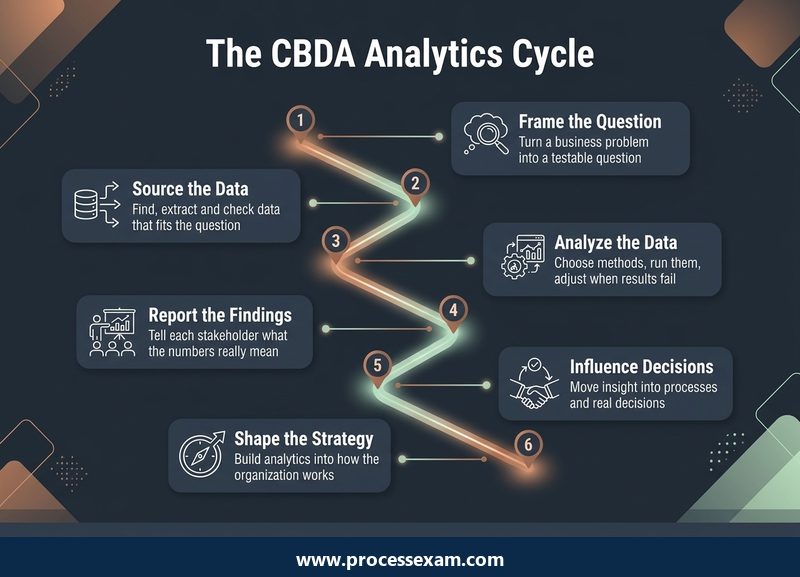
Most analytics credentials certify a product: a BI platform, a database or a programming language. The CBDA certifies a way of working. Its six knowledge areas follow an analytics initiative from the first conversation about the business problem to the point where the organisation changes how it decides. A holder is expected to understand why each stage exists and what goes wrong when it is skipped, whatever software the team happens to use. That makes the credential portable across employers and technology stacks, and it tells a sponsor that you will not jump straight to the charts.
It comes from a standards body with an audited process
IIBA states in the CBDA handbook that its credentialing policies follow ISO/IEC 17024, the international standard for bodies that certify people, and the guidelines of the National Commission for Certifying Agencies. For a hiring manager, that means the exam is not a course completion badge: the questions, the delivery rules and the recertification requirements sit inside a governed programme. Every candidate must also agree to IIBA's Code of Ethical Conduct and Professional Standards, and IIBA reserves the right to audit holders and to revoke the certification. Those controls are dull to read about, but they are the reason the letters after your name mean something to a stranger.
It stays current by design
Unlike many credentials that are earned once and never checked again, the CBDA has to be renewed every year with documented professional development. When a colleague sees a CBDA holder in IIBA's Certified Professional Directory, they know the person has kept learning within the last twelve months. That annual cycle is covered in detail further down, because it is the part candidates most often overlook.
What does IIBA actually measure in the CBDA exam?
The CBDA exam is competency based. IIBA does not ask you to recite definitions from the Guide to Business Data Analytics; it gives you a short business scenario and asks what a capable analyst would do next. The core figures are below, taken from Master and confirmed against the IIBA CBDA handbook.
| Exam detail | IIBA CBDA |
|---|---|
| Exam code | CBDA |
| Exam name | IIBA Certification in Business Data Analytics |
| Category | Specialized Business Analysis |
| Questions | 75 |
| Duration | 120 minutes |
| Exam fee | Member - $250, Non-Member - $405 |
| Question style | Multiple-choice, scenario-based |
| Retake fee | Member - $195, Non-Member - $350 |
| Recertification fee | Member - $30 USD, Non-Member - $50 |
| Delivery | Online remote proctored |
| Result | Pass or fail, shown on screen at the end |
Two points in that table deserve attention. First, the clock allows roughly 96 seconds for each of the 75 questions. That feels comfortable right up to the moment you meet a scenario that describes a retailer's data sources, a stakeholder's concern and a half-finished analysis in the same paragraph. Reading time is the real constraint, so practise reading scenarios for the decision being asked about before you look at the options.
Second, IIBA reports the outcome as pass or fail and does not publish a percentage pass mark for the CBDA in its handbook. Anyone who tells you the exact score you need is guessing. The useful target is consistency across all six knowledge areas, because a scenario exam punishes a single blind spot far more than a recall exam does.
What "scenario-based" means in practice
A typical CBDA question describes a situation and offers four plausible actions. Several of them would be sensible at some point in an analytics initiative; only one is right for the stage the scenario describes. For example, a scenario may explain that a marketing team wants to know why repeat purchases fell and that three data sets are available. One option proposes building a predictive model, another suggests confirming with the sponsor what decision the answer will feed, a third recommends cleaning all three data sets, and a fourth suggests presenting a trend chart. If the research question has not yet been agreed, the correct move is the conversation with the sponsor, even though the other three are good analytics habits. Learning to spot the stage is most of the skill the exam rewards.
Which six knowledge areas decide your result?
The exam blueprint on the IIBA CBDA page splits the 75 questions across six knowledge areas. The weights below come straight from IIBA; the right-hand column explains what each area adds to the trust others place in your work. If you want every competency listed under each area, our topic-by-topic CBDA syllabus sets them out with their proficiency levels.
| Knowledge area | Share of questions | Why it builds credibility |
|---|---|---|
| 1. Identify the Research Questions | 20% | Your analysis answers the question the business needs answered |
| 2. Source Data | 15% | You can defend where the data came from and whether it is fit for use |
| 3. Analyze Data | 16% | Your method suits the question, and you notice when it does not work |
| 4. Interpret and Report Results | 20% | Stakeholders understand the finding and its limits |
| 5. Use Results to Influence Business Decision Making | 20% | Insight turns into a changed process or decision |
| 6. Guide Organization-level Strategy for Business Analytics | 9% | You can help the organisation make analytics a lasting capability |
Read the weights carefully and a pattern appears. Only 16% of the exam is about analysing data in the narrow, technical sense. The three areas that deal with the business side, framing the question, reporting the result and influencing the decision, carry 60% between them. The CBDA is therefore a business analysis credential that happens to be about data, not a data science exam with a business chapter. Candidates from a technical background tend to underestimate that, while business analysts tend to over-prepare on statistics they will barely be asked about.
Identify the Research Questions (20%)
This area is about framing. You are expected to understand the business situation, identify the stakeholders, pin down the problem or opportunity and agree a research question that data can realistically answer. Questions here often test whether you would push back on a vague request before any data is touched.
Source Data (15%)
Here the focus moves to planning what data is needed, where it lives, how it will be extracted and whether its quality and lineage are good enough. Expect scenarios about incomplete data, data owned by another department and data collected for a different purpose.
Analyze Data (16%)
This area covers choosing the analytical approach, preparing the data, running the analysis and checking whether the results actually answer the question. IIBA's own description stresses adjusting the approach when results fail to answer the question, so questions reward judgement more than formula knowledge.
Interpret and Report Results (20%)
Interpretation and communication get as much weight as framing. You need to know how to turn output into insight, tailor the message to each audience and be honest about uncertainty. Scenarios often involve an executive who wants a simple answer that the data does not fully support.
Use Results to Influence Business Decision Making (20%)
This is where analysis earns its keep: recommending action, addressing the business problem, influencing the business model and processes, and embedding results in workflows so that decisions can be made closer to real time. Change management ideas appear here, since insight nobody adopts has no value.
Guide Organization-level Strategy for Business Analytics (9%)
The smallest area looks at the organisation as a whole: how analytics fits the enterprise architecture, how readiness is assessed and how data and insights support strategy. It is only 9% of the exam, but it is the area that most separates a trusted analytics adviser from a skilled report builder.
Do you need experience or a degree to sit the CBDA?
No. The CBDA has no work-experience requirement, no education requirement and no application to be approved before you can buy the exam. IIBA's certification fees page lists the application fee as not required. This is a point many older descriptions of the credential get wrong, and it matters, because it removes the paperwork barrier that stops candidates for some other IIBA certifications.
IIBA does, however, say who the credential is really for. The handbook recommends it for business analysis professionals with at least two years of experience carrying out analysis work in business data analytics. That recommendation is worth taking seriously. The exam's scenarios assume you have been in the room when a stakeholder changed the question halfway through, or when a data set turned out to be unusable. Candidates who have only studied the theory can pass, but they have to work harder to recognise which option reflects real practice.
Who gains the most from the credential
- Business analysts moving into data work, who need to show that their requirements skills extend to analytics initiatives.
- Reporting and BI specialists, who have the technical skills but want evidence that they understand the business decisions their reports feed.
- Product owners and managers who commission analytics and need to judge whether the work is sound.
- Consultants, for whom an independent, standards-based credential helps win the confidence of new clients quickly.
Who may want something else
A data scientist whose day is spent building and tuning models will find the CBDA light on mathematics; its value for them lies in the business framing, not the technique. Someone at the very start of a career, with no analysis experience at all, may get more from an entry-level business analysis credential first and come back to the CBDA once they have real projects to draw on.
How much does the CBDA cost, and what does it take to keep it?
IIBA charges Member - $250, Non-Member - $405 for a first attempt; a second attempt is billed at Member - $195, Non-Member - $350. According to IIBA's certification fees page, a non-member who pays the higher exam fee receives the first year of IIBA membership with it, and the CBDA page describes the price as "$405 or less" for that reason. The membership is not a side benefit: it unlocks the Guide to Business Data Analytics, which IIBA makes available to members only and which is the main reference for the exam.
Once you buy the exam, the handbook gives you six months from the day IIBA receives payment to schedule and sit it, and 30 days from payment to request a refund. Each attempt is charged separately, so the retake fee is not included in the first purchase.
The part candidates forget: renewal every year
The CBDA is a certification rather than a certificate, and it must be renewed every year. The CBDA recertification handbook sets out the cycle: your certification term begins on the day you pass and ends on the one-year anniversary of that date. Within each term you earn and record 20 Continuing Development Units (CDUs) in the BA Development Log, covering both the Learning and the Applying streams, with at least 10 CDUs in the Learning stream. You then pay the recertification fee, Member - $30 USD, Non-Member - $50, and submit the application before the anniversary.
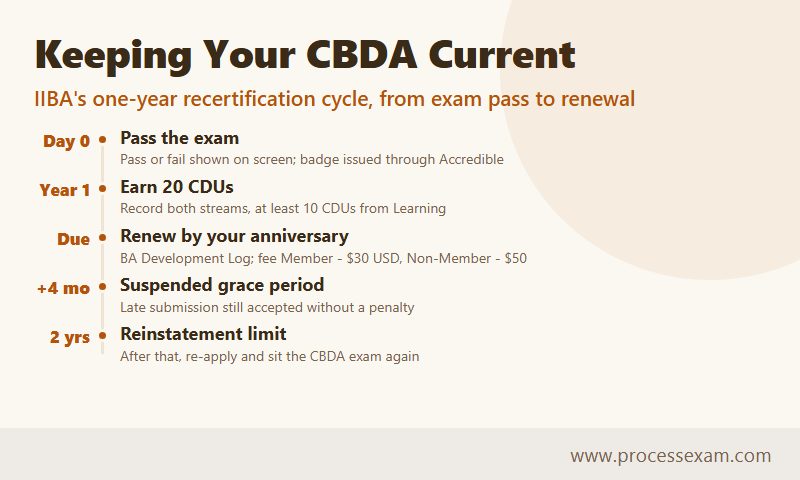
One CDU is generally earned for each hour of a planned, structured activity, recorded in quarter-hour steps. Activities must relate to the six knowledge areas described in IIBA's business data analytics publications. Learning-stream activities include professional development, formal academic study and self-directed learning; the Applying stream covers work history, professional activities and volunteer service. For most working analysts, 20 hours a year is achievable with a mix of work on analytics projects, a course or two and some reading.
What happens if you miss the date
A holder who does not renew on time is no longer certified and may not present themselves as certified. IIBA allows a four-month grace period, called suspended status, in which CDUs can still be recorded, the fee paid and the application submitted without penalty; the next term keeps its original dates. After that, the holder becomes uncertified. Reinstatement is possible only within two years of the original certification date or the last successful recertification, by contacting IIBA; beyond that, the only route back is to apply again and retake the exam.
This yearly discipline is exactly what gives the CBDA its standing. A credential that must be renewed with evidence of ongoing learning says more about the holder today than one earned a decade ago. It also means the true cost of the CBDA is the exam fee plus a small annual fee and roughly 20 hours of logged development each year, which most employers will happily support.
Is the CBDA certification worth it next to CBAP, CCBA or a tools certificate?
"Is CBDA certification worth it?" is one of the most common searches about this credential, and the honest answer depends on what you want it to prove. The table below compares the CBDA with the alternatives analysts usually weigh it against. It deliberately avoids quoting other exams' fees or hour counts; check the relevant IIBA or vendor page for those.
| If you want to show... | Better fit | Why |
|---|---|---|
| That you can run analytics work that stands up to business scrutiny | CBDA | Covers framing, sourcing, analysis, reporting, decision and strategy in one exam |
| Broad business analysis across the whole BABOK Guide | CCBA or CBAP | Both assess general business analysis and require documented experience and references |
| Hands-on skill in a named BI or data platform | A vendor tool certificate | Proves product skill, but says little about business judgement |
| A first step into business analysis | An entry-level IIBA credential | Builds the foundations the CBDA scenarios assume |
Where the CBDA stands out is in combining two things that are rarely certified together: business analysis judgement and data literacy. Tool certificates change as the software changes and do not show that you can decide what to analyse. General business analysis certifications show broad competence but not that you can handle data initiatives. The CBDA sits in the gap between them, which is why it pairs well with either. A CBAP or CCBA holder who adds the CBDA signals range; a BI developer who adds it signals business maturity.
The case against
The CBDA is not a shortcut to a data science role, and it will not replace portfolio evidence. A hiring manager who needs someone to build machine-learning pipelines will look for technical proof first. The annual renewal also means the credential asks for a small, continuing commitment rather than a one-off effort. If you are not prepared to log 20 hours of development each year, choose a credential without that requirement.
The case for
For analysts whose work is judged by whether leaders act on it, the CBDA is a strong choice. It is inexpensive compared with many analytics programmes, needs no application, can be taken from home and is backed by an internationally recognised standards framework. Its digital badge links to a directory entry that anyone can check, which answers the "why should we believe you?" question before it is asked.
What does an eight-week CBDA preparation plan look like?
Most working analysts with some analytics experience prepare in six to ten weeks of steady study. The plan below assumes around six to eight hours a week and is built around the blueprint rather than around a textbook's chapter order.
- Week 1 - Map the ground. Read the handbook in full, which IIBA requires anyway, and skim the Guide to Business Data Analytics end to end. Note the knowledge areas where your own experience is thin.
- Week 2 - Framing. Study Identify the Research Questions in depth. Take three problems from your own work and rewrite each as a research question with a named decision maker and a decision it will support.
- Week 3 - Data sourcing. Work through Source Data. For one real data set you use, write down its owner, lineage, known quality issues and the questions it cannot answer.
- Week 4 - Analysis choices. Cover Analyze Data, focusing on when to use descriptive, diagnostic, predictive and prescriptive approaches and how to tell when results do not answer the question.
- Week 5 - Reporting. Study Interpret and Report Results. Take one piece of your own analysis and rewrite its summary for three audiences: an executive, an operations manager and a technical peer.
- Week 6 - Influence and strategy. Cover the last two knowledge areas together, since both deal with adoption and organisational change. Then sit a first full-length, timed practice run.
- Week 7 - Close the gaps. Review every question you missed and trace it back to a knowledge area. Revisit the Guide only for those areas.
- Week 8 - Rehearse the day. Run the PSI compatibility check and tutorial test, sit a second timed practice run, and rest before the exam.
In week six, a timed CBDA mock exam is the quickest way to find out whether you can read scenarios at the pace the real exam demands, and which of the six areas still costs you marks.
Study sources IIBA points to
The handbook lists the Guide to Business Data Analytics (members only), two IIBA publications, Introduction to Business Data Analytics: A Practitioner View and Introduction to Business Data Analytics: An Organizational View, IIBA's Knowledge Hub, training from IIBA-endorsed partners and chapter study groups. Members have free access to the reading material, which is another reason the non-member fee, with its first year of membership, is good value.
Mistakes that cost candidates the pass
- Studying statistics instead of judgement. Analyze Data carries the smaller blueprint weight of 16%, so hours spent on formulas bring little return.
- Answering with the right action at the wrong stage. Many wrong options are good practice, just not yet. Always ask which stage of the initiative the scenario is in.
- Skipping the smallest area. Guide Organization-level Strategy is only 9%, but those questions are often the hardest to guess.
- Reading the options first. Read the scenario for the decision it asks about, then the options, or you will be anchored by the first plausible answer.
- Leaving the technical setup to exam day. A failed room scan or a blocked work laptop forfeits the fee.
What happens from booking the exam to sharing your badge?
The CBDA is delivered only as an online remote proctored exam through PSI, and IIBA's handbook is strict about the setup. Knowing the steps in advance removes most of the stress.
Booking
You purchase and schedule from the Certification menu of your IIBA profile, selecting My Certifications and then CBDA. Scheduling, rescheduling and cancelling all need at least 48 hours' notice; later than that and the fee is lost. If you need a testing accommodation, request it before you schedule, since it can take up to 10 business days to arrange.
Preparing your setup
Use a personal computer rather than a work laptop, because company firewalls often block the proctoring software. Run PSI's compatibility check, then complete the PSI tutorial test at least once, and up to three times, before exam day. It takes about 30 minutes and lets you practise the room scan. You need a quiet room, a clear desk, a reliable connection, a microphone and a camera.
Identification
Bring a valid, original government-issued photo ID in Western characters with your photo and signature. Your first and last name must match exactly across the ID, your IIBA profile and your PSI booking. If they do not, contact IIBA at least a week before the exam, because only IIBA can correct the record.
On the day
You launch the exam from the IIBA portal, never directly from PSI, up to 30 minutes before the start time, then follow the check-in steps and connect with your proctor. When you finish, the pass or fail result appears on screen, and IIBA confirms it by email within 48 hours.
After you pass
Your digital badge is issued through Accredible, where you can download it or share it on LinkedIn, and you can choose to be listed in IIBA's Certified Professional Directory. This is where recognition becomes visible: anyone, from a recruiter to a client, can confirm your status with a click. Keep it that way by starting your CDU log in the first month of your term rather than the last, and the CBDA will keep speaking for your work year after year.
Frequently Asked Questions
Is the CBDA certification worth it?
For business analysts and BI professionals whose work must persuade decision makers, yes. It proves you can frame the question, source and analyse data and turn results into decisions, it needs no application, and it is renewed yearly. Data scientists seeking technical proof gain less, because the exam weights business judgement over mathematics.
How much does the IIBA CBDA certification cost?
The exam fee is Member - $250, Non-Member - $405, and IIBA's fees page states that the non-member fee includes the first year of IIBA membership. A retake costs Member - $195, Non-Member - $350, and yearly recertification costs Member - $30 USD, Non-Member - $50. There is no application fee.
What are the requirements for the IIBA CBDA exam?
There are no formal requirements: no minimum work experience, no degree and no application to approve. IIBA recommends the CBDA for business analysis professionals with at least two years of experience in business data analytics work, and every candidate must read the handbook and accept IIBA's Code of Ethical Conduct.
What is the passing score for the CBDA exam?
IIBA reports CBDA results as pass or fail and does not publish a percentage pass mark in its handbook. The result appears on screen when you finish the exam, and IIBA emails a confirmation within 48 hours. Aim for steady strength across all six knowledge areas rather than a particular score.
How do you maintain the CBDA certification?
The CBDA is renewed every year. Within each one-year term you record 20 Continuing Development Units in the BA Development Log, at least 10 of them in the Learning stream, then pay the recertification fee and submit the application before the anniversary of your pass date. A four-month grace period follows a missed date.
- CBDA Question Bank |
- CBDA Exam Questions Download |
- CBDA Test Questions |
- IIBA Business Data Analytics Test Questions |
- Business Data Analytics Simulator |
- Business Data Analytics Mock Exam |
- IIBA Business Data Analytics Book |
- Business Data Analytics Certification Cost |
- Business Data Analytics Certification Requirements |
- IIBA Business Data Analytics Sample Questions |
- Business Data Analytics PDF |
- Specialized Business Analysis


