
ICYB Meaning and Roadmap: IASSC Yellow Belt to Green Belt
ICYB stands for the IASSC Certified Lean Six Sigma Yellow Belt, the first rung of the ladder that IASSC, the International Association for Six Sigma Certification, builds towards the Green Belt (ICGB) and the Black Belt (ICBB). A Yellow Belt works on improvement projects part time, either leading a small one or serving on a team that a Green or Black Belt runs. This guide follows that road: what the work looks like, how the three IASSC outlines stack up, and when to move on.
What does ICYB mean, and where does it sit on the IASSC ladder?
People type "ICYB meaning" into a search box because the letters give nothing away. The I and C are IASSC and Certified, the Y is Yellow, and the B is Belt. The name comes from the martial-arts colour scheme that Six Sigma borrowed: the belt colour tells you how much of the method you are expected to apply and how much of the project you carry.
IASSC's Yellow Belt page, checked in November 2026, describes the holder as someone who understands the basic elements of the Lean Six Sigma method and works in a part-time role. Yellow Belts lead limited improvement projects, or take a team seat on more complex ones that a Certified Green Belt or Certified Black Belt leads. The Green Belt page describes a professional who leads improvement projects or contributes to larger ones led by a Black Belt, again typically part time. The Black Belt page describes someone who leads complex projects, usually full time.
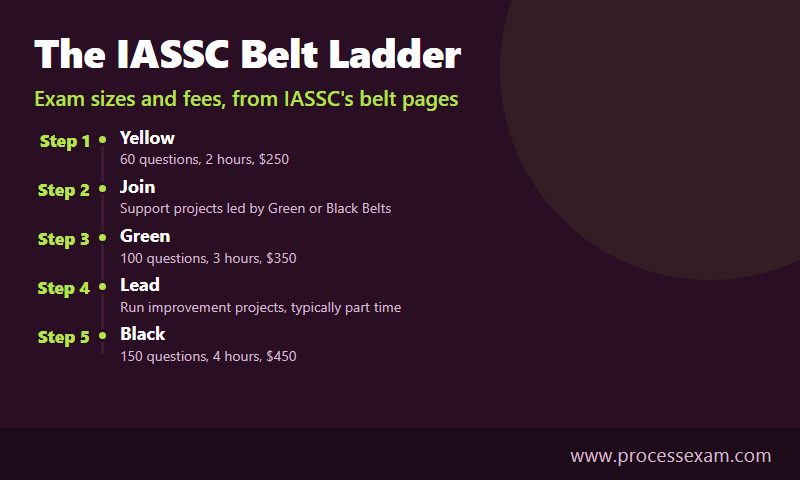
Read together, those three descriptions give you a ladder with a clear logic. Each step changes who owns the project and how much statistics the owner needs, not just how many letters follow your name. The picture below puts IASSC's exam sizes and fees against that ladder.
The Yellow Belt exam in one table
The ICYB paper itself is the entry price of the whole ladder, so it helps to have its figures beside the story. A separate guide on this site goes through the exam in depth; here is the short version.
| Item | ICYB |
|---|---|
| Certification | IASSC Certified Lean Six Sigma Yellow Belt (ICYB) |
| Questions | 60 |
| Duration | 120 minutes |
| Passing score | 70% |
| Exam fee (USD) | 250 |
| Outline covers | Define, Measure and Control |
The paper is 60 questions long, and IASSC adds that some forms carry up to six extra questions that are not graded, and that no prerequisite is needed to sit the exam; training is recommended but not required.
What part does an ICYB holder play on an improvement project?
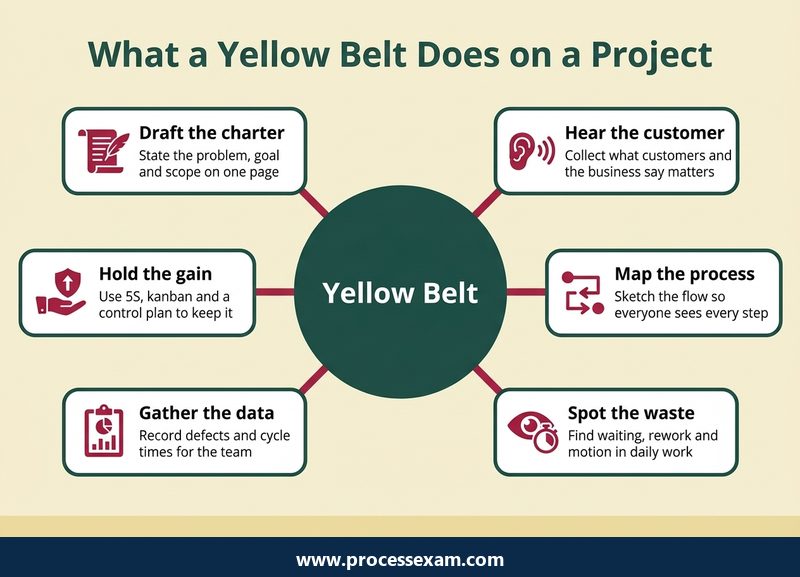
The certificate is a knowledge exam, so it helps to translate its topics into the jobs a Yellow Belt is handed. The outline lists Define, Measure and Control, and each of those turns into a different kind of Tuesday morning.
In the charter meeting
The Define part of the outline asks you to understand the deliverables of a Lean Six Sigma project, the problem-solving strategy Y = f(x), the voice of the customer, the business and the employee, and the roles on a project team. In practice this is the room where somebody says "customers are waiting too long for refunds" and the team has to turn that into a problem statement with a measurable goal and a boundary.
A Yellow Belt is often the person who knows how the work really runs. Your contribution is to say which step the customer actually feels, which complaint is a one-off and which is a pattern, and what a defect means in this process. The same section covers critical-to-quality characteristics, the cost of poor quality and Pareto analysis, so you can help rank problems by how often they occur instead of by who shouted loudest. The project selection topics, such as the business case, the charter, project metrics and the financial evaluation of benefits, show you how the Green Belt will justify the work to a sponsor.
At the process walk
Measure begins with process definition, whose tools are the fishbone, the SIPOC map, the value stream map, the X-Y diagram and FMEA. This is the walk along the line, the desk or the queue with a notepad. A Yellow Belt can draw the SIPOC while the team agrees where the process begins and ends, then add a value stream map that separates working time from waiting time.
The Lean topics in the Define section feed straight into that walk. IASSC's outline names the seven wastes as overproduction, correction, inventory, motion, overprocessing, conveyance and waiting, and it names 5S as sort, straighten, shine, standardize and self-discipline. Once you can spot those in an office as readily as on a shop floor, you will find waste faster than a newcomer who has only the vocabulary.
The Measure section also includes basic and descriptive statistics, normal distributions and graphical analysis, followed by process capability. At Yellow Belt level the job is to collect clean data and read a chart sensibly: counting defects per unit, timing a step, noticing that the histogram has two humps. Deciding which test to run on the data comes later in the ladder, and that boundary is the main topic of the next two sections.
When the gain has to hold
The last block is Control, and it is the one Yellow Belts feel most directly, because they work in the process after the project team leaves. The outline lists Lean controls, meaning how to keep 5S going, kanban and poka-yoke (mistake proofing), then Six Sigma control plans, with a cost-benefit step and the parts of a control plan and of a response plan.
The response plan is the part people skip. A control plan says what to watch; a response plan says what the person at the desk does when the number drifts. A Yellow Belt who can write that second page in plain language is worth a lot to a project that is about to hand over.
How do the Yellow, Green and Black Belt bodies of knowledge build on each other?
All three IASSC outlines open with the same Define and Measure sections. As read in IASSC's Yellow Belt and Green Belt outlines in November 2026, the Define outline runs from the basics and fundamentals of Six Sigma through project selection to the Lean enterprise, and the Measure outline runs from process definition through six sigma statistics and measurement system analysis to process capability. What changes from belt to belt is how much sits after Measure.
| Outline block | Yellow Belt | Green Belt | Black Belt |
|---|---|---|---|
| Define (project basics, fundamentals, selection, Lean) | Yes | Yes | Yes |
| Measure (process definition, statistics, measurement systems, capability) | Yes | Yes | Yes |
| Analyze (variation patterns, inference, hypothesis tests) | Not in the outline | Yes | Yes |
| Improve: regression | Not in the outline | Yes | Yes |
| Improve: designed experiments | Not in the outline | Not in the outline | Yes |
| Control: Lean controls and control plans | Yes | Yes | Yes |
| Control: statistical process control charts | Not in the outline | Yes | Yes |
The table is a reading of the outlines, not an IASSC table. It shows a pattern worth noticing: the Yellow Belt outline is not a thinner copy of the Green Belt one. It is a deliberate cut. It keeps everything that lets you take part in a project and drops the statistical machinery that lets you prove, model and chart the effect of a change.
IASSC also publishes the depth it expects. Its Yellow Belt outline page says that Yellow Belt exams target a cognitive level up to Analyze, Green Belt exams up to Evaluate and Black Belt exams up to Create, using the revised Bloom's taxonomy. In plain terms a Yellow Belt is expected to understand, apply and break a situation into parts; a Green Belt is expected to judge between options; a Black Belt is expected to design something new.
Why the Control section is the bridge
Control is where all three outlines overlap most, and it shows how the belts are supposed to hand work to each other. A Yellow Belt writes the Lean controls and the control plan; a Green Belt adds control charts built on sampling and variation; a Black Belt works through the full chart family and the maths behind the limits. The vocabulary of the first stays valid in the next two.
What does a Green Belt add that a Yellow Belt project cannot do?
Look at what the Yellow Belt outline leaves out and you can see exactly what a Green Belt project does with the data your team collects. The Green Belt outline has an Analyze section with patterns of variation, inferential statistics, hypothesis testing with normal data (t-tests and one-way ANOVA) and with non-normal data (Mann-Whitney, Kruskal-Wallis and chi-squared among them). Its Improve section covers correlation and regression. Its Control section adds statistical process control with charts such as I-MR, Xbar-R, U, P and NP.
Say your team believes a new handover checklist cut rework. At Yellow Belt level you can describe the process, count the defects before and after, and draw the chart. The Green Belt question is whether the difference is bigger than the random variation in the data, and which test settles it. That is a judgement about risk: how likely it is that you are fooled by chance, and whether a statistically real change is large enough to matter in practice.
IASSC's own pages show the weight. The Green Belt page lists 100 closed-book questions with three hours allotted, about 20 from each major section, a 70% minimum and a USD $350 voucher; the Black Belt page lists 150 questions, four hours and USD $450. Both pages state that no prerequisite is required, and both say training and real-world project experience are recommended.
That last point matters for planning. Nothing on IASSC's pages forces you to hold a Yellow Belt before a Green Belt. The order is a choice you make for yourself, and the next section is about when that choice pays off.
When is a Yellow Belt ready to step up to the ICGB?
There is no deadline and no rule, so the decision rests on signals from your own work. Four of them are worth watching.
You keep asking the Green Belt the same question
If your project reaches the point where the team has collected data and someone says "the Green Belt will test it", and you would like to be the one who runs the test, you have found your gap. The Analyze and Improve sections of the Green Belt outline are where that gap is filled.
You are offered a project of your own
A manager who wants you to own a bigger problem is describing the Green Belt job. IASSC's description of a Green Belt is a leader of improvement projects, so the next belt matches the next level of responsibility.
The Yellow Belt vocabulary feels automatic
Define, Measure and Control topics carry straight into the Green Belt paper, where each of the five sections supplies about a fifth of the questions. If you can already explain SIPOC, the seven wastes, capability and a response plan without notes, you are spending your study time on the new sections, not rereading the old ones. If you cannot, a Yellow Belt attempt is the cheaper place to find out, at USD $250 against USD $350.
You are comfortable with numbers, or willing to become so
The jump from Yellow to Green is a jump in statistics more than in project management. A candidate who has never calculated a standard deviation will need real time for hypothesis testing and regression. A candidate who uses spreadsheets and charts daily may find the Green Belt a smaller step than expected. Weigh your own starting point honestly; the ICGB syllabus topics show what each section expects.
If none of those signals applies, staying a Yellow Belt is a perfectly sound end point. IASSC describes the role as a standing one, and a team with several confident Yellow Belts runs better projects than one with a single expert and a crowd of onlookers.
How might a first year on the ladder be planned?
A plan helps because a certificate with no project behind it fades quickly. This is a suggested shape rather than an IASSC requirement, and you should stretch or shrink it around the project calendar where you work.
- Before the exam. Read IASSC's Yellow Belt outline end to end and mark each topic as familiar, half-known or new. Spend your time on the second and third groups. Working through ICYB practice exam questions is a quick way to sort topics into those piles before you book the voucher.
- The first project after the exam. Ask to join one, and take a specific job: the SIPOC, the waste walk, the data collection sheet or the control plan. Keep a short log of what you did and what changed.
- The second project. Offer to lead a small piece. IASSC's description allows a Yellow Belt to lead limited projects, so a one-process, one-team improvement is a fair test of your Define and Control skills.
- The decision point. Look at your log. If the same statistical questions keep arriving, plan the Green Belt study. If the work is mostly mapping, waste and control, a second year of Yellow Belt practice is time well spent.
Whichever way you go, remember that your certification status carries a clock. IASSC recognises certification indefinitely, but since March 2017 a certification shows as Current for three years from the last day of the month in which you were certified, and you renew by passing a recertification exam, and the page allows a window that runs to 90 days after the elapse date, according to IASSC's recertification page. The fees listed there are USD $115 for Yellow, $175 for Green and $235 for Black. Planning a Green Belt within the three-year window means your first certificate does not lapse unnoticed while you study.
How should you prepare for a first IASSC exam without wasting effort?
For the ICYB specifically, an outline-led approach beats a book-led one. IASSC publishes its Body of Knowledge free, and the exam is written from it, so your reading list is already set. Turn each numbered topic into a one-line question to yourself, such as "what does CTQ mean, and what is one in my own process", and answer it aloud.
Practise with examples from your own workplace
Every concept in the outline has a home in some real process: a hospital discharge, an invoice approval, a help-desk ticket. Choose one process and run the topics through it from start to end. You will remember a fishbone you drew about late invoices far longer than one in a textbook figure.
Treat calculations as small habits
Defects per unit, defects per million opportunities, first-time yield and rolled throughput yield sit inside the Define outline as basic Six Sigma metrics, and cycle time sits beside them. They are short sums, but they punish rushing, so write each formula once on paper and use it on three invented examples.
Be wary of memorised answer lists
Searches for "dumps" are common for this exam, and they are a poor foundation for the ladder this guide describes. The exam tests whether you understand the method, and every belt above it builds on the same Define and Measure content. A candidate who memorised answers has nothing to build the Green Belt on. Practice questions earn their place when you use them to find weak topics and then read the outline again, not when you try to memorise them.
Book when the weak list is short
IASSC sells the exam as a voucher, and the paper is closed book and proctored. Schedule it once your list of weak topics is short enough to revisit in a weekend. Booking earlier only adds pressure; booking much later lets the vocabulary fade.
Does the Yellow Belt pay off if you never plan to lead a project?
Yes, for the reason IASSC's page gives: Yellow Belts serve as team members on projects that others lead. A project with a Green Belt leader and three Yellow Belt members has people who can read the charter, the process map and the control chart without a translator. That shared language shortens meetings and gets problems out in the open sooner.
It is also an honest credential. It says you know the Define, Measure and Control content, and nothing more. It does not claim you can run a regression, so no employer is misled. For many roles in operations, service desks, finance, healthcare and logistics that is exactly the right level: enough to contribute, with room to grow later.
Finally, treat it as evidence, not as a promise. Holding any belt does not guarantee a promotion or a pay change, and this guide makes no claim about salary. What it does is make the next conversation easier: you can show the outline you studied, the projects you joined and the control plan you wrote, and your manager can judge the rest.
Frequently Asked Questions
What does ICYB mean?
ICYB stands for the IASSC Certified Lean Six Sigma Yellow Belt, the entry-level credential from the International Association for Six Sigma Certification. It shows knowledge of the Define, Measure and Control parts of the Lean Six Sigma method, and suits people who lead small projects or join larger ones.
Do I need a Yellow Belt before the Green Belt?
No. IASSC's Green Belt page states that no prerequisites are required to sit the exam, and recommends training and project experience instead. Many people still start with the Yellow Belt because Define, Measure and Control carry straight into the Green Belt outline.
How many questions and what pass mark does the ICYB exam have?
The ICYB exam has 60 closed-book questions in 120 minutes, with a 70% minimum score. IASSC says some forms add up to six extra questions that are not graded. It mixes multiple-choice and true/false items and needs no prerequisite.
How much does the ICYB cost compared with the other belts?
IASSC lists the Yellow Belt exam voucher at USD $250, the Green Belt at USD $350 and the Black Belt at USD $450. Those are exam voucher prices only. Recertification is priced separately, at USD $115, $175 and $235 respectively on IASSC's recertification page.
Does an ICYB certification expire?
IASSC recognises certification perpetually, but its status shows as Current for three years from the last day of the month you were certified. After that you recertify by passing a shorter exam, which IASSC allows up to 90 days after the elapse date, so the certificate stays marked Current.
- Lean Six Sigma |
- IASSC Lean Six Sigma Yellow Belt Sample Questions |
- ICYB Exam Questions Download |
- ICYB Test Questions |
- Lean Six Sigma Yellow Belt PDF |
- IASSC Lean Six Sigma Yellow Belt Test Questions |
- Lean Six Sigma Yellow Belt Certification Requirements |
- IASSC Lean Six Sigma Yellow Belt Book |
- IASSC ICYB BOK PDF |
- Lean Six Sigma Yellow Belt Certification Cost |
- ICYB Question Bank |
- ICYB Body of Knowledge (BOK)


