
ICYB Exam Guide: IASSC Yellow Belt Cost, Syllabus and Study Plan
Updated on 29 September 2026. What’s new: iassc keeps a yellow belt current for three years, then a 30-question recertification exam is needed to renew it
Your manager has asked you to join a Lean Six Sigma project, and the Green Belt running it suggests you get a Yellow Belt first. The ICYB is that exam: the IASSC Certified Lean Six Sigma Yellow Belt, 60 multiple-choice and true/false questions in 120 minutes, a 70% pass mark and a USD $250 fee, with no prerequisites. It tests the Define, Measure and Control topics at foundation level. This guide covers what each topic asks, a worked example, a four-week study plan and how the certificate stays current.

What does ICYB mean, and what does the exam involve?
ICYB is the short name for the IASSC Certified Lean Six Sigma Yellow Belt, the entry-level credential from the International Association for Six Sigma Certification. IASSC describes the holder as someone who knows the foundations of Lean Six Sigma, can lead a limited improvement project, or can act as a team member on a larger project run by a Green Belt or Black Belt, usually in a part-time role.
The person who passes is not expected to design experiments or run regression models. They are expected to recognise waste, describe a process clearly, read basic statistics and graphs, judge whether a measurement can be trusted, and keep an improvement in place once the team has made it. That practical, supportive level shapes every question on the paper.
The figures below are the ones to plan around.
| Exam detail | ICYB |
|---|---|
| Exam name | IASSC Certified Lean Six Sigma Yellow Belt |
| Exam code | ICYB |
| Vendor | IASSC |
| Number of questions | 60 |
| Duration | 120 minutes |
| Exam fee | USD $250 |
| Passing score | 70% |
How is the paper set out?
The paper is closed book and proctored. Every question is multiple choice or true/false, drawn from each section of the Yellow Belt Body of Knowledge. IASSC says some versions add up to six further questions that are not graded, so you may see more than 60 items on screen without knowing which ones count. Treat every question as if it scores.
At 60 questions in two hours you have about two minutes per item, which is generous. Time is rarely the problem on this exam. The usual problem is reading a familiar-looking term such as accuracy, precision or capability and answering the version you remember instead of the one being asked.
Are there any prerequisites?
None. IASSC states that there are no prerequisites to sit the Yellow Belt exam, and it recommends, but does not require, training with a qualified provider first. The official IASSC Yellow Belt certification page is the place to confirm the fee, format and delivery options before you book, because the vendor can change them.
Where and how can you take it?
IASSC lists two routes: a proctored online session through its remote-proctoring partner, bought as an on-demand web-based voucher, and a seat at a physical testing centre. It quotes more than 8,000 centres in 165 countries, and accredited training providers can also administer the paper. Choose online if your desk, webcam and connection are dependable; choose a centre if you would rather not think about your own equipment on the day.
IASSC also offers a non-proctored Yellow Belt evaluation exam that you can use as a readiness check before paying for the real one. It is informal, so use it to find weak spots, not to predict your result.
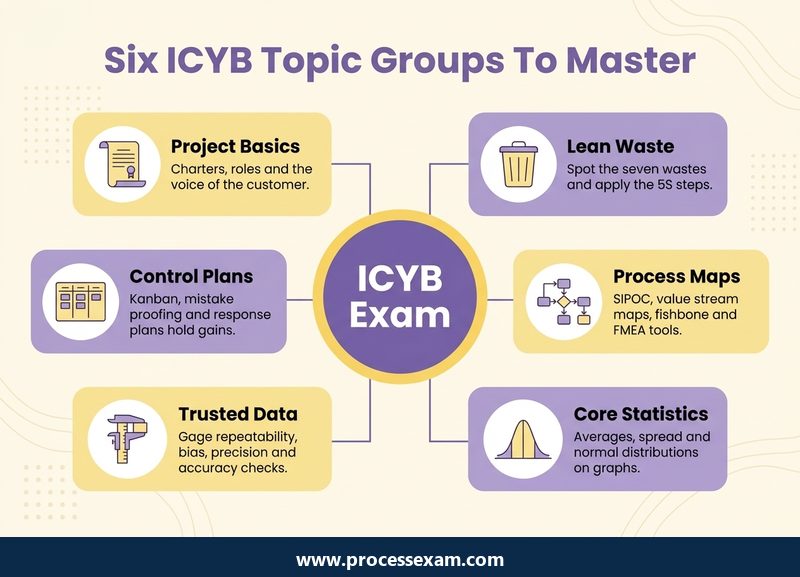
What is in the ICYB Body of Knowledge, topic by topic?
The published outline groups the exam into three phases: Define, Measure and Control. The outline is numbered 1.0, 2.0 and 5.0, which shows that the Analyze and Improve phases are left to the Green Belt level, although IASSC's introduction to the document names all five. If you want the same list in your own study notes, the ICYB syllabus page on ProcessExam sets it out phase by phase, and IASSC's own Yellow Belt Body of Knowledge is the source it follows.
Define: what problem is the project solving?
Define has four groups of topics, and it is the phase where the most vocabulary lives.
- The basics of Six Sigma. The meanings of Six Sigma, its history and the wider story of continuous improvement, the deliverables of a project, the problem-solving idea Y = f(x), the voice of the customer, business and employee, and the roles people play on a project.
- The fundamentals. Defining a process, critical to quality characteristics, cost of poor quality, Pareto analysis, and the basic metrics that count defects and yield (DPU, DPMO, first-time yield and rolled throughput yield) alongside cycle time.
- Selecting projects. Building a business case and project charter, developing project metrics, and evaluating the financial benefit.
- The Lean enterprise. What Lean is, where it came from, how it sits beside Six Sigma, the seven wastes and the five steps of 5S.
Y = f(x) deserves a moment because it underpins the whole method. The outcome you care about (Y, such as late deliveries) is a function of the inputs that drive it (the x values, such as order entry errors or staffing gaps). A Yellow Belt is not asked to model that function, only to understand why fixing the x values is the way to move Y.
The seven wastes are listed by IASSC as overproduction, correction, inventory, motion, overprocessing, conveyance and waiting. Expect a scenario in which a team walks long distances to fetch forms, and a question asking which waste that is. Motion concerns people; conveyance concerns material or information being moved. Candidates swap them more often than any other pair.
Measure: what is actually happening, and can you trust the numbers?
Measure is the largest block and the one with the most calculation.
- Process definition. Cause and effect (fishbone) diagrams, process maps, SIPOC and value stream maps, the X-Y diagram, and failure modes and effects analysis (FMEA).
- Six Sigma statistics. Averages and spread, the normal curve and how to test for it, and reading charts.
- Measurement system analysis. Precision and accuracy, bias, linearity and stability, gage repeatability and reproducibility, and variable and attribute measurement systems.
- Process capability. How to measure capability, why a process must be stable first, capability for pass/fail data, and ways to monitor it over time.
Measurement system analysis is the topic that surprises newcomers. Before you measure a process, you must know whether the measuring itself is reliable. Precision is how tightly repeated readings cluster; accuracy is how close they sit to the true value. A scale that always reads two kilograms high is precise but not accurate, and the difference is bias. Repeatability is one person getting the same answer twice with the same tool; reproducibility is different people getting the same answer.
On the statistics side, keep the normal distribution's shape in your head: roughly 68% of values fall within one standard deviation of the mean, 95% within two and 99.7% within three. That single fact answers a surprising number of questions once you can read the graph.
Control: how do you make the gain stick?
Control is the smallest phase, with two groups of topics, and it rewards a clear head more than heavy memory.
- Lean controls. Control methods for 5S, kanban and poka-yoke (mistake proofing).
- Six Sigma control plans. Cost-benefit analysis, the elements of a control plan and the elements of a response plan.
A control plan says what will be watched, how often, by whom and against which limit. A response plan says what happens when the reading goes out of limits. Questions frequently ask which of the two a described document is, so learn to tell them apart by the verb: monitoring belongs to the control plan, reacting belongs to the response plan.
How deeply are you tested?
IASSC aligns its exams to the revised Bloom's Taxonomy and says Yellow Belt questions go up to the Analyze level, meaning you should be able to break a described situation into parts and see how they relate, not only recall definitions. Green Belt questions reach Evaluate and Black Belt questions reach Create. Read the syllabus with that in mind: for each topic ask what it is, when you would use it and what a result would tell you.
How do the ICYB calculations look in a worked example?
The exam expects you to read numbers rather than run software, so it helps to have done a few by hand. The example below is invented for practice; only the formulas come from the method.
An accounts team checks 500 supplier invoices. Each invoice offers 4 chances to make an error, and the team finds 60 defects in total.
| Measure | Working | Result |
|---|---|---|
| Defects per unit (DPU) | 60 defects / 500 invoices | 0.12 |
| Opportunities | 500 invoices x 4 chances | 2,000 |
| Defects per opportunity | 60 / 2,000 | 0.03 |
| Defects per million opportunities (DPMO) | 0.03 x 1,000,000 | 30,000 |
Which defects should the team tackle first?
A Pareto analysis sorts the causes from largest to smallest and adds a running percentage. Suppose the 60 defects break down as follows.
| Defect type | Count | Share | Running total |
|---|---|---|---|
| Wrong purchase order number | 24 | 40.0% | 40.0% |
| Missing approval | 18 | 30.0% | 70.0% |
| Wrong tax code | 10 | 16.7% | 86.7% |
| Duplicate invoice | 5 | 8.3% | 95.0% |
| Other | 3 | 5.0% | 100.0% |
The first two causes account for 70% of the defects, which is the 80:20 idea in action: a few causes produce most of the trouble, so start there. A question built on this kind of table usually asks which single cause to address first or what share the top two represent.
How much work passes every step without rework?
Now follow the same invoices through three steps: entry, approval and payment. First-time yield for each step is the share that passes without correction. Rolled throughput yield multiplies them.
| Step | First-time yield |
|---|---|
| Entry | 95% |
| Approval | 90% |
| Payment | 98% |
| Rolled throughput yield | 0.95 x 0.90 x 0.98 = 83.8% |
The lesson is that a process made of three good-looking steps can still send out one in six invoices needing rework. Candidates who average the three percentages get 94.3% and pick the wrong answer.
Is the process capable?
Suppose payment must be made within 4 to 10 days, so the lower specification limit is 4 and the upper is 10. The process averages 8 days with a standard deviation of 0.8 days.
- Cp compares the width of the specification with the natural spread: (10 - 4) / (6 x 0.8) = 6 / 4.8 = 1.25.
- Cpk also asks whether the process is centred, using the closer limit: the distance from the mean to the upper limit is 2 and to the lower limit is 4, so Cpk = 2 / (3 x 0.8) = 0.83.
Cp says the spread could fit inside the limits; Cpk says that, as centred today, it does not. Recognising why Cpk is lower than Cp, namely that the process sits off-centre, is the sort of reasoning the Analyze level rewards. Check how deeply your training material treats capability indices, since IASSC's outline lists capability analysis without spelling out every formula.
What does a realistic ICYB study plan look like?
Four weeks of about six to eight hours each is a sensible pace for someone new to the method; stretch it if you are also busy at work, and shorten it if the vocabulary is already familiar. The order below follows the phases so each block builds on the last.
| Week | Focus | What to finish |
|---|---|---|
| 1 | Define | Roles, voice of the customer, CTQ, cost of poor quality, Pareto, the metrics DPU, DPMO, FTY and RTY, charters, seven wastes and 5S |
| 2 | Measure, part one | Fishbone, SIPOC, process and value stream maps, X-Y diagram, FMEA, descriptive statistics and the normal distribution |
| 3 | Measure, part two and Control | Measurement system analysis, capability, stability, 5S controls, kanban, poka-yoke, control and response plans |
| 4 | Practice and review | Timed mixed sets, the IASSC evaluation exam, and a second pass over every topic you missed |
What study habits work best?
Make a one-line definition card for every item in the outline, then attach one example from your own workplace. A term you can tie to a real queue, form or handover is far harder to confuse with a look-alike. Redo the invoice example above with new numbers each week until the formulas need no notes.
Practise as you will sit. Read each stem twice, cover the options, decide your own answer, then compare. When you are ready for exam-style sets, the ICYB practice exam gives you timed practice against the same 60-question format so you can see how you pace yourself. After each set, log every miss with the reason: did you not know the term, misread the stem, or slip in arithmetic? The reasons cluster quickly, and the cluster tells you what to fix.
What should the last two days look like?
Stop adding new material. Read your definition cards, redo the calculation drills, and write a single sheet with the seven wastes, the five S words, the DPMO and RTY formulas, the precision and accuracy distinction and the difference between a control plan and a response plan. If you are testing online, check your room, camera and connection the day before so nothing about the setup costs you focus.
What trips up first-time ICYB candidates?
- Mixing up look-alike terms. Precision versus accuracy, repeatability versus reproducibility, motion versus conveyance, control plan versus response plan. Write each pair on a card and state the difference in one sentence.
- Averaging yields. Rolled throughput yield multiplies step yields. An average overstates how well the whole process performs.
- Confusing DPU and DPMO. DPU counts defects per unit; DPMO scales defects per opportunity to a million. The number of opportunities per unit changes the answer.
- Treating Lean as a separate subject. Waste and 5S appear in Define, and kanban, mistake proofing and 5S controls appear in Control. Lean is woven through the paper.
- Studying the whole DMAIC toolbox. Hypothesis tests, regression and design of experiments are not in the Yellow Belt outline. Time spent there is time taken from measurement systems and capability.
- Memorising without applying. Because questions go up to the Analyze level, a bare definition is often not enough; you must say what a result means or which step comes next.
- Rushing true/false items. One absolute word such as always or never can flip the answer. Read every word of a true/false statement before deciding.
- Learning answer letters. Learn the reasoning behind each answer instead of recognising a memorised one. Anything that only teaches you which letter to pick will fail you on a reworded stem.
What does a Yellow Belt add to your role, and how does it compare with other belts?
For someone who works inside a process, whether in operations, finance, healthcare, logistics, service desks or administration, the Yellow Belt gives a shared language with the people who run improvement projects. You can join a team, read its charter and data, and contribute without needing a translator. That is the honest value: credibility as a capable team member and a first rung on the belt ladder.
Because IASSC is an independent certification body rather than a training provider, the credential is not tied to any one course. IASSC also issues a certificate with a certification number and a digital badge, and lists holders on its certification register, so an employer can verify it.
| IASSC belt | Role in short | Highest cognitive level tested |
|---|---|---|
| Yellow Belt (ICYB) | Leads limited projects or supports larger ones, part time | Analyze |
| Green Belt | Leads improvement projects within a business area | Evaluate |
| Black Belt | Leads complex, cross-functional projects | Create |
If you plan to go on to a Green Belt, the Yellow Belt topics are not wasted effort: Define, Measure and Control terminology carries straight through. Treat the ICYB as either a destination for a supporting role or a low-risk first step before a larger investment. Holding it does not promise any particular pay rise, so judge its value by the projects it lets you join.
How do you register, and does the ICYB certification expire?
To register, buy the exam voucher from IASSC's order site for the delivery method you want, then follow its scheduling instructions. Once you pass, IASSC issues the certificate and badge, adds your name to its register and lets you use its certification marks and titles in line with its marks policy.
How long does the certification stay current?
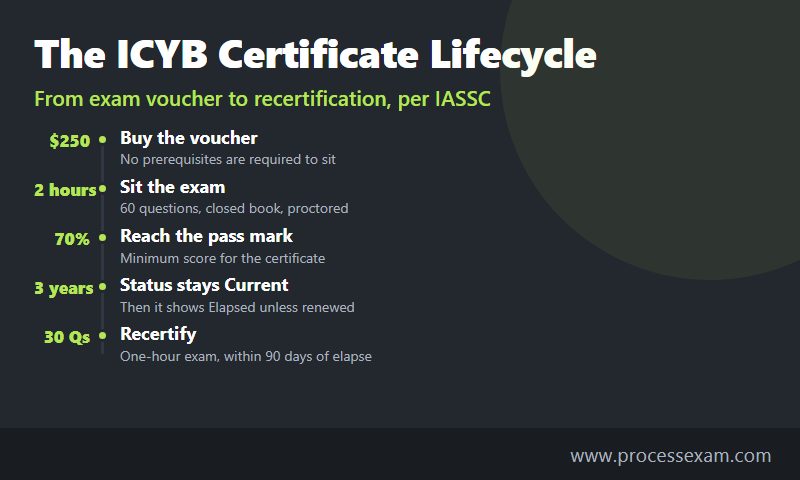
IASSC recognises certified professionals indefinitely, but since 1 March 2017 it has also given each certification a status. A certification is Current for three years from the date you earn it. After that the status shows as Elapsed unless you recertify. Recertification for the Yellow Belt is a shorter exam: 30 questions in one hour, roughly 10 from each major section of the outline, with the same 70% minimum score and a fee of USD $115.
You must take the recertification exam before the elapse date or within 90 days after it. IASSC allows two attempts, at least two weeks apart. If both fail, or the window passes, the certification is not revoked but its status becomes permanently Elapsed, and you would pass a full certification exam again to earn a new three-year Current status. The IASSC recertification policy has the current wording and fees.
What is a sensible next step?
Print the outline, mark each topic red, amber or green for how confident you feel, and start the four-week plan with the reds. If you can explain a term in one sentence and use it on a small example, mark it green. When most of the sheet is green and your timed practice scores hold steady at or above the 70% mark, book the voucher.
Frequently Asked Questions
What does ICYB stand for?
ICYB is the short name for the IASSC Certified Lean Six Sigma Yellow Belt, the entry-level certification from the International Association for Six Sigma Certification. It shows foundation knowledge of the Define, Measure and Control topics and suits people who support or lead small improvement projects.
How many questions are on the ICYB exam?
The ICYB exam has 60 multiple-choice and true/false questions, taken closed book under proctoring in 120 minutes. IASSC notes that some versions add up to six non-graded questions, so you may see slightly more items than 60 without knowing which ones are unscored.
How much does the ICYB exam cost?
The ICYB exam fee is USD $250 according to the exam master. IASSC sells it as a voucher, either on-demand web-based or for a testing centre. Recertification is priced separately, so check IASSC's official page for the current fee before you book.
What is the passing score for the ICYB exam?
The passing score for the ICYB exam is 70%. IASSC requires a minimum of 70% on the Yellow Belt exam to award the certification, and there are no prerequisites to sit it.
Does the ICYB certification expire?
IASSC recognises certification indefinitely, but its status is Current for three years, then Elapsed unless you recertify. The Yellow Belt recertification exam has 30 questions in one hour with a 70% minimum score, and must be taken before or within 90 days after the elapse date.
- Lean Six Sigma |
- IASSC Lean Six Sigma Yellow Belt Sample Questions |
- ICYB Exam Questions Download |
- ICYB Test Questions |
- Lean Six Sigma Yellow Belt PDF |
- IASSC Lean Six Sigma Yellow Belt Test Questions |
- Lean Six Sigma Yellow Belt Certification Requirements |
- IASSC Lean Six Sigma Yellow Belt Book |
- IASSC ICYB BOK PDF |
- Lean Six Sigma Yellow Belt Certification Cost |
- ICYB Question Bank |
- ICYB Body of Knowledge (BOK)


