
ICBB Certification: Inside the IASSC Black Belt Exam
You have run Green Belt projects for years, closed charters, and shown savings to a steering committee. Can a knowledge exam prove any of that? Not the projects themselves. What the IASSC Certified Lean Six Sigma Black Belt (ICBB) proves is that you command the full Black Belt toolset, from non-parametric tests to fractional factorials, without notes and against the clock. That is a different claim, and for many practitioners it is the missing one.

This article is about the ICBB exam itself: what the letters mean, what the Body of Knowledge asks for in each DMAIC phase, what "knowledge-based, no project" really means for someone who already has project scars, and how to prepare for a long, closed-book paper. It is written for the experienced Green Belt who is weighing whether the step up is worth the study time.
What does ICBB mean, and what does the certificate say about you?
ICBB stands for IASSC Certified Lean Six Sigma Black Belt. IASSC is the International Association for Six Sigma Certification, which has been part of the PeopleCert portfolio since 2020. The ICBB is its top belt: above the Yellow Belt (ICYB) and the Green Belt (ICGB), and built on the same five-phase structure of Define, Measure, Analyze, Improve and Control.
IASSC describes a certified Black Belt as someone who leads complex improvement projects, usually full time, and who can implement, perform, interpret and apply Lean Six Sigma at an advanced level. The certificate itself is narrower than that description. It states that you passed a standardised, proctored exam on the Black Belt Body of Knowledge. It does not state that a particular project succeeded, that a sponsor signed anything off, or that you trained with a particular provider. Knowing exactly what the credential claims helps you describe it honestly on a CV and in an interview.
The figures every candidate needs are these:
| Exam detail | ICBB |
|---|---|
| Exam name | IASSC Certified Lean Six Sigma Black Belt |
| Exam code | ICBB |
| Vendor | IASSC |
| Number of questions | 150 |
| Duration | 240 minutes |
| Passing score | 70% |
| Exam fee | USD $450 |
IASSC lists the same details, together with voucher links and delivery options, on its Black Belt certification page. Read that page before you buy a voucher, because delivery channels and voucher types are where changes are most likely to appear.
Once you pass, IASSC issues a certificate in PDF with a certification number, a digital badge, an entry in its certification register and the right to use the Black Belt title under its marks policy. Anyone who wants to check your claim can verify it against that register, which matters more than it sounds: a verifiable number is the thing that separates this credential from a training-course attendance certificate.
Can a knowledge exam prove what years of projects taught you?
This is the question that stops many seasoned Green Belts from booking. The honest answer is that the ICBB was never designed to prove project success, and IASSC says so openly.
What IASSC measures, and what it deliberately leaves out
In its published position on certification, IASSC argues that knowledge and the ability to apply it are not the same thing and cannot be measured the same way. Its Black Belt, Green Belt and Yellow Belt exams therefore require no prerequisites, no training from any particular provider, no specific training method and no proof of project work. The exam is the whole requirement: sit it, score at least 70%, and the certification is yours.
That design choice has a direct consequence for you. Your project history earns no marks on the day. A candidate who has never led a project and a candidate who has led twenty face exactly the same 150 questions. What your experience gives you is not credit but fluency: you will recognise a SIPOC, a charter or a control plan instantly, and those questions will cost you seconds rather than minutes.
Why the exam can still expose an experienced practitioner
Real projects are selective. Most improvement work uses a small, reliable subset of tools: process maps, Pareto charts, a fishbone, a capability study, a two-sample t-test, an I-MR chart. The Black Belt Body of Knowledge is not selective. It covers Kruskal-Wallis and Friedman tests, Box Cox transformations, fractional factorial resolution, CuSum and EWMA charts, and a long list of topics that many practitioners never needed on the shop floor.
So the exam tests breadth that projects rarely demand. A Green Belt with ten years of experience can be expert in the tools their organisation uses and still be rusty on half the Analyze and Improve phases. That is not a flaw in the candidate. It is exactly the gap a knowledge exam is built to reveal.
What the credential adds to a project portfolio
Think of your experience and the ICBB as two separate pieces of evidence. The project portfolio shows that you can deliver results in one organisation. The certificate shows that your understanding of the method meets an independent standard that does not depend on who trained you or who signed your projects. Hiring managers who do not know your previous employer can check the second piece in a minute. Together, they tell a fuller story than either tells alone.
What does each DMAIC phase of the Black Belt Body of Knowledge cover?
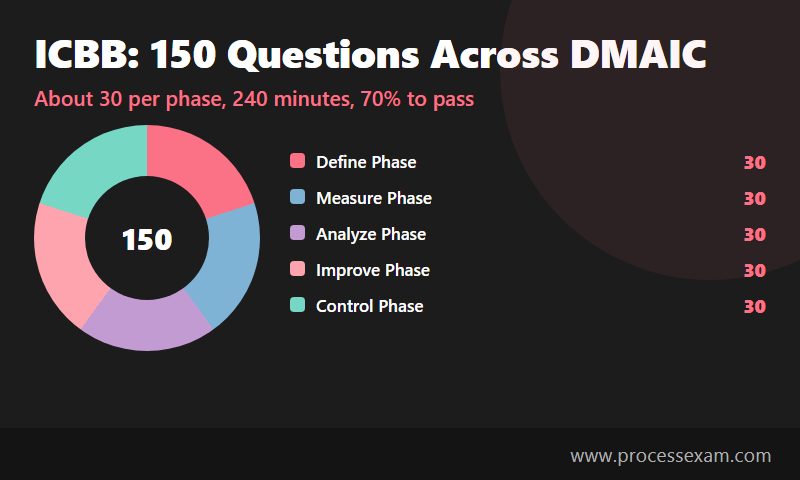
IASSC builds every Black Belt exam from its Lean Six Sigma Black Belt Body of Knowledge. The Body of Knowledge is organised into the five DMAIC phases, and IASSC states that the exam draws approximately 30 questions from each major section. In practice, that means no phase is optional and none is a quick win.
Define: the basics, the fundamentals and Lean
The Define phase starts with what Six Sigma means, where it came from, the deliverables of a Lean Six Sigma project, the Y = f(x) problem-solving strategy, the voices of the customer, business and employee, and the roles on a Six Sigma team. It then moves to process definition, critical-to-quality characteristics, the cost of poor quality, Pareto analysis and the basic metrics: DPU, DPMO, first-time yield, rolled throughput yield and cycle time. Expect to derive these metrics, not just name them.
Project selection is part of Define too: building a business case and a charter, developing project metrics, and evaluating the financial benefits. The phase closes with the Lean enterprise, including the history of Lean, how it combines with Six Sigma, the seven elements of waste and 5S.
Measure: from process maps to capability
Measure begins with process definition tools: cause-and-effect diagrams, process maps, SIPOC, value stream maps, the X-Y diagram and FMEA. It then turns statistical, with basic and descriptive statistics, normal distributions and normality, and graphical analysis.
Measurement system analysis is where many candidates slow down. You need to separate precision from accuracy, understand bias, linearity and stability, read a gage repeatability and reproducibility study, and know how variable and attribute MSA differ. The phase ends with process capability: capability analysis, the concept of stability, attribute and discrete capability, and monitoring techniques.
Analyze: the heaviest statistics in the paper
Analyze covers patterns of variation through multi-vari analysis and classes of distributions, then inferential statistics: what inference is, sampling techniques and the central limit theorem. Hypothesis testing follows, with its goals, the difference between practical and statistical significance, and alpha and beta risk.
The test menu is long. For normal data you need one- and two-sample t-tests, the one-sample variance test and one-way ANOVA, along with equal-variance tests, normality tests and sample-size calculation. For non-normal data the list is Mann-Whitney, Kruskal-Wallis, Mood's Median, Friedman, the one-sample sign test, the one-sample Wilcoxon, one- and two-sample proportion tests and chi-squared contingency tables. The skill examined is choosing the right test for a situation and reading its result correctly.
Improve: regression and designed experiments
Improve opens with simple linear regression, correlation and residuals analysis, then extends to non-linear and multiple linear regression, confidence and prediction intervals, and data transformation with Box Cox. The second half is designed experiments: objectives, methods and design considerations, then full factorial designs with 2k structures, linear and quadratic models, balanced and orthogonal designs, model fit and centre points. Fractional factorials close the phase, with their designs, confounding effects and experimental resolution.
Control: holding the gain
Control combines Lean controls, such as sustaining 5S, kanban and poka-yoke, with statistical process control. The SPC list is broad: I-MR, Xbar-R, Xbar-S, U, P, NP, CuSum and EWMA charts, control chart anatomy, rational subgroups, sampling frequency, and centre line and control limit calculations. The phase finishes with Six Sigma control plans: cost-benefit analysis and the elements of both the control plan and the response plan.
Our phase-by-phase topic list sets out the same subject areas in one page, which makes it a practical checklist to tick off as you study.
How is the 150-question closed-book paper built and delivered?
IASSC describes the Black Belt exam as a 150-question, closed-book, proctored exam with four hours allowed. The questions are multiple choice and true/false, drawn from all five phases in roughly equal numbers. Some forms of the exam also carry up to 15 extra questions that are not graded; you cannot tell which ones they are, so treat every question as if it counts.
What "closed book" means on the day
You bring no notes, no textbooks and no formula sheets into the exam. For a Black Belt paper that is significant, because the Body of Knowledge is full of formulas, test-selection rules and chart constants. Anything you normally look up, such as when to use Mood's Median rather than Kruskal-Wallis, or how DPMO relates to yield, has to be in your head. Preparation for a closed-book exam is less about collecting material and more about recall practice.
Where and how you can sit it
IASSC offers several routes to the same exam. You can buy an on-demand, web-based exam taken through PeopleCert's online proctoring, book a seat at a Pearson VUE test centre, or take it through an IASSC Accredited Provider that is authorised to administer exams. The content and passing standard are the same whichever route you use; the choice is about convenience and where you concentrate best.
How deep the questions go
IASSC maps its exams to the revised Bloom's taxonomy. According to its note on Bloom's taxonomy, Black Belt exams target cognitive levels up to Create, one level above the Green Belt's ceiling of Evaluate. In plain terms, you will meet questions that ask you to remember a definition, but also questions that ask you to judge which data in a complex scenario deserves further analysis, or which conclusion the evidence actually supports.
The pace you need
Four hours for 150 questions works out at just over a minute and a half per question. That sounds generous until a regression output or an ANOVA table appears and you need to read it carefully. Candidates who finish comfortably usually answer recall questions in well under a minute, which banks time for the interpretation questions that need three or four.
Which topics catch experienced Green Belts off guard?
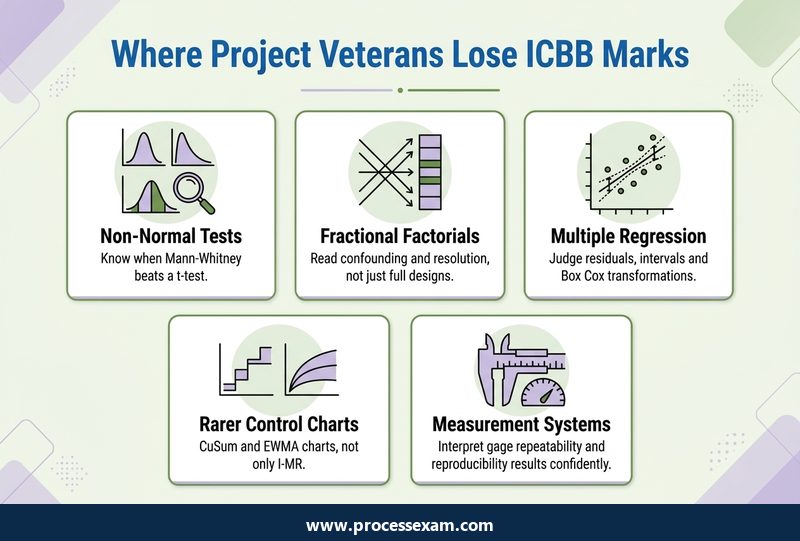
Years of project work build confidence, and that confidence can hide gaps. The same five areas come up again and again when experienced practitioners review their practice results.
Non-parametric tests
Most projects either find normal data or transform it. The exam expects you to know the whole non-parametric family and when each member applies: Mann-Whitney for two independent medians, Kruskal-Wallis for more than two, Mood's Median when outliers are a concern, Friedman for blocked designs, and the sign and Wilcoxon tests for a single sample. Build a one-page decision tree and rehearse it until you can redraw it from memory.
Fractional factorials and confounding
Many Green Belts have run a full factorial, often with software doing the heavy lifting. Fewer have designed a fractional factorial and had to explain which effects are confounded, or what resolution III, IV and V mean for the conclusions they can draw. These questions are conceptual rather than computational, which makes them very learnable once you know they are coming.
Multiple regression and transformations
Reading a multiple regression output, telling a confidence interval from a prediction interval, and deciding when a Box Cox transformation is justified are core Improve topics. Practitioners who mostly used simple correlation on projects should give this area extra time.
Less common control charts
I-MR and Xbar-R charts appear on almost every project. CuSum and EWMA charts rarely do, yet both sit in the Body of Knowledge, alongside the attribute charts U, P and NP. Know what each chart is for, which data type it needs, and what makes it more sensitive than a standard Shewhart chart.
Measurement system analysis in detail
Many teams accept a gage study result as pass or fail. The exam asks why: what repeatability and reproducibility each measure, how bias, linearity and stability differ, and what to do when an attribute measurement system disagrees with itself. Treat MSA as its own topic rather than a line in the Measure phase.
How should you prepare for four hours without notes?
A realistic plan for a working Green Belt is eight to ten weeks at five to seven hours a week. Candidates who already work daily with statistics can compress it; candidates who have been away from hypothesis testing for a while should stretch it.
| Weeks | Focus | What done looks like |
|---|---|---|
| 1 | Baseline | One timed diagnostic set of questions across all five phases, with scores logged by phase |
| 2-3 | Analyze | A test-selection tree you can redraw from memory; normal and non-normal tests practised with worked data |
| 4-5 | Improve | Regression outputs read without hesitation; factorial and fractional designs explained in your own words |
| 6 | Measure | MSA, capability and descriptive statistics revised; FMEA and value stream map terms checked |
| 7 | Define and Control | Metrics derived by hand, waste and 5S terms fixed, every control chart matched to its data type |
| 8-10 | Full rehearsal | Two or three full-length timed papers, every wrong answer logged and revisited |
Start with the phases your projects never needed
The plan deliberately starts with Analyze and Improve rather than Define. For an experienced Green Belt, Define and Control are mostly revision, while the heavier statistics are where marks are won or lost. Front-loading them leaves time to return to anything that does not stick.
Practise recall, not recognition
Reading a chapter and nodding along is recognition. The exam demands recall. After each topic, close the book and write down the test assumptions, the formula or the chart rules from memory, then check what you missed. A deck of flashcards for formulas and test-selection rules is worth building, because it is exactly what the closed-book format takes away from you.
Rehearse the full four hours
A long exam tests stamina as well as knowledge. At least twice, sit a full 150-question paper in one session, in a quiet room, with no notes and no breaks you would not have on the day. When you want a realistic run under those conditions, our ICBB mock exam follows the same 150-question, 240-minute format, so your timing and stamina both get tested before they count.
Use the evaluation exam and your error log
IASSC also sells an informal, non-proctored Black Belt evaluation exam intended to help candidates judge readiness. Whichever practice source you use, keep an error log: the question, the phase, why you chose the wrong answer, and the rule you should have applied. In the final two weeks, the log is a better revision guide than any textbook, because it lists your own mistakes rather than everyone's.
Common preparation mistakes
- Relying on project memory. Your organisation's way of doing a tool may not match the Body of Knowledge definition the exam uses.
- Leaning on software. If Minitab or a spreadsheet always picked the test for you, practise choosing it yourself.
- Skipping Lean topics. Waste, 5S, kanban and poka-yoke questions are quick marks that statisticians sometimes neglect.
- Timing only short sets. Twenty-question drills do not reveal what happens to concentration in the third hour.
- Ignoring true/false questions. They look easy, but a single qualifying word often decides them. Read every one slowly.
What happens after you pass the ICBB?
Passing gives you the IASSC Certified Black Belt designation, a numbered certificate and a badge you can add to professional profiles. IASSC recognises its certifications indefinitely, but it also classifies them by status. A new certification is "Current" for three years. After that it becomes "Elapsed" unless you pass a shorter recertification exam; the certification itself is not revoked. The IASSC recertification policy gives the exam details and the timing rules, including the window after the elapse date in which you can still recertify.
How to present the credential alongside your projects
On a CV or LinkedIn profile, list the ICBB with its certification number and the year you passed, then list your projects separately with their measured results. The combination answers two different questions a hiring manager has: does this person know the full method, and have they used it to change something? Keeping them distinct also avoids the common mistake of implying that the certificate verified the projects.
Where the Black Belt knowledge pays off
The biggest practical change after an ICBB is usually the kind of project you are trusted with. Black Belts are expected to take on problems where the cause is not obvious, the data is messy and several factors interact. Designed experiments, multiple regression and the full hypothesis-testing toolkit are exactly what those projects need, and preparing for the exam is often the first time a Green Belt studies those tools systematically. Many candidates find that the study itself, not only the certificate, changes how they approach their next project.
If you are that Green Belt with years of projects behind you, the ICBB will not re-examine your past work. It will ask whether you know the parts of the method your past work never required. Answer that honestly with a diagnostic test in week one, and you will know how long your preparation needs to be.
Frequently Asked Questions
What does ICBB stand for?
ICBB stands for IASSC Certified Lean Six Sigma Black Belt. It is the Black Belt certification from the International Association for Six Sigma Certification, awarded to candidates who pass a proctored, closed-book exam on the IASSC Black Belt Body of Knowledge, which is organised into the five DMAIC phases.
How many questions are on the ICBB exam, and how long do you get?
The ICBB exam has 150 questions and a time limit of 240 minutes. The questions are multiple choice and true/false, drawn from all five DMAIC phases. Some exam forms carry up to 15 additional non-graded questions, so answer every question as if it counts toward your score.
What score do you need to pass the ICBB exam?
You need a minimum score of 70% to pass the ICBB exam. There is no separate pass mark per phase, but the questions are spread roughly evenly across Define, Measure, Analyze, Improve and Control, so a weak phase can easily pull an otherwise solid overall score below the line.
Do you need a Green Belt before taking the ICBB?
No. IASSC sets no prerequisites for the Black Belt exam, so you do not need an ICGB or any other belt first. IASSC does recommend training and some real-world Lean Six Sigma experience, because the Black Belt Body of Knowledge goes well beyond Green Belt statistics and design of experiments.
Can you take the ICBB exam online?
Yes. IASSC sells an on-demand, web-based Black Belt exam delivered through PeopleCert's online proctoring, so you can sit it from home or the office. The same exam is also available at test centres and through IASSC Accredited Providers. The format and passing standard do not change between routes.
- Lean Six Sigma |
- IASSC Lean Six Sigma Black Belt Sample Questions |
- ICBB Exam Questions Download |
- ICBB Test Questions |
- Lean Six Sigma Black Belt PDF |
- Lean Six Sigma Black Belt Certification Requirements |
- IASSC Lean Six Sigma Black Belt Book |
- IASSC ICBB BOK PDF |
- Lean Six Sigma Black Belt Certification Cost |
- IASSC Lean Six Sigma Black Belt Test Questions |
- ICBB Question Bank |
- ICBB Body of Knowledge (BOK)


