
HRCI vs SHRM: Which HR Certification Should You Get?
Updated on 22 September 2026. What’s new: the SHRM exams corrected to 134 questions in 220 minutes at $399 member / $499 non-member, and the PHR outline updated to its seven functional areas
Choose HRCI if you want an exam that checks what HR law and practice require, a level matched to your years of experience, and the freedom to book a seat any week of the year. Choose SHRM if you would rather be tested on judgment in workplace scenarios, want to start with no HR experience, and can plan around two testing windows a year. Before 2014 there was nothing to choose; today the right body depends on your work, your calendar and the job ads you answer.

This guide does not rank the two bodies, because neither is simply better. It walks through the five things that actually separate them for a working HR professional: what the exams measure, who is allowed to sit them, when you can test, what it costs to earn and keep the letters, and what employers write in their adverts. At the end you will find a short checklist that turns those differences into one decision, plus a note on when holding a credential from each body is worth the extra upkeep.
All exam figures below come from the current exam listings for the HR Certification Institute (HRCI) and the Society for Human Resource Management (SHRM). Rules that sit outside those listings, such as eligibility routes, recertification credits and testing windows, are taken from each body's own website and linked where they appear, checked in September 2026.
Why are there two HR certifying bodies, and does the split still matter?
For almost four decades the answer to "which HR certification?" was short. HRCI grew out of an accreditation institute that SHRM's predecessor helped set up in the 1970s, and for most of that time SHRM promoted HRCI's Professional in Human Resources (PHR) and Senior Professional in Human Resources (SPHR) as the profession's credentials. In 2014 SHRM announced certifications of its own, the SHRM Certified Professional (SHRM-CP) and the SHRM Senior Certified Professional (SHRM-SCP), and began testing candidates against its own model of HR competence. From that point the profession had two certifying bodies with two different ideas of what a certified HR professional should be able to do.
The split still matters for three practical reasons.
- The exams are built on different blueprints. HRCI writes each exam from a content outline organised by HR functional area. SHRM writes both of its exams from a single framework that mixes HR knowledge with behavioural competencies. That shapes how you study far more than the name on the certificate.
- The rules around the exam differ. Eligibility, testing dates, recertification credits and fees are set independently, and they diverge in ways that can push a candidate towards one body regardless of preference.
- Employers learned to treat them as alternatives. Because many HR teams now include holders of both, hiring managers generally accept either. That makes the decision more personal than strategic: you are choosing the exam and the upkeep that suit you, not a winner.
What has not changed is the underlying ladder. Both bodies separate the practitioner who carries out HR work from the professional who shapes HR policy and strategy. HRCI does it with several levels (aPHR, PHR, SPHR, and international and global editions); SHRM does it with two exams on one framework. Picking a body first and a level second is usually the easier order, and it is the order this article follows.
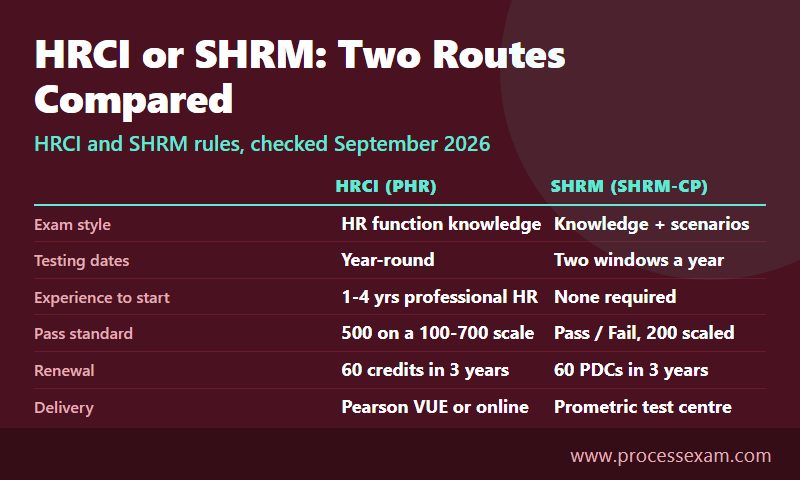
Does the exam test what you know, or how you judge a situation?
This is the difference candidates feel most on exam day, and it is the one to weigh first if you already know how you learn best.
HRCI: knowledge of HR functions, applied to the job
HRCI builds every exam from an exam content outline produced by a practice analysis, a survey of what HR professionals at that level actually do. The PHR outline, for example, is divided into seven functional areas, from Business Management and Workforce Planning and Talent Acquisition to Total Rewards, Employee Engagement, Employee and Labor Relations and HR Information Management. Each area lists responsibilities and the knowledge behind them, and the questions test whether you know the rule, the process or the right next step. The domestic US exams also expect you to know the employment laws in force on the day you test, which HRCI states plainly in its outlines.
HRCI's own categories show how the levels step up: the aPHR is listed as a Knowledge Certification, the PHR as a Professional Certification and the SPHR as a Strategic Certification. The format moves with the level, from 90 questions for the aPHR to 115 for the PHR and 140 for the SPHR.
SHRM: HR knowledge plus behavioural competence
SHRM builds both of its exams from the SHRM Body of Applied Skills and Knowledge (BASK). The BASK pairs HR knowledge domains with behavioural competencies such as leadership, communication, consultation and business acumen. The exam mixes straightforward knowledge items with situational judgment items: a short workplace scenario followed by several possible responses, where more than one looks reasonable and you must pick the most effective. There is no single rule to recall for those items; you are scored on whether your judgment matches that of experienced practitioners.
SHRM-CP and SHRM-SCP share the same format, 134 questions in 220 minutes, and differ in the level of responsibility the scenarios assume: operational for the SHRM-CP, strategic for the SHRM-SCP.
How to find out which style suits you
Reading about item types only takes you so far. The quicker test is to answer a set of each. Work through a few dozen SHRM-CP sample questions and notice whether scenario items feel natural or whether you keep changing your mind between two sensible answers. Then sit a timed PHR mock exam and see how comfortable you are recalling law, process and terminology at pace. Most candidates find one style clearly easier within an evening, and that is useful evidence: the credential you can pass with focused preparation is worth more than the one that looks better on paper and costs you two attempts.
| Credential | Body and level | Questions | Testing time | Passing standard |
|---|---|---|---|---|
| aPHR | HRCI, Knowledge Certification | 90 | 105 Minutes plus 30 minutes administration time | 500 (on a scale of 100-700) |
| PHR | HRCI, Professional Certification | 115 | 120 Minutes plus 30 minutes administration time | 500 (on a scale of 100-700) |
| SPHR | HRCI, Strategic Certification | 140 | 150 Minutes plus 30 minutes administration time | 500 (on a scale of 100-700) |
| SHRM-CP | SHRM, Human Resources | 134 | 220 minutes | Pass / Fail (200 Scaled Score) |
| SHRM-SCP | SHRM, Human Resources | 134 | 220 minutes | Pass / Fail (200 Scaled Score) |
One more difference follows from the scoring column. HRCI reports a scaled score, so a candidate who falls short can see how far away they were. SHRM reports a pass or a fail against its scaled cut score. If you like to measure progress in numbers, HRCI's report tells you more after a failed attempt; if you simply want the result, the two are equivalent.
Which body lets you sit an exam with the experience you have today?
Eligibility is where the choice is often made for you, so check it before you compare anything else.
HRCI ties each level to professional-level HR experience
HRCI sets experience thresholds for its professional and strategic credentials and counts only professional-level HR work, not administrative support. According to HRCI's PHR certification page, you qualify for the PHR with at least one year of professional-level HR experience and a master's degree or higher, two years and a bachelor's degree, or four years without a degree. The SPHR requirements rise to four years with a master's degree, five with a bachelor's degree, or seven without one. The aPHR is the exception: HRCI requires no HR experience at all for it.
SHRM asks for no experience at the first level
SHRM's eligibility criteria state that SHRM-CP candidates need no HR title, no degree and no previous HR experience to apply; a working knowledge of HR practice is recommended rather than required. The SHRM-SCP asks for at least three years of strategic-level HR work, with at least 1,000 hours of it in each calendar year, or three years as a SHRM-CP holder.
What that means for your decision
- New to HR, or changing careers: you can sit the aPHR or the SHRM-CP straight away. The aPHR is an entry-level knowledge credential; the SHRM-CP is the same credential a mid-career generalist holds. If you expect to stay in HR, starting at SHRM-CP means one credential grows with you instead of two.
- Two to four years in a professional HR role: both the PHR and the SHRM-CP are open to you, and the choice comes down to exam style, calendar and cost.
- Senior practitioner with a strategic remit: the SPHR and the SHRM-SCP are the matching pair. Check how your years are counted: HRCI counts professional-level experience against your degree, SHRM counts strategic-level hours per year.
- Experience that is hard to document: HRCI audits applications for professional-level experience. If your HR work was part of a broader role, read HRCI's definition carefully before you pay; SHRM's first level avoids the question entirely.
Can you test next month, or do you have to wait for a window?
Timing is the most underrated factor in this decision. The two bodies run completely different calendars.
HRCI tests year-round
HRCI states on its apply for certification page that it offers year-round testing, including online options, and that you schedule your exam within 180 days of approval through Pearson VUE. You can apply in a quiet month at work, study for eight to twelve weeks and book the date that suits you. HRCI also lists which exams can be taken from home: online delivery is currently open to residents of the United States and Canada for the aPHR, PHR, PHRca, SPHR and GPHR, according to its exam availability page. Everyone else books a Pearson VUE test centre.
SHRM tests in two fixed windows
SHRM's exams are delivered in two windows each year, at Prometric test centres, and you must apply during the application period that belongs to the window you want. In 2026 the first window ran from 1 May to 15 July and has closed. The second window runs from 1 December 2026 to 15 February 2027. Its early-bird application period ended on 31 August 2026; the standard application period is open from 1 September until 24 December 2026, closing at 11:59 p.m. Eastern Time. Those dates come from SHRM's exam options and fees page, checked September 2026; confirm them there before you apply, because SHRM sets each year's dates separately.
How the calendar should shape your choice
- You need the letters by a fixed date (a promotion round, a contract bid, a job offer that is conditional on certification): HRCI's year-round testing gives you control. With SHRM, a missed application deadline can mean waiting several months for the next window.
- You work best to an external deadline: SHRM's windows can help. Applying on or before 24 December for the winter window gives you a firm target, and many study groups and courses are timed to the windows.
- Your year has predictable peaks (open enrolment, year-end reviews, a payroll migration): with HRCI, book around them. With SHRM, the December to February window falls across the year-end, so check that your testing weeks are genuinely free before you commit.
What does each credential cost to earn and to keep?
Cost is two numbers, not one: the price of passing and the price of holding the credential for the years after.
Earning it
HRCI charges an exam fee plus a separate application fee. The current listing shows Exam Fee: $300 and Application Fee: $100 for the aPHR, Exam Fee: $395 and Application Fee: $100 for the PHR, and Exam Fee: $495 and Application Fee: $100 for the SPHR. SHRM prices both exams the same, at Member - $399 and Non-member - $499 at the standard rate. SHRM's own fee page also lists a lower early-bird rate for applications made in the early period and reduced rates for students and military candidates, so the price you pay depends on when you apply as much as on membership.
Two practical notes. First, a SHRM membership can pay for itself on the exam fee alone if you would join anyway, since the member and non-member prices differ by $100. Second, HRCI's application fee is paid again with each new application, so a candidate who lets an approval lapse without testing pays it twice.
Keeping it
Both bodies run three-year recertification cycles, and both let you recertify either by earning credits or by retaking the exam. The detail differs.
- HRCI: PHR holders earn 60 recertification credits over three years. SPHR holders earn the same total, of which 45 must be HR credits and 15 business credits. The aPHR needs 45 credits. Since 1 January 2021, every HRCI certificant must also include one ethics credit in the total, as set out in HRCI's ethics requirement.
- SHRM: holders earn 60 professional development credits (PDCs) in each three-year cycle, which begins on the day you pass. SHRM groups PDC activities under education, work that advances your organisation, and work that advances the profession. Its recertification page lists the application fee as $165 for members and $210 for non-members at the regular rate, with a late fee on top. A retake in the final year of the cycle is allowed, but a fail revokes the credential.
In practice the effort is similar. Sixty hours over three years is roughly one conference day, a handful of webinars and a short course each year. The difference is in what counts: SPHR holders must find genuinely business-focused learning, while SHRM rewards on-the-job projects that advance your organisation, which suits people whose development happens at work rather than in classrooms.
What do HR job ads ask for, and how can you check your own market?
For many readers the only question that matters is what employers want. The honest answer is that it depends on your market, and you can measure it yourself in about half an hour.
What you will usually see
In the United States, postings that mention an HR credential very often name one from each body side by side, in forms such as "PHR or SHRM-CP preferred" or "SPHR/SHRM-SCP a plus". Employers write it that way because their own HR teams hold a mix of both, and screening software is set to accept either. Roles with a heavy compliance load, such as HR for a manufacturing plant, a hospital or a government contractor, sometimes lean towards HRCI's legally grounded credentials. Roles framed as business partnering, organisational development or HR consulting sometimes lean towards SHRM's competency model. Neither lean is a rule, and a posting that names only one body rarely excludes a candidate who holds the other.
A thirty-minute market check
- Search a job board for the role you want next, in the city or region where you want it, and open the first twenty postings that mention certification.
- Tally how many name HRCI credentials only, SHRM credentials only, or both.
- Note whether the credential is listed as required or preferred. "Required" postings are rare, and they are the ones that matter most.
- Repeat for one level up, because the credential you earn now should still count in your next move.
If the tally is close to even, as it usually is in US generalist roles, stop worrying about recognition and decide on exam style, calendar and cost. If one body clearly dominates the postings you care about, that is a strong reason to follow it, whatever the rest of this article suggests.
Outside the United States
Recognition shifts abroad. Both bodies offer credentials for international candidates: HRCI through its international editions such as the PHRi and SPHRi, and SHRM through the same two exams, which do not change by country. In some regions a national body carries more weight than either; in the United Kingdom, for example, employers commonly ask for CIPD qualifications. Run the same tally in your own market before you assume that a US credential is what local employers screen for.
When does holding both an HRCI and a SHRM credential pay off?
Plenty of HR professionals hold one credential from each body. Most earned the second deliberately, but some drifted into it and now pay two sets of fees for little return. Holding both is worth it in a few specific situations.
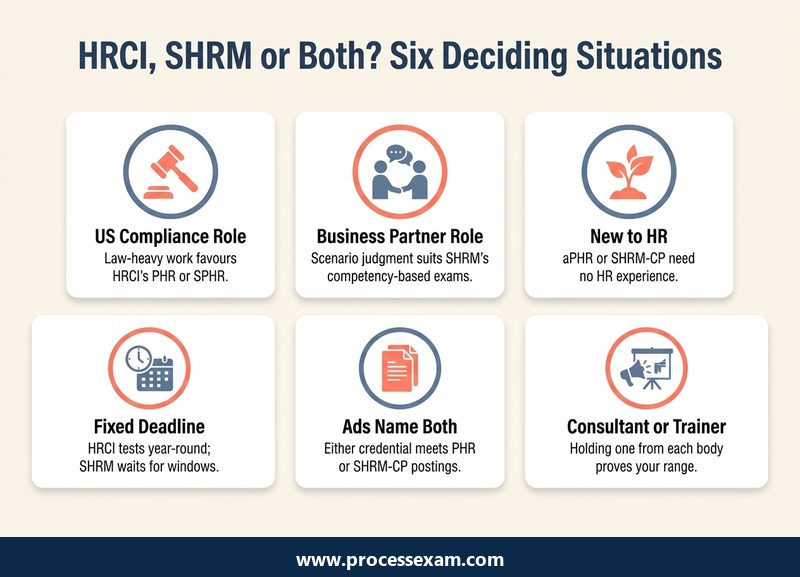
- You are a consultant, trainer or HR service provider. Clients read your credentials as proof of range, and some procurement checklists name one body. Covering both removes a question from every proposal.
- You move between compliance-heavy and strategic roles. An SPHR signals depth in US employment law and HR operations; a SHRM-SCP signals judgment in leadership and consulting situations. Together they describe a senior generalist well.
- Your target market is genuinely split. If your job-ad tally shows a real share of postings asking for each body, the second credential widens the funnel.
- Your employer pays for both. Then the decision is only about study time, and passing a second exam in a different style is good preparation for senior interviews in any case.
It is rarely worth it when you are early in your career and still one level below where you want to be. The effort is better spent moving up a level with one body, for example from the aPHR to the PHR, or from the SHRM-CP to the SHRM-SCP once you meet its strategic experience requirement.
Keeping two credentials without doubling the work
The upkeep is lighter than it looks. Both cycles last three years, and many conferences, webinars and courses are approved by both bodies, so the same hours can be claimed on both records when each body has approved the activity. Keep one log of everything you complete, with certificates, and check approval for each body before you enrol. The main extra cost is the second recertification fee, plus the discipline of SPHR business credits and the HRCI ethics credit, which SHRM does not ask for in the same form.
Are AIHR or other HRCI alternatives a better choice, and how do you decide?
Searches for alternatives to HRCI and comparisons such as "AIHR vs SHRM" usually come from people who want the learning without the exam. That is a fair goal, but it is a different product. The Academy to Innovate HR (AIHR) runs online certificate programs: you complete a course and its assessments at your own pace. HRCI and SHRM, by contrast, award credentials by a proctored exam against a published standard, and they require recertification to keep them. Employers who write "PHR or SHRM-CP" into a job advert are asking for the second kind. A course certificate is valuable for building a skill, such as people analytics or HR business partnering, and many of those courses can also count towards HRCI or SHRM recertification when approved. It is not a substitute for the credential itself when a posting names one.
A five-question check before you apply
- Can you sit it now? If you have no professional-level HR experience, your options are the aPHR or the SHRM-CP. If you have experience, check which level each body allows.
- Which question style did you handle better? Answer a set of knowledge questions and a set of scenario questions and trust the result.
- When do you need the letters? A fixed deadline in the next few months favours HRCI's year-round testing, unless SHRM's winter window (application by 24 December 2026, testing 1 December 2026 to 15 February 2027) happens to fit.
- What does your job-ad tally say? A clear majority for one body settles it; an even split means the other answers decide.
- Which upkeep suits how you learn? Structured courses and business learning fit HRCI's credit rules; development through projects at work fits SHRM's PDC categories.
Three or more answers pointing the same way is a decision. If the answers split, choose the exam you are more likely to pass on the first attempt: the letters open the same doors in most HR job markets, and a first-time pass saves both a second fee and months of waiting. Once you have chosen, plan your study around the body's own outline, the HRCI exam content outline or the SHRM BASK, rather than around general HR reading, and book your exam date before your motivation fades.
Frequently Asked Questions
What is the main difference between HRCI and SHRM?
HRCI builds each exam from a content outline of HR functional areas and tests knowledge applied to the job, with levels tied to professional HR experience. SHRM builds its two exams on one framework that mixes HR knowledge with behavioural competencies, tested partly through situational judgment scenarios, and needs no experience for the SHRM-CP.
Is HRCI or SHRM more recognized by employers?
In the United States most employers treat them as alternatives and often list both, such as 'PHR or SHRM-CP preferred'. Compliance-heavy roles sometimes lean towards HRCI and business-partner roles towards SHRM. Check twenty postings for the role you want in your own city; that tally is more reliable than any general ranking.
Can you take a SHRM exam without HR experience?
Yes. SHRM states that SHRM-CP candidates need no HR title, degree or previous HR experience to apply, although a working knowledge of HR practice is recommended. HRCI's PHR, by contrast, requires one to four years of professional-level HR experience depending on your degree, while its aPHR needs no experience.
Can you hold both an HRCI and a SHRM certification?
Yes. Many HR professionals hold one credential from each body. Each has its own three-year recertification cycle and fee, but activities approved by both bodies can count on both records, so one well-kept learning log covers most of the work. It pays off most for consultants and senior generalists.
Is AIHR an alternative to HRCI or SHRM certification?
Not directly. AIHR offers online certificate programs completed through coursework and assessments, which are useful for building specific skills. HRCI and SHRM award credentials through a proctored exam against a published standard, with recertification. When a job advert names PHR or SHRM-CP, a course certificate does not meet that requirement.
- HRCI HR Professional Exam Questions |
- HRCI HR Professional Question Bank |
- HRCI HR Professional Questions |
- HRCI HR Professional Study Guide |
- HRCI PHR Quiz |
- PHR Certification |
- PHR Questions |
- PHR Practice Test |
- PHR Study Guide Material |
- PHR Sample Exam |
- HR Professional Certification |
- HRCI HR Professional Book |
- HR Professional Certification Cost |
- HR Professional Certification Requirements |
- HRCI HR Professional Sample Questions |
- PHR Exam Questions Download |
- PHR Test Questions |
- HR Professional PDF |
- HRCI Professional in Human Resources


