
How the ITIL 4 Foundation Exam Works: 40 Questions, 26 to Pass
Question 17 of 40 describes a service provider whose request workflows only half work and asks which guiding principle it should apply first. Two of the four options look right, and telling them apart is what the ITIL 4 Foundation exam really measures. The paper itself is simple: 40 one-mark multiple-choice questions in 60 minutes, closed book, with 26 correct answers (65%) needed to pass and no deduction for a wrong answer.

Here is that question in full, written in the style of the real paper:
Question 17. A service provider wants to improve the way it fulfils service requests. Some of its current request workflows are quick and well liked by users; others regularly miss their targets. Which guiding principle should it apply FIRST?
A. Optimize and automate
B. Start where you are
C. Progress iteratively with feedback
D. Keep it simple and practical
Most candidates narrow this to B and C within seconds, and then hesitate. Improvement in ITIL 4 is iterative, so C feels safe. But the stem hands you two clues. It says some workflows already work well, and it asks what to do FIRST. Assessing what exists, keeping what works and measuring it directly before designing anything new is the whole of start where you are, so B is the answer. C is a true statement about ITIL that answers a different question: how to run the improvement once it has started. A is a trap of its own, because ITIL 4 automates only after something has been simplified and optimised, and D is sound advice that the stem never asks for.
That pattern, a true-but-irrelevant option sitting next to the right one, repeats across the paper. The rest of this article explains how the paper is built, where its marks come from, how the pass mark behaves under pressure, which traps cost the most, how to sit the exam, and what happens if the first attempt falls short.
How is the ITIL 4 Foundation exam paper put together?
PeopleCert, which owns and examines ITIL, publishes the headline format on its ITIL 4 Foundation certification page. The figures below are the ones to plan around.
| Exam detail | ITIL 4 Foundation |
|---|---|
| Exam name | PeopleCert ITIL 4 Foundation |
| Exam code | ITIL 4 Foundation |
| Vendor | PeopleCert |
| Number of questions | 40 |
| Duration | 60 minutes |
| Passing score | 65% |
| Exam fee | USD $463 |
| Format | Multiple choice, closed book |
| Exam languages | 12, including English, Spanish, German and Japanese |
Every question is worth one mark and offers four options, of which you choose one. PeopleCert's candidate syllabus calls these objective test questions and is candid about how the wrong options are written: they are the answers a candidate with incomplete knowledge would be likely to pick, and they are generally plausible statements about the same syllabus area. That single design choice explains why the exam feels harder than a 65% pass mark suggests. You are rarely choosing between a right answer and nonsense. You are choosing between a right answer and three answers that are nearly right.
The syllabus also sets the level of thinking for each topic. Criteria that begin with recall or define are Level 1: you recognise a term or a purpose statement. Criteria that begin with describe or explain are Level 2: you have to understand a concept well enough to spot it inside a short scenario. Question 17 is a Level 2 item, and so is most of the paper.
Two smaller rules matter on the day. If you sit the exam in a language that is not your native or working language, the syllabus allows up to 25% extra time, which makes 75 minutes in total. And the fee is not one global number in practice: PeopleCert prices by the country you select and sells the exam alone or in bundles with the eBook, eLearning or a re-sit, so check the price for your location before you compare offers.
Which ITIL version is the paper written against?
Anyone searching for ITIL versions finds a long family tree, but this paper is written against one version only: ITIL 4, with its service value system, its guiding principles and its practices. The syllabus references each topic to a section of the ITIL 4 book. For exam technique the useful consequence is simple. An option that uses words ITIL 4 does not use, such as lifecycle stages or process owners from older editions, is a distractor however familiar it sounds.
What do the four question styles look like on screen?
The syllabus names four styles. Knowing them in advance saves time, because each one rewards a slightly different way of reading.
Standard
A stem and four options, one of them correct. Most of the paper is written this way, and most standard items are short scenarios rather than bare definitions. Read the final sentence of the stem first so you know whether you are being asked for a principle, a practice, a dimension or a term, and only then read the scenario.
Missing word(s)
A sentence with a gap, marked in square brackets, and four candidate words or phrases. For example: "A [ ? ] is a possible event that could cause harm or loss, or make it more difficult to achieve objectives." The options might be risk, problem, incident and event. These items are nearly always Level 1 definitions, and the distractors are neighbouring terms from the same family. If you know the exact ITIL wording, they are the quickest marks on the paper; if you only know the rough idea, they are surprisingly easy to lose.
List
Four numbered statements, of which exactly two are correct, followed by four options that pair them up: 1 and 2, 2 and 3, 3 and 4, 1 and 4. The syllabus states that list questions are never negative. They look slow, but the structure helps you. Each statement appears in exactly two of the four pairs, so a single statement you are certain is true removes two options straight away, and a single statement you are certain is false does the same. One confident judgement usually leaves you a fifty-fifty choice, and two settle it.
Negative
A standard question with the stem turned round, such as "Which is NOT a key activity of problem control?". PeopleCert uses them only as an exception, where part of the learning outcome is knowing that something should not happen. The safest way to read one is to flip it: three of the options are true, find those three, and the one left over is your answer. The capitalised NOT is easy to see and still easy to forget halfway through a long stem.
If you want to see these styles before you meet them under the clock, the free sample questions for this exam on ProcessExam include worked items you can use to practise reading each style.
Where do the 40 marks on the paper come from?
The candidate syllabus (version 4.2, published by PeopleCert with its official training materials) fixes how many marks each learning outcome carries. This is the single most useful table for planning, because it shows that the paper is anything but evenly spread.
| Learning outcome | Level | Marks |
|---|---|---|
| 1. Key concepts of service management | Recall and describe | 5 |
| 2. The guiding principles | Describe and explain | 6 |
| 3. The four dimensions of service management | Describe | 2 |
| 4. The ITIL service value system | Describe | 1 |
| 5. The service value chain | Describe | 2 |
| 6. Purpose and key terms of 15 ITIL practices | Recall | 7 |
| 7. Seven ITIL practices in detail | Explain | 17 |
| Total | 40 |
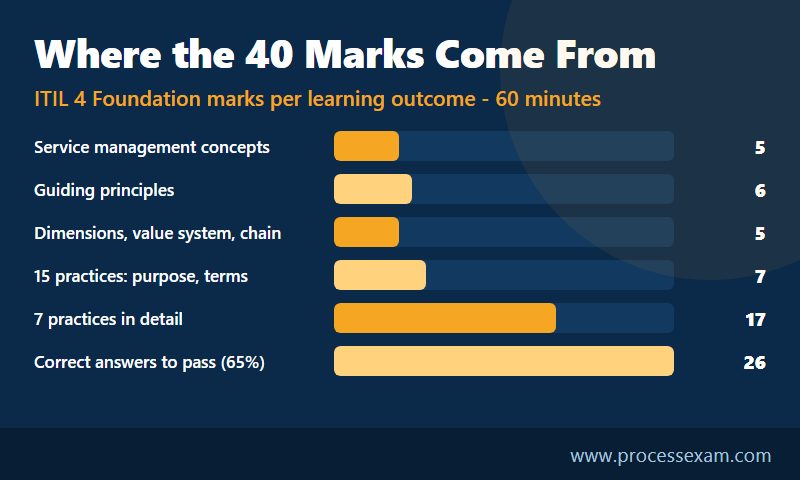
Three things stand out. First, outcome 7 alone carries 17 marks, which is 42.5% of the paper. Second, outcomes 2 and 7 together carry 23 marks, only three short of the 26 you need. Third, at least 28 of the 40 marks sit on outcomes that are assessed entirely at Level 2, so the exam leans on understanding rather than memory. The four dimensions, the service value system and the value chain matter as background, but together they account for five marks.
What the guiding principle questions lean on
The syllabus asks you to describe the nature, use and interaction of the seven principles, and to explain each one. On the paper that usually means a scenario and a question about which principle it shows, breaks or should apply next. The quickest way to answer is to learn the signal each principle leaves in a stem:
- Focus on value: the stem talks about how customers or users perceive a service, or about outcomes rather than activity.
- Start where you are: something already exists and works in part, and the temptation is to replace it wholesale.
- Progress iteratively with feedback: a large piece of work is being split into smaller steps, each checked before the next.
- Collaborate and promote visibility: work is hidden, or the people affected by a decision have not been involved.
- Think and work holistically: a change in one team has knock-on effects the stem wants you to notice across the end-to-end service.
- Keep it simple and practical: a step, a control or a report adds effort and no value.
- Optimize and automate: a manual activity is a candidate for automation, and the right answer usually simplifies it first.
Questions about interaction are the harder variant. They describe a situation where two principles pull together, such as keeping a workflow simple before automating it, and ask which pairing or which order is correct.
What the seven practice questions lean on
Outcome 7 covers continual improvement, change enablement, incident management, problem management, service request management, service desk and service level management. The exam goes beyond each practice's purpose and into how it works, so these are the details that turn up:
- Continual improvement: the seven steps of the continual improvement model, in order, from what is the vision? through where are we now?, where do we want to be?, how do we get there?, take action and did we get there? to how do we keep the momentum going?
- Change enablement: standard, normal and emergency changes, who authorises each, and the idea of a change authority rather than one fixed board.
- Incident management: restoring service quickly, prioritising by impact and urgency, and the fact that some incidents are resolved by users themselves through self-help.
- Problem management: its three phases of problem identification, problem control and error control, together with known errors and workarounds.
- Service request management: requests are normal parts of service delivery, handled through standardised, often pre-approved workflows.
- Service desk: the single point of contact, the channels it uses, and the weight ITIL puts on empathy and understanding the user's situation, not only technical skill.
- Service level management: service levels agreed with the business, measured end to end, and backed by engagement with customers rather than by operational metrics alone.
Outcome 6 adds eight more practices at recall level, from information security management to deployment management, plus seven terms: IT asset, event, configuration item, change, incident, problem and known error. Those seven marks reward exact wording, which makes them a natural home for missing-word questions.
How does the 65% pass mark play out on the day?
Twenty-six correct answers out of 40 is the line. That leaves room for 14 wrong answers, which sounds generous until you connect it to the weighting above.
Take a candidate who is comfortable with the principles and the concepts but weaker on the seven practices. Suppose they score 5 of 6 on principles, 4 of 5 on concepts, 4 of the 5 marks on dimensions and the value system and chain, and 5 of 7 on the recall practices. That is 18 marks. They now need 8 of the 17 practice marks, less than half, and they pass. Reverse the picture: a candidate who scores 9 of 17 on the practices must find 17 of the other 23 marks, about three quarters, to reach 26. Weakness on outcome 7 does not fail you on its own, but it removes nearly all of your margin everywhere else.
Why every question deserves an answer
Because a wrong answer costs nothing beyond the mark itself, an empty answer and a wrong answer score exactly the same. A blind guess among four options is worth a quarter of a mark on average. Remove two options you know are wrong and the same guess is worth half a mark. Over the handful of questions most candidates are genuinely unsure about, that difference can be two or three marks, which is often the gap between 24 and 27.
Pacing the 60 minutes
Sixty minutes across 40 questions is ninety seconds each, but the questions do not take equal time. Missing-word items can take twenty seconds; a list question with a long scenario can take three minutes. A workable rhythm is to reach question 20 at around the 25-minute mark, finish the first pass by the 50th minute, and use the rest to revisit the questions you answered provisionally. Candidates with the 75-minute allowance can stretch each checkpoint by a quarter. What matters is that every question has some answer recorded on the first pass, so that a late rush never leaves marks on the table.
Which wrong-answer traps catch well-prepared candidates?
Knowing the syllabus is not the same as scoring on it. These traps account for most of the marks that well-prepared candidates drop, and each one has a counter.
The true statement that answers another question
Question 17's option C is the model. The option is correct ITIL, it just does not answer the stem. The counter is to reread the last line of the stem before you commit and ask whether your choice answers that exact question, not the topic in general.
Qualifier words
FIRST, BEST, MOST and PRIMARY change the question completely. A stem that asks for the first step in an improvement is not asking for the most important one. When a qualifier appears, expect at least two options that would be correct without it.
The half-right pair
In list questions, one statement you are sure of often appears in a pair with a statement that is false. Candidates see the familiar statement and stop reading. Confirm both statements in the pair you choose, or use elimination until only one pair survives.
Your workplace instead of the book
If your organisation sends every change to one weekly board, or calls every ticket an incident, your instincts will fight the paper. ITIL 4 uses the idea of a change authority, treats standard changes as pre-authorised, and separates incidents from service requests. The exam marks ITIL's version, not your employer's. When your experience and the book disagree, answer from the book.
Word swaps in definitions
Several definitions come in pairs that differ by one idea: output and outcome, utility and warranty, customer, user and sponsor, problem and known error. Distractors swap one for the other. A stem where users can log in but the service slows to a crawl at month-end is describing a shortfall in warranty, not utility, because the service does what it should but not reliably enough. Practise with pairs rather than single definitions.
Automation before simplification
An option that proposes automating a messy or poorly understood activity looks modern and efficient. ITIL 4 says to simplify and optimise first, so it is usually wrong.
Importing facts the stem does not give
Scenarios are short on purpose. If you catch yourself thinking "but the budget is probably tight" or "they must already have a tool for this", you are answering a question the examiner did not write. Use only what the stem states.
How should you practise for this paper, rather than just revise it?
Revision teaches you the syllabus. Practice teaches you the paper, and the two need different habits.
Start by drilling the styles separately. Do a block of list questions on their own until the elimination method is automatic, then a block of negative items, then missing-word items against exact definitions. Mixing styles too early hides which one is costing you marks.
Next, keep a trap log. Every time you get a practice question wrong, write down which trap caught you: the irrelevant truth, a missed qualifier, a half-right pair, a workplace habit, a word swap, or an assumption the stem did not support. After a hundred or so questions the log usually shows one or two patterns, and those patterns are more useful than your raw score, because each one has a specific fix.
Then move to full papers under the real limit. PeopleCert sells an official ITIL 4 Foundation mock exam, a full, timed and marked paper that comes with a test report pointing to areas for improvement, and where it offers more than one version each has its own questions. Alongside it, the ProcessExam ITIL 4 Foundation practice test runs 40 questions against a 60-minute clock, so you can check that your score stays above 26 when time pressure is added and your trap log stops growing. Aim for a margin of four or five marks above the line across several attempts before you book, since practice scores tend to drift down a little under real exam nerves.
Finally, review every attempt the same way: questions you got wrong, questions you got right by guessing, and questions that took more than two minutes. The third group is the one most candidates ignore, and it is where the pacing problems on the day come from.
Should you sit the exam online or through a training organisation?
PeopleCert describes two ways to reach the exam. You can study on your own or with PeopleCert's eLearning and sit an online proctored exam, or you can take training and the exam through an accredited training organisation (ATO), which offers courses both online and in person.
Sitting online with a remote proctor
The online route uses PeopleCert's Web Based Exam Driver, and it is the most flexible option: PeopleCert says you can sit as little as four hours after booking, and an exam voucher stays valid for 12 months. The trade-off is a strict setup. PeopleCert's exam driver guidelines set out what is checked, and the main points are these:
- Computer: Windows 10 or 11, or macOS Mojave (10.14) onwards, with Microsoft Edge, Google Chrome or Opera, at least 4GB of RAM and a broadband connection of at least 4Mbps. Check it at least 72 hours before the exam.
- Camera and audio: a webcam you can turn through a full 360 degrees to show the room, plus speakers and a microphone. A mobile phone cannot stand in for the webcam, and headsets are allowed only during onboarding.
- Room: private and quiet, one doorway visible to the camera, no glass walls, a clear desk and clear walls, and no other visible screens. You must be alone.
- Identification: an original, current, government-issued photo ID showing your full date of birth and your name in Latin characters, matching the details you booked with. Electronic IDs are not accepted.
If you plan to use a work laptop, the guidelines warn that corporate restrictions can block the exam software, so have your IT team available on the day or use a personal machine.
Rescheduling costs
Dates slip, and PeopleCert's booking page is clear about the cost of moving one:
| When you reschedule | Fee stated by PeopleCert |
|---|---|
| More than 48 hours before the exam | Free |
| Between 48 and 4 hours before | USD 60 or local equivalent, plus tax where applicable |
| Less than 4 hours before | USD 120 or local equivalent |
Going through an accredited training organisation
An ATO route suits candidates who want a course and the exam arranged together, or who prefer a supervised setting to a home office. Arrangements differ between organisations, so before you pay, ask how and where the ATO seats its exams, whether the exam is included in the course price, and whether a re-sit is part of the package.
A simple way to decide: if you have a quiet private room, a compliant computer and the discipline to study alone, the online route is faster and cheaper. If any of those is missing, the ATO route removes the risk of a cancelled session.
What happens if you fail, and how do retakes work?
A failed attempt is not the end of the story, but the cheapest safety net has to be bought before you sit. PeopleCert's Take2 re-sit option works as follows:
- It must be purchased before the exam, either at checkout or from the Overview tab of your PeopleCert account up to 15 minutes before your session. It cannot be bought after a failed attempt.
- It is free for PeopleCert Plus members, who get a re-sit for every exam they schedule during their membership year.
- If you do not pass, you receive an email to schedule the re-sit, which must be taken within six months of the original exam date.
- It is tied to the same exam, is non-transferable and non-refundable, and is lost if you miss the re-sit session.
Some of PeopleCert's own bundles for this exam include a free re-take, so check what a bundle contains before adding Take2 separately. Without either, a second attempt simply means booking and paying for the exam again.
Whatever route you take, treat the gap before a retake as targeted work, not a full restart. Go back to your trap log and to the marks table: if outcome 7 was the weak area, that is where most of the recoverable marks are. A candidate who missed by two or three marks rarely needs more reading. They need forty more practice questions on the seven practices, reviewed carefully, and one more full timed run to prove the fix.
Question 17 is a fair summary of the whole exam. It does not test whether you have heard of the guiding principles. It tests whether you can read a short stem, notice the word FIRST, and choose between two answers that are both true. Practise that skill on purpose and the 26-mark line becomes a comfortable one.
Frequently Asked Questions
How many questions do you need to get right to pass ITIL 4 Foundation?
You need 26 correct answers out of 40, which is the 65% pass mark. Each question is worth one mark and a wrong answer carries no extra penalty, so you can miss up to 14 questions and still pass. Answer every question, because a blank scores the same as a wrong answer.
Can you take the ITIL 4 Foundation exam online from home?
Yes. PeopleCert runs the exam online with a remote proctor through its Web Based Exam Driver. You need a compatible computer, a webcam you can rotate to show the room, a private room with one visible door, and a valid government-issued photo ID that matches your booking details.
What happens if you fail the ITIL 4 Foundation exam?
You can sit it again. If you bought PeopleCert's Take2 re-sit before the exam, or hold PeopleCert Plus membership, the re-sit is included and must be taken within six months. Take2 cannot be bought after a failed attempt, so without it you book and pay for a new exam.
Does the ITIL 4 Foundation certification expire?
PeopleCert states that the certification is renewed every three years. You can keep it current by logging 60 continuing professional development points through PeopleCert's membership scheme, or by passing another exam from the same product suite before your renewal date. Check your renewal date in your PeopleCert account.
Which ITIL version does the ITIL 4 Foundation exam test?
The exam tests ITIL 4 only: its service value system, guiding principles, four dimensions and practices, referenced to the ITIL 4 book. Terms from earlier ITIL editions, such as the old lifecycle stages, are not examined and often appear as distractors, so study from material written for ITIL 4.
- ITIL 4 Foundation Question Bank |
- ITIL 4 Foundation Test Questions |
- ITIL 4 Foundation Body of Knowledge (BOK) |
- ITIL 4 Foundation Certification Cost |
- ITIL 4 Foundation Certification Requirements |
- ITIL 4 Foundation PDF |
- PeopleCert ITIL 4 Foundation Test Questions |
- ITIL 4 Foundation Simulator |
- ITIL 4 Foundation Mock Exam |
- PeopleCert ITIL 4 Foundation Book |
- PeopleCert ITIL 4 Foundation BOK PDF |
- PeopleCert ITIL 4 Foundation Sample Questions |
- ITIL 4 Foundation Exam Questions Download


