
ISTQB Certified Testers: What Hiring One Really Gives You
Hiring ISTQB certified testers pays back mainly in two places: fewer defects reach customers, and the team stops losing hours to arguments about words. A defect caught while a requirement is still being read costs a conversation. The same defect found in production costs triage, a hotfix, regression testing, support calls and sometimes a customer. That gap is the business case, and a certificate is only the first, cheap signal that someone has been trained to close it.

Where does a certified tester save an employer money before release?
Put the same defect at three points in a project and follow the bill. Found while the requirement is reviewed, it costs a few minutes of a business analyst's time and a corrected sentence. Found during system testing, it costs a developer to reproduce, fix and re-check it, plus a tester to retest and rerun the tests around it. Found in production, it adds everything the first two have, and then an incident, a deployment outside the normal cycle, a message to customers and the time of people who were meant to be building something else. No published figure is needed to see the shape of the curve, and none is invented here: every stage adds people, and each one adds more than the stage before.
That shape is why the testing syllabus keeps returning to one habit, testing early. The ISTQB Foundation syllabus treats reviews of requirements and designs as testing in their own right, and it lists, among the outcomes a certified candidate should reach, understanding how risk affects testing, writing clear defect reports and increasing testing effectiveness and efficiency (ISTQB's CTFL page). Each of those is a cost lever rather than a theory topic.
Three places the saving shows up
- Earlier discovery. A tester who has been taught static testing reads a user story looking for the missing condition, the ambiguous word and the untestable promise. Those are the cheapest defects the project will ever see.
- Better-aimed effort. Risk-based thinking tells a team where a failure would hurt most, so a limited testing budget goes there first instead of being spread evenly across screens that nobody worries about.
- Fewer repeat cycles. A defect report that states the steps, the expected result, the actual result and the environment can be reproduced on the first attempt. A vague one bounces between tester and developer for days, and every bounce is paid time.
None of this belongs to certified people alone. Plenty of uncertified testers work this way, and a certificate does not make anyone do it. What certification changes is the odds: you are hiring someone who has been examined on the method, which is a better starting point than hoping the method was picked up by accident.
What changes when the whole team shares one testing vocabulary?
Ask three testers from three employers what separates a smoke test from a sanity test, or a failure from a defect, and you may get three answers. Inside one team that is an expensive habit, because a bug report written in one dialect is read in another. A defect is recorded against the wrong cause, a test level is skipped because two people assumed the other had covered it, and a status report says "tested" when it means "tried once".
The ISTQB syllabus fixes the terms. It defines error, defect and failure as three different things, separates the test levels from the test types, and gives names to the activities (planning, monitoring and control, analysis, design, implementation, execution and completion). When several people on a team have learned the same definitions, three things get easier.
- Handover. A new tester joining mid-project can read the existing test plan without a glossary session, because the words carry the meaning the author intended.
- Tender and supplier work. When a vendor's test lead and your own use the same vocabulary, an acceptance clause such as "system testing complete" or "entry criteria met" means the same thing on both sides. Disputes over what was agreed shrink.
- Estimation. A manager asking for "regression testing of the release" and a tester reading it as "re-run every test" or "re-run the risky ones" will plan different weeks. Shared terms narrow that gap before the sprint starts.
The benefit grows with the number of certified people. One certified tester in a team of ten brings knowledge; four of ten start to change how the team speaks. That is worth bearing in mind when you decide whether to hire one specialist or to certify the people you already have.
Which test design techniques does a certified tester bring to a sprint?
The largest chapter of the CTFL v4.0 syllabus is Test Analysis and Design, and it is the one that shows most clearly in day-to-day output. A tester who has studied it picks a technique for a reason instead of writing tests by instinct. For the hiring manager, the practical question is whether a candidate can name the technique they used and why. Here is what to listen for.
Black-box techniques
These derive tests from the specification without looking at the code. Equivalence partitioning splits an input range into groups the system should treat alike, so one test per group replaces fifty. Boundary value analysis then probes the edges, where off-by-one mistakes live. Decision tables capture combinations of conditions, such as customer type, order value and delivery region, and expose combinations nobody specified. State transition testing follows an object such as an order or an account through its lifecycle and finds illegal moves, for example refunding an order that was never paid.
White-box techniques
Statement and branch coverage measure how much of the code a test set exercises. A certified tester understands what the number does and does not say: full statement coverage does not mean every outcome of every decision was seen, so a reported percentage is a prompt for questions, not a verdict.
Experience-based techniques
Error guessing, exploratory testing and checklist-based testing capture knowledge a specification cannot hold. The syllabus treats them as complements to the systematic techniques, which is a useful correction for teams that believe either exploring or scripting is enough alone.
What it looks like in an interview
Give the candidate a field that accepts ages from 18 to 65 and ask how many tests they would run. A trained answer names the partitions (below range, in range, above range), proposes the boundary values 17, 18, 65 and 66, and mentions non-numeric input as a separate class. An untrained answer is a long list of random ages. The difference costs you nothing to test, and it shows more than the certificate does. The CTFL syllabus overview sets out how the syllabus structures this material, chapter by chapter.
What does each ISTQB level tell a hiring manager?
ISTQB certification is a ladder, and the rung matters more than the logo. A Foundation certificate says one thing and an Advanced certificate says something different. Reading them correctly stops you from asking the wrong person to do the wrong job. ISTQB lists the full set of tracks on its certifications page; the table below covers the ones employers meet most often, with the current exam figures.
| Level | What it signals | Exam format |
|---|---|---|
| CTFL (Foundation, v4.0) | Knows the fundamentals and the shared vocabulary; ready to work inside a test team | 40 questions, 60 minutes, pass at 26 of 40, USD $229 |
| CTAL-TA v4.0 (Test Analyst) | Can design tests from requirements and business rules and review them | 45 questions, 120 minutes, pass at 51 of 78, USD $249 |
| CTAL-TTA v4.0 (Technical Test Analyst) | Can test at code and architecture level: white-box, performance, security and tooling | 45 questions, 120 minutes, pass at 51 of 78, USD $249 |
| CTAL-TM v3.0 (Test Manager) | Can plan, steer and report on a test effort and manage the people doing it | 50 questions, 120 minutes, pass at 58 of 88, USD $249 |
| CTAL-TAE v2.0 (Test Automation Engineering) | Can design and run an automation architecture, not merely write scripts | 40 questions, 90 minutes, pass at 43 of 66, USD $249 |
| CTAL-AT 2.0 (Agile Tester) | Can test inside an agile team: shift left, exploratory work, working with developers | 40 questions, 90 minutes, pass at 34 of 52, USD $199 |
Prices vary by exam provider and member board, and the passing figures for the Advanced papers are points, not question counts. The practical reading follows from the table.
Foundation: a baseline, not a specialism
CTFL tells you the person has covered the whole field at an introductory depth. It suits a junior hire, a developer moving into testing or a business analyst taking on acceptance work. It does not tell you whether they can automate, lead, or test a payment system. ISTQB's CTFL page notes that Foundation is also the prerequisite for other ISTQB certifications that require it, so for the employer it works as the entry ticket to a development path.
Advanced: a role signal
The Advanced certificates split by job. Hiring a lead for a regulated release? The Test Manager certificate matches the work: risk, estimation, reporting and process improvement. Hiring someone to catch performance and security problems in code? Look at the Technical Test Analyst. Staffing a squad that releases every two weeks? The Agile Tester certificate is closer to the daily reality than a general one. Match the certificate to the vacancy, and treat an Advanced pass in the wrong specialism as general evidence of discipline rather than proof of the job skill.
Why the cost of the exam matters to you
A single Foundation sitting is USD $229 and an Advanced sitting USD $249 (Agile Tester, USD $199) at the figures above. Training courses, if you choose them, are extra and priced by the training provider; ISTQB describes training as recommended but optional, with self-study also possible. For a team lead budgeting a group, the exam fee is the smaller part of the bill, and the hours people spend studying are the larger one.
What can a certificate not guarantee about a candidate?
This is the section that saves hiring mistakes. An ISTQB certificate is evidence that someone passed a multiple-choice examination on a published syllabus. It is not evidence of anything the examination did not measure, and several things that matter most to a hiring manager sit outside it.
- Hands-on skill. A paper of 40 questions in 60 minutes tests recognition and application of the syllabus. It does not test whether the person can find a bug in an unfamiliar application under time pressure.
- Domain knowledge. A certified tester may know nothing about insurance claims, medical devices or payment settlement. Domain mistakes are the ones that reach production unnoticed.
- Communication. Whether a candidate writes a report a developer thanks them for, or pushes back on an unrealistic release date, is invisible to the exam.
- Current practice. The certificate records a pass at one point, against one version of the syllabus. It does not tell you whether the person has kept learning. Ask which version they studied, because the Foundation syllabus has been rewritten for v4.0 and the content differs from earlier versions.
- Judgement. Knowing when to stop testing, what to leave out and how to argue for a delay is learned on projects.
The old claim that certified staff automatically produce near-perfect defect detection, or that they cut costs by a fixed percentage, does not survive scrutiny. No ISTQB publication promises it, and a hiring decision should not rest on one. Treat the certificate as a filter that raises the proportion of candidates who know the basics, then use an interview to find out the rest.
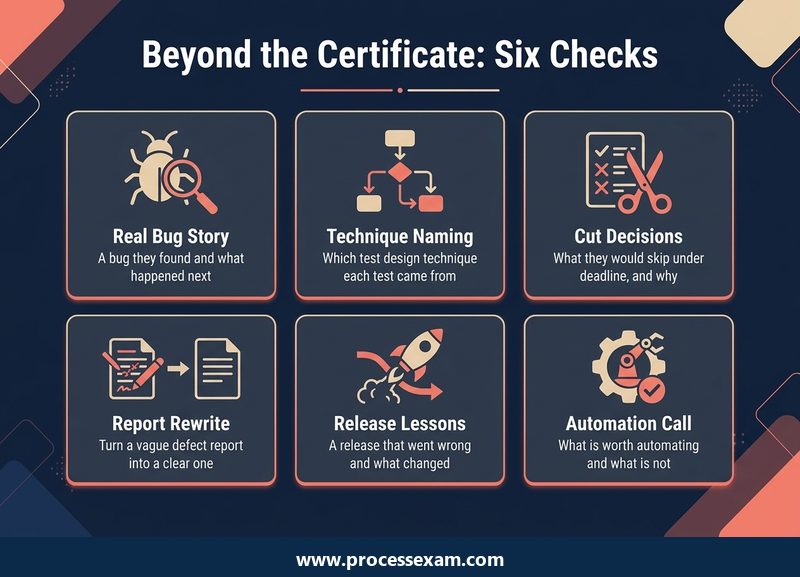
Six checks that test skill beyond the certificate
The graphic above lists six checks to put alongside the certificate. In practice they take no more than an hour of an interview loop.
- Ask for a bug the candidate found that they were proud of, and what happened after they reported it.
- Give a small piece of software or a screen mock-up and ask for a first list of tests, then ask which technique each test came from.
- Show a poor defect report and ask them to rewrite it.
- Ask what they would leave untested on a tight deadline and how they would defend that choice to a product owner.
- Ask about a release that went wrong and what they changed afterwards.
- Ask how they decide a test is worth automating, and what they would refuse to automate.
How do you check that an ISTQB certificate is genuine?
Certificates from any source can be misstated on a CV, so verification is a normal part of hiring. ISTQB itself does not issue certificates; the member board or exam provider that ran the examination does, and ISTQB points employers to two routes.
Route one: the Successful Candidate Register
ISTQB runs a Successful Candidate Register (SCR) that employers can search. ISTQB's help page on the register describes it as a tool to verify the certificates an individual holds. Two limits apply. Listing is voluntary, so a missing name is not proof of a false claim, and people who passed before January 2017 may not appear. Where certificate numbers are searchable, they are shown partly masked, so ask the candidate for their number and match it against what the register displays.
Route two: the issuing board or exam provider
If the register shows nothing, contact the member board or exam provider that issued the certificate. ISTQB states that it cannot supply this information itself. Boards may charge a fee for verification, and the candidate can also request a copy of the certificate from the original issuer.
A short checklist for the hiring file
- Record the certificate title, the version of the syllabus, the date and the issuing board or provider.
- Ask for the certificate number and search the register with it.
- If the entry is missing, ask the candidate which provider they sat the exam with and write to that provider.
- Do not accept a screenshot alone for a role where the certificate is a condition of a client contract.
If a client contract requires a stated number of certified testers, keep the evidence on file. Auditors ask for it, and finding it after the audit date is awkward.
How would you build a certification path for a testing team?
Hiring certified people is one route. Certifying the staff you have is another, often cheaper and often better, because it keeps the project knowledge you already paid for. A sensible path follows the roles in the team and not the other way round.
Start with a clear reason
Write down what you want. Is it a contract that demands certified staff? A shared vocabulary after a merger of two teams? A way to move developers into testing? The reason decides who sits which exam and in what order. Without it, certification turns into a sticker collection.
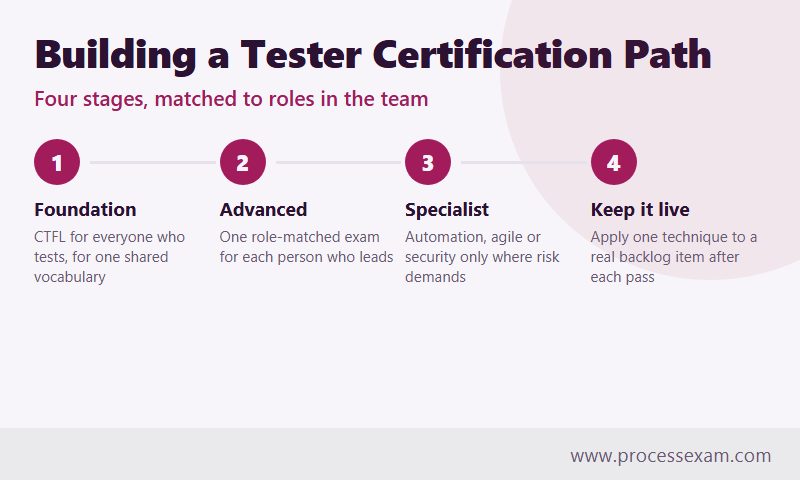
A staged path
- Stage one: Foundation for everyone who tests. Include testers, business analysts doing acceptance and the developers who write unit tests. The aim is the shared vocabulary, so breadth beats selection here.
- Stage two: a role-matched Advanced exam for the people who lead. One person takes the Test Manager route, one or two take Test Analyst or Technical Test Analyst depending on whether the product is business-rule-heavy or code-heavy.
- Stage three: specialists where the product demands it. Automation engineering for the person who owns the pipeline, Agile Tester for squads, and the specialist certificates (such as security or performance) only where a real product risk justifies them.
- Stage four: keep it alive. A short internal session after each exam that applies one technique to a live backlog item turns a pass into practice.
Practical budget questions
Count the exam fee, any training, and the study hours. Most of the real cost is time, so give people protected hours rather than expecting evenings. Agree in advance what happens if someone fails a first attempt, so nobody is embarrassed, and who pays for a retake. Decide whether the certificate is a condition of a role or a development benefit, because the two send different messages.
Getting a team ready without a course
ISTQB lists training as optional. For a team that prefers to study together, a weekly one-hour session on one syllabus chapter works well, followed by sample papers under exam conditions. ISTQB publishes sample exams, and sitting the CTFL practice exam as a group, against the clock, shows each person which chapters are still thin before anyone pays an exam fee.
Is certifying testers worth it for a small team?
For a small team the question is not whether certification is good in general, but whether it is the best use of limited hours and money. It usually is when a few conditions hold.
- You are growing the team. New testers need a common base, and the Foundation syllabus is a ready-made onboarding curriculum that costs you only the exam fee.
- You work with suppliers or clients who ask. A certified proportion can be a commercial advantage in a tender.
- Your testers learned on the job. Self-taught testers often have strong instincts and gaps in terminology and technique. A syllabus fills the gaps and gives their instincts names.
It is less compelling when the team is two experienced people with no supplier requirements and a stable product. In that case the same money may go further on tooling, a test environment or a dedicated week of exploratory sessions. The honest recommendation is to certify with a purpose, measure one or two outcomes (defect leakage into production, time to reproduce a reported bug) before and after, and decide on the next round from the figures rather than from the brochure.
Frequently Asked Questions
What are the benefits of hiring ISTQB certified testers?
Employers gain testers trained on one shared vocabulary and a set of test design techniques, which helps defects surface earlier and reports read the same across teams. A certificate also helps in contracts that ask for certified staff. It does not prove hands-on skill, so pair it with an interview task.
Is ISTQB certification worth it for a hiring manager?
It is worth using as a filter, because it shows a candidate has been examined on a published syllabus. It is weaker as proof of skill or domain knowledge. Most managers read it alongside examples of real bugs found, a short practical exercise and the candidate's experience.
How can an employer verify an ISTQB certificate?
Ask for the certificate number and issuing board, then search ISTQB's Successful Candidate Register. Listing is voluntary and older certificates may be missing. If nothing appears, contact the member board or exam provider that issued it, because ISTQB itself cannot confirm certificates directly.
Which ISTQB level should a company hire for?
Match the level to the vacancy. Foundation (CTFL) suits junior testers and career changers. Advanced certificates signal a role: Test Manager for leads, Test Analyst or Technical Test Analyst for design and code-level testing, Test Automation Engineering for automation, Agile Tester for agile squads.
How much does the CTFL exam cost and how is it passed?
The CTFL v4.0 exam costs USD $229 and has 40 questions in 60 minutes, with a passing score of 26 of 40. Fees differ by exam provider and member board, and training is optional, so confirm the amount when booking.
- ISTQB Tester Foundation Exam Questions |
- ISTQB Tester Foundation Question Bank |
- ISTQB Tester Foundation Questions |
- ISTQB Tester Foundation Study Guide |
- ISTQB CTFL Quiz |
- CTFL Certification |
- CTFL Questions |
- CTFL Practice Test |
- CTFL Study Guide Material |
- CTFL Sample Exam |
- Tester Foundation Certification |
- ISTQB Tester Foundation Book |
- ISTQB Tester Foundation Sample Questions |
- CTFL Exam Questions Download |
- CTFL Test Questions |
- Tester Foundation PDF |
- ISTQB Foundation Level Certification |
- ISTQB Foundation Level Exam Questions |
- ISTQB Foundation Level Sample Questions |
- ISTQB Foundation Level |
- ISTQB Foundation Level PDF |
- ISTQB Foundation Level Book |
- ISTQB Foundation Level Question Bank |
- ISTQB Foundation Level Study Guide |
- ISTQB Foundation Level Questions


