
The Hidden ROI of ASQ CMBB: What Leaders Don't Tell You
The ASQ Certified Master Black Belt (CMBB) credential signifies the pinnacle of Lean Six Sigma expertise, validating an individual's exceptional ability to lead and deploy complex, enterprise-wide improvement initiatives. This advanced certification transcends typical process improvement roles, equipping professionals with the strategic foresight and comprehensive analytical skills to drive significant organizational change and foster a culture of sustained excellence. Designed for seasoned Black Belts seeking to elevate their impact, the CMBB certification is for those ready to shape business strategy and mentor future leaders. This article will thoroughly explore the nuanced value of the ASQ CMBB, from its rigorous examination framework to its profound implications for career progression and organizational profitability.
Advancing Strategic Impact: The ASQ CMBB Executive Role
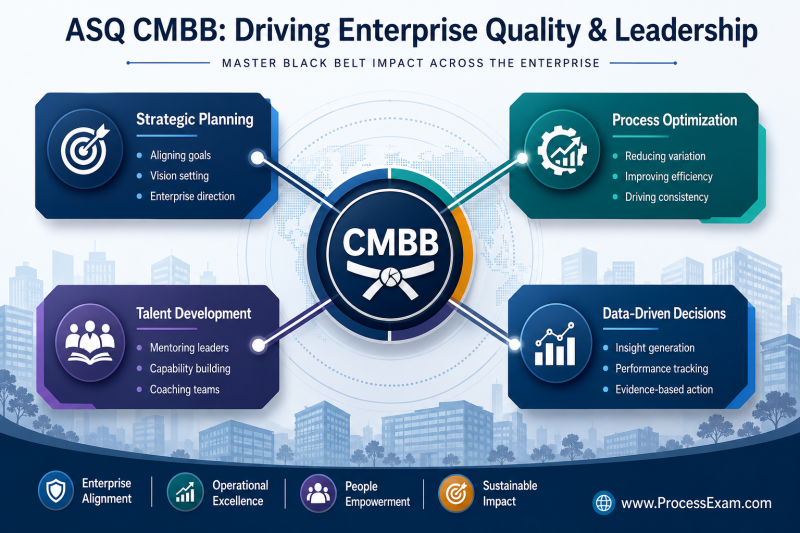
Achieving the ASQ CMBB certification positions professionals as indispensable assets, capable of bridging the gap between high-level organizational strategy and its tactical execution through Lean Six Sigma methodologies. A Master Black Belt operates not just as a problem-solver but as a strategic architect, influencing executive decisions and guiding the overarching direction of quality and operational efficiency. Their role extends far beyond individual projects, encompassing portfolio management, organizational change leadership, and the development of a company-wide culture of continuous improvement.
The strategic contributions of a Master Black Belt often include:
-
Driving Vision: Translating organizational goals into actionable Lean Six Sigma strategies.
-
Resource Allocation: Optimizing the deployment of resources across multiple improvement projects to maximize ROI.
-
Systemic Change: Identifying and addressing root causes of systemic inefficiencies across departments.
-
Performance Enhancement: Implementing advanced statistical methods to achieve breakthrough improvements in critical business processes.
This strategic orientation ensures that CMBBs are not merely executing tasks but are actively shaping the future operational landscape of their organizations. Their expertise is crucial in navigating complex business challenges and fostering sustainable competitive advantages.
Essential Examination Details for ASQ Certified Master Black Belt
Prospective candidates for the ASQ Certified Master Black Belt (CMBB) certification must understand the rigorous structure of the examination to plan their preparation effectively. This certification demands a high level of mastery, reflecting the strategic importance of the role it validates. The exam is a comprehensive assessment designed to differentiate top-tier Lean Six Sigma professionals.
The key details outlining the ASQ CMBB examination are:
-
Exam Price: The cost varies based on membership status: ASQ Members pay $1,499, Non-Members pay $1,599, and Retakes are priced at $1,399.
-
Duration: Candidates are allotted a total appointment time of 330 minutes, with the actual exam time being 320 minutes.
-
Number of Questions: The exam consists of 110 questions, evaluating a broad spectrum of advanced Lean Six Sigma concepts and applications.
-
Passing Score: To achieve certification, candidates must score 550 out of a possible 750 points.
Understanding these fundamental aspects is the first step towards a focused and successful certification journey. Detailed information and requirements can be found on the official ASQ exam page, which serves as the authoritative source for all candidate guidelines.
Candidate Eligibility and Application Insights
Beyond the examination specifics, eligibility criteria play a crucial role in the ASQ CMBB application process. Candidates typically need a current ASQ Certified Black Belt certification and at least five years of experience in the role, or a similar advanced professional qualification coupled with significant experience leading Lean Six Sigma projects. This experience must demonstrate a history of successful deployments and sustained impact.
Key considerations for eligibility include:
-
Project Leadership: Documented evidence of leading multiple successful Black Belt level projects.
-
Mentorship Experience: A track record of coaching or mentoring other Lean Six Sigma practitioners.
-
Strategic Involvement: Participation in the strategic planning and deployment of Lean Six Sigma initiatives within an organization.
The application typically requires submitting a portfolio of work, including project summaries and letters of recommendation, which undergo a thorough review by ASQ. This comprehensive review ensures that only individuals with demonstrated strategic impact and technical proficiency are eligible to attempt the Master Black Belt exam. A detailed overview of the application process is available through the comprehensive certification insert provided by ASQ.
Illuminating Key Domains: The ASQ CMBB Syllabus Framework
The ASQ Certified Master Black Belt (CMBB) exam syllabus is meticulously designed to assess a candidate's mastery across six critical domains, each vital to operating at the highest level of Lean Six Sigma leadership. These domains collectively form the intellectual backbone of a Master Black Belt, ensuring they possess the breadth and depth of knowledge required to drive complex organizational improvements. A thorough understanding of each section is paramount for anyone aspiring to this elite credential.
The ASQ CMBB syllabus is structured as follows:
-
I. Enterprise-wide Planning: This domain covers the strategic alignment of quality initiatives with overall business objectives, including organizational assessment, strategic planning processes, and the integration of Lean Six Sigma with other management systems. It emphasizes the ability to design and implement a comprehensive deployment strategy that supports long-term organizational success.
-
II. Organizational Competencies for Deployment: Focuses on the infrastructure needed for effective Lean Six Sigma deployment. This includes understanding leadership roles, team structures, cultural change management, and how to build internal capabilities to sustain continuous improvement efforts across the enterprise.
-
III. Project Portfolio Management: This section addresses the selection, prioritization, and management of a portfolio of projects. It includes criteria for project selection, resource allocation, risk management at the portfolio level, and the integration of project outcomes into organizational strategy.
-
IV. Training Design and Delivery: Acknowledges the CMBB's role as an educator and developer of talent. It covers curriculum development, adult learning principles, effective presentation techniques, and methodologies for evaluating training effectiveness, ensuring the proliferation of Lean Six Sigma knowledge.
-
V. Coaching and Mentoring Responsibilities: Delves into the critical leadership function of guiding and developing other practitioners. This includes coaching Black Belts and Green Belts, providing feedback, fostering problem-solving skills, and building a strong community of practice within the organization.
-
VI. Advanced Data Management and Analytic Methods: This domain assesses proficiency in sophisticated statistical tools and data analysis techniques beyond the Black Belt level. Topics include advanced experimental design, multivariate analysis, reliability analysis, and complex process modeling, enabling deeper insights and more robust solutions.
Each domain represents a pillar of the Master Black Belt's capability, requiring not just theoretical knowledge but also the practical application of these principles in real-world scenarios.
Realizing Professional Growth: The ASQ CMBB Value Proposition
Earning the ASQ CMBB certification is not merely an accolade; it is a profound investment in professional development that yields substantial returns in career trajectory and financial compensation. The value proposition of this certification extends far beyond individual recognition, translating into enhanced leadership opportunities, increased earning potential, and a significant boost to one's professional credibility within the industry. Leaders increasingly seek individuals who can demonstrate a proven track record of driving strategic change, a core competency validated by the CMBB.
The tangible benefits of becoming an ASQ Certified Master Black Belt include:
-
Accelerated Career Advancement: CMBBs are often fast-tracked into senior leadership, director, or executive positions where strategic impact is paramount.
-
Elevated Earning Potential: Salary data consistently shows a significant premium for Master Black Belts, reflecting the rarity and value of their expertise.
-
Enhanced Influence: The certification empowers professionals to drive organizational strategy and influence decisions at the highest levels.
-
Global Recognition: The ASQ credential is internationally respected, opening doors to opportunities worldwide.
This certification acts as a powerful differentiator in a competitive job market, clearly signaling to employers a deep commitment to excellence and a proven ability to deliver transformative results. Professionals keen to explore the diverse career trajectories enabled by this certification can further their understanding by reviewing career insights on explore career paths related to process excellence leadership.
Organizational Benefits and Impact
Beyond individual career growth, organizations employing ASQ CMBBs gain a distinct competitive advantage. These individuals are instrumental in embedding a culture of continuous improvement, leading to sustainable operational efficiency, reduced waste, and enhanced customer satisfaction. Their expertise translates directly into measurable improvements in profitability and market share.
For organizations, the benefits are:
-
Sustainable Improvement Programs: CMBBs design and oversee robust Lean Six Sigma programs that deliver long-term results.
-
Talent Development: They actively mentor and develop internal talent, creating a pipeline of skilled improvement practitioners.
-
Problem Resolution: Their advanced analytical skills enable the resolution of the most intractable business problems.
-
Strategic Alignment: They ensure that all improvement efforts are perfectly aligned with overarching business objectives, maximizing strategic impact.
The presence of a Master Black Belt on a team signifies a serious commitment to quality and operational excellence, directly contributing to the organization's bottom line and its reputation for efficiency and innovation.
Empowering Enterprise Excellence: Leading Deployment Initiatives
At the heart of a Master Black Belt's role is the unparalleled ability to lead and orchestrate enterprise-wide Lean Six Sigma deployments. This involves more than just managing projects; it means designing the very architecture through which continuous improvement efforts will flow across an entire organization. An ASQ CMBB is tasked with establishing governance structures, defining roles and responsibilities, and ensuring that the necessary resources are in place for success. They are instrumental in fostering buy-in from leadership down to the front lines, transforming resistance into engagement.
Leading successful deployments requires:
-
Clear Vision Setting: Communicating a compelling vision for continuous improvement that resonates throughout the organization.
-
Stakeholder Engagement: Building strong relationships with executive sponsors, functional managers, and team members to ensure alignment and support.
-
Program Management: Overseeing the entire portfolio of improvement projects, ensuring they meet strategic objectives and deliver anticipated benefits.
-
Change Management Expertise: Guiding the organization through the human and process aspects of significant change, minimizing disruption and maximizing adoption.
The CMBB acts as a catalyst for change, driving the integration of Lean Six Sigma principles into the core operational DNA of the enterprise. Their leadership ensures that improvement initiatives are not isolated events but rather interconnected components of a larger, cohesive strategy.
Cultivating Expert Practitioners: Coaching and Mentoring Responsibilities
A crucial, yet often underestimated, aspect of the ASQ Certified Master Black Belt role is their profound responsibility as a coach and mentor. CMBBs are not only practitioners of advanced Lean Six Sigma but also architects of talent, tasked with developing the next generation of Black Belts and Green Belts. This mentorship involves imparting technical knowledge, fostering critical thinking, and guiding individuals through the complexities of real-world improvement projects. Their ability to elevate the skill sets of others directly impacts the scalability and sustainability of continuous improvement efforts within an organization.
Effective coaching and mentoring by a CMBB involves:
-
Technical Guidance: Providing expert advice on the application of Lean Six Sigma tools and methodologies.
-
Problem-Solving Facilitation: Guiding mentees to independently identify root causes and develop robust solutions.
-
Leadership Development: Helping Black Belts and Green Belts hone their leadership, communication, and change management skills.
-
Performance Feedback: Offering constructive criticism and recognition to drive continuous personal and professional growth.
Through this hands-on guidance, Master Black Belts ensure that the organization's investment in Lean Six Sigma extends beyond individual projects, creating a self-sustaining ecosystem of skilled practitioners. This focus on capability building is a hallmark of the CMBB's strategic impact.
Mastering Analytical Methods: Driving Data-Driven Insights
The ASQ CMBB distinguishes itself through an unparalleled command of advanced data management and analytic methods, moving beyond standard statistical process control to embrace sophisticated modeling and inference. This mastery enables Master Black Belts to tackle highly complex problems, identify subtle patterns in vast datasets, and develop predictive models that inform strategic decision-making. Their proficiency in these advanced techniques ensures that solutions are not just effective but also robust, data-driven, and capable of withstanding scrutiny.
Advanced analytical capabilities include:
-
Multivariate Analysis: Uncovering relationships between multiple variables to understand complex process interactions.
-
Design of Experiments (DOE): Systematically testing factors to optimize process outputs with minimal resources.
-
Predictive Modeling: Developing statistical models to forecast future performance and anticipate potential issues.
-
Measurement System Analysis (MSA): Ensuring the accuracy and precision of data collection processes, foundational to reliable analysis.
By wielding these powerful analytical tools, CMBBs can unlock deeper insights, drive innovative solutions, and ensure that every improvement initiative is grounded in verifiable evidence, leading to more impactful and sustainable results.
Developing a Winning Strategy: ASQ CMBB Exam Preparation
Success in the ASQ Certified Master Black Belt exam requires a disciplined and comprehensive preparation strategy, leveraging a variety of resources to cover the breadth and depth of the syllabus. Candidates should approach their study with a structured plan, focusing not only on theoretical knowledge but also on the application of advanced Lean Six Sigma principles. Given the intensity and scope of the exam, a multi-faceted approach is essential to build confidence and competence.
Effective preparation typically involves:
-
Deep Dive into Syllabus: Systematically studying each of the six domains outlined in the ASQ CMBB Body of Knowledge.
-
Reference Material Review: Utilizing recommended textbooks, academic papers, and official ASQ resources to reinforce understanding.
-
Practical Application: Regularly engaging in case studies and real-world problem-solving to apply theoretical concepts.
-
Practice Examinations: Taking mock tests to familiarize oneself with the exam format, question types, and time constraints. Dedicated platforms like specialized practice tests can be invaluable for simulating the actual exam environment and identifying areas for improvement.
Beyond academic preparation, it is crucial for candidates to maintain a strategic mindset. This includes managing study time efficiently, seeking peer support or mentorship, and ensuring a healthy balance to avoid burnout. The journey to becoming a CMBB is demanding, but with a well-orchestrated preparation plan, success is within reach.
Upholding Credential Integrity: The ASQ CMBB Recertification Process
Maintaining the ASQ Certified Master Black Belt (CMBB) credential signifies a continuous commitment to professional development and staying current with evolving Lean Six Sigma practices. Recertification is not just a formality; it is a mechanism to ensure that Master Black Belts remain at the forefront of process improvement, consistently contributing value to their organizations. The process typically involves accumulating professional development units (PDUs) through various activities.
Key elements of the recertification process include:
-
Professional Development Units (PDUs): Earning a specified number of PDUs through activities like work experience, training courses, presentations, articles, or further academic study.
-
Continuing Education: Participating in advanced Lean Six Sigma workshops, seminars, or conferences to enhance knowledge and skills.
-
Contribution to the Field: Engaging in activities such as mentoring, publishing, or leading organizational improvement projects that demonstrate ongoing application of CMBB principles.
The recertification process underscores the ASQ's commitment to maintaining the high standards and relevance of its certifications. It encourages Master Black Belts to actively participate in their professional community and continuously seek opportunities for growth and learning.
Defining Elite Leadership: ASQ Master Black Belt vs Black Belt
Understanding the distinction between an ASQ Certified Black Belt and an ASQ Certified Master Black Belt (CMBB) is crucial for career planning and organizational development. While both certifications denote proficiency in Lean Six Sigma, the CMBB represents a significant elevation in scope, responsibility, and strategic influence. A Black Belt primarily focuses on leading and executing specific improvement projects, driving measurable results within defined departmental or process boundaries.
In contrast, a Master Black Belt:
-
Strategic Scope: Operates at an enterprise level, aligning Lean Six Sigma initiatives with overarching business strategy.
-
Mentorship & Training: Is responsible for coaching, mentoring, and developing other Black Belts and Green Belts, acting as a technical resource.
-
Advanced Methods: Possesses expertise in highly advanced statistical tools and methodologies, capable of tackling the most complex, cross-functional problems.
-
Program Oversight: Manages the entire Lean Six Sigma program portfolio, ensuring consistent methodology application and sustained improvement across the organization.
The Master Black Belt role is fundamentally about leadership, program management, and advanced technical mentorship, making it a pivotal position for driving widespread organizational excellence. It signifies a transition from project leader to strategic advisor and capability builder.
The ASQ Certified Master Black Belt (CMBB) is more than just a certification; it's a testament to an individual's capacity for transformative leadership and advanced problem-solving within the realm of process excellence. This credential signals a readiness to drive strategic impact, cultivate talent, and champion a culture of continuous improvement across an entire enterprise. The journey to becoming a CMBB is rigorous, but the profound career growth, increased earning potential, and unparalleled influence it bestows make it a truly worthwhile endeavor for the dedicated Lean Six Sigma professional.
Embarking on the ASQ CMBB path is a commitment to not just personal excellence, but also to shaping the future of organizational efficiency and quality. For aspiring Master Black Belts, understanding the detailed exam requirements and leveraging appropriate study materials is crucial. Begin your preparation today and explore dedicated exam resources to ensure you are fully equipped for this challenging yet rewarding journey.
Frequently Asked Questions
1. What does the ASQ CMBB certification validate?
The ASQ CMBB certification validates an individual's advanced expertise in Lean Six Sigma, specifically their ability to lead and deploy enterprise-wide improvement initiatives, manage project portfolios, mentor practitioners, and apply sophisticated analytical methods to complex business challenges.
2. What are the prerequisites for the ASQ CMBB exam?
Typically, candidates must hold a current ASQ Certified Black Belt certification and possess at least five years of experience as a Black Belt, or equivalent advanced professional experience and qualifications, demonstrating significant leadership in Lean Six Sigma deployments.
3. How does the ASQ CMBB benefit career progression?
The ASQ CMBB significantly accelerates career progression into senior leadership, director, or executive roles, offering higher earning potential, enhanced professional credibility, and the ability to influence strategic decision-making within an organization.
4. What is the approximate cost of the ASQ CMBB exam?
The ASQ CMBB exam costs approximately $1,499 for ASQ members and $1,599 for non-members, with retakes priced at $1,399. These fees are subject to change and should always be verified on the official ASQ website.
5. What is the ASQ CMBB recertification process like?
ASQ CMBB recertification typically requires accumulating Professional Development Units (PDUs) through ongoing work experience, training, presentations, publications, or other activities that demonstrate continuous engagement and contribution to the field of quality and Lean Six Sigma.
- Six Sigma |
- ASQ Master Black Belt Test Questions |
- ASQ Master Black Belt Book |
- Master Black Belt Certification Cost |
- Master Black Belt Certification Requirements |
- ASQ Master Black Belt Sample Questions |
- Master Black Belt PDF |
- CMBB Question Bank |
- CMBB Body of Knowledge (BOK) |
- Master Black Belt Simulator |
- Master Black Belt Mock Exam |
- ASQ CMBB BOK PDF |
- CMBB Exam Questions Download |
- CMBB Test Questions |
- CMBB Handbook


